
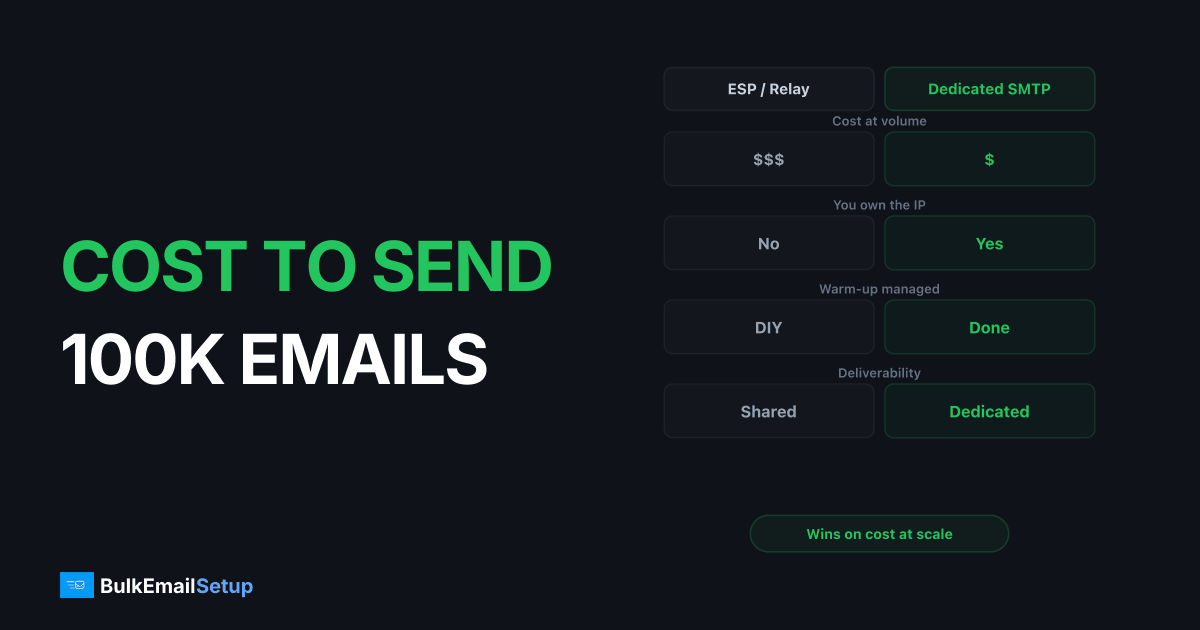
The 100000 emails per month cost ranges from about $10 on Amazon SES to $90-250 on SendGrid, with self-hosting near $20-40 in raw server cost and a managed dedicated SMTP server sitting at a flat $50-150/month. The cheapest sticker price is SES; the cheapest once you count your own labor depends on how much deliverability work you want to own. At exactly 100K/month you're sitting on the line where pay-per-email and flat-fee dedicated start to cross over, which is why this volume is the most argued-about number in bulk email.
I've run 100K-a-month sends through most of these in production. Below is what each one actually costs, including the parts the pricing page leaves out.
The short answer: cost across all 7 options
| Option | ~Monthly cost at 100K | Dedicated IP | Who owns deliverability | Hidden labor |
|---|---|---|---|---|
| Amazon SES | ~$10 | +$24.95/mo | You | High |
| SendGrid | ~$90-250 | Add-on (~$30/mo) | Shared (or paid IP) | Low |
| Mailgun | ~$75-90 | Higher tiers | Shared | Low |
| Brevo | ~$65-80 | Paid add-on | Shared | Low |
| SMTP2GO | ~$75-100 | Higher plans | Shared | Low |
| Self-hosted Postal/Postfix | ~$20-40 (server) | Yes | You, entirely | Very high |
| Managed dedicated SMTP (BulkEmailSetup) | Flat ~$50-150 | Yes, warmed | Managed for you | Near zero |
Prices are 2026 ballparks. Check current pricing before you commit, vendors change tiers constantly.
The spread is huge, $10 to $250, for the same 100K emails. The number that matters isn't the sticker. It's sticker plus your hourly rate times the hours each option demands.
Why 100K is the awkward middle
Below 50K a month, the math is easy: use the cheapest pay-per-email provider and move on. The volume is too low to justify a dedicated IP or a flat monthly fee.
Above 500K a month, the math is also easy: flat-fee or self-hosted wins by a mile, because per-email pricing punishes scale. I broke that down in the cost to send 1 million emails per month.
100K sits in the dead center. It's enough volume that a dedicated IP can actually stay warm (a dedicated IP needs steady volume or its reputation goes stale), but it's low enough that SES at $10 still looks tempting on paper. So the decision turns on factors the price page doesn't show: how much your time is worth, whether you want your own IP reputation, and how badly a deliverability incident would hurt.
Amazon SES: $10 sticker, your weekend as the deductible
SES is the price floor of the industry. About $0.10 per 1,000 emails, so 100K costs roughly $10. Add a dedicated IP for $24.95/month if you want one, which at this volume you probably do.
What you don't get: warm-up automation, useful analytics, or support that answers fast. SES will auto-pause your account if bounce or complaint rates tick up, and the sandbox-exit process rejects plenty of legitimate bulk senders. You are the deliverability team.
The real cost of SES at 100K:
| Line item | Cost |
|---|---|
| Sending (100K) | ~$10 |
| Dedicated IP | ~$25 |
| Your time (warm-up + monitoring) | 5-15 hrs/mo |
At a $50/hour internal rate, those hours are $250-750/month of hidden cost. SES is genuinely excellent if you have the engineering time and want to own deliverability. If you don't, the $10 sticker is a trap. I compared the two paths directly in Amazon SES vs dedicated SMTP server, and listed the closest swaps in Amazon SES alternatives.
SendGrid: the convenience tax
SendGrid at 100K runs roughly $90-250/month depending on tier, before dedicated IP add-ons (around $30/month extra). It's the most expensive mainstream option at this volume on a per-email basis.
What you pay for: a polished dashboard, decent docs, and infrastructure that mostly just works on day one. What you're renting on lower tiers is a shared IP pool, which means your inbox placement rides on the behavior of every other sender in that pool. One spammer next to you and your opens drop through no fault of your own.
At 100K I think SendGrid is hard to justify on price alone. You're paying 9-25x the SES sticker for convenience that a managed dedicated server delivers at lower cost. If you're already on it and shopping, see SendGrid alternatives and SendGrid vs dedicated SMTP server.
Mailgun: better tooling, mid-range price
Mailgun lands around $75-90 per 100K on its Foundation tier in 2026. The API and logs are better than SendGrid's, and for debugging deliverability the logs alone can save you hours.
The downsides are the same shared-IP reputation issue on lower tiers and steep jumps between pricing tiers, where adding 50K emails can bump you into a much pricier plan. Full teardown in Mailgun pricing breakdown and the swaps in Mailgun alternatives.
Brevo: marketing suite with a relay attached
Brevo (ex-Sendinblue) bundles a campaign builder and automation with an SMTP relay, around $65-80 per 100K. If you want one tool for both the marketing UI and the relay, the value is reasonable.
But the SMTP relay is a side product. Throughput limits run lower than dedicated relay providers, and dedicated IPs are a paid add-on with thin warm-up support. Fine for a marketing team that mostly lives in the campaign UI; weak as a pure high-volume relay. If you're comparing it against Mailchimp-style suites, see Mailchimp alternatives for high-volume senders and Klaviyo alternatives.
SMTP2GO: the easy drop-in
SMTP2GO is the lowest-effort swap on this list. Change your host, port, and credentials, and you're sending in ten minutes. Support is responsive and the dashboard is clean. Pricing sits in the $75-100 per 100K range.
You're still on shared infrastructure at most tiers, so reputation isn't fully yours, and dedicated IPs only show up on higher plans. Solid if migration effort is your main constraint and volume is moderate. For a wider relay price view, see SMTP relay pricing comparison.
Self-hosted Postal or Postfix: cheapest, most work
Run Postal or Postfix on a $20-40/month VPS with a dedicated IP and your per-email cost approaches zero. At 100K a month, $30 of server cost is hard to beat on sticker.
The honest line item nobody puts on the invoice is your labor. You own the IP warm-up schedule, rDNS, DKIM/SPF/DMARC, feedback loops, blacklist delisting, and bounce processing. Budget 10-20 hours for setup and a few hours a month after. Get warm-up wrong and you're in the spam folder for weeks, which at 100K a month is real lost revenue.
| Self-hosted at 100K | Cost |
|---|---|
| VPS + dedicated IP | ~$20-40/mo |
| Setup labor (one-time) | 10-20 hrs |
| Ongoing labor | 2-5 hrs/mo |
| Incident risk | High if inexperienced |
Which engine to run? I compared them in Postal mail server vs Postfix. If you go this route, read how to set up an SMTP server for bulk email before you send a single message.
Managed dedicated SMTP: flat fee, reputation handled
This is the middle path between SES's cheap-but-DIY and SendGrid's expensive-but-easy. You get your own server and dedicated IP, so reputation is entirely yours, but a provider handles warm-up, monitoring, blacklist remediation, and DNS. Cost is a flat $50-150/month, and it doesn't move whether you send 100K, 300K, or 500K.
Honest trade-off: the floor is higher than SES. At 20K a month, SES wins easily. At 100K, you're at the crossover, SES is still cheaper on sticker, but the flat fee wins once you price in your own hours and the value of owning your IP reputation without doing the ops work yourself. I argued the full case in is managed SMTP worth it and the total-cost math in self-hosted vs managed vs ESP TCO.
The dedicated IP matters more than people expect at this volume. The difference between a shared and dedicated IP is covered in dedicated IP vs shared IP email, and the warm-up timeline in how long does IP warm-up take.
True cost: sticker vs sticker-plus-labor
Here's the comparison the pricing pages won't show you. Same 100K emails, but with a rough labor cost added at a $50/hour internal rate.
| Option | Sticker | Est. labor/mo | True monthly cost |
|---|---|---|---|
| Amazon SES | ~$35 (w/ IP) | $250-750 | ~$285-785 |
| SendGrid | ~$90-250 | ~$50 | ~$140-300 |
| Mailgun | ~$75-90 | ~$50 | ~$125-140 |
| Self-hosted | ~$30 | $150-400 | ~$180-430 |
| Managed dedicated SMTP | ~$50-150 | ~$0 | ~$50-150 |
The point isn't that SES is bad. It's that the $10 number is fiction unless your time is free. Once you include labor at a realistic rate, the flat-fee managed server is the cheapest true cost at 100K for most senders who don't have a spare deliverability engineer.
Who should pick what at 100K
- Engineering team, cost-obsessed, owns deliverability already: Amazon SES. The $10 sticker is real value when the labor is already covered.
- Want a dashboard and don't want to think about it, budget is flexible: SendGrid or Mailgun. You're paying the convenience tax, but it works.
- Marketing-led team living in a campaign UI: Brevo.
- Lowest migration effort, moderate volume: SMTP2GO.
- Have a sysadmin with spare time and want maximum control: self-host Postal.
- Want your own IP reputation and a predictable bill, without the 2 a.m. delisting work: managed dedicated SMTP.
Two related reads if budget is the hard constraint: the cheapest way to send 100K emails per month and bulk email setup under $100. If you're escaping a marketing suite specifically, cheaper than Mailchimp covers that angle.
Costs people forget to budget
Bounce processing. High bounce rates cost you on every provider, and on SES they'll get you auto-paused. Cleaning your list before a send is cheaper than the reputation damage after. See how to reduce email bounce rate.
Subdomain setup. Sending from a dedicated subdomain protects your root domain's reputation. It's free but easy to skip. Subdomain vs root domain for email sending covers why it matters.
Stream separation. If you send both transactional and marketing at 100K, splitting them onto different subdomains or IPs is worth it. One bad campaign should never take down your password-reset emails. That isolation is also a reason to keep streams on infrastructure you control.
Incident downtime. The cost that never shows on an invoice. A Microsoft block with no support to call can cost more in one weekend than a year of the price difference between options. Price the risk, not just the rate.
One cost applies to every row in these tables: meeting the receiving networks' sender rules. Google's bulk sender guidelines apply from 5,000 messages a day to Gmail, and the complaint-rate ceiling of 0.3% is measured against your domain rather than your provider, so it follows you between options.
How BulkEmailSetup helps
BulkEmailSetup runs dedicated SMTP servers with managed IP warm-up, blacklist monitoring, and full DNS setup. You get your own IP reputation and a flat monthly bill that doesn't move as you scale past 100K, without owning the delisting work yourself. At 100K and up, the flat fee usually beats SendGrid by 60-90% and beats SES once you count your own hours. See pricing for current plans, and the best dedicated SMTP server providers for how to evaluate any vendor against us.
Frequently asked questions
What is the cheapest way to send 100,000 emails per month?
Amazon SES is the cheapest sticker price at roughly $10 per 100K emails. But once you add your own time for warm-up, blacklist monitoring, and bounce handling, the true cost is higher. Self-hosting on a $20-40 VPS is cheaper still on paper but needs the most labor.
How much does SendGrid cost for 100,000 emails a month?
Roughly $90 to $250 per month in 2026 depending on tier, before dedicated IP add-ons. Check current pricing, but it is one of the more expensive options at this volume on a per-email basis.
When does a flat-fee dedicated SMTP server become cheaper than pay-per-email?
The crossover is usually between 100K and 300K emails a month. At 100K you are right at the edge: SES still wins on price alone, but a managed dedicated server wins on total cost once you value your own time and want your own IP reputation.
Does sending volume affect deliverability cost?
Yes. Higher volume on a shared IP raises the risk that someone else's spam drags down your inbox placement. A dedicated IP isolates your reputation, which is why most senders past 100K a month move to one, either self-managed or managed.
Is the cost per email lower at 100K than at 10K?
On pay-per-email providers, per-email price barely changes between 10K and 100K. On flat-fee dedicated servers, the per-email cost drops sharply as volume rises, because the monthly fee is fixed regardless of send count.


