
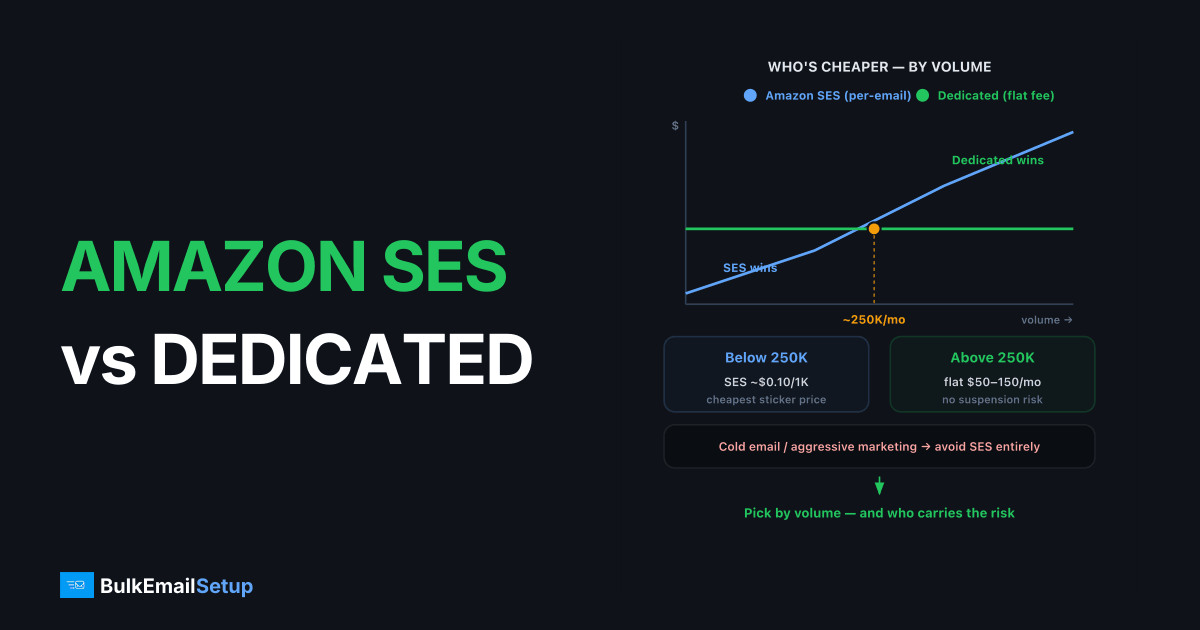
Amazon SES wins on raw price, about $0.10 per 1,000 emails, so $100 for a million sends, while a managed dedicated SMTP server wins on control, costing a flat $50-150/month with warm-up and deliverability handled for you. The crossover point is roughly 200-300K emails per month: below that, SES is hard to beat on cost; above it, the flat fee plus the absence of account-suspension risk usually makes the dedicated server the better deal. Cold email and aggressive marketing senders should avoid SES entirely.
I've run both in production for years. The comparison that actually matters, not the sticker price, but who carries the risk.
The headline numbers
| Factor | Amazon SES | Managed dedicated SMTP server |
|---|---|---|
| Pricing model | $0.10 per 1,000 emails | Flat monthly fee (~$50-150) |
| Dedicated IP | +$24.95/mo each | Included |
| IP warm-up | Generic auto-schedule | Managed, tuned to your sending |
| Who owns reputation | You (shared or your dedicated IP) | You, with provider managing it |
| Account suspension risk | Real and automatic | None, it's your server |
| Setup difficulty | Moderate (sandbox exit, DNS, SDK) | Done for you |
| Analytics | Minimal (CloudWatch, event streams) | Varies by provider |
| Cold email / aggressive marketing | Against AUP, gets paused | Allowed (your risk, your rules) |
Prices are 2026 ballparks, check current pricing.
Where SES is genuinely great
SES is the cheapest legitimate email infrastructure on the planet. If you're sending transactional mail, receipts, password resets, notifications, from an application with a healthy list, SES at $0.10/1,000 is unbeatable.
It also scales without thinking. Going from 10K to 5M emails a month requires a quota increase request, not an architecture change. The infrastructure reliability is AWS-grade.
If you're already deep in AWS, the integration story is clean: IAM, SNS for bounce events, CloudWatch metrics, Lambda processing.
Where SES hurts
The sandbox and the suspension hammer
Every SES account starts sandboxed, you can only email verified addresses until AWS approves production access. Approval requires explaining your use case, and bulk marketing use cases get rejected regularly.
Once approved, the limits don't go away. Cross roughly a 5% bounce rate or 0.1% complaint rate and SES can pause your sending automatically. I've seen production transactional email go down at midnight because a marketing campaign on the same account spiked complaints. Recovery means a support case and a written remediation plan, usually days, not hours.
You are the deliverability team
SES delivers mail to the receiving server. What happens after, inbox vs spam, is your problem. No blacklist monitoring, no inbox placement insight, no one to call when Outlook starts junking everything. You'll build suppression handling, bounce processing, and feedback loop wiring yourself via SNS.
Dedicated IPs cost extra and warm-up is generic
A dedicated IP on SES is $24.95/month. The managed warm-up follows a standard curve that ignores your list quality and destination mix. If 70% of your list is Microsoft addresses, a generic warm-up curve will trip Outlook throttling that a tuned schedule avoids.
Where a dedicated SMTP server is genuinely great
Nobody can pause your account
It's your server and your IP. There's no acceptable-use algorithm watching your complaint rate with a kill switch. You can send what you want at the pace you want, the consequences (blacklists, throttling by receivers) are real but they're yours to manage, not a vendor's to enforce.
Flat cost at volume
A million emails through SES with two dedicated IPs: ~$100 + $50 in IP fees, plus event-processing infrastructure, plus your hours. The same volume through a managed dedicated server: the same flat $100-200/month you paid at 100K. The math gets better the more you send, full breakdown in Self-Hosted SMTP vs ESP at 1 Million Emails/Month.
Warm-up and monitoring done properly
A managed provider warms your IP against your actual list, watches Spamhaus/Barracuda/SORBS listings daily, sets up rDNS, DKIM, SPF, and DMARC correctly, and handles delisting when something fires. That's the work that eats your weekends on SES.
Where a dedicated server hurts
Honesty time. The floor price is higher, at 20K emails/month, paying $50-150 flat when SES would charge $2 makes no sense. And a single IP has throughput ceilings; very large senders need multiple IPs and domains, which managed providers handle but which adds cost.
Also, "managed" varies wildly by vendor. Some sell you a bare VPS with Postal installed and call it managed. Vet providers on what happens when you land on a blacklist, see best dedicated SMTP server providers for the checklist.
Cost comparison by volume
| Monthly volume | SES (incl. 1 dedicated IP) | Managed dedicated server | Winner |
|---|---|---|---|
| 10K | ~$26 | ~$50-100 | SES |
| 100K | ~$35 | ~$50-150 | SES on price, server on control |
| 300K | ~$55 | ~$50-150 | Roughly even |
| 1M | ~$125 + ops time | ~$100-200 | Dedicated server |
| 3M+ | ~$325 + multiple IPs + ops time | ~$200-400 | Dedicated server |
The hidden line item in the SES column is engineering time: bounce pipelines, suppression lists, warm-up babysitting, suspension recovery. Price that at even 5 hours/month and the table shifts left.
The hybrid setup nobody mentions
These options aren't mutually exclusive, and the strongest configuration I've run is both: SES for transactional mail (receipts, resets, low volume, clean engagement, exactly what SES's policy engine likes) and a dedicated server for marketing campaigns (where volume, content, and pacing are yours to control).
The split protects each stream from the other. A complaint spike on a campaign can't trigger an SES pause that takes down password resets, and transactional mail's pristine engagement isn't diluted by promotional sends. Use separate subdomains, send.yourdomain.com for campaigns, mail.yourdomain.com for transactional, so reputations stay independent at Gmail and Microsoft.
Cost of the hybrid at 1M marketing + 50K transactional monthly: roughly $5 of SES plus $100-200 for the dedicated server. Still a fraction of running everything through a relay.
The decision in one paragraph
Pick SES if you're sending transactional email from an application, your list is clean opt-in, and you have engineers happy to own deliverability plumbing. Pick a dedicated SMTP server if you send marketing volume above ~200K/month, send anything SES's policy team would frown at, or simply don't want a vendor's automated kill switch between you and your revenue. For the broader architectural question, see SMTP server vs email service provider.
How BulkEmailSetup helps
BulkEmailSetup gives you a dedicated SMTP server with a warmed dedicated IP, managed DNS authentication, and daily blacklist monitoring. SES-beating economics at volume without SES's suspension risk. Flat monthly pricing means 1M emails costs the same as 100K. Current plans are on the pricing page.
Frequently asked questions
Is Amazon SES cheaper than a dedicated SMTP server?
On raw per-email price, yes. SES costs about $0.10 per 1,000 emails. But SES dedicated IPs cost $24.95/month each, and your time handling warm-up, suppression, and account-pause risk is the real cost. Above roughly 200-300K emails/month, a flat-fee managed dedicated server is usually cheaper overall.
Can Amazon SES suspend my sending?
Yes, and it does so automatically. If your bounce rate exceeds roughly 5% or complaint rate exceeds 0.1%, SES can pause your account with little warning. Recovery requires a remediation plan and a support case.
Does Amazon SES warm up IPs for me?
SES offers automatic warm-up on managed dedicated IPs, but it follows a generic schedule and doesn't account for your specific list quality or target inbox providers. On a managed dedicated server, warm-up is tuned to your actual sending.
What does a dedicated SMTP server cost in 2026?
A managed dedicated SMTP server typically runs $50-150/month flat, including the server, a dedicated IP, warm-up, and monitoring. Self-managing one on a VPS costs $20-40/month plus your own time.
Which is better for cold email. SES or a dedicated server?
A dedicated server. SES's acceptable use policy and automatic complaint thresholds make cold outreach risky, accounts get paused fast. On your own server you control the rules, though you still need clean lists to stay off blacklists.


