
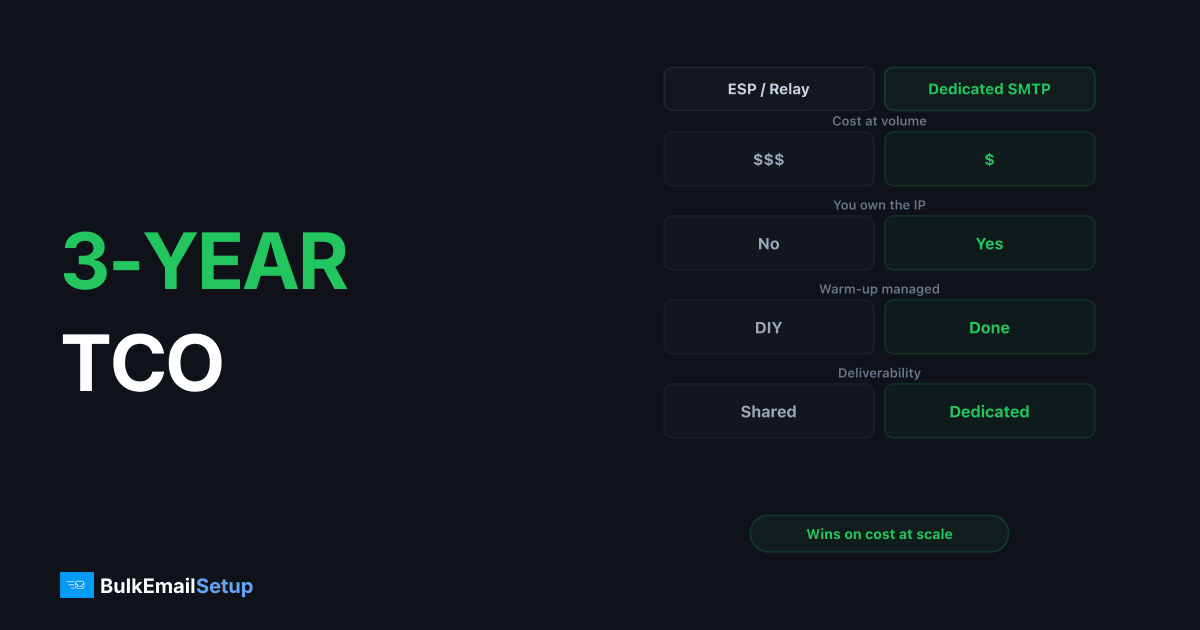
Over three years, email infrastructure TCO splits cleanly by volume: at 10K/month Amazon SES wins at roughly $36 total spend, at 100K-1M/month a managed dedicated SMTP server wins at a flat $1,800-7,200 over three years, and a pure ESP like SendGrid or Mailgun is the most expensive at every tier above 50K once per-email pricing kicks in. Self-hosting looks cheapest on the invoice (around $720-1,500 in server costs over three years) but adds 30-80 unpaid labor hours that flip the math for most teams. Below I break down all three models across five volume tiers, with labor counted as a real line item, because that's where the actual money goes.
I've run production email through self-hosted Postal boxes, managed dedicated servers, and three different ESPs. Here's what three years actually costs once you stop reading pricing pages and start counting both dollars and hours.
What goes into email infrastructure TCO
Sticker price is the smallest part of the bill. The full email infrastructure TCO has four components, and ESPs win by hiding three of them inside one monthly number.
| Cost component | Self-hosted | Managed dedicated SMTP | ESP (SendGrid/Mailgun) |
|---|---|---|---|
| Software / subscription | Free (Postal, Postfix) | Bundled in flat fee | Per-email or per-tier |
| Server + bandwidth | $20-40/mo VPS | Bundled | Bundled |
| Dedicated IP | $0 (comes with VPS) | Bundled, warmed | $24.95-80/mo add-on |
| Setup labor | 10-20 hrs one-time | ~0 (done for you) | 1-3 hrs |
| Ongoing ops labor | 2-6 hrs/month | ~0 | ~0 |
| Blacklist delisting | You, manually | Provider | Provider (shared IP only) |
The trap is the labor rows. They don't show up on an invoice, so people leave them out of comparisons and then act surprised when the "cheap" self-hosted option swallows a weekend. I price labor at $50/hour in this article. Adjust it to whatever your time is worth, but don't set it to zero. Setting it to zero is how teams talk themselves into the most expensive option.
A note on pricing: everything here is 2026 ballparks. Check current pricing before you commit, because ESP tiers and SES rates move and dedicated server providers shift plans.
The three models, honestly compared
Each model trades money against control and labor differently. There's no universal winner, only a winner per volume tier.
Self-hosted (Postal or Postfix)
You run the mail server yourself on a VPS with a dedicated IP. Per-email cost approaches zero. You own everything: SPF, DKIM, DMARC, rDNS, feedback loops, warm-up scheduling, bounce processing, and every blacklist delisting request.
- Cash cost: $20-40/month VPS, flat regardless of volume.
- Labor cost: 10-20 hours setup, then 2-6 hours/month ongoing. Spikes hard when an IP gets listed.
- Best for: technical teams with sysadmin time and a tolerance for 2 a.m. delisting work.
If you go this route, read Postal vs Postfix before picking the stack and how to set up an SMTP server for bulk email for the full build.
Managed dedicated SMTP server
You get your own server and dedicated IP, so reputation is entirely yours, but the provider handles warm-up, monitoring, delisting, and DNS. Flat monthly fee, typically $50-150/month, that doesn't move with volume.
- Cash cost: flat $50-150/month.
- Labor cost: near zero after onboarding.
- Best for: sustained senders at 100K+/month who want their own reputation without the ops burden.
ESP (SendGrid, Mailgun, and similar)
A relay with an API, dashboard, and per-email or per-tier pricing. Easiest to start, most expensive to scale. On lower tiers you share IP reputation with strangers, which is the deliverability risk I keep watching people pay for.
- Cash cost: scales with volume, $0.10-0.90 per 1,000 emails depending on provider and tier.
- Labor cost: lowest, the provider runs the infra.
- Best for: low volume, transactional-heavy, or teams that value zero ops over cost.
Amazon SES is its own category here: ESP-class infrastructure at near-self-hosted prices, but with self-hosted-level labor because it hands you nothing. I split it out in the tables below. For the deeper SES breakdown see Amazon SES vs Dedicated SMTP Server.
3-year TCO at 5 volume tiers
This is the core table. Three-year totals, cash plus labor at $50/hour. Self-hosted labor assumes 15 hours setup plus 3 hours/month ongoing (108 hours over 3 years = $5,400 labor on top of server cost). SES labor assumes 10 hours setup plus 1.5 hours/month (64 hours = $3,200). Managed and ESP labor is treated as near zero because the provider absorbs it.
| Monthly volume | Self-hosted (Postal) | Amazon SES | ESP (SendGrid/Mailgun) | Managed dedicated SMTP |
|---|---|---|---|---|
| 10K | ~$6,480 | ~$3,236 | ~$720 | ~$3,600 |
| 100K | ~$6,480 | ~$3,560 | ~$5,400 | ~$3,600 |
| 500K | ~$6,840 | ~$5,000 | ~$18,000+ | ~$3,600 |
| 1M | ~$7,200 | ~$6,800 | ~$28,000+ | ~$5,400 |
| 5M | ~$8,000 | ~$21,200 | ~$120,000+ | ~$10,800 |
Read the columns carefully, because the labor assumption changes the story:
- Self-hosted looks expensive here only because I'm counting your hours. Strip labor out and it's the cheapest column by far ($720-2,600 in pure cash over three years). The number you see is honest TCO, not the invoice.
- SES is genuinely cheap on cash but carries the same labor tax as self-hosting, so its TCO climbs with the operational load even though the email itself stays cheap.
- ESP is the only column that explodes. Per-email pricing compounds: at 5M/month you're looking at six figures over three years.
- Managed dedicated SMTP is the flattest line. $50/month tier covers small volume, $100-150/month covers heavy volume, and labor stays near zero.
Crossover point: somewhere between 100K and 300K/month, the managed flat fee beats both the labor-loaded self-hosted TCO and the volume-loaded ESP bill. Below 100K, SES or a cheap ESP tier wins. I worked the high end of this in detail in self-hosted SMTP vs ESP cost at 1 million emails.
Tier by tier, who actually wins
The 3-year total is a blunt instrument. Here's the per-tier reasoning, because the right answer at 10K is wrong at 1M.
10K/month: ESP or SES wins, dedicated is overkill
At 10K emails, a basic ESP tier is ~$20/month and SES is roughly $1/month in send cost. A dedicated server at $50/month is more than you need, and self-hosting's setup hours aren't worth it for this volume.
| Option | 3-yr cash | 3-yr labor | TCO | Verdict |
|---|---|---|---|---|
| ESP (Essentials) | ~$720 | ~$0 | ~$720 | Best for non-technical |
| Amazon SES | ~$36 | ~$3,200 | ~$3,236 | Best cash, if you have the hours |
| Self-hosted | ~$1,080 | ~$5,400 | ~$6,480 | Skip at this volume |
| Managed dedicated | ~$3,600 | ~$0 | ~$3,600 | Overkill |
Winner: ESP on a basic tier, or SES if you've already got the deliverability skills in-house.
100K/month: the crossover begins
This is where ESP pricing starts to hurt. SendGrid or Mailgun runs $75-250/month at 100K, which is $2,700-9,000 over three years. SES is still cheap at ~$10/month send cost. The dedicated server is now competitive.
| Option | 3-yr cash | 3-yr labor | TCO | Verdict |
|---|---|---|---|---|
| Amazon SES | ~$360 | ~$3,200 | ~$3,560 | Best if you own ops |
| Managed dedicated | ~$3,600 | ~$0 | ~$3,600 | Best hands-off |
| ESP | ~$2,700-9,000 | ~$0 | ~$5,400 | Getting expensive |
| Self-hosted | ~$1,080 | ~$5,400 | ~$6,480 | Cash-cheap, labor-heavy |
Winner: tie between SES (if technical) and managed dedicated (if not). The ESP is now the worst hands-off option. For the cheapest possible route at this exact tier, see the cheapest way to send 100K emails per month.
500K/month: flat fee pulls ahead
ESP per-email pricing is brutal here, $300-500+/month, which is $10,800-18,000+ over three years. The managed dedicated server hasn't moved off its flat fee. SES is still the cash floor but the labor load grows with the bigger send.
| Option | 3-yr cash | 3-yr labor | TCO | Verdict |
|---|---|---|---|---|
| Managed dedicated | ~$3,600 | ~$0 | ~$3,600 | Best overall |
| Amazon SES | ~$1,800 | ~$3,200 | ~$5,000 | Cheap cash, real labor |
| Self-hosted | ~$1,440 | ~$5,400 | ~$6,840 | Only if you have a sysadmin |
| ESP | ~$10,800-18,000 | ~$0 | ~$18,000+ | Stop paying this |
Winner: managed dedicated SMTP, clearly. Flat fee plus zero labor beats everything once volume is sustained.
1M/month: ESP is now indefensible
At a million a month, an ESP can run $600-1,000+/month, $21,600-36,000+ over three years. That's 4-7x the managed dedicated TCO for worse reputation control. SES is still the cash king but you're now running real deliverability operations to keep it clean.
| Option | 3-yr cash | 3-yr labor | TCO | Verdict |
|---|---|---|---|---|
| Managed dedicated | ~$5,400 | ~$0 | ~$5,400 | Best overall |
| Self-hosted | ~$1,800 | ~$5,400 | ~$7,200 | Viable with a dedicated ops person |
| Amazon SES | ~$3,600 | ~$3,200 | ~$6,800 | Cheap, but you're the deliverability team |
| ESP | ~$21,600-36,000 | ~$0 | ~$28,000+ | Indefensible |
Winner: managed dedicated, with self-hosting close behind if you have an experienced operator who lives in the mail logs. See infrastructure to send 100K emails per day for the build that handles this throughput.
5M/month: only flat or self-hosted survive
At five million a month, ESP pricing is a six-figure three-year number. The only sane options are a managed multi-IP setup or a self-hosted fleet, and at this scale you'll want multiple dedicated IPs and segmented streams regardless of model.
| Option | 3-yr cash | 3-yr labor | TCO | Verdict |
|---|---|---|---|---|
| Self-hosted fleet | ~$2,600 | ~$5,400 | ~$8,000 | Cheapest if you have the team |
| Managed dedicated (multi-IP) | ~$10,800 | ~$0 | ~$10,800 | Best hands-off |
| Amazon SES | ~$18,000 | ~$3,200 | ~$21,200 | Cash climbing, labor real |
| ESP | ~$120,000+ | ~$0 | ~$120,000+ | Don't |
Winner: self-hosted if you have a real ops team, managed dedicated if you don't. The ESP column at this tier is the single strongest argument for owning your infrastructure.
The labor line nobody budgets for
The reason these tables surprise people is the labor column. Here's what those hours actually buy at volume.
- IP warm-up. A new dedicated IP needs 2-4 weeks of careful ramping, and you can't rush it. Get the schedule wrong and you're in spam for weeks. Read how long IP warm-up takes and domain warm-up vs IP warm-up before your first send. With managed dedicated, the provider warms the IP. Self-hosting, that's your 10+ hours.
- Blacklist delisting. Hit Spamhaus or a Microsoft block and you're filing delisting requests and waiting. On a shared ESP IP you can't even do this yourself, you wait on support. On a managed dedicated IP, the provider handles it. Self-hosting, it's your afternoon.
- Bounce and complaint handling. SES will pause your account if bounces spike. Self-hosted means building the suppression logic yourself. See how to reduce email bounce rate and the email list cleaning guide for the work that keeps these rates down.
- Monitoring. Google Postmaster Tools, reputation dashboards, deferral patterns. Someone has to watch them. The Google Postmaster Tools guide covers the setup.
Two to six hours a month sounds small. It isn't, because it's unpredictable. The month nothing breaks, it's zero. The month an IP gets listed mid-campaign, it's twenty. That variance is exactly what a flat managed fee buys out.
Dedicated vs shared IP changes the TCO too
One factor that doesn't show as a line item but drives long-term cost: whether reputation is yours or shared. On most ESP tiers below the top plans, you're on a shared IP pool, so a stranger's spam run can tank your inbox placement and there's nothing you can do but wait. Self-hosted and managed dedicated both give you a dedicated IP, so your reputation is yours to build and protect. That's worth real money over three years in avoided deliverability disasters. I broke down the trade-off in dedicated IP vs shared IP email.
For senders running both transactional and marketing mail, also separate the streams onto different subdomains or IPs so one bad campaign can't take down password resets. Subdomain vs root domain for email sending covers how to split them.
How to use these numbers for your own decision
- Pin your real monthly volume. Not your peak, your sustained average. The crossover tiers depend on it.
- Price your own labor honestly. $50/hour is a floor for a competent ops person. If your engineers cost $150/hour, self-hosting's TCO triples.
- Find your tier in the tables above. Below 100K, lean ESP or SES. Above 100K sustained, lean managed dedicated unless you have a dedicated mail ops person.
- Add the variance buffer. If a blacklist disaster would cost you real revenue, the flat managed fee is cheap insurance against the bad month.
- Check current pricing. These are 2026 ballparks. Verify ESP tiers and server plans before signing anything.
The pattern across every tier is the same one I keep coming back to: per-email pricing punishes volume, flat pricing rewards it, and unpriced labor is where the real money quietly leaves. For more on the relay pricing side, see SMTP relay pricing comparison and the broader SendGrid alternatives list.
How BulkEmailSetup helps
BulkEmailSetup provides managed dedicated SMTP servers with a warmed dedicated IP, blacklist monitoring, and full DNS setup, at a flat monthly fee that doesn't move whether you send 100K or 5M emails. That's the column in every table above that stays flat while ESP pricing climbs and self-hosted labor piles up, your own reputation with none of the 2 a.m. delisting work. At sustained volume above 100K/month it typically beats an ESP by 60-90% on three-year TCO, and beats self-hosting once you price your team's hours honestly. See pricing for current plans.
Frequently asked questions
What is email infrastructure TCO?
Email infrastructure TCO is the total 3-year cost of sending email, including software or subscription fees, server costs, dedicated IPs, and the labor hours you spend on warm-up, blacklist monitoring, and bounce handling. ESPs hide most of the labor in the price; self-hosting moves it onto your team.
Is self-hosted SMTP actually cheaper than an ESP?
On the invoice, yes. A self-hosted Postal server runs $20-40/month plus a dedicated IP. But once you price your own labor at even $50/hour, self-hosting at 100K+/month often costs more in year one than a managed dedicated SMTP server, because warm-up and delisting eat 10-30 hours.
At what volume does a flat-fee SMTP server beat an ESP?
Usually between 100K and 300K emails per month. Below that, Amazon SES or a cheap ESP tier wins on raw cost. Above it, ESP per-email pricing climbs while a flat $50-150/month dedicated server stays put, so the crossover favors flat pricing fast.
Why include labor in an email TCO comparison?
Because deliverability work is the real cost of email. Sticker price ignores the weekend you spend diagnosing a Microsoft block. A $10/month SES bill can hide 20 hours of unpaid ops work, which makes the cheap option the expensive one.


