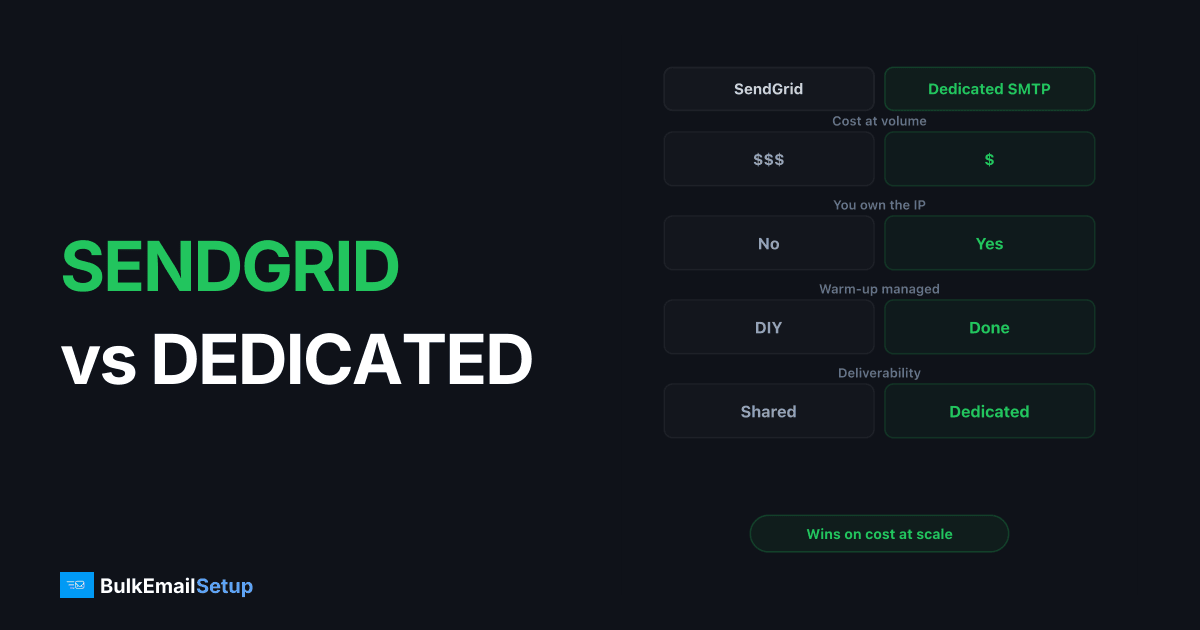
SendGrid bills per email and shares its IP pool on lower tiers, so at 100K emails a month you'll pay roughly $90 to $250 with reputation you don't fully control. A dedicated SMTP server flips both: a flat $50 to $150 a month and your own IP, so reputation is yours and cost stays put whether you send 100K or 1M. The sendgrid vs dedicated smtp server choice comes down to volume and how much deliverability work you want to own. Below roughly 100K a month SendGrid is cheaper; above it a dedicated server usually wins on both cost and control.
I've run production email through both for years. Here's the honest comparison once you stop reading feature pages and start counting dollars and reputation risk.
SendGrid vs dedicated SMTP server: the core difference
Two things separate them, and they're the two things that actually matter at volume.
Billing. SendGrid charges by send count. The more you mail, the more you pay, and the curve gets steep above the free and Essentials tiers. A dedicated SMTP server is a fixed monthly cost. Send 80K or 800K, the invoice is identical.
IP reputation. On SendGrid's cheaper plans you're on a shared IP pool. Your inbox placement rides on the behavior of every other sender in that pool. One spammer in your block and your open rates drop for reasons that have nothing to do with you. A dedicated SMTP server gives you a single IP that only sends your mail. Good or bad, the reputation is yours.
Everything else (APIs, dashboards, logs) is real but secondary. People switch over cost and reputation, not feature lists.
Cost compared at real volumes
Here's what each option actually costs across the volumes I see most often. These are 2026 ballparks, check current pricing before you commit.
| Monthly volume | SendGrid | Self-hosted SMTP server | Managed dedicated SMTP |
|---|---|---|---|
| 10K | ~$20 | ~$20-40 (VPS) | ~$50-100 (overkill) |
| 100K | ~$90-250 | ~$20-40 (VPS) | ~$50-150 flat |
| 500K | ~$400+ | ~$30-60 (VPS) | ~$50-150 flat |
| 1M | ~$700+ | ~$40-80 (VPS) | ~$100-200 flat |
The pattern: per-email pricing punishes volume, flat pricing rewards it. At 10K a month SendGrid is the cheap option and a dedicated server is wasteful. By 500K the gap reverses hard, SendGrid is multiples more expensive than a flat-fee server.
The self-hosted column looks unbeatable on raw cost, and on raw cost it is. That number leaves out your time, which I'll get to. For the full math at the high end, see self-hosted SMTP vs ESP cost at 1 million emails.
Where the crossover happens
The break-even isn't a single number, it's a band. A managed dedicated SMTP server has a higher floor (you're paying $50 to $150 even at low volume), so it loses at small scale. The crossover where flat pricing beats SendGrid's per-email rate usually lands between 100K and 300K emails a month.
| Your situation | Cheaper option |
|---|---|
| Under 50K/mo, mostly transactional | SendGrid (or SES, even cheaper) |
| 50K-100K/mo | Close call, depends on tier and IP add-ons |
| 100K-300K/mo | Crossover zone, dedicated usually pulls ahead |
| 300K+/mo | Dedicated SMTP server wins clearly |
If you're at the bottom of that range, don't switch for cost alone. Switch for control, or wait until volume makes the math obvious. I've laid out the pure cost-floor question in the cheapest way to send 100K emails per month.
Control: shared IP vs your own IP
This is the part SendGrid's pricing page won't frame honestly, so I will.
On a shared pool, you inherit the pool's reputation. SendGrid does police it, but no provider catches everything, and you have zero say over who else is in your block. When a mailbox provider throttles the pool, you get throttled too. You can pay for a dedicated IP add-on (around $30/month on eligible tiers), but then you're warming and managing it yourself, which is most of the work a dedicated SMTP provider would have done for you.
A dedicated SMTP server hands you a clean IP that sends only your mail. The upside is total: your engagement, your complaint rate, your sender history, full stop. The downside is also total. A new IP starts with no reputation and has to be warmed. Send 50K on day one off a cold IP and you'll land in spam or get blocked outright. Budget a 2 to 4 week ramp. See how long IP warm-up takes and the difference between dedicated IP and shared IP email before you flip the switch.
The trade-off in one line: shared IP is zero setup and shared blame; dedicated IP is real setup and sole ownership.
The hidden cost SendGrid hides and self-hosting exposes
Self-hosted SMTP at $30 a month VPS looks like the obvious winner above. It isn't, and here's the part nobody puts in the comparison table: your hours.
Run your own server and you own every operational task:
- IP warm-up scheduling, day by day, for weeks
- rDNS, SPF, DKIM, DMARC, and keeping alignment intact
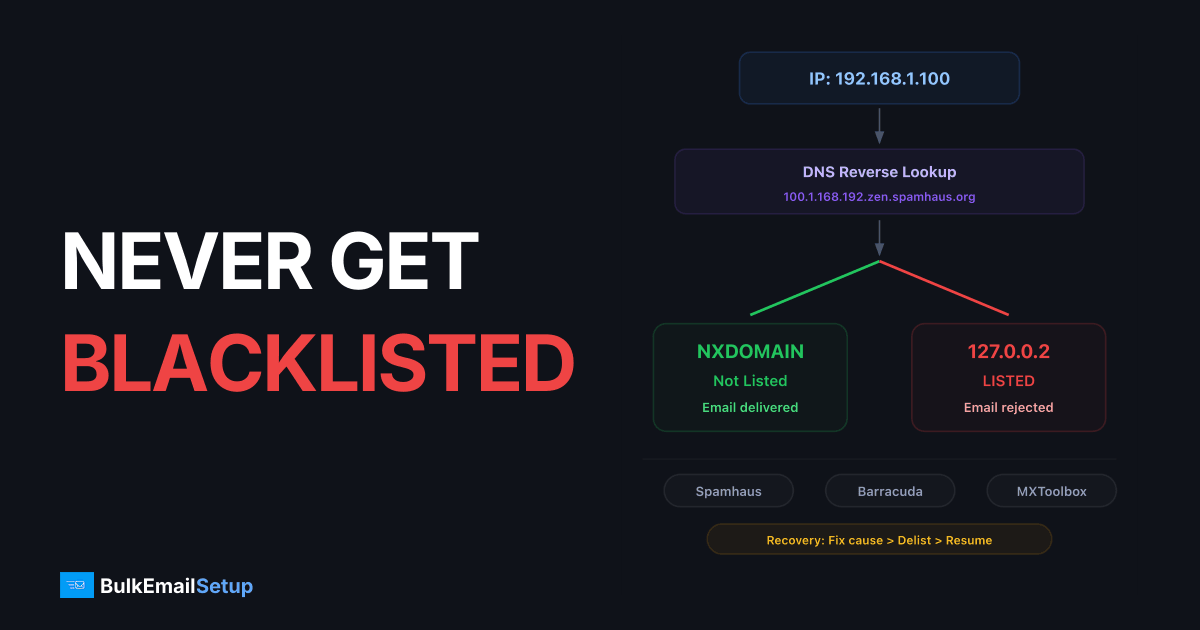
- Blacklist monitoring and delisting requests (Spamhaus, Microsoft, etc.)
- Bounce and complaint processing, feedback loop handling
- Patching, queue tuning, and the 2 a.m. page when Postfix backs up
Budget 10 to 20 hours for setup and a few hours a month after. Get warm-up or DNS wrong and you're in the spam folder for weeks while you diagnose it with nobody to call. Price your own time into that $30 server before you call it cheap. If you're going this route, Postal vs Postfix covers which stack to pick.
A managed dedicated SMTP server is the middle path. You get the dedicated IP and flat fee of self-hosting, but the provider runs warm-up, monitoring, delisting, and DNS. You pay more than a bare VPS and far less than SendGrid at volume, and you don't lose a weekend to a Microsoft block.
Deliverability: who actually owns it
| Factor | SendGrid (shared tier) | SendGrid (dedicated IP add-on) | Self-hosted server | Managed dedicated SMTP |
|---|---|---|---|---|
| IP reputation | Pool's | Yours | Yours | Yours |
| Warm-up handled | N/A | You | You | Provider |
| Blacklist remediation | Provider | You | You | Provider |
| Bounce/FBL handling | Provider | Provider | You | Provider |
| DNS setup | Guided | You | You | Provider |
| Cost at 500K/mo | ~$400+ | ~$430+ | ~$30-60 | ~$50-150 flat |
The two columns that make sense for most volume senders are the ends: SendGrid if you want zero ops and accept shared reputation, or a managed dedicated SMTP server if you want your own reputation without the ops load. The middle two each ask you to do half the work for none of the discount or all of the work for all the discount.
Whatever you pick, monitor it. Google Postmaster Tools is non-negotiable for watching Gmail reputation, and keeping your list clean with list cleaning does more for deliverability than any provider switch.
Migration: SendGrid to a dedicated server without tanking inbox rates
Moving badly costs more than staying. The sequence that works:
- Export suppression lists first. Pull unsubscribes, bounces, and complaints from SendGrid's suppression API and import them into the new system before you send a single message. Mailing a previously-suppressed address is a compliance problem and a complaint magnet.
- Set up authentication on the new IP. New SPF include, new DKIM selector, confirm DMARC still aligns. Run a test through mail-tester before real traffic. If you're moving sending to a subdomain, read subdomain vs root domain for email sending first.
- Warm the new IP over 2 to 4 weeks. Start with your most engaged recipients at 1 to 2K a day, roughly doubling every 2 to 3 days, while SendGrid carries the rest. Engaged openers build reputation fastest.
- Watch bounce codes daily. 4xx deferrals mean slow down. 5xx blocks mean stop and diagnose. Bring your bounce rate down before it drags the new IP.
- Keep SendGrid alive for 30 days after cutover. A downgraded fallback plan is cheap insurance if the new IP hits a surprise listing.
Calendar time is 4 to 6 weeks. Actual hands-on work is a few hours. The rest is waiting for reputation to accrue, which is exactly why a managed provider that runs warm-up for you saves the only resource that's actually scarce here, your attention.
So which one
| You are | Pick |
|---|---|
| Under 50K/mo, mostly transactional | Stay on SendGrid |
| 50K-100K/mo, want zero ops | SendGrid, or test a dedicated server |
| 100K+/mo, want your own reputation, no sysadmin time | Managed dedicated SMTP server |
| 100K+/mo, have sysadmin time, want max control | Self-host Postal/Postfix |
| Sending cold outreach or aggressive marketing | Dedicated server, your IP, your rules |
SendGrid isn't bad software. It's expensive software with shared reputation, and both of those problems get worse as you grow. A dedicated SMTP server fixes both once your volume justifies the floor.
How BulkEmailSetup helps
BulkEmailSetup runs dedicated SMTP servers with managed IP warm-up, blacklist monitoring, and full DNS setup, so you get your own IP and reputation without the 2 a.m. delisting work that self-hosting drags in. At 100K or more emails a month, a flat monthly fee typically beats SendGrid by 60 to 90 percent, and the bill doesn't move when your volume does. See pricing for current plans, and the best dedicated SMTP server providers if you want to compare vendors first.
Frequently asked questions
Is a dedicated SMTP server cheaper than SendGrid?
At sustained volume, yes. SendGrid runs roughly $90 to $250 a month at 100K emails and climbs past $700 at 1M. A managed dedicated SMTP server is a flat $50 to $150 a month regardless of send count, so it wins once you're past roughly 100K to 300K emails monthly. Below that, SendGrid or SES is cheaper.
What's the main difference between SendGrid and a dedicated SMTP server?
Billing model and IP ownership. SendGrid charges per email and, on lower tiers, puts you on a shared IP pool where other senders affect your reputation. A dedicated SMTP server gives you your own IP and a flat fee, so your reputation is yours alone and cost doesn't scale with volume.
Does SendGrid give you a dedicated IP?
Only on higher tiers, as a paid add-on around $30 a month, and you still have to warm it yourself or accept the pool's reputation in the meantime. A managed dedicated SMTP server includes a warmed dedicated IP in the base price.
When should I stay on SendGrid instead of moving to a dedicated server?
If you send under about 50K emails a month, especially transactional mail, SendGrid's per-email pricing is cheaper than a dedicated server's flat floor. The dedicated option only pays off once your volume makes flat pricing beat per-email rates.
Who handles deliverability on a dedicated SMTP server?
Depends on the setup. A self-hosted server means you own warm-up, blacklist monitoring, and bounce handling. A managed dedicated SMTP provider handles all of that for you while still giving you a dedicated IP, which is the practical middle ground between SendGrid and rolling your own.