
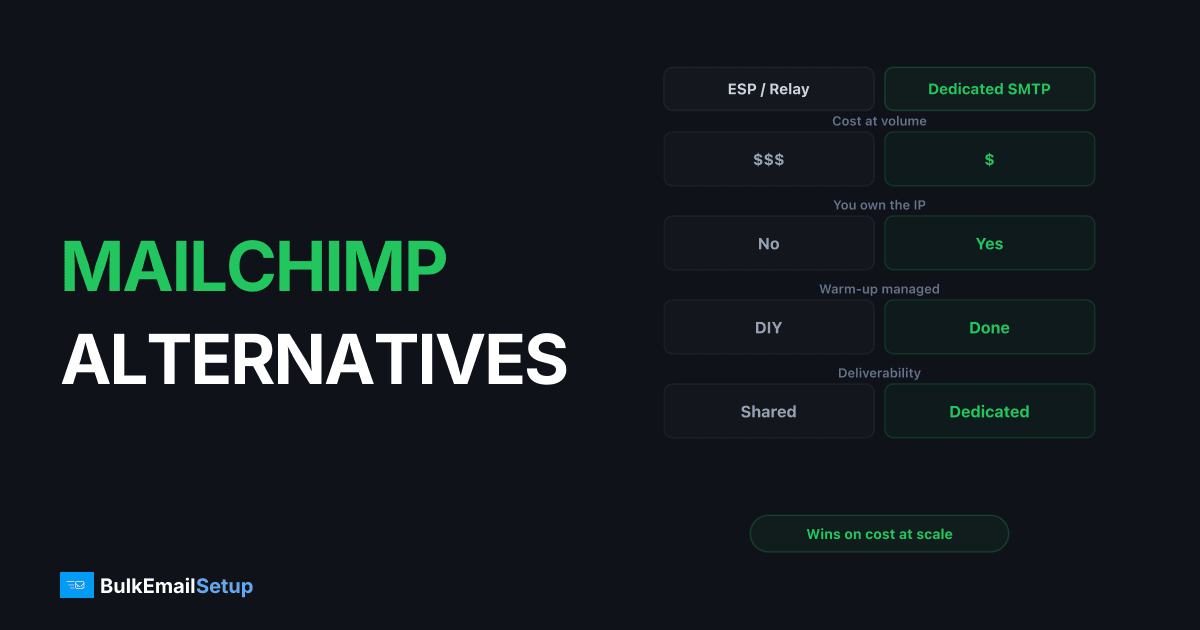
If you're a high-volume sender leaving Mailchimp in 2026, the core problem is that Mailchimp bills you per contact stored, not per email sent, so a 100K-contact list costs several hundred dollars a month even if you mail it twice. The cheapest mailchimp alternatives for high volume are Amazon SES at roughly $0.10 per 1,000 emails and a managed dedicated SMTP server at a flat $50-150/month, both of which ignore contact count entirely. Brevo and MailerLite sit in the middle and price by sends, which already saves most big-list senders 40-70%. The right pick depends on whether you want a marketing UI or just a relay.
I've migrated several lists off Mailchimp, including one north of 400K contacts. Here's what actually happens to the bill, and where each alternative wins or loses.
Why per-contact pricing kills high-volume senders
Mailchimp's pricing model is the whole reason this article exists. You pay for contacts in your audience, not emails delivered. That breaks in three ways at scale.
First, dead weight costs money. A 250K list where 60% never opens still bills you for all 250K every single month. With send-based pricing you'd pay nothing for the people you don't mail.
Second, the tiers jump hard. Crossing a contact threshold (say 100K to 150K) can add a few hundred dollars overnight. There's no smooth curve, just cliffs.
Third, some plan types count contacts you'd never expect: unsubscribed, non-subscribed, even cleaned addresses depending on the plan. People discover this when their bill doesn't drop after a list purge. Cleaning your list (which you should do anyway, see the email list cleaning guide) helps deliverability but may not cut a contact-based bill much.
The fix is moving to a model that bills by sends or charges a flat fee. That's every alternative below.
The 6 Mailchimp alternatives compared
Here's the shortlist I actually recommend, ranked roughly by how well they handle volume. Prices are 2026 ballparks, check current pricing before committing.
| Alternative | Pricing model | ~Cost at 100K contacts mailed 4x/mo | Marketing UI | Dedicated IP | Best for |
|---|---|---|---|---|---|
| Amazon SES | Per email | ~$40 (400K sends) | No, API only | +$24.95/mo | Engineers, cost-obsessed |
| Managed dedicated SMTP (BulkEmailSetup) | Flat monthly | ~$50-150 flat | No, bring your own | Yes, warmed | Volume senders, agencies |
| Brevo | Per email sent | ~$65-125 | Yes | Add-on | Marketing teams leaving per-contact pain |
| MailerLite | Hybrid (contacts + sends) | ~$100-180 | Yes | Add-on | Creators, mid-size lists |
| Mailjet | Per email sent | ~$35-90 | Yes | Higher tiers | EU senders wanting SMTP + UI |
| Self-hosted Postal | Server cost only | ~$20-40 (VPS) | No | Yes | Technical teams with time |
| Mailchimp (for reference) | Per contact stored | ~$350-600+ | Yes | Add-on | Small lists, all-in-one convenience |
The pattern: anything billed by send or flat fee crushes Mailchimp once your stored-contact count is high relative to how often you mail.
1. Amazon SES, the price floor
SES costs about $0.10 per 1,000 emails. Mail a 100K list four times and you've sent 400K emails for roughly $40. Mailchimp would charge that list several hundred a month regardless. On raw cost, nothing wins.
What you give up: there's no campaign builder, no drag-and-drop editor, no audience UI. You send via API or SMTP and build (or buy) everything around it. SES also auto-pauses sending if bounce or complaint rates climb, and its sandbox-exit review rejects plenty of legitimate bulk senders. You're the deliverability team. I broke down the trade-offs in Amazon SES vs dedicated SMTP server.
2. Managed dedicated SMTP server, flat and predictable
This is the option I move most high-volume senders to when they want their own reputation without running infrastructure. You get a dedicated server and a warmed dedicated IP, and a provider handles warm-up, blacklist monitoring, and DNS. The bill is flat, typically $50-150/month, whether you send 100K or 1M.
Against SES it has a higher floor: at 20K sends a month, SES is cheaper. The crossover where flat-fee wins is usually 100K-300K sends. Against Mailchimp at high volume it's not close, you're comparing $50-150 flat to several hundred dollars that grows with your list. The catch is you bring your own sending tool (a mail merge app, a self-hosted campaign tool, or your app's email logic). Why a dedicated IP matters for reputation is covered in dedicated IP vs shared IP email.
3. Brevo, the closest UI replacement
Brevo (formerly Sendinblue) is the alternative most ex-Mailchimp marketers settle on, because it has a real campaign builder and automation, but prices by emails sent instead of contacts stored. Store a million contacts for free; pay only when you mail them.
For a 100K list mailed four times monthly, expect roughly $65-125 in 2026 depending on tier and add-ons. That's typically less than a third of Mailchimp. The relay is solid for marketing volume, though throughput limits are lower than a dedicated relay and dedicated IPs are a paid add-on with limited warm-up help.
4. MailerLite, clean and cheap for mid-size
MailerLite is the favorite among creators and small businesses for a reason: the editor is genuinely nice and the price is fair. Its model is hybrid, you pay by subscriber count but the tiers are far gentler than Mailchimp's, and unsubscribed contacts don't count against you.
At 100K contacts you're looking at roughly $100-180/month in 2026. Cheaper than Mailchimp, more UI than a raw relay. Where it stops scaling well is very large lists (500K+) and very high send rates, where send-based or flat pricing pulls ahead.
5. Mailjet, SMTP plus UI for EU senders
Mailjet prices by emails sent, offers both a marketing UI and a clean SMTP relay, and is EU-based with solid GDPR posture. For 400K monthly sends, roughly $35-90 depending on tier. It's a reasonable middle ground if you want one tool for both campaign building and transactional relay and your volume is moderate.
Dedicated IPs are reserved for higher tiers, and like all shared-pool options, your reputation isn't fully your own until you pay for that IP and warm it.
6. Self-hosted Postal, cheapest if you have the time
Run Postal on a $20-40/month VPS with a dedicated IP and your per-email cost approaches zero. I've run it in production. It works well.
The honest cost is your time. You own IP warm-up, rDNS, DKIM/SPF/DMARC, feedback loops, blacklist delisting, and bounce processing. Budget 10-20 hours to set up and a few hours a month after. Get warm-up wrong and you'll sit in spam for weeks, see how long IP warm-up takes. There's also no marketing UI, so you'd pair it with a self-hosted campaign tool or your own app.
Cost at different list sizes
This is where the per-contact model really shows. Assume each list is mailed roughly four times a month.
| List size (mailed 4x/mo) | Mailchimp | Brevo | MailerLite | Amazon SES | Managed dedicated SMTP |
|---|---|---|---|---|---|
| 25K (100K sends) | ~$150-250 | ~$30-50 | ~$50-90 | ~$10 | ~$50-150 flat |
| 100K (400K sends) | ~$350-600 | ~$65-125 | ~$100-180 | ~$40 | ~$50-150 flat |
| 250K (1M sends) | ~$800-1,200 | ~$150-300 | ~$300+ | ~$100 | ~$100-200 flat |
| 500K (2M sends) | ~$1,500+ | ~$350+ | not ideal | ~$200 | ~$100-200 flat |
2026 ballparks, check current pricing. The takeaway: Mailchimp's bill tracks your stored contacts and climbs relentlessly, while send-based and flat models stay flat or grow slowly. The bigger and quieter your list, the more Mailchimp overcharges you.
How to choose
- Cost-obsessed, have engineers, fine owning deliverability: Amazon SES. Pair it with your own templates and a sending app.
- 100K+ contacts, want your own warmed IP and a flat bill, no marketing UI needed: managed dedicated SMTP server.
- Marketing team that wants the Mailchimp experience minus the per-contact bill: Brevo first, MailerLite if your list is mid-size and you love the editor.
- EU sender wanting one tool for campaigns and relay: Mailjet.
- Sysadmin time and a control freak: self-host Postal.
If your volume is genuinely huge (1M+ sends a month), read the cheapest way to send 100K emails per month and the breakdown of self-hosted SMTP vs ESP cost at 1 million emails before you commit. The math shifts hard at that scale.
Migration checklist (don't skip these)
Leaving Mailchimp badly costs more than staying. The sequence that works:
- Export your audience with everything attached. Subscribed status, tags, merge fields, and most of all the unsubscribe and bounce data. Mailing someone who unsubscribed in Mailchimp is a compliance problem and a complaint generator. Import suppression data into the new system before you send a single email.
- Rebuild authentication on the new infrastructure. New SPF include or dedicated IP, new DKIM selector, confirm DMARC still passes with alignment. If you're moving to a dedicated IP, consider sending from a subdomain, see subdomain vs root domain for email sending. Run a test through a mail-tester before real traffic.
- Warm the new IP over 2-4 weeks. Start with your most engaged subscribers (recent openers) at 1-2K/day, roughly doubling every 2-3 days while Mailchimp carries the rest. Engaged recipients build reputation fastest. The difference between warming the IP and warming the domain is covered in domain warm-up vs IP warm-up.
- Watch bounce codes daily during the ramp. 4xx deferrals mean slow down. 5xx blocks mean stop and diagnose. Set up Google Postmaster Tools so you can see your Gmail reputation move in real time.
- Keep Mailchimp alive for 30 days after cutover. A downgraded plan as a fallback is cheap insurance if the new IP hits an unexpected listing.
Calendar time is 4-6 weeks, but actual work is only a few hours. Most of it is waiting for reputation to build.
Two mistakes I keep seeing
Migrating the dead weight along with the good list. People export all 250K contacts and import all 250K, including the 60% who haven't opened in a year. On a fresh IP those dead addresses generate bounces and low engagement that tank your warm-up. Clean first, then migrate. Lower bounce rates also keep you off blocklists, see how to reduce email bounce rate.
Assuming the new tool does deliverability for you. Mailchimp's shared pools quietly handled a lot of reputation management you never saw. Move to a dedicated IP and that's now your job (or your provider's, if managed). Don't cut over on a Friday and mail 200K Monday morning. The IP isn't warm.
How BulkEmailSetup helps
BulkEmailSetup provides dedicated SMTP servers with managed IP warm-up, blacklist monitoring, and full DNS setup, so you get your own reputation without the 2 a.m. delisting work. Unlike Mailchimp, the bill doesn't move when your list grows, it's a flat monthly fee whether you store 50K contacts or 5M. For high-volume senders mailing 100K+ a month, that flat rate typically beats Mailchimp by 60-90%. See pricing for current plans.
Frequently asked questions
What is the best Mailchimp alternative for high volume senders?
It depends on volume. For raw cost at scale, Amazon SES is cheapest at about $0.10 per 1,000 emails but you build your own UI and own deliverability. For a flat predictable bill at 100K+ sends a month, a managed dedicated SMTP server at roughly $50-150/month usually beats Mailchimp by 60-90%. For a marketing UI without per-contact pricing pain, Brevo and MailerLite price more gently at volume.
Why is Mailchimp so expensive for large lists?
Mailchimp charges by the number of contacts stored, not just emails sent. Unengaged and duplicate contacts inflate your bill every month even if you never email them. A 100K-contact list on a Standard plan runs several hundred dollars a month in 2026, and Mailchimp counts unsubscribed and non-subscribed contacts on some plan types, which surprises people.
Can I keep my Mailchimp templates if I switch?
Partly. You can export campaign HTML and re-import it into most ESPs or an SMTP relay. Mailchimp's merge-tag syntax and automation logic do not port directly, so rebuild automations in the new tool. Export your audience, including tags and unsubscribe status, before you cancel.
Is Brevo cheaper than Mailchimp at high volume?
Usually yes. Brevo prices by emails sent rather than contacts stored, so a large but lightly-mailed list costs far less. At 100K contacts mailed a few times a month, Brevo often lands well under half of Mailchimp's bill in 2026. Check current pricing, both vendors change tiers often.
Does switching from Mailchimp hurt deliverability?
It can temporarily. Mailchimp uses shared IP pools, so moving to a dedicated IP means warming a fresh reputation over 2-4 weeks. Move your most engaged subscribers first and keep Mailchimp running until the new infrastructure is warmed.


