
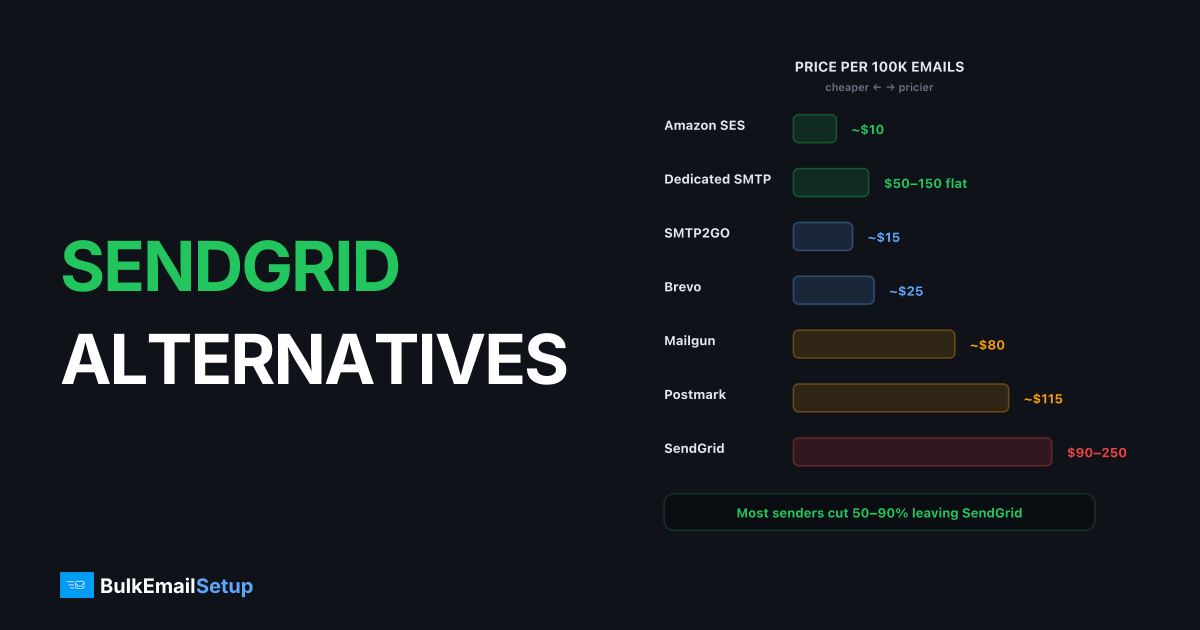
If you're leaving SendGrid in 2026, the cheapest direct replacement is Amazon SES at roughly $10 per 100K emails, and the cheapest at sustained volume is a managed dedicated SMTP server, which runs a flat $50-150/month regardless of send count. SendGrid charges roughly $90-250/month for 100K emails depending on tier, so most senders at that volume can cut costs by 50-90%. The right pick depends on how much deliverability work you want to own yourself.
I've run production email through every provider on this list. How they actually compare when you stop reading marketing pages and start counting dollars per 100K sends.
Why people leave SendGrid
SendGrid is fine software. The complaints I hear (and had myself) cluster around three things.
First, price. The Essentials plan covers low volume cheaply, but once you cross 100K/month you're pushed toward Pro tiers that run $90-250/month and climb fast. As of 2026, check current pricing, 1M emails/month on SendGrid costs several hundred to over a thousand dollars.
Second, shared IPs. On lower tiers you share IP reputation with every other customer on that pool. One spammer in your pool and your inbox placement drops through no fault of yours.
Third, support. Twilio-era SendGrid support is slow unless you're on a high-tier contract. When a domain gets blocked at Microsoft, waiting three days for a ticket reply costs real money.
The 7 alternatives compared
| Provider | ~Cost per 100K emails | Dedicated IP | Who owns deliverability | Best for |
|---|---|---|---|---|
| Amazon SES | ~$10 | +$24.95/mo | You | Engineers, cost-driven senders |
| Mailgun | ~$75-90 | Included on higher tiers | Shared | Developers wanting good APIs |
| Postmark | ~$115 | Transactional-focused | Provider (strict) | Transactional email only |
| SMTP2GO | ~$75-100 | On higher plans | Shared | Simple SMTP relay swap |
| Brevo (ex-Sendinblue) | ~$65-80 | Add-on | Shared | Marketing + SMTP combo |
| Self-hosted Postal/Postfix | ~$20-40 (server cost) | Yes | You, entirely | Technical teams with time |
| Managed dedicated SMTP (BulkEmailSetup) | Flat ~$50-150/mo total | Yes, warmed | Managed for you | Volume senders, agencies |
Prices are 2026 ballparks, check current pricing before committing.
1. Amazon SES, cheapest per email, zero hand-holding
SES is the price floor of the industry: about $0.10 per 1,000 emails. 100K emails costs roughly $10. Nothing beats that on raw per-email cost.
The catch is that SES gives you nothing else. No warm-up automation, minimal analytics, aggressive automatic sending pauses if your bounce or complaint rate ticks up, and a sandbox-exit approval process that rejects plenty of legitimate bulk senders. You're the deliverability team. If that's fine, SES is excellent. I wrote a full comparison in Amazon SES vs Dedicated SMTP Server.
2. Mailgun, developer-friendly, mid-range pricing
Mailgun's API and docs are better than SendGrid's, and its logs are genuinely useful for debugging. Pricing lands around $75-90 per 100K emails on the Foundation tier as of 2026.
Cons: shared IPs on lower tiers have the same pool-reputation problem as SendGrid, and pricing jumps are steep between tiers. Full teardown in Mailgun Pricing Explained.
3. Postmark, best deliverability, transactional only
Postmark's inbox placement for transactional mail is the best I've measured, because they aggressively police what customers send. That's also the limitation: they separate transactional and broadcast streams and will not tolerate cold outreach or aggressive marketing.
At roughly $115 per 100K, it's one of the pricier options. Worth it for password resets and receipts; wrong tool for newsletters at volume.
4. SMTP2GO, the easy drop-in swap
SMTP2GO is a straightforward SMTP relay: change your host, port, and credentials, done in ten minutes. Support is responsive and the dashboard is clean.
Pricing sits in the $75-100 per 100K range. You're still on shared infrastructure at most tiers, so reputation isn't fully yours. Solid choice if you want minimal migration effort and your volume is moderate.
5. Brevo, marketing suite with SMTP attached
Brevo (formerly Sendinblue) bundles a campaign builder, automation, and an SMTP relay. If you want one tool for both marketing UI and relay, it's reasonable value at roughly $65-80 per 100K.
The SMTP relay is a side product, though. Throughput limits are lower than dedicated relay providers, and dedicated IPs are a paid add-on with limited warm-up support.
6. Self-hosted Postal or Postfix, cheapest, most work
Run Postal or Postfix on a $20-40/month VPS with a dedicated IP and your per-email cost approaches zero. I've run both in production; see Postal vs Postfix for which to pick.
The honest downside: you own everything. IP warm-up schedules, rDNS, DKIM/SPF/DMARC, feedback loops, blacklist delisting, bounce processing. Budget 10-20 hours for setup and a few hours a month ongoing. Get it wrong and you're in the spam folder for weeks.
7. Managed dedicated SMTP server, flat cost, deliverability handled
This is the middle path: you get your own server and dedicated IP (so reputation is entirely yours), but a provider handles warm-up, monitoring, blacklist remediation, and DNS configuration. Cost is a flat monthly fee, typically $50-150/month, so at 100K, 500K, or 1M emails the price doesn't move.
The trade-off versus SES is a higher floor: at 20K emails/month, SES is cheaper. The crossover where a flat-fee dedicated server wins is usually somewhere between 100K and 300K emails/month. See our guide to the best dedicated SMTP server providers for how to evaluate vendors.
Cost at different volumes
| Monthly volume | SendGrid | SES | Mailgun | Managed dedicated SMTP |
|---|---|---|---|---|
| 10K | ~$20 | ~$1 | ~$15 | ~$50-100 (overkill) |
| 100K | ~$90-250 | ~$10 | ~$75-90 | ~$50-150 flat |
| 500K | ~$400+ | ~$50 | ~$300+ | ~$50-150 flat |
| 1M | ~$700+ | ~$100 | ~$600+ | ~$100-200 flat |
The pattern is clear: per-email pricing punishes volume, flat pricing rewards it. SES is the exception, cheap at every tier, but you carry the operational load.
How to choose
- Under 50K/month, mostly transactional: Postmark or SMTP2GO.
- Engineering team, cost-obsessed, willing to own deliverability: Amazon SES.
- Want APIs and logs, moderate volume: Mailgun.
- 100K+/month marketing or mixed sending, want your own reputation without the ops work: managed dedicated SMTP server.
- Have sysadmin time and want maximum control: self-host Postal, and read how to set up an SMTP server for bulk email first.
Migration checklist (don't skip these)
Leaving SendGrid badly costs more than staying. The sequence that works:
- Export your suppression lists first. Unsubscribes, bounces, spam reports, pull them all from SendGrid's suppression API and import them into the new system before sending anything. Mailing a previously-unsubscribed address is a compliance problem and a complaint generator.
- Stand up authentication on the new infrastructure. New SPF include or IP, new DKIM selector, confirm DMARC still passes with alignment. Run a test through a mail-tester before real traffic.
- Warm the new IP over 2-4 weeks. Start with your most engaged segment, recent openers, at 1-2K/day, roughly doubling every 2-3 days while SendGrid carries the remainder. Engaged recipients generate the opens and replies that build reputation fastest.
- Watch bounce codes daily during the ramp. 4xx deferrals mean slow down; 5xx blocks mean stop and diagnose before continuing.
- Keep SendGrid alive for 30 days after cutover. A downgraded plan as a fallback is cheap insurance if the new IP hits an unexpected listing.
The whole process takes 4-6 weeks calendar time but only a few hours of actual work, most of it is waiting for reputation to accrue.
Two mistakes I keep seeing
Chasing the cheapest sticker price without counting labor. SES at $10/month becomes expensive the first weekend you spend diagnosing a Microsoft block with no support to call. Price your own hours into the comparison.
Splitting transactional and marketing onto the same replacement. If you do both, separate them, different subdomains at minimum, ideally different IPs. One bad campaign should never take down your password-reset emails, which is also a reason to keep streams on infrastructure you control.
How BulkEmailSetup helps
BulkEmailSetup provides dedicated SMTP servers with managed IP warm-up, blacklist monitoring, and full DNS setup, your own reputation, none of the 2 a.m. delisting work. At 100K+ emails a month, a flat monthly fee typically beats SendGrid by 60-90%. See pricing for current plans.
Frequently asked questions
What is the cheapest SendGrid alternative in 2026?
Amazon SES is the cheapest pay-per-email option at roughly $0.10 per 1,000 emails ($10 per 100K). At higher volumes, a dedicated SMTP server with a flat monthly fee usually works out cheaper per email.
Is Mailgun cheaper than SendGrid?
At low volumes they are close. Mailgun's Basic tier starts around $15/month for 10K emails, while SendGrid's Essentials starts around $20/month. At 100K+ emails per month, pricing converges and both get expensive compared to SES or self-hosted options.
Can I replace SendGrid with my own SMTP server?
Yes. Tools like Postal or Postfix on a VPS with a dedicated IP can fully replace SendGrid's relay function. The hard parts are IP warm-up, blacklist monitoring, and bounce handling, which is what managed dedicated SMTP providers handle for you.
Why do people leave SendGrid?
The most common reasons are price increases at volume, shared IP reputation problems on lower tiers, and slow support responses. Senders doing 100K+ emails monthly often find the per-email cost hard to justify.
Does switching SMTP providers hurt deliverability?
Temporarily, yes, any new IP needs warming up. Plan a 2-4 week ramp where you move traffic gradually from SendGrid to the new provider rather than cutting over in one day.


