
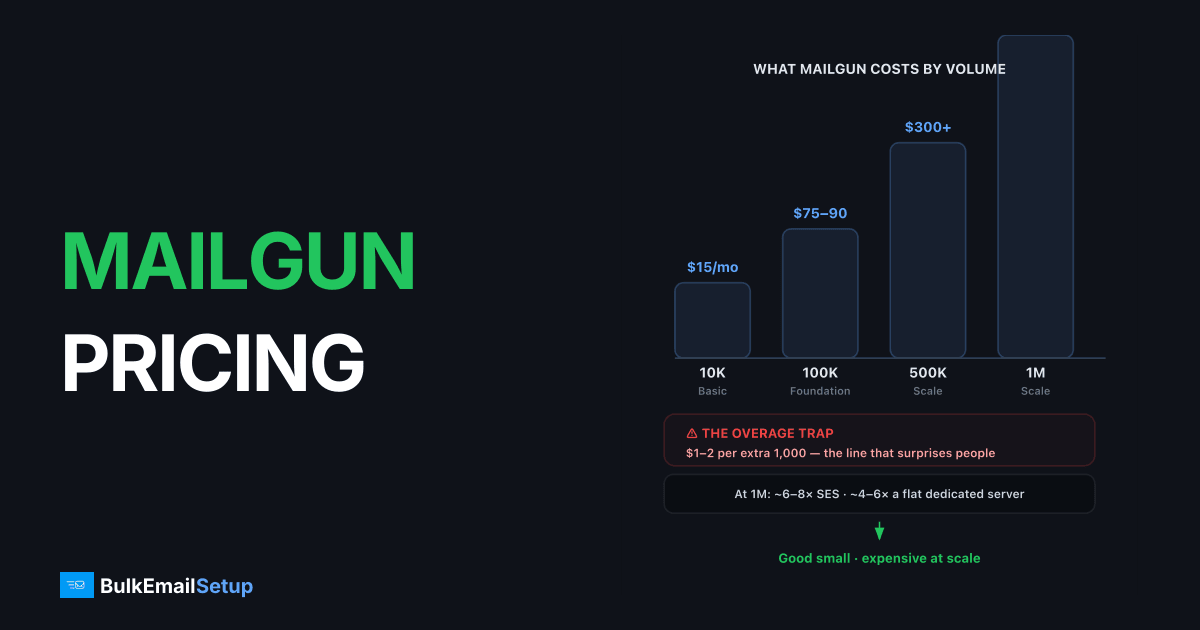
As of 2026, Mailgun costs roughly $15/month for 10K emails (Basic), $75-90/month for 100K (Foundation), and $600-800/month at 1M emails, with overages at $1-2 per extra 1,000 emails being the line item that surprises people. That makes Mailgun reasonable at small volume and expensive at scale: 1M emails costs about 6-8x what Amazon SES charges and 4-6x a flat-fee dedicated SMTP server. Pricing tiers shift, so check current numbers before deciding.
I ran Mailgun for three years across two products. The product is good; the bill needs reading carefully. The breakdown.
Mailgun's plan structure in 2026
| Plan | ~Monthly price | Included emails | Effective rate per 1K | Dedicated IP | Log retention |
|---|---|---|---|---|---|
| Free | $0 | ~100/day | , | No | 1 day |
| Basic | ~$15 | 10K | $1.50 | No | 1 day |
| Foundation | ~$35-90 | 50K-100K | $0.70-0.90 | No (add-on) | 3-5 days |
| Scale | ~$90+ | 100K+ | $0.80+ | Yes | 15-30 days |
| Enterprise | Custom | Custom | Negotiated | Yes, multiple | Custom |
Ballpark figures as of 2026. Mailgun reshuffles tiers regularly, so check current pricing.
Two structural things to understand. First, you pay for the bucket, not the emails: send 51K on a 100K plan and your effective rate doubles. Second, features are gated by tier, log retention, send-time optimization, and dedicated IPs all live up the ladder.
The three traps in the bill
Trap 1: overages
Exceed your included volume and overage rates of roughly $1-2 per 1,000 kick in, often double or triple your in-plan rate. One viral signup day or a re-engagement blast and a $90 month becomes a $250 month. If your volume is spiky, size the plan for your peak, not your average, and accept paying for headroom.
Trap 2: log retention
Basic keeps logs for one day. When a customer says "I never got my receipt" three days later, you have nothing. Real debugging needs Foundation or Scale retention, which means the cheap tiers are cheaper than they are usable.
Trap 3: shared IPs until you pay up
Below Scale, you send from shared pools. I watched our open rates drop 30% for two weeks because of pool neighbors. Mailgun's support confirmed a pool reputation issue and moved us, but the campaigns were already sent. A dedicated IP fixes this and costs extra (roughly $50-60/month as an add-on, included at Scale).
What each volume really costs
| Monthly volume | Plan needed | Realistic monthly cost | Cost per 1K |
|---|---|---|---|
| 10K | Basic | ~$15 | $1.50 |
| 50K | Foundation | ~$35-50 | $0.70-1.00 |
| 100K | Foundation/Scale | ~$75-90 | $0.75-0.90 |
| 500K | Scale | ~$300-400 | $0.60-0.80 |
| 1M | Scale/Enterprise | ~$600-800 | $0.60-0.80 |
Add ~$50-60/month if you need a dedicated IP below Scale tier.
What you get for the money
To be fair, Mailgun earns part of its premium. The API is one of the cleanest in the industry, the documentation is excellent, and features like inbound routing, email validation, and EU-region sending are genuinely useful. Deliverability on its managed dedicated IPs is solid, and their support (on paid tiers) knows email.
If you're a developer sending 30-80K transactional emails a month, Mailgun is a defensible choice and the bill won't hurt. The problem is purely what happens at volume.
Mailgun vs the alternatives at volume
| Monthly volume | Mailgun | Amazon SES | Managed dedicated SMTP |
|---|---|---|---|
| 100K | ~$75-90 | ~$10 | ~$50-150 flat |
| 500K | ~$300-400 | ~$50 | ~$50-150 flat |
| 1M | ~$600-800 | ~$100 | ~$100-200 flat |
SES is cheaper at every tier but hands you the full deliverability workload and an account-suspension risk, see Amazon SES vs Dedicated SMTP Server. A managed dedicated server costs the same at 1M as at 100K because you're paying for infrastructure, not per email. Mailgun also appears in our wider SMTP relay pricing comparison across nine providers.
How to cut your Mailgun bill without leaving
If you're staying for now, three levers reduce the bill immediately:
- Right-size to your real volume. Pull the last six months of send stats and check whether you're paying for a bucket you never fill, or repeatedly paying overages that a one-tier upgrade would eliminate. Overages above ~30% of months mean the bigger plan is cheaper.
- Stop sending to non-engagers. Cutting contacts who haven't opened in 6 months typically trims 20-40% of volume, drops you a tier, and improves deliverability at the same time.
- Split transactional from marketing. Keep low-volume transactional mail on Mailgun (where its logs and reliability earn their price) and move bulk campaigns to cheaper infrastructure. This hybrid is the most common end-state I see. Mailgun for receipts, a dedicated server for newsletters.
That third lever is usually worth $200-500/month on its own once campaign volume passes a few hundred thousand sends.
When to stay, when to leave
Stay on Mailgun if: you're under ~100K/month, you value the API and inbound routing, and your volume is steady enough to avoid overages.
Leave when: your monthly bill crosses roughly $100-150 and your sending is mostly outbound campaigns. At that point you're paying SaaS margins for SMTP relay, and either SES (if you have the engineers) or a dedicated SMTP server (if you don't) will cut the bill by more than half.
How BulkEmailSetup helps
BulkEmailSetup replaces per-email pricing with a flat monthly fee for your own dedicated SMTP server. IP warm-up, DNS authentication, and blacklist monitoring managed for you. Senders moving from Mailgun at 100K+/month typically cut costs 50-80% while gaining their own IP reputation. Plans are on the pricing page.
Frequently asked questions
How much does Mailgun cost per month in 2026?
As of 2026, Mailgun's paid plans start around $15/month (Basic, 10K emails) and run to $90+/month for Scale tiers. 100K emails/month lands around $75-90, and 1M emails/month typically costs $600-800 depending on plan and overages. Check current pricing as tiers change.
Does Mailgun have a free plan?
Mailgun offers a limited free tier (around 100 emails/day as of 2026), intended for development and testing rather than production sending.
What do Mailgun overages cost?
Overage rates vary by plan but typically run $1-2 per 1,000 emails beyond your included volume, often 2-3x the effective rate of the emails inside your plan. A traffic spike can double a monthly bill.
Is a dedicated IP included with Mailgun?
Only on higher tiers (Scale and above as of 2026). On lower plans you send from shared IP pools, where other customers' behavior affects your deliverability.
What's cheaper than Mailgun at high volume?
Amazon SES (~$0.10 per 1,000) is cheaper per email at any volume. A managed dedicated SMTP server at a flat $50-150/month beats Mailgun above roughly 100K emails/month while giving you your own IP reputation.


