
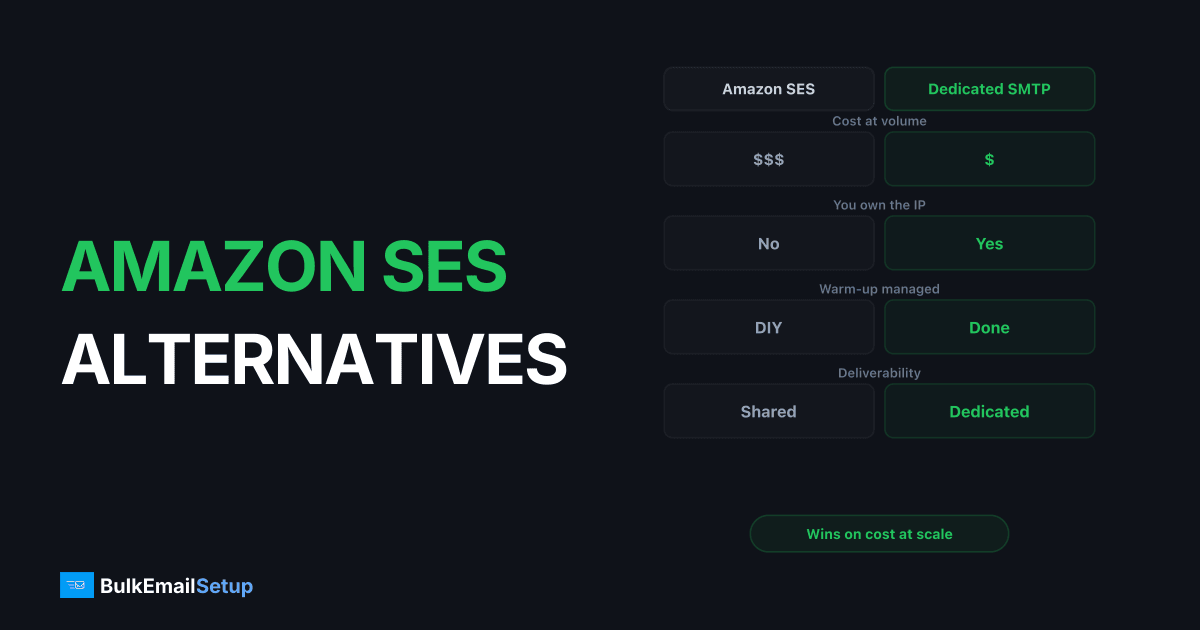
If Amazon SES has stopped being simple, the best alternatives in 2026 split three ways: cheap relays with support (SMTP2GO, Mailgun, around $75-100 per 100K emails), strict transactional providers (Postmark, around $115 per 100K), and flat-fee managed dedicated SMTP servers (roughly $50-150/month regardless of volume). SES itself is still the cheapest on paper at about $10 per 100K, so you only leave it when its sandbox rejections, auto-pauses, or zero support cost you more than the savings. The right Amazon SES alternative depends on how much deliverability work you want to keep owning yourself.
I've run production email through SES and most of the providers below. Here's how they actually compare once you stop reading the AWS console and start counting both dollars and the hours you spend unblocking your own sends.
Why SES stops being simple
SES is cheap and reliable as a pipe. The pain shows up around it.
The sandbox. Every new account starts capped and sandboxed. Getting a production limit increase means a support request where AWS asks about your list sourcing and bounce handling, and they reject plenty of legitimate senders, especially anyone doing cold outreach or list-based marketing.
The auto-pauses. SES watches your bounce and complaint rates hard. Cross roughly 5% bounce or 0.1% complaint and they can pause your account with little warning. On a managed provider a human nudges you first. On SES the tap just closes.
The support. On the basic tier, there isn't any worth the name. When Microsoft blocks your IP at 2 a.m., you're reading forum threads, not opening a priority ticket.
The ops. SES hands you a sending endpoint and nothing else. No warm-up automation, thin analytics, no blacklist monitoring, no opinion on your DNS. You are the deliverability team. For a lot of teams that's the real reason they go looking for Amazon SES alternatives.
The 12 alternatives compared
Prices are 2026 ballparks per 100K emails. Check current pricing before committing.
| # | Provider | ~Cost per 100K | Dedicated IP | Who owns deliverability | Best for |
|---|---|---|---|---|---|
| 1 | Mailgun | ~$75-90 | Higher tiers | Shared | Devs wanting good APIs + logs |
| 2 | Postmark | ~$115 | Transactional focus | Provider (strict) | Transactional mail only |
| 3 | SMTP2GO | ~$75-100 | Higher plans | Shared | Easiest drop-in relay swap |
| 4 | Brevo | ~$65-80 | Add-on | Shared | Marketing UI + SMTP combo |
| 5 | SparkPost | ~$60-90 | Add-on | Shared/dedicated | High-volume API senders |
| 6 | SendGrid | ~$90-250 | Higher tiers | Shared | Existing SendGrid shops |
| 7 | Mailjet | ~$50-95 | Add-on | Shared | EU senders, simple needs |
| 8 | Elastic Email | ~$10-45 | Add-on | Shared (loose) | Bargain-hunters, mixed risk |
| 9 | MailerSend | ~$45-65 | Add-on | Shared | Transactional, modern API |
| 10 | Resend | ~$80-100 | Higher tiers | Shared | Dev-first transactional |
| 11 | Self-hosted Postal/Postfix | ~$20-40 server | Yes | You, entirely | Technical teams with time |
| 12 | Managed dedicated SMTP (BulkEmailSetup) | Flat ~$50-150/mo | Yes, warmed | Managed for you | Volume senders, agencies |
1. Mailgun, the developer's relay
Better API and docs than SES gives you, and the logs are genuinely useful for debugging deferrals. Pricing lands around $75-90 per 100K on the Foundation tier. Shared IPs on lower tiers carry the same pool-reputation risk as anywhere else. Full numbers in Mailgun pricing explained.
2. Postmark, best transactional inbox placement
The best inbox placement I've measured, because they police what customers send aggressively. That policing is also the limit: they split transactional and broadcast streams and won't tolerate cold outreach. Around $115 per 100K, pricey, worth it for receipts and password resets, wrong for newsletters at volume.
3. SMTP2GO, the ten-minute swap
Change host, port, credentials, done. Responsive support, clean dashboard, real free tier at 1,000/month. Pricing sits in the $75-100 per 100K band. You're on shared infrastructure at most tiers, so reputation isn't fully yours. The easiest migration on this list if your volume is moderate.
4. Brevo, marketing suite with SMTP bolted on
Brevo (formerly Sendinblue) bundles a campaign builder and an SMTP relay. Reasonable value at roughly $65-80 per 100K if you want one tool for both. The relay is a side product though: lower throughput limits than dedicated relays, and dedicated IPs are a paid add-on with thin warm-up support.
5. SparkPost, built for scale
SparkPost (now part of Bird) handles big API volume well and was historically the engine behind some huge senders. Around $60-90 per 100K depending on tier and commit. Good for teams already comfortable with API-driven sending who don't want to touch infrastructure.
6. SendGrid, the lateral move
Leaving SES for SendGrid mostly trades cheap-and-bare for expensive-and-featured. At $90-250 per 100K it's the priciest mainstream relay here. Only makes sense if you specifically want its marketing tooling. If you're weighing it the other direction, see SendGrid alternatives.
7. Mailjet, the EU-friendly option
Mailjet (also Bird-owned now) is straightforward, with EU data residency that matters for some compliance setups. Around $50-95 per 100K. Dedicated IPs are an add-on. Fine for simple transactional and light marketing, not built for aggressive volume.
8. Elastic Email, cheapest sticker price
The closest thing to SES on raw cost, roughly $10-45 per 100K depending on plan. The trade-off is looser sender vetting, which means the shared pools can run hot. I've seen good and bad stretches on it. Cheap, but you're partly betting on who else is in your pool.
9. MailerSend, modern transactional API
Clean API, good templating, a generous free tier, around $45-65 per 100K. Aimed squarely at transactional and product email. Shared IPs by default, dedicated as an add-on. A solid SES replacement if your sending is app-driven, not campaign-driven.
10. Resend, dev-first newcomer
Resend has won a lot of fans with a clean DX and React-friendly email tooling. Around $80-100 per 100K. Younger platform, shared IPs except on higher tiers, transactional-leaning. Great if your team lives in code and values the developer experience over per-email savings.
11. Self-hosted Postal or Postfix, cheapest, most work
Run Postal or Postfix on a $20-40/month VPS with a dedicated IP and per-email cost approaches zero. The honest downside: you own everything SES already made you own, plus the mail server itself. Warm-up, rDNS, DKIM/SPF/DMARC, feedback loops, delisting, bounce processing. Budget 10-20 hours setup. See Postal vs Postfix to pick one.
12. Managed dedicated SMTP server, flat cost, deliverability handled
The middle path. You get your own server and dedicated IP, so reputation is entirely yours, but a provider runs warm-up, monitoring, blacklist remediation, and DNS. Flat $50-150/month, so 100K, 500K, or 1M emails cost the same. Higher floor than SES at low volume, cheaper per email at sustained volume. The deep comparison is in Amazon SES vs dedicated SMTP server.
Cost at different volumes
This is the table that decides most migrations.
| Monthly volume | SES | Mailgun | SMTP2GO | Managed dedicated SMTP |
|---|---|---|---|---|
| 10K | ~$1 | ~$15 | ~$15 | ~$50-100 (overkill) |
| 100K | ~$10 | ~$75-90 | ~$75-100 | ~$50-150 flat |
| 500K | ~$50 | ~$300+ | ~$300+ | ~$50-150 flat |
| 1M | ~$100 | ~$600+ | ~$500+ | ~$100-200 flat |
Two patterns. Per-email pricing punishes volume, so Mailgun and SMTP2GO get ugly past 500K. SES stays cheap at every tier, which is exactly why people stay on it despite the pain. The flat-fee managed server is the only line that doesn't move with send count, which is what makes it the answer at sustained volume. More math in self-hosted SMTP vs ESP cost at 1 million emails.
How to choose your SES alternative
- Mostly transactional, under 100K/month: Postmark or MailerSend.
- App-driven, dev team values the API: Resend, Mailgun, or SparkPost.
- Want the easiest possible relay swap with support: SMTP2GO.
- Marketing UI plus relay in one tool: Brevo.
- Cost-obsessed and willing to keep owning deliverability: stay on SES, or self-host Postal.
- 100K+/month, want your own reputation without the 2 a.m. ops: managed dedicated SMTP server.
If you're chasing pure price per send, read the cheapest way to send 100K emails per month before you pick.
Migration checklist (don't skip these)
Leaving SES badly costs more than staying. The sequence that works:
- Export your suppression data first. Pull bounces and complaints from SES (or your own logs) and import them into the new system before sending anything. Mailing a known bounce or complainer on day one tanks your fresh reputation. See email list cleaning.
- Set up authentication on the new infrastructure. New SPF include or IP, new DKIM selector, confirm DMARC passes with alignment. Run one send through a mail-tester before real traffic.
- Warm the new IP over 2-4 weeks. Start with your most engaged recipients at 1-2K/day, roughly doubling every 2-3 days while SES carries the rest. Engaged opens build reputation fastest. Details in how long IP warm-up takes.
- Watch bounce codes daily during the ramp. 4xx deferrals mean slow down. 5xx blocks mean stop and diagnose. Wire up Google Postmaster Tools so Gmail tells you before your inbox rate craters.
- Keep SES alive for 30 days after cutover. It costs almost nothing to leave running as a fallback if the new IP hits an unexpected listing.
Calendar time is 4-6 weeks. Actual work is a few hours. The rest is waiting for reputation to accrue.
Two mistakes I keep seeing
Chasing Elastic Email or raw SES pricing without counting labor. A $10 bill becomes expensive the first weekend you spend diagnosing a Microsoft block with no one to call. Price your own hours into the comparison. That single change flips a lot of decisions toward managed.
Putting transactional and marketing on the same replacement IP. If you send both, split them. Different subdomains at minimum, ideally different IPs, so a bad campaign never takes down your password resets. See subdomain vs root domain for email sending.
How BulkEmailSetup helps
BulkEmailSetup runs dedicated SMTP servers with managed IP warm-up, blacklist monitoring, and full DNS setup, so you get your own reputation without the delisting work SES leaves on your desk. The trade is honest: at 10K-20K emails a month SES is cheaper, but once you're past roughly 100K-300K/month, a flat monthly fee beats per-email pricing and removes the ops load that made you start hunting for Amazon SES alternatives in the first place. See pricing for current plans.
Frequently asked questions
What is the best Amazon SES alternative in 2026?
It depends on what you want SES to stop being. For a near drop-in relay with logs and support, SMTP2GO or Mailgun. For transactional inbox placement, Postmark. For high sustained volume with your own reputation and no ops work, a managed dedicated SMTP server at a flat $50-150/month usually wins.
Is Amazon SES cheaper than every alternative?
On raw per-email cost, almost always. SES runs about $0.10 per 1,000 emails. The catch is hidden labor: warm-up, blacklist remediation, bounce handling, and support tickets you answer yourself. Once you price your own hours in, cheaper-on-paper SES often loses to a flat-fee managed server at volume.
Why do people leave Amazon SES?
The common reasons are the sandbox approval process rejecting legitimate bulk senders, automatic sending pauses when bounce or complaint rates tick up, near-zero support on the basic tier, and the fact that you are the entire deliverability team. People want the cheap email without owning every part of the stack.
Can I move off SES without warming a new IP?
No. Any provider that gives you a fresh dedicated IP needs a 2-4 week warm-up. Shared-pool providers like SMTP2GO or Brevo let you skip warm-up but you inherit pool reputation. A managed dedicated SMTP provider warms the IP for you, so you get your own reputation without doing the schedule yourself.
Does SES have a free tier I will miss on alternatives?
SES dropped its old EC2-linked free tier; in 2026 it is roughly $0.10 per 1,000 emails from the first send. Most alternatives have a small free or trial tier too (Brevo 300/day, Postmark trial, SMTP2GO 1,000/month), so you are not giving up much at low volume.


