
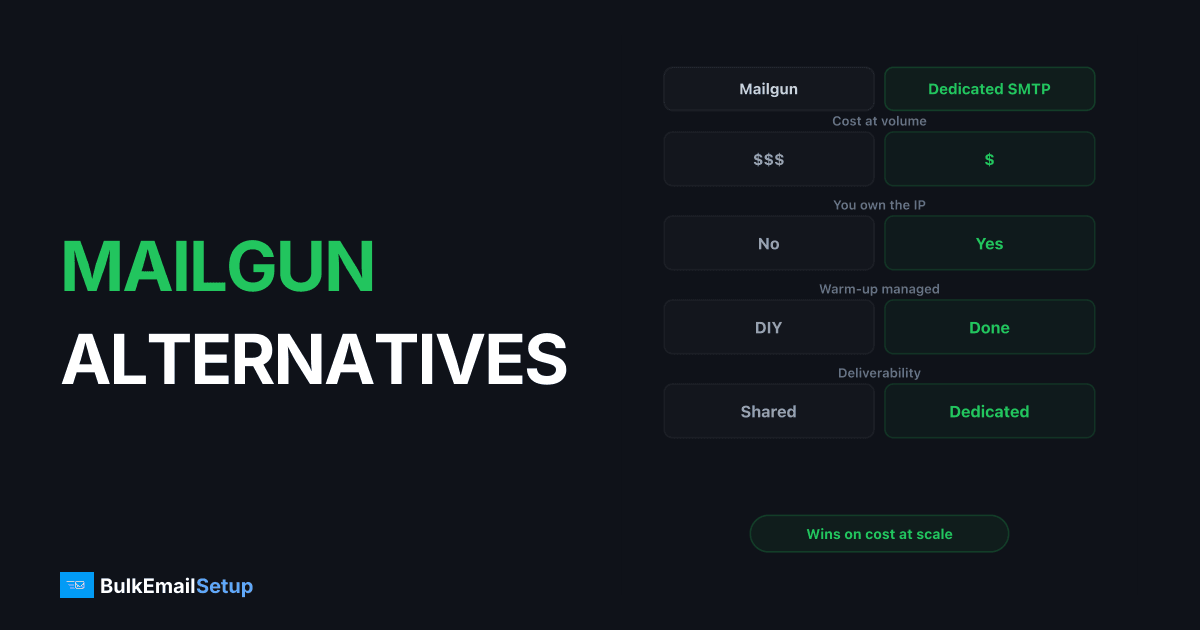
If you're leaving Mailgun in 2026, the cheapest direct replacement is Amazon SES at roughly $10 per 100K emails ($100 per 1M), and the cheapest at sustained volume is a managed dedicated SMTP server at a flat $50-200/month no matter how much you send. Mailgun's Foundation tier runs about $75-90 per 100K and $600+ per 1M, so most high-volume senders can cut their bill by 50-85% with one of the eleven Mailgun alternatives below. The right pick comes down to how much deliverability work you're willing to own.
I've run production email through every provider on this list. Below is how they actually compare once you stop reading pricing pages and start counting dollars per million sends.
Why people leave Mailgun
Mailgun's API and logs are genuinely good. The reasons senders churn off it cluster around three things.
First, the per-email math. Mailgun prices by send, so your bill grows in a straight line. At 100K you barely notice. At 1M+ you're paying several hundred dollars a month for a relay, and the tier jumps between Foundation and Scale are steep.
Second, shared IP reputation on lower tiers. You share a pool with other Mailgun customers. One sloppy sender in that pool and your inbox placement drops for reasons you can't see or control.
Third, support and account stability. Mailgun has tightened its anti-abuse stance over the years, and legitimate bulk senders sometimes get flagged or suspended with little warning. When that happens mid-campaign, the per-ticket wait costs real revenue.
The 11 Mailgun alternatives compared
| Provider | ~Cost per 100K | ~Cost per 1M | Dedicated IP | Who owns deliverability | Best for |
|---|---|---|---|---|---|
| Amazon SES | ~$10 | ~$100 | +$24.95/mo | You | Engineers, cost-driven senders |
| Postmark | ~$115 | ~$1,000+ | Transactional-focused | Provider (strict) | Transactional email only |
| SMTP2GO | ~$75-100 | ~$400+ | On higher plans | Shared | Simple SMTP relay swap |
| Brevo (ex-Sendinblue) | ~$65-80 | ~$400+ | Add-on | Shared | Marketing + SMTP combo |
| SendGrid | ~$90-250 | ~$700+ | Add-on | Shared | Mixed sending, broad features |
| SparkPost | ~$70-90 | ~$500+ | Higher tiers | Shared | Enterprise volume, analytics |
| Postmark Broadcast | ~$100+ | ~$900+ | Shared | Provider | Newsletters with strict policy |
| Elastic Email | ~$45-60 | ~$300+ | Add-on | Shared | Budget marketing senders |
| MailerSend | ~$60-80 | ~$400+ | Add-on | Shared | Developer transactional |
| Self-hosted Postal/Postfix | ~$20-40 server | ~$40-80 server | Yes | You, entirely | Technical teams with time |
| Managed dedicated SMTP (BulkEmailSetup) | Flat ~$50-150/mo | Flat ~$100-200/mo | Yes, warmed | Managed for you | Volume senders, agencies |
Prices are 2026 ballparks, check current pricing before committing.
1. Amazon SES, the price floor
SES sits at about $0.10 per 1,000 emails. 100K costs roughly $10, 1M roughly $100. Nothing on the market beats that per-email number.
What you give up is everything around the send. No warm-up automation, thin analytics, automatic sending pauses the moment your bounce or complaint rate ticks up, and a sandbox-exit review that rejects plenty of legitimate bulk senders. You are the deliverability team. If your engineers are comfortable with that, SES is excellent. I broke down the full trade-off in Amazon SES vs Dedicated SMTP Server.
2. Postmark, best transactional inbox placement
Postmark's inbox rate for transactional mail is the best I've measured, because they aggressively police what their customers send. That policing is also the limitation. They separate transactional and broadcast streams and won't tolerate cold outreach.
At roughly $115 per 100K it's pricey, and it gets worse at 1M. Right tool for receipts and password resets, wrong tool for newsletters at volume.
3. SMTP2GO, the ten-minute drop-in
SMTP2GO is a clean SMTP relay. Change host, port, and credentials and you're migrated in ten minutes. Support is responsive and the dashboard is readable.
Pricing lands in the $75-100 per 100K range, similar to Mailgun, so it's a lateral move on cost. You're still on shared infrastructure at most tiers. Good if you want minimal migration effort and moderate volume.
4. Brevo, marketing suite with SMTP attached
Brevo (formerly Sendinblue) bundles a campaign builder, automation, and an SMTP relay at roughly $65-80 per 100K. If you want one tool for both your marketing UI and your relay, it's decent value.
The relay is a side product, though. Throughput caps are lower than dedicated relay providers, and dedicated IPs are a paid add-on with limited warm-up help.
5. SendGrid, the obvious lateral move
SendGrid does what Mailgun does with a broader feature set, and lands around $90-250 per 100K depending on tier. If you're leaving Mailgun on developer-experience grounds rather than cost, SendGrid is a sideways step that solves nothing on price. I compared its options in SendGrid alternatives.
6. SparkPost, enterprise analytics
SparkPost (now part of MessageBird/Bird) targets high-volume enterprise senders with strong analytics and event webhooks. Roughly $70-90 per 100K, with negotiated pricing at the top. Good engagement data, still per-email pricing that punishes scale, still shared reputation unless you pay up.
7. Elastic Email, the budget option
Elastic Email is one of the cheaper hosted relays, around $45-60 per 100K. The trade-off is exactly what you'd expect at that price: a more crowded shared IP pool and looser sender vetting, which can drag inbox placement. Fine for tolerant marketing audiences, risky for anything reputation-sensitive.
8. MailerSend, developer transactional
MailerSend, from the MailerLite team, is a clean transactional API in the $60-80 per 100K range. Nice templates and a usable free tier. It's a Mailgun-style product, so the same per-email scaling problem appears at 1M.
9. Postmark Broadcast streams
If you like Postmark but need newsletters, their broadcast streams handle bulk marketing under the same strict policy. Around $100+ per 100K. You get Postmark's deliverability discipline applied to broadcast, at Postmark prices, with the same zero tolerance for cold lists.
10. Self-hosted Postal or Postfix, cheapest, most work
Run Postal or Postfix on a $20-40/month VPS with a dedicated IP and your per-email cost approaches zero, even at 1M+. I've run both in production. See Postal vs Postfix for which to pick.
The honest cost is your time. IP warm-up, rDNS, DKIM/SPF/DMARC, feedback loops, blacklist delisting, bounce processing, all yours. Budget 10-20 hours for setup and a few hours a month after. Get it wrong and you're in spam for weeks. The full economics are in self-hosted SMTP vs ESP cost at 1 million emails.
11. Managed dedicated SMTP server, flat cost at any volume
The middle path. You get your own server and a warmed dedicated IP, so reputation is entirely yours, but a provider handles warm-up, monitoring, blacklist remediation, and DNS. Cost is a flat monthly fee, typically $50-200/month, so at 100K, 1M, or 5M emails the bill doesn't move.
The trade-off versus SES and Mailgun is a higher floor. At 20K emails/month, SES is cheaper. The crossover where a flat-fee server wins is usually between 100K and 300K emails/month. Read the best dedicated SMTP server providers for how to evaluate vendors.
Cost at different volumes
Where these Mailgun alternatives actually diverge is at scale. Here's the same spend modeled across four volume tiers.
| Monthly volume | Mailgun | SES | SMTP2GO | Managed dedicated SMTP |
|---|---|---|---|---|
| 10K | ~$15 | ~$1 | ~$15 | ~$50-100 (overkill) |
| 100K | ~$75-90 | ~$10 | ~$75-100 | ~$50-150 flat |
| 500K | ~$300+ | ~$50 | ~$250+ | ~$50-150 flat |
| 1M | ~$600+ | ~$100 | ~$400+ | ~$100-200 flat |
| 5M | ~$2,500+ | ~$500 | negotiated | ~$150-300 flat |
The pattern is the same one I see every time: per-email pricing punishes volume, flat pricing rewards it. SES is the exception, cheap at every tier, but you carry the full operational load. For a deeper number-by-number look, see the cheapest way to send 100K emails per month.
How to choose a Mailgun alternative
- Under 50K/month, mostly transactional: Postmark or MailerSend.
- Engineering team, cost-obsessed, willing to own deliverability: Amazon SES.
- Want a fast drop-in relay swap, moderate volume: SMTP2GO.
- Budget marketing to a tolerant audience: Elastic Email or Brevo.
- 100K+/month and you want your own reputation without the ops work: managed dedicated SMTP server.
- Have sysadmin time and want maximum control: self-host Postal, and read how to set up an SMTP server for bulk email first.
The dedicated-IP question matters more than people think. On shared tiers across Mailgun, SMTP2GO, Brevo, and Elastic Email, you inherit other senders' mistakes. If you're sending enough to care, dedicated IP vs shared IP email lays out when the upgrade pays off.
Migration checklist, don't skip these
Leaving Mailgun badly costs more than staying. The sequence that works:
- Export your suppression lists first. Unsubscribes, bounces, spam complaints, pull them from Mailgun's suppression API and import them into the new system before you send a single message. Mailing a previously-suppressed address is both a compliance problem and a complaint generator.
- Stand up authentication on the new infrastructure. New SPF include or IP, new DKIM selector, confirm DMARC still passes with alignment. Run a test through a mail-tester before any real traffic.
- Warm the new IP over 2-4 weeks. Start with your most engaged recipients at 1-2K/day, roughly doubling every 2-3 days while Mailgun carries the rest. Engaged opens and replies build reputation fastest. See how long IP warm-up takes.
- Watch bounce codes daily during the ramp. 4xx deferrals mean slow down. 5xx blocks mean stop and diagnose before continuing. Keep an eye on Google Postmaster Tools for Gmail reputation signals.
- Keep Mailgun alive for 30 days after cutover. A downgraded fallback plan is cheap insurance if the new IP hits an unexpected listing.
Calendar time is 4-6 weeks. Actual work is a few hours, most of it waiting for reputation to accrue.
Two mistakes I keep seeing
Chasing the lowest sticker price without counting labor. SES at $10/month or Elastic Email at $45 looks great until the first weekend you spend diagnosing a Microsoft block with no support to call. Price your own hours into the comparison.
Mixing transactional and marketing on one replacement. If you do both, separate them, different subdomains at minimum, ideally different IPs. One bad campaign should never knock out your password-reset emails. Cleaning your list before you migrate also keeps complaint rates down, see the email list cleaning guide.
How BulkEmailSetup helps
BulkEmailSetup provides dedicated SMTP servers with managed IP warm-up, blacklist monitoring, and full DNS setup, your own reputation with none of the 2 a.m. delisting work. At 100K+ emails a month a flat monthly fee typically beats Mailgun by 60-85%, and the gap only widens as you scale past 1M. See pricing for current plans.
Frequently asked questions
What is the cheapest Mailgun alternative in 2026?
Amazon SES is the cheapest pay-per-email option at roughly $0.10 per 1,000 emails ($10 per 100K, $100 per 1M). At sustained high volume, a managed dedicated SMTP server on a flat monthly fee usually beats Mailgun and SES on total cost once you price in your own time.
Why is Mailgun expensive at high volume?
Mailgun prices per email, so cost scales linearly with send count. At 1M emails per month you're looking at roughly $600+ on the Foundation tier in 2026, while a flat-fee dedicated server stays around $100-200 regardless of volume.
Is Amazon SES better than Mailgun?
SES is far cheaper per email but gives you almost no deliverability tooling, no warm-up automation, and strict auto-pausing on bounces. Mailgun has better logs and APIs. SES wins on price, Mailgun wins on developer experience, and a managed dedicated server wins on flat cost plus owned reputation.
Can I move off Mailgun without hurting deliverability?
Yes, if you warm the new IP over 2-4 weeks and keep Mailgun running as a fallback during cutover. Export your suppression lists first and move your most engaged recipients to the new infrastructure before the rest.
Do Mailgun alternatives give me a dedicated IP?
Some do. SES sells dedicated IPs at about $24.95/month, Mailgun includes them on higher tiers, and managed dedicated SMTP servers give you a warmed dedicated IP by default. On shared tiers you share reputation with other senders.


