
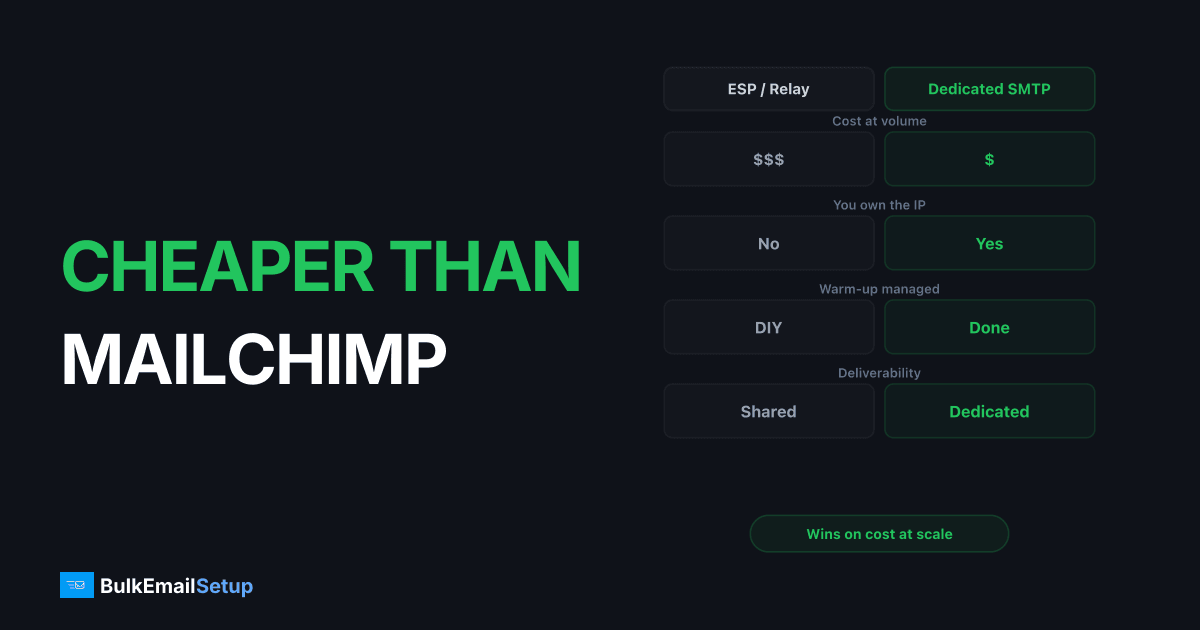
If you want something cheaper than Mailchimp in 2026, the problem to fix first is the billing model: Mailchimp charges by how many contacts you store, not how many emails you send, so a 50,000-contact list costs roughly $350/month on Standard even if you mail it twice. Amazon SES at about $10 per 100K emails and Brevo billing by sends (from $9-25/month) both ignore list size, and a flat-fee dedicated SMTP server runs $50-150/month no matter how many contacts you hold. Most senders at 50K+ contacts cut their bill 50-90% by switching off per-contact pricing.
I've moved a dozen lists off Mailchimp over the years. The trap is almost never the email volume. It's the dead weight in the audience that you keep paying to store.
Why Mailchimp gets expensive: the per-contact trap
Mailchimp's bill is driven by audience size. Every contact you keep counts toward your tier, and the tiers climb hard. A list that grows from 10K to 60K contacts can take your monthly cost from under $100 to several hundred dollars, even if your send frequency never changes.
The part that stings: dormant subscribers cost the same as active ones. The person who opened once in 2023 and never again is billed identically to your best customer. On some plans even unsubscribed and non-sending contacts still count toward your total until you archive them.
So the first lever is usually not "find a cheaper provider." It's "stop paying to store contacts who never engage." A list-cleaning pass alone can drop you a tier or two. I wrote the process up in email list cleaning, and it also lifts deliverability, which is a second win.
But cleaning only goes so far. If you legitimately have a big engaged list, per-contact pricing will always punish you, and that's when you change the model entirely.
Per-contact vs per-send vs flat: the three pricing models
There are really only three ways email gets billed. Understanding which one you're on explains your whole bill.
| Model | Who charges this way | What drives cost | Hurts you when |
|---|---|---|---|
| Per contact stored | Mailchimp, Constant Contact, ActiveCampaign | Audience size | Big list, low send frequency |
| Per email sent | Brevo, Amazon SES, Mailgun, SendGrid | Volume mailed | High send frequency, small list |
| Flat monthly fee | Managed dedicated SMTP server | Nothing (fixed) | Very low volume (overkill) |
Per-contact pricing is the worst fit for the most common newsletter pattern: a large list you email infrequently. You pay every month for contacts you barely touch. Switching to a per-send or flat model means a 60K-contact list you mail four times a month is billed on roughly 240K sends, not on the standing 60K headcount, and that math almost always comes out cheaper.
Cheaper than Mailchimp: the alternatives compared
Prices below are 2026 ballparks, check current pricing before committing.
| Option | ~Cost at 50K contacts / 200K sends/mo | Billing model | Campaign builder | Best for |
|---|---|---|---|---|
| Mailchimp Standard | ~$350/mo | Per contact | Yes | People who want one all-in-one tool |
| Brevo | ~$65-90/mo | Per send | Yes | Marketing UI without per-contact billing |
| MailerLite | ~$75-140/mo | Per contact (cheaper tiers) | Yes | Lighter Mailchimp replacement |
| Amazon SES | ~$20/mo | Per send | No | Engineers who own deliverability |
| Self-hosted Listmonk + VPS | ~$20-40/mo | Flat (server cost) | Basic | Technical teams with time |
| Managed dedicated SMTP (BulkEmailSetup) | Flat ~$50-150/mo | Flat | No (use any tool) | Volume senders, agencies |
Brevo: kills the per-contact problem, keeps the UI
Brevo (formerly Sendinblue) is the closest like-for-like swap if you want to keep a campaign builder and automation but stop paying per contact. It bills by emails sent. Store 500K contacts, mail them once, you pay for 500K sends that month, not for the standing list.
For a large list you email rarely, that's a big saving. For a small list you mail daily, per-send can actually cost more than per-contact, so run your own numbers. Brevo's deliverability on shared IPs is decent but not exceptional, and dedicated IPs are a paid add-on with limited warm-up help.
MailerLite: a lighter, cheaper Mailchimp
MailerLite still bills by contacts, so it doesn't escape the model. But its per-contact rates are lower than Mailchimp's and the editor is clean. If you like the all-in-one approach and just want the same thing for less, it's the easy move. It won't save you at very large list sizes, where the per-contact tax compounds.
Amazon SES: the price floor, no frills
SES is the cheapest per-email option at roughly $0.10 per 1,000 emails. 200K sends costs about $20. There's no campaign builder, no audience management, no automation. You bring your own sending tool or code, and you own deliverability entirely, including warm-up and complaint handling. I compared the trade-offs in Amazon SES vs a dedicated SMTP server. Great for engineering teams, painful if you wanted Mailchimp's UI.
Self-hosted Listmonk or Mautic: cheapest, most work
Run an open-source campaign tool like Listmonk on a $20-40/month VPS, point it at your own dedicated IP, and your per-contact cost is zero. You get a real campaign UI and full control. The cost is your time: IP warm-up, DNS, bounce processing, blacklist monitoring. Budget setup hours and a few hours a month after. Worth it if you're technical and your volume justifies it.
Managed dedicated SMTP server: flat fee, deliverability handled
This is the middle path. You get your own server and dedicated IP, so your sending reputation is yours alone, but the provider handles warm-up, monitoring, blacklist remediation, and DNS. Cost is flat, typically $50-150/month, and it doesn't move whether you hold 50K contacts or 500K, or send 100K emails or 2M. You'd pair it with any campaign tool or your app's own mailer. See the best dedicated SMTP server providers for how to vet vendors.
The honest catch: it has a higher floor than SES. At 10K contacts mailed lightly, SES or even Mailchimp's free tier wins. The flat fee starts paying off as your list and volume grow.
Cost by list size: where each option wins
Assume four sends per month so contacts and volume both scale. 2026 ballparks.
| List size | Mailchimp Standard | Brevo (per send) | Amazon SES | Managed dedicated SMTP |
|---|---|---|---|---|
| 5K contacts | ~$60/mo | ~$25/mo | ~$2/mo | ~$50-100 (overkill) |
| 25K contacts | ~$200/mo | ~$45/mo | ~$10/mo | ~$50-150 flat |
| 50K contacts | ~$350/mo | ~$70/mo | ~$20/mo | ~$50-150 flat |
| 100K contacts | ~$500-800/mo | ~$120/mo | ~$40/mo | ~$50-150 flat |
| 250K contacts | ~$1,000+/mo | ~$250/mo | ~$100/mo | ~$100-200 flat |
The crossover where leaving Mailchimp clearly pays is somewhere around 25K-50K contacts. Below that, the convenience of an all-in-one tool can justify the price. Above it, the per-contact line item gets hard to defend. SES stays cheapest on paper at every tier, but you're carrying all the deliverability work yourself, so price your own hours in.
For the deeper volume math, I broke down the cheapest way to send 100K emails a month and self-hosted SMTP vs ESP cost at 1 million emails.
How to migrate off Mailchimp without nuking deliverability
Moving the list is the easy part. Moving the reputation is the part people get wrong.
- Clean before you export. Drop hard bounces, role accounts, and contacts with zero engagement in 12+ months. You'll move a healthier list and possibly avoid paying for dead weight at the new provider too.
- Export your unsubscribes and complaints. Pull Mailchimp's unsubscribe and abuse data and suppress those addresses in the new system before your first send. Mailing a previously-unsubscribed contact is a compliance problem and a complaint magnet.
- Set up authentication on the new infrastructure. New SPF include or IP, new DKIM selector, confirm DMARC still aligns. Send a test through a mail-tester before real traffic.
- Warm the new IP over 2-4 weeks. Start with your most engaged segment at 1-2K/day and ramp gradually. See how long IP warm-up takes for the schedule.
- Watch bounces and Postmaster Tools daily during the ramp. Google Postmaster Tools shows your domain reputation building in near real time. 4xx deferrals mean slow down; 5xx blocks mean stop and diagnose.
Calendar time is 4-6 weeks, mostly waiting on reputation, but only a few hours of real work.
How BulkEmailSetup helps
BulkEmailSetup provides dedicated SMTP servers with managed IP warm-up, blacklist monitoring, and full DNS setup, so you get your own sending reputation without paying per contact and without the 2 a.m. delisting work. Pair it with any campaign tool you like and your bill stays flat whether your list is 50K or 500K. At sustained volume that flat fee typically beats Mailchimp by 50-90%. See pricing for current plans.
Frequently asked questions
Why is Mailchimp so expensive?
Mailchimp bills by the number of contacts you store, not the number of emails you send. A 50,000-contact list on the Standard plan runs roughly $350/month in 2026 even if you only email twice a month. The pricing punishes list size, not activity, so dormant subscribers keep costing you.
What is the cheapest alternative to Mailchimp in 2026?
For raw cost, Amazon SES at about $0.10 per 1,000 emails is the floor, but it has no campaign builder. Brevo bills by emails sent rather than contacts stored, starting around $9-25/month. At sustained volume a flat-fee dedicated SMTP server (around $50-150/month) is cheapest per email.
Does Mailchimp charge per email or per contact?
Per contact. Mailchimp counts every address in your audience, including unsubscribed and non-sending contacts on some plans, and pushes you up a pricing tier as the list grows. Sending volume barely affects the bill, which is why large dormant lists are so costly.
Can I keep marketing automation if I leave Mailchimp?
Yes. Brevo, MailerLite, and others bundle a campaign builder and automation while billing by sends. If you only need delivery, you can pair a cheap SMTP relay or a dedicated SMTP server with an open-source tool like Listmonk or Mautic for the campaign UI.
Is a dedicated SMTP server cheaper than Mailchimp?
At sustained volume, yes. A managed dedicated SMTP server runs a flat $50-150/month regardless of contact count or send volume, while a 100K-contact Mailchimp list can cost $500-800/month. At small list sizes Mailchimp or SES are cheaper, so the crossover is usually somewhere between 25K and 75K contacts.


