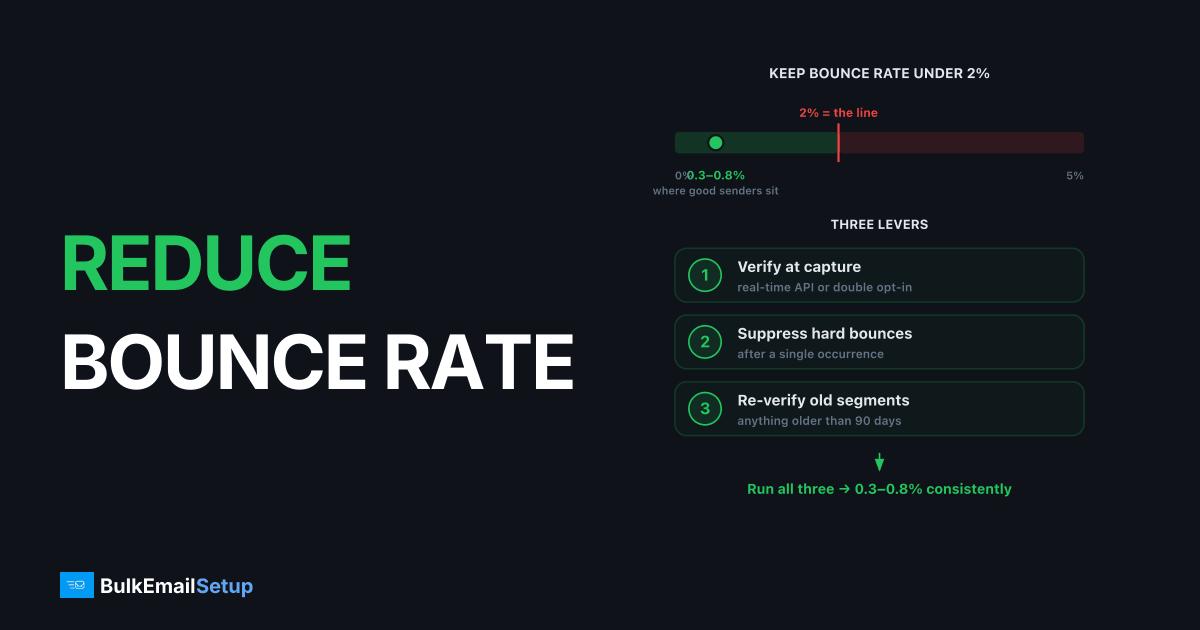
To get your email bounce rate below 2%, do three things: verify addresses at the point of capture (real-time API or double opt-in), suppress every hard bounce after a single occurrence, and re-verify any segment older than 90 days before mailing it. Senders who run all three consistently sit at 0.3-0.8%, well inside every mailbox provider's tolerance.
Why 2% is the line
Mailbox providers read bounce rate as a list-quality signal. A sender hitting unknown addresses at scale looks like someone who bought, scraped, or never cleaned a list.
| Bounce rate | How providers read it | What happens |
|---|---|---|
| < 0.5% | Well-managed list | Full sending speed |
| 0.5-2% | Normal decay | No action, but watch the trend |
| 2-5% | Stale or careless list | Throttling, partial bulk-foldering |
| 5-10% | Likely purchased/scraped | Heavy deferrals, reputation damage |
| > 10% | Spam-like behavior | Blocks, possible blacklisting |
During IP warm-up the tolerance is tighter, a 2% bounce day on a cold IP can stall the entire ramp.
Know your bounce types
| Type | SMTP code | Meaning | Action |
|---|---|---|---|
| Hard bounce | 550, 551, 553 | Address/domain doesn't exist | Suppress immediately, permanently |
| Soft bounce | 421, 450, 452 | Mailbox full, server busy, greylisting | Retry 48-72h; suppress after 3-5 consecutive campaigns |
| Block bounce | 554, custom | Your IP/domain rejected by policy | Stop, diagnose reputation, don't retry blindly |
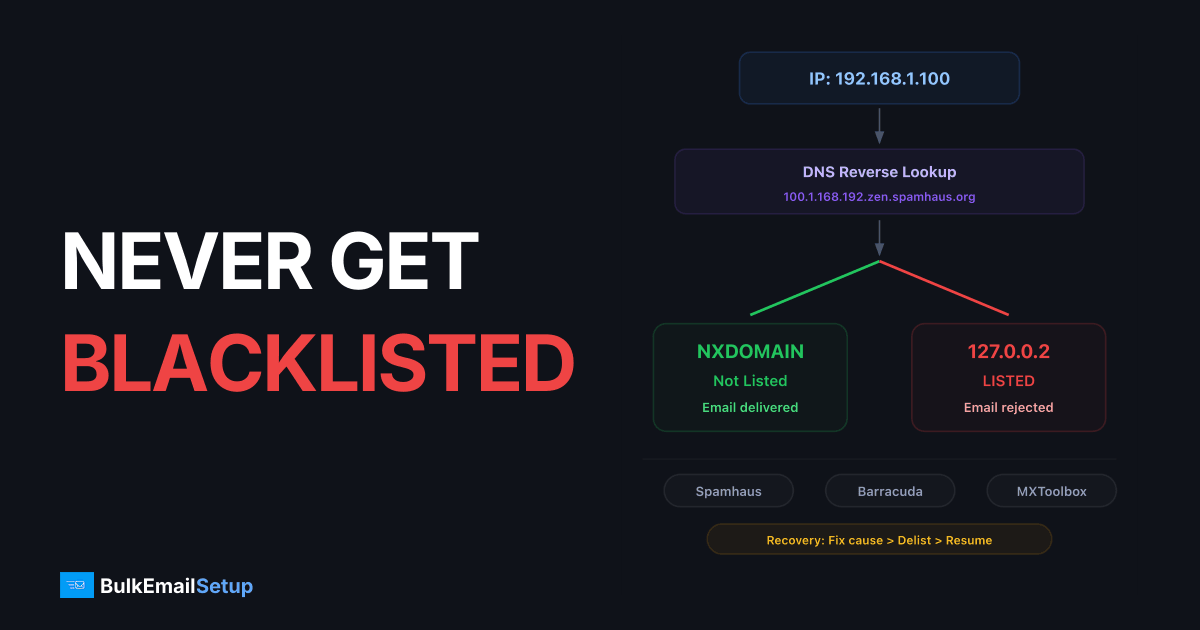
Block bounces are the dangerous ones to misread. Retrying a 554 from Microsoft at full volume digs the hole deeper; the fix is reputation repair, not redelivery. If blocks persist, see how to send without getting blacklisted.
Fix 1: Verify at the point of capture
Bad addresses are cheapest to stop before they enter the list.
- Real-time verification API on signup forms, checks syntax, MX records, and mailbox existence in ~200-500ms. Blocks typos like gamil.com and dead domains at the door.
- Double opt-in, the confirmation click proves the mailbox exists and the owner wants mail. Cuts bounce-prone signups to near zero.
- Typo correction prompts, "Did you mean @gmail.com?" catches the 1-2% of signups with domain typos.
Double opt-in costs you 15-25% of raw signups but the addresses you lose were mostly worthless, fake, mistyped, or never going to engage.
Fix 2: Suppress hard bounces instantly and permanently
One hard bounce is enough. The address does not exist; mailing it again is a pure negative signal.
- Parse SMTP responses (or your provider's webhook) and write 5xx addresses to a suppression list the same day.
- Make the suppression list global, across every campaign, system, and team that sends.
- Never re-import suppressed addresses. CSV re-uploads that bypass suppression are the most common cause of recurring bounce spikes.
Watch for resurrected addresses too: Yahoo and others recycle abandoned mailboxes into spam traps. An address that hard-bounced last year and "works" today is a trap candidate, not a recovered subscriber.
Fix 3: Re-verify before mailing old segments
Addresses decay at roughly 2-3% per year for consumer lists and 20-30% per year for B2B (people change jobs; the mailbox dies).
| Segment age since last successful send | Action before mailing |
|---|---|
| < 90 days | Send normally |
| 90 days - 1 year | Run through verification; drop invalids |
| 1-2 years | Verify + send a re-permission email first |
| > 2 years | Verify + re-permission; expect to keep < 50% |
The full cleaning workflow, including catch-all and role-account handling, is in our email list cleaning guide.
Fix 4: Handle soft bounces with a retry budget
Soft bounces deserve patience, but bounded patience.
- Retry schedule: 15 min → 1 h → 4 h → 12 h → 24 h, give up at 72 h.
- Track consecutive soft bounces per address. At 3-5 straight campaigns, suppress, a perpetually full mailbox is an abandoned mailbox.
- Greylisting (a first-attempt 450 that succeeds on retry) is normal and not a list problem.
Fix 5: Don't let infrastructure create fake bounces
Some "bounces" are your setup, not the list:
- Missing or failing authentication. Gmail and Yahoo reject unauthenticated bulk mail outright since their 2024 sender requirements. SPF, DKIM, and DMARC are mandatory; setup guide here.
- No reverse DNS (PTR) on your sending IP, many servers 550 on this alone.
- Sending faster than provider connection limits, bursts get 421-deferred; smooth your send over hours instead of minutes.
Weekly monitoring routine
- Check bounce rate per campaign and per mailbox provider, a Microsoft-only spike means a Microsoft-specific problem.
- Alert at 2% overall or any single-provider rate over 4%.
- Review block bounces (554s) manually every week; they are early blacklist warnings.
- Audit that suppression sync is working, count suppressed addresses that received mail (should be zero).
How BulkEmailSetup helps
Our dedicated SMTP servers handle bounce processing automatically, hard bounces are suppressed in real time, soft-bounce retries follow a sane schedule, and we alert you before a bounce trend turns into a reputation problem. See plans and pricing.
Frequently asked questions
What is a good email bounce rate?
Under 2% is acceptable, under 1% is good, and under 0.5% is what well-run programs hit. Sustained rates above 2% trigger throttling and reputation damage at Gmail and Microsoft.
What's the difference between a hard bounce and a soft bounce?
A hard bounce (5xx) is permanent, the address doesn't exist or the domain is dead, and must be suppressed immediately. A soft bounce (4xx) is temporary, like a full mailbox or greylisting, and can be retried.
Should I remove soft bounces from my list?
Not immediately. Retry soft bounces for 48-72 hours, but suppress any address that soft-bounces on 3-5 consecutive campaigns, repeated soft bounces usually mean an abandoned mailbox.
Do purchased email lists cause high bounce rates?
Yes, reliably. Purchased lists typically bounce at 10-30% and contain spam traps, which damage your sender reputation far beyond the bounce metric itself. No verification service makes a purchased list safe.
How often should I verify my email list?
Re-verify any segment you haven't mailed in 90+ days before sending to it, and run a full list verification every 6 months. Roughly 2-3% of B2C addresses and up to 30% of B2B addresses go stale per year.