
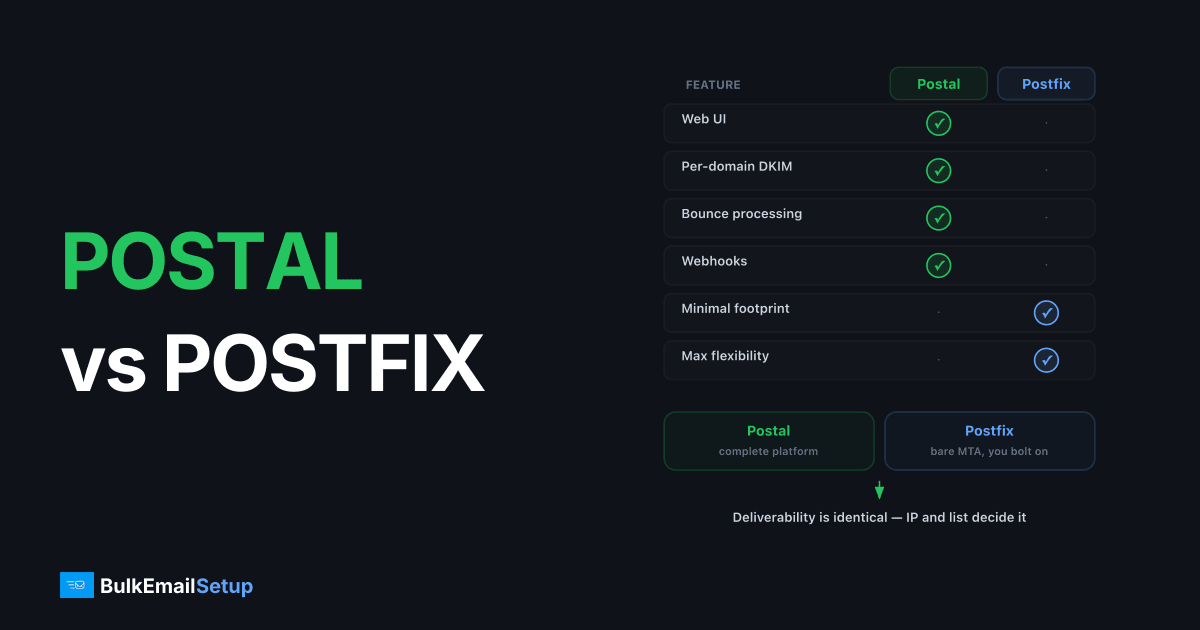
For bulk email sending, Postal is the better choice for most teams: it's a complete sending platform with a web UI, per-domain DKIM, bounce processing, and webhooks included, while Postfix is a bare MTA that needs OpenDKIM, custom bounce parsing, and monitoring bolted on to do the same job. Choose Postfix when you need maximum flexibility, minimal footprint, or already have Postfix expertise in-house. Deliverability is identical on both, that's decided by your IP, your DNS, and your list, not your MTA.
I've run both in production for years. Postfix since the late 2000s, Postal since around 2018. The practical comparison.
What each one actually is
This matters because they're not the same category of software.
Postfix is a mail transfer agent, the engine that accepts and delivers SMTP. It's been in production since 1998, runs a large share of the world's mail, and is as stable as software gets. It has no UI, no API, no concept of "campaigns" or "message history" beyond logs.
Postal is a bulk-sending platform that happens to include its own MTA. Think "self-hosted Mailgun": web dashboard, HTTP API, SMTP credentials per organization, click/open tracking, bounce parsing, webhooks, suppression lists. It's Ruby, backed by MariaDB.
Head-to-head
| Factor | Postal | Postfix |
|---|---|---|
| Category | Sending platform | Mail transfer agent |
| Web UI | Yes, built in | No |
| HTTP API | Yes | No (SMTP only) |
| DKIM signing | Built in, per domain | Via OpenDKIM (separate setup) |
| Bounce handling | Parsed and webhooked automatically | Logs only; you build parsing |
| Click/open tracking | Built in | You build it |
| Suppression lists | Built in | You build it |
| Multiple IPs / IP pools | Supported in UI | Supported via transport maps (config files) |
| Resource footprint | Moderate (Ruby + MariaDB) | Tiny |
| Maturity / track record | ~10 years | 25+ years |
| Setup time for bulk sending | 2-4 hours | 8-20 hours for an equivalent stack |
| Community / docs | Smaller, decent docs | Enormous, every problem already answered |
Where Postal wins
The out-of-box experience for bulk sending is the whole pitch. Within an afternoon you have an API endpoint, SMTP credentials for tools like MailWizz, DKIM keys generated per sending domain with the DNS records displayed for you, and bounces flowing back as parsed webhooks instead of cryptic log lines.
The message history UI alone justifies it for teams. "Did the email to customer X deliver?" is a search box in Postal and a grep expedition through /var/log/mail.log in Postfix.
IP pools are configured in the interface, assign different sending IPs to different organizations or message streams without touching transport maps.
Where Postfix wins
Stability and footprint. Postfix runs for years untouched on 512MB of RAM. Postal drags along Ruby, MariaDB, and a worker-process architecture; upgrades occasionally need migration attention, and I've had its queue require manual intervention under disk-full conditions where Postfix would have paused gracefully.
Flexibility. Anything is possible in Postfix: header rewriting, content filters, complex routing policies, milter integrations. Postal does what Postal does.
Knowledge base. Twenty-five years of mailing lists and Stack Overflow answers mean every Postfix error message has been solved publicly. Postal's community is helpful but small, some problems you debug alone reading Ruby source.
Edge cases at very high volume. Postal handles millions/month fine, but the largest self-hosted senders I know run tuned Postfix (or Haraka/PowerMTA-class tools) because queue behavior under sustained 100K+/day load is more predictable.
What neither one solves
The MTA is maybe 20% of successful bulk sending. The other 80% is identical regardless of choice:
- A clean dedicated IP with proper rDNS.
- SPF, DKIM, and DMARC actually aligned.
- A warm-up plan, weeks of ramped volume before full sending.
- Blacklist monitoring and a delisting process.
- List hygiene so your bounce rate doesn't torch the reputation you built.
Get those wrong and the world's best-configured Postal install delivers straight to spam. The full checklist lives in how to set up an SMTP server for bulk email.
Recommendation by scenario
| Scenario | Pick |
|---|---|
| Connecting MailWizz/Mautic to your own server | Postal, it's built for exactly this |
| Need API + dashboard, small team, no Postfix veteran | Postal |
| Existing Postfix expertise, custom routing needs | Postfix |
| Minimal-footprint relay on a tiny VPS | Postfix |
| Millions/day, dedicated mail-ops staff | Tuned Postfix or commercial MTA |
If you're pairing the server with a campaign tool, the MailWizz SMTP setup guide shows the sending-server side of that configuration. And if reading this whole comparison made you tired, that's useful data too, the cost math on outsourcing the ops is in self-hosted SMTP vs ESP at 1M emails.
How BulkEmailSetup helps
BulkEmailSetup deploys and manages dedicated SMTP servers. Postal-based stacks with warmed IPs, authentication configured, and blacklists monitored, so you get the open-source economics without becoming the mail admin. Flat monthly pricing, details on the pricing page.
Frequently asked questions
Is Postal better than Postfix for bulk email?
For bulk sending specifically, Postal is usually the better starting point, it ships with a web UI, per-domain DKIM, bounce processing, and webhooks out of the box. Postfix is the more battle-tested MTA but needs significant assembly to match those features.
Is Postal mail server free?
Yes. Postal is open source under the MIT license. You pay only for the server it runs on, typically a $20-40/month VPS for serious sending.
Can Postfix handle bulk email sending?
Absolutely. Postfix powers some of the largest mail systems in the world. But bulk-sending features like per-stream rate limiting, bounce parsing, and reporting require additional tooling (OpenDKIM, custom scripts, log parsers) that Postal includes natively.
What are the server requirements for Postal?
Postal needs MariaDB and runs comfortably on a 2-4 core VPS with 4-8GB RAM for hundreds of thousands of emails a month. Postfix alone is lighter, but a comparable full stack ends up with similar requirements.
Do Postal and Postfix have deliverability differences?
No. Inbox placement depends on IP reputation, authentication (SPF, DKIM, DMARC), list quality, and warm-up, not which MTA delivers the message. Both speak the same SMTP to receiving servers.


