
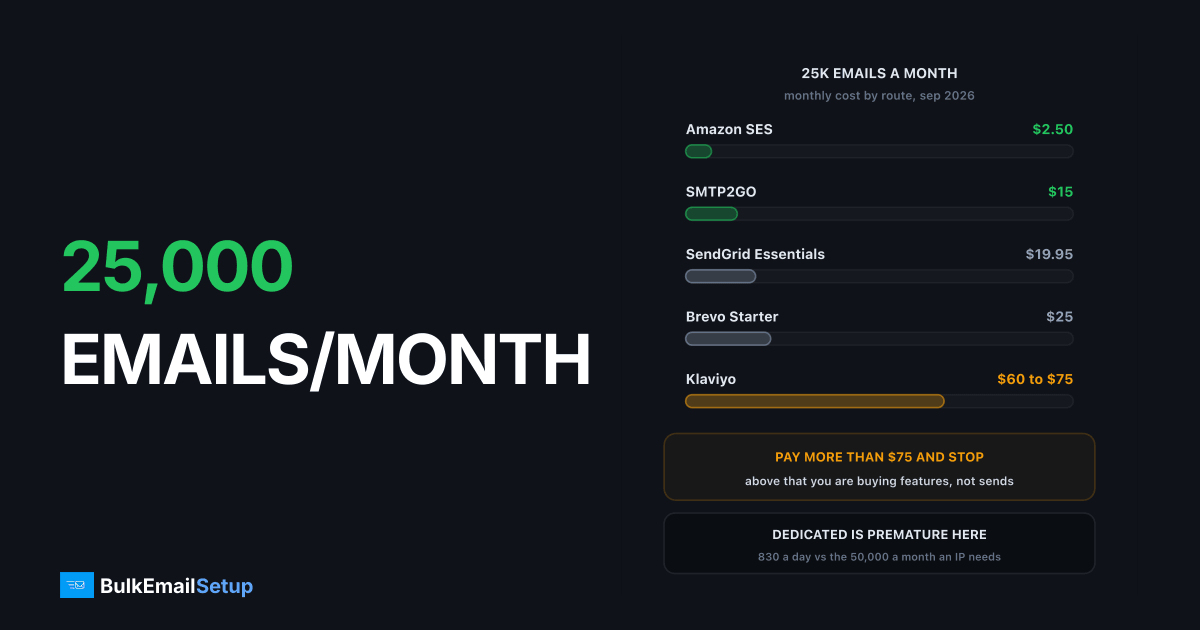
Sending 25,000 emails a month costs between about $3 and $75, and at this volume you are in the cheapest and most competitive part of the market. Amazon SES charges $0.10 per 1,000 on its a la carte rate, so $2.50 in send fees. Mid-market relays land at $15 to $35. Full marketing platforms run $30 to $75. If you are paying more than $75, you are buying features rather than sending capacity.
This is also the tier where a dedicated SMTP server is the wrong answer, and it is worth being clear about why. 25,000 a month is about 830 emails a day. A dedicated IP wants ten times that to stay warm.
What each route costs at 25,000 a month
Prices checked against the vendors' own pricing pages in September 2026. Relay tiers move, so treat these as close rather than exact.
| Provider | Plan at 25K/month | Monthly cost | Dedicated IP | Campaign builder |
|---|---|---|---|---|
| Amazon SES | A la carte, $0.10 per 1,000 | ~$2.50 | +$24.95/mo | No |
| SMTP2GO | 40K tier | ~$15 | Higher plans only | Basic |
| Mailgun Basic | 50K tier | ~$20 | +$59/mo | No |
| Brevo Starter | 20K to 40K credits | ~$25 | +$45 to $60/mo | Yes |
| MailerLite Growing Business | ~2,500 contacts | ~$25 to $30 | Not offered | Yes |
| SendGrid Essentials | 50K tier | ~$19.95 | Not on Essentials | Marketing add-on |
| Mailchimp Standard | ~6,250 contacts | ~$45 to $60 | Not offered | Yes, best in class |
| Klaviyo | ~6,250 profiles | ~$60 to $75 | Not offered | Yes |
| Dedicated SMTP server | Basic, 25K/day, 3 IPs | $549 one-time | 3 included | Bring your own |
The spread between SES at $2.50 and Klaviyo at $70 is not a value judgment. SES sends mail and nothing else, at $0.10 per 1,000 on the a la carte plan. Klaviyo gives you a builder, flows, segmentation, e-commerce integrations and a support team. At this volume the absolute difference is under $70 a month, so pick on features.
Two structural notes. SendGrid's Essentials tier starts at $19.95 and covers 50,000 emails, so 25,000 sends buy you a plan with 25,000 emails of headroom you never touch. And Mailchimp and Klaviyo bill on contacts, not sends, so their figures assume a list of about 6,250 mailed four times a month. Mail the same list twice and the bill stays identical.
What a year costs, and the per-1,000 rate
Monthly figures at this size are small enough that people stop doing the arithmetic. Twelve months makes the gaps visible.
| Route | Monthly | 12-month total | Effective per 1,000 |
|---|---|---|---|
| Amazon SES, no dedicated IP | $2.50 | $30 | $0.10 |
| SMTP2GO | ~$15 | ~$180 | $0.60 |
| SendGrid Essentials | ~$19.95 | ~$239 | $0.80 |
| Mailgun Basic | ~$20 | ~$240 | $0.80 |
| Brevo Starter | ~$25 | ~$300 | $1.00 |
| MailerLite | ~$28 | ~$336 | $1.12 |
| Amazon SES + dedicated IP | ~$27.45 | ~$329 | $1.10 |
| Mailchimp Standard (6,250 contacts) | ~$50 | ~$600 | $2.00 |
| Klaviyo (6,250 profiles) | ~$70 | ~$840 | $2.80 |
| Dedicated SMTP server (Basic) | $549 once | $549 + hosting | ~$2.20 year one |
That last row is the whole point. At 25,000 a month the $549 server has a worse per-1,000 rate than everything except Klaviyo, because a one-time fee spread across 300,000 emails a year is expensive per head. The same $549 across 3 million emails a year is $0.18 per 1,000, which is why the 250,000 a month breakdown reaches the opposite conclusion.
Note also that SES with a dedicated IP costs eleven times bare SES, and buys you an IP you cannot keep warm at this volume. Paying $24.95 a month to make delivery worse is a real risk at 25,000.
Where the free tiers actually end
People arrive at this volume from a free plan and want to know how much longer they can stay. The honest answer is not much longer.
| Provider | Free allowance | Monthly equivalent | Limit that bites |
|---|---|---|---|
| Brevo | 300 emails a day | ~9,000 | Daily cap, not monthly |
| Mailchimp | 500 contacts, 1,000 sends a month | 1,000 | Contact cap hits first |
| MailerLite | 1,000 subscribers, 12,000 sends a month | 12,000 | Subscriber cap |
| SendGrid | 100 a day for 60 days | ~3,000, then nothing | Trial expires |
| Amazon SES | $200 AWS credit for new accounts, 12 months | Covers 2M sends once | One-off credit, not a tier |
| Mailgun | Trial credits only | Short-lived | No permanent free tier |
None of the reputable providers cover a full 25,000 a month free on an ongoing basis. The practical ceiling is around 9,000 to 12,000 on Brevo or MailerLite, which is where most senders start paying. Amazon SES is the odd one out: the $200 of AWS free tier credit for a new account covers 2 million sends at the a la carte rate, so a new AWS account genuinely sends 25,000 a month free for years, but that is a credit balance running down, not a permanent tier.
If you are hitting the wall right now, outgrew your free tier, what next walks the options in order.
Why dedicated infrastructure is wrong here
This comes up because people read about dedicated IPs and assume more control is always better. At 25,000 a month it is not.
Dedicated IPs need volume to stay warm. Receiving networks build trust from consistent sending. An IP pushing 25,000 a month, spread across two or three campaign days, sends nothing for most of the month. That inconsistency reads as suspicious, and the IP never builds the reputation a busy shared pool already has.
| Setup | Daily volume | What happens |
|---|---|---|
| Shared pool at 25K/month | ~830/day | Established reputation, works immediately |
| Dedicated at 25K/month | ~830/day | Never fully warms, worse delivery |
| Dedicated at 100K/month | ~3,300/day | Warms, holds, marginal against shared |
| Dedicated at 250K/month | ~8,300/day | Reputation is yours and stays warm |
The rule of thumb I use is 50,000 emails a month of steady traffic as the floor for a warm dedicated IP. 25,000 is half that, and worse, it is usually bursty rather than steady. The crossover where dedicated starts winning is roughly 100,000 a month, and it is clear by 250,000. Below that, a well-managed shared pool genuinely outperforms your own cold IPs.
The cost side says the same thing. $549 against a $25 monthly relay bill is a 22-month payback. Against a $250 bill at 250,000 a month it is month 3. See is a dedicated IP worth it and when do you need a dedicated SMTP server for the full threshold discussion.
The hidden costs at this size
The sticker price is small, so the add-ons are proportionally worse. These are the lines that turn a $20 bill into $60.
| Hidden cost | Who charges it | Typical size at 25K |
|---|---|---|
| Dedicated IP add-on | SES, Mailgun, Brevo | $24.95 to $59 a month, and useless here |
| Tier floor you do not use | SendGrid, Mailgun, SMTP2GO | Paying for 40K to 50K to send 25K |
| Contact-based billing | Mailchimp, Klaviyo | Bill rises with list growth, not sends |
| Email validation | Sold separately almost everywhere | ~$0.80 to $1.20 per 100 checks |
| Overage per 1,000 | Any tiered relay | $1.10 to $1.80 per 1K over plan |
| Your ops time | SES and self-hosted routes | 2 to 5 hours a month |
| Mailer software | Self-hosted routes | Mautic free, MailWizz ~$99 one-time |
The tier floor is the one that defines this volume. Nearly every relay's smallest paid plan covers 40,000 to 50,000 emails, so at 25,000 you are buying roughly double what you send. That is why the effective per-1,000 rate in the table above is $0.60 to $1.00 for providers whose headline rate at 1 million is a fifth of that.
The ops-time line is the one people underprice on the SES route. SES send fees are $2.50, but you own bounce processing, complaint handling and the campaign layer. At $50 an hour, three hours a month is $150, sixty times the send fee. Hidden costs of ESP overage fees covers the rest of the small print.
What to spend money on instead
At this volume, the things that actually move delivery are free or cheap.
Authentication. SPF, DKIM and DMARC on your sending domain. Costs nothing, and missing DKIM alone will hurt you more than any provider choice at this size. Google's bulk sender requirements apply from 5,000 messages a day to Gmail, so at 830 a day you are under the formal threshold, but the same alignment rules are what shared pools enforce anyway. See SPF vs DKIM vs DMARC.
List hygiene. Removing hard bounces and 12-month non-openers improves your rates more than switching providers ever will, and on contact-billed platforms like Mailchimp it drops you a tier. Email list cleaning covers the process.
A sending subdomain. Keep marketing mail off the domain your invoices go out on, so a bad campaign cannot damage transactional delivery.
Google Postmaster Tools. Free, and it tells you your actual Gmail reputation rather than guessing. Aim to keep the complaint rate under 0.1% against Google's 0.3% hard line. Setup guide.
Those four together are worth more than the difference between any two providers on the table above.
Who should pick which
| Your situation | Route | Cost at 25K |
|---|---|---|
| App sends transactional mail, engineers on staff | Amazon SES | ~$2.50/mo |
| Bulk sending from your own tool, want simple reporting | SMTP2GO | ~$15/mo |
| Developer-led sending, want API and detailed logs | Mailgun Basic | ~$20/mo |
| Mixed transactional and marketing, one vendor | SendGrid Essentials | ~$19.95/mo |
| Small marketing team, need a builder and automation | Brevo or MailerLite | ~$25 to $30/mo |
| E-commerce, need flows and product blocks | Klaviyo or Mailchimp | ~$50 to $75/mo |
| Steady 100K a month or more, want your own IPs | Dedicated SMTP server | $549 once |
The only wrong answer at this size is overpaying for a platform you do not open. If you log into Mailchimp once a month to send a newsletter, you are paying $50 for something SMTP2GO does for $15.
When to revisit this decision
Re-run the numbers when any of these happen.
- You pass roughly 100,000 emails a month, about 3,300 a day
- Your bill crosses $150 a month
- A shared-pool suspension interrupts a campaign
- You need to separate transactional from marketing streams onto different IPs
- Your use case starts running into provider policy limits
Until then, pick the cheapest option whose features you actually need, authenticate properly, and keep the list clean. How many emails before you need dedicated infrastructure has the full threshold table if you want to know exactly where the line sits for your sending pattern.
How BulkEmailSetup helps
Honestly, at 25,000 a month you probably do not need us yet. Dedicated infrastructure makes sense from around 100,000 a month, and below that a shared relay plus good authentication will serve you better. A $549 build against a $20 relay bill is a two-year payback, and that is not an argument.
When you do cross that line, Basic starts at $549 one-time covering 1 SMTP server, 3 dedicated IPs, 25,000 emails/day and unlimited contacts, which is roughly 30 times this monthly volume. Higher tiers scale to 15 IPs and 200,000 emails/day. See pricing, or what 100,000 emails a month costs for the tier where the decision actually changes.
Frequently asked questions
How much does it cost to send 25,000 emails a month?
Between roughly $3 and $75 a month. Amazon SES charges $0.10 per 1,000 on its a la carte rate, so $2.50 in send fees, mid-market relays like SMTP2GO and Mailgun sit around $15 to $35, and full marketing platforms with a builder and automation run $30 to $75 depending on list size. This is the cheapest tier in the market, so paying more than $75 means you are buying features rather than sending.
Is 25,000 emails a month enough to need a dedicated IP?
No. A dedicated IP needs roughly 50,000 emails a month of steady traffic to hold its reputation, and 25,000 spread across two or three campaign days is well under half that. A cold or under-used dedicated IP performs worse than a well-managed shared pool. The threshold where dedicated starts making sense is around 100,000 a month, and it is decisive by 250,000.
What is the cheapest way to send 25,000 emails a month?
Amazon SES at $2.50 in send fees on the $0.10 per 1,000 a la carte rate, if you already have engineering capacity and only need raw sending. It includes no campaign builder, list management or bounce dashboard, so the real cost is the developer time to build around it. For most senders at this size a $15 to $35 relay or platform is better value.
Do free email tiers cover 25,000 emails a month?
Not on an ongoing basis. Brevo's free plan allows 300 emails a day, about 9,000 a month. Mailchimp's free plan stops at 500 contacts and 1,000 sends a month. SendGrid's free trial is 100 emails a day for 60 days only. Expect to start paying somewhere between 5,000 and 9,000 emails a month.
Should I use a marketing platform or an SMTP relay at this volume?
A platform if you need the campaign builder, automation and signup forms, which most marketing senders do. A relay if you are sending from your own application and already have the campaign layer. At 25,000 a month the gap between them is about $20 a month, small enough that feature fit should decide, not price.
What is the effective cost per 1,000 emails at this volume?
From $0.10 on Amazon SES to $2.40 on Mailchimp Standard with 6,250 contacts. SMTP2GO lands around $0.60, Mailgun around $0.80 and SendGrid Essentials around $0.80 once you divide the $19.95 plan by 25,000 sends. Small monthly plans always show a high per-1,000 rate because you are paying for a tier floor, not for your actual sends.
At what volume does a dedicated SMTP server start to make sense?
Around 100,000 emails a month, and clearly by 250,000. A $549 one-time server against a $25 relay bill takes 22 months to pay back, which is not a real argument. Against a $250 relay bill at 250,000 a month it pays back in month 3, which is.


