
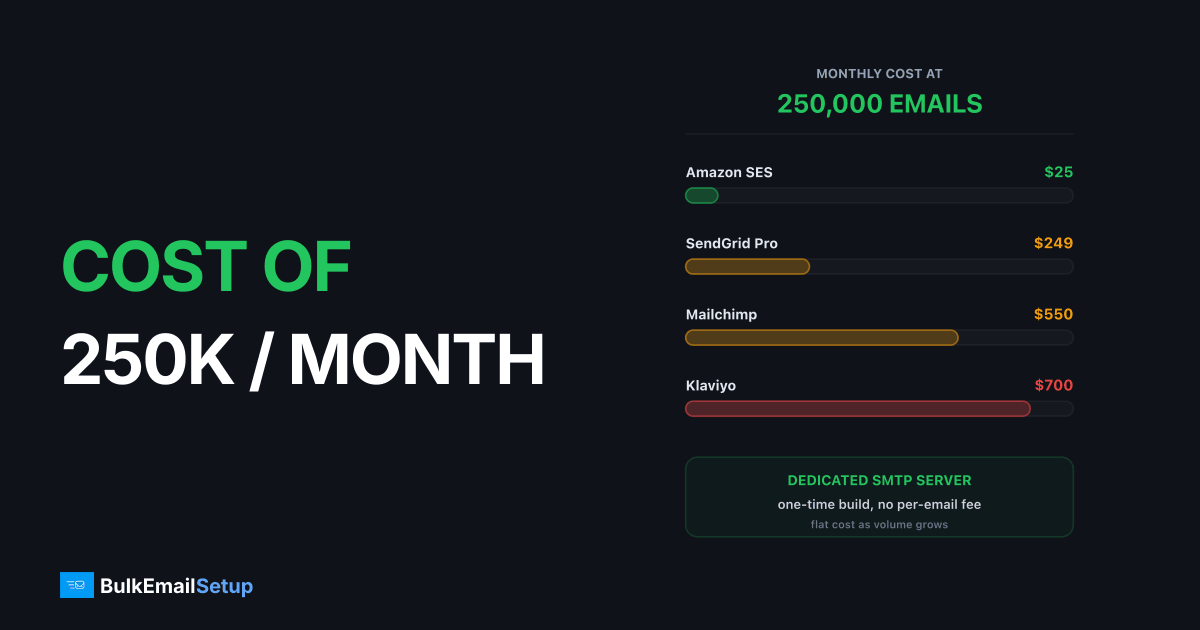
Sending 250,000 emails a month costs about $25 in send fees on Amazon SES, $250 on Mailgun or SendGrid, $200 to $300 on SMTP2GO or Brevo, and $500 to $700 or more on Mailchimp or Klaviyo once your list reaches 60,000 contacts. A dedicated SMTP server is $549 one-time and carries 250K in about 10 sending days at 25,000 a day. This is the volume where the two models cross: a shared relay bill of $250 a month pays for the server in under a quarter.
I've run sends at this tier through most of the routes below. Here's what each one costs, what the pricing pages skip, and where the break-even actually falls.
The cost to send 250000 emails a month, route by route
Prices checked against the vendors' own pricing pages in September 2026. Tiers move, so treat the relay figures as close rather than exact.
| Provider | Plan at 250K/month | Monthly cost | Dedicated IP | Overage |
|---|---|---|---|---|
| Amazon SES | Pay as you go, $0.10 per 1,000 | ~$25 | +$24.95/mo | None, metered |
| SMTP2GO | 250K tier | ~$200-250 | Higher plans only | Per 1K over plan |
| Mailgun Foundation | $35 + 200K overage at $1.30/1K | ~$295 | +$59/mo | $1.30 per 1K |
| Mailgun Scale | $90 + 150K overage at $1.10/1K | ~$255 | 1 included | $1.10 per 1K |
| SendGrid Pro | 300K tier | ~$249 | 1 included on Pro | Per 1K over plan |
| Brevo Business | 250K email credits | ~$250-350 | +$45-60/mo | Buys more credits |
| Mailchimp Standard | ~60K contacts | ~$500-600 | Not offered | Contact overage |
| Klaviyo | ~60K contacts | ~$700+ | Not offered | Contact overage |
| Dedicated SMTP server | Basic, 25K/day, 3 IPs | $549 one-time | 3 included | None |
Two things stand out. Mailgun's Scale plan is cheaper than Foundation at this volume because the overage rate is lower and it bundles an IP, which is the sort of tier trap you only spot by doing the arithmetic. And the marketing platforms cost two to three times what the relays cost for the same 250K sends, because they bill on list size and the sends are almost incidental.
The Amazon SES pricing page is the one worth bookmarking, since SES is the floor every other relay is measured against.
What a year costs on each route
Monthly figures hide the crossover. Twelve months is where a one-time fee and a subscription actually compete.
| Route | Monthly | 12-month total | Per 1,000 emails (year) |
|---|---|---|---|
| Amazon SES, no dedicated IP | $25 | $300 | $0.10 |
| Amazon SES + dedicated IP | $50 | $600 | $0.20 |
| SMTP2GO | ~$225 | ~$2,700 | $0.90 |
| SendGrid Pro | ~$249 | ~$2,988 | $1.00 |
| Mailgun Scale | ~$255 | ~$3,060 | $1.02 |
| Brevo Business + IP | ~$300 | ~$3,600 | $1.20 |
| Mailchimp Standard | ~$550 | ~$6,600 | $2.20 |
| Klaviyo | ~$700 | ~$8,400 | $2.80 |
| Dedicated SMTP server (Basic) | $549 once | $549 | $0.18 |
Over a year the dedicated server costs less than SES with a dedicated IP, and it's a tenth of what SendGrid or Mailgun charge. The 500K tier widens that gap further, which I covered in cost to send 500,000 emails per month. At 100K the picture is closer and SES still wins on cash, as the 100K breakdown shows. 250K is the tier where it flips.
Where the $549 breaks even against each route
Divide $549 by the monthly bill you'd otherwise pay and round up.
| Compared against | Monthly bill | Break-even month |
|---|---|---|
| Klaviyo (~$700) | $700 | Month 1 |
| Mailchimp (~$550) | $550 | Month 1 |
| Brevo + dedicated IP (~$300) | $300 | Month 2 |
| Mailgun Scale (~$255) | $255 | Month 3 |
| SendGrid Pro (~$249) | $249 | Month 3 |
| SMTP2GO (~$225) | $225 | Month 3 |
| Amazon SES + dedicated IP ($50) | $50 | Month 11 |
| Amazon SES bare ($25) | $25 | Month 22 |
Against anything that isn't SES, the server is paid off inside one quarter. Against SES the payback takes most of a year on cash alone, which is why the SES comparison is really a comparison of your time, not your invoice. The full argument is in Amazon SES vs a dedicated SMTP server.
The hidden costs at 250K
The sticker is never the bill. These are the lines that turn up after you've signed.
| Hidden cost | Who pays it | Typical size |
|---|---|---|
| Dedicated IP add-on | SES, Mailgun Foundation, Brevo | $24.95 to $59 per IP per month |
| Overage per 1,000 | Every relay with a tier | $1.10 to $1.80 per 1K over plan |
| Contact-based pricing | Mailchimp, Klaviyo | Bill rises with list size, not sends |
| Second IP for stream separation | Any route with one IP | Another $25 to $59 a month on relays |
| Mailer software | Self-hosted and dedicated routes | Mautic free, MailWizz ~$99 one-time |
| Your ops time | SES, self-hosted, dedicated | 5 to 15 hours a month on SES, 1 to 3 on managed |
| Email validation | Sold separately almost everywhere | ~$0.80 to $1.20 per 100 checks |
The overage line is the one that bites at 250K specifically. A launch month that pushes 250K to 350K costs an extra $110 to $180 on Mailgun before you notice. On a flat plan or a one-time server, the same spike costs nothing, provided you stay under the daily ceiling.
The ops-time line is the one people underprice. If you go SES or self-hosted, you own warm-up, bounce processing, feedback loops and blocklist monitoring. At $50 an hour, 10 hours a month is $500, ten times the SES send fee. A dedicated server with the DNS, MTA tuning and warm-up done for you cuts that to an hour or two of watching Postmaster Tools.
Deliverability at 250K a month
At this volume the question isn't whether shared pools work. They do, as long as your complaint rate stays under 0.1% at Gmail. Google's published limit in its sender guidelines is 0.3%, but every shared relay acts well before that line because your complaints land on IPs their other customers use.
The question is whether a dedicated IP can stay warm, and at 250K the answer is comfortably yes.
| Factor | Threshold | 250K/month spread daily |
|---|---|---|
| Volume to keep a dedicated IP warm | ~50,000/month steady | ~8,300/day, 5x the floor |
| Gmail complaint rate | 0.3% hard line, 0.1% target | Same on any route |
| Sending days at 25K/day | 10 days at full tilt | 20 days of slack for spikes |
| Per-IP daily ceiling to Gmail, warmed | ~60K to 80K before deferrals | Not a constraint |
| Warm-up to full volume on new IPs | 4 to 8 weeks | Ramp ~30% every 2 days |
Three IPs on the Basic tier also lets you split streams: one for marketing, one for transactional, one spare or for a second brand. A complaint spike on the newsletter never touches your receipts. Whether the dedicated IP is worth it at your volume is a separate question, and I answered it in is a dedicated IP worth it.
Reputation stays attached to your domain regardless of route. A 0.4% complaint rate on Mailgun follows you to a dedicated server, so fix the list before you move, not after.
Who should not go dedicated yet
The break-even table makes the server look like a no-brainer, and for steady senders it is. Three groups should wait.
Bursty senders. If your 250K arrives as two 125K blasts a month and nothing in between, a dedicated IP goes cold between sends and you re-warm each time. A shared relay's pool absorbs that pattern. Move once you can pace sends across at least 15 days a month, or use the 3 IPs to spread the burst.
No ops time at all. A managed server removes the hard parts, but someone still needs to read the bounce reports weekly and check Postmaster Tools. If nobody on the team will do even that hour, a relay that emails you when things break is the safer buy, even at $250 a month.
Volume that might halve. If 250K is a seasonal peak and the baseline is 40K, you're below the 50K warm-IP floor for most of the year. SES at $4 for a 40K month is hard to beat, and the dedicated infrastructure threshold guide explains why volume stability matters more than the peak.
Everyone else at 250K steady is paying a $250 subscription for infrastructure they could own for two months of that bill.
Picking the route
| Your situation | Route | Cost at 250K |
|---|---|---|
| Engineering team, AWS skills, time to own deliverability | Amazon SES + dedicated IP | ~$50/mo |
| Want the fastest drop-in swap, moderate volume | SMTP2GO | ~$225/mo |
| Need good logs and an API, accept the tier jumps | Mailgun Scale | ~$255/mo |
| Marketing team living in a campaign builder, small list | Brevo | ~$300/mo |
| Large list, need the platform's automation, budget is flexible | Klaviyo or Mailchimp | $550-700+/mo |
| Steady 250K, want your own IPs and no meter | Dedicated SMTP server | $549 once |
If you're on Mailgun or SendGrid today at this volume, the honest arithmetic is that you'll have spent the price of the server by Christmas and still owe next year's $3,000.
How BulkEmailSetup helps
We build dedicated SMTP infrastructure you own: your own server, your own IPs, SPF/DKIM/DMARC/PTR configured, MTA tuned, bounce handling wired up and a warm-up plan for the first 4 to 8 weeks. There's no per-email meter and no overage, so a launch month costs what a quiet month costs.
Basic is $549 one-time, covering 1 SMTP server, 3 dedicated IPs, 25,000 emails/day and unlimited contacts, which carries 250K a month with 20 days of headroom. Higher tiers scale to 15 IPs and 200,000 emails/day. See pricing, or compare the year-one maths against your current relay in Amazon SES vs a dedicated SMTP server.
Frequently asked questions
How much does it cost to send 250,000 emails a month?
Between about $25 and $700 a month depending on the route. Amazon SES charges $0.10 per 1,000, so $25 in send fees. Mailgun and SendGrid land around $250. SMTP2GO and Brevo sit in the $200 to $300 band. Mailchimp or Klaviyo with 60,000 contacts costs $500 to $700 or more because they bill per contact. A dedicated SMTP server is $549 one-time with no per-email fee.
What is the cheapest way to send 250,000 emails per month?
On sticker price, Amazon SES at roughly $25 a month, or $50 with a $24.95 dedicated IP. On a 12-month view, a $549 one-time dedicated server is cheaper than every shared relay except SES, and it beats SES too once you value the 5 to 15 hours a month SES makes you spend on warm-up, bounces and monitoring.
When does a $549 dedicated server pay for itself at 250K emails a month?
Against Mailgun or SendGrid at about $250 a month, in month 3. Against SMTP2GO or Brevo, month 3 as well. Against Mailchimp or Klaviyo at $500 to $700, in the first month. Against Amazon SES with a dedicated IP at $50 a month, month 11. After the break-even month the server keeps sending at zero per-email cost.
Do I need a dedicated IP at 250,000 emails a month?
Yes, and the volume supports it. A dedicated IP needs about 50,000 emails a month of steady traffic to keep its reputation warm, and 250,000 spread across the month is roughly 8,300 a day, five times that floor. Shared pools still work at this volume if your complaint rate stays under 0.1%, but you are sharing reputation with strangers.
How many sending days does 250,000 emails take on a 25,000-per-day server?
Ten days at full capacity. Most senders do not run flat out, so a 25,000-a-day server carries 250K a month with room for a launch that doubles a week's volume. If your monthly total is heading toward 500,000 or more, the next tier up gives you more IPs and a higher daily ceiling.
Why do Mailchimp and Klaviyo cost so much more at 250K emails?
They charge by contact, not by email. A list of 60,000 contacts sending four emails a month produces 250,000 sends, and that list size puts you in the $500 to $700-plus tier on both platforms whether you send once or ten times. Relays like Mailgun and SES only meter the sends, which is why they are two to three times cheaper for the same volume.


