
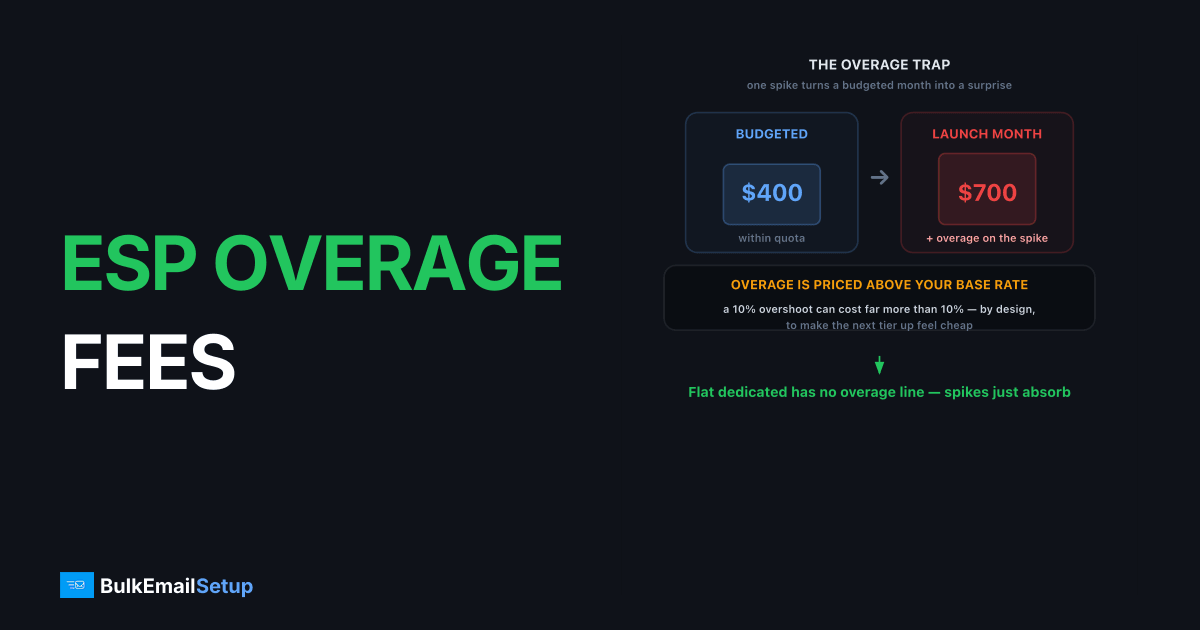
ESP overage fees are charges for sending above your plan's included email quota, usually billed per message at a rate higher than your base plan. They're the hidden cost that turns a budgeted $400 month into a $700 month, because a single launch or seasonal spike pushes you past your tier and meters every extra email at a premium. Flat-rate dedicated SMTP avoids this entirely: the bill is the same whether you send your average volume or a once-a-year spike, so there's no overage line item to absorb.
How do ESP overage fees actually work?
Overage fees kick in the moment your monthly send count passes your plan's included quota, and each extra email is billed separately, often at a rate above your base per-email cost. The structure is deliberate. Overage is priced to make upgrading to the next tier feel cheap by comparison, even when you only spike once a year.
A typical pattern looks like this:
| Scenario | What you pay |
|---|---|
| Within quota | base plan price |
| 10% over quota | base + overage on the extra 10%, at a higher per-email rate |
| Launch-month spike | base + large overage, often more than the next tier up |
| Sustained growth | forced upgrade to a higher tier |
The overage rate being higher than your base rate is the part senders miss. You'd assume the extra emails cost the same as your included ones. They usually don't. The penalty pricing is the mechanism that herds you upward, and it's why a 10% volume overshoot can cost far more than 10% of your bill.
Where do the hidden costs hide on an ESP bill?
The hidden costs hide in three places: overage on volume, per-IP add-ons, and feature gating that forces tier jumps. Each one is reasonable alone, but together they pull your effective cost per email well above the headline rate you compared on the pricing page.
The usual suspects:
- Per-email overage, billed above your quota at a premium rate.
- Dedicated IP add-ons, $20 to $80/month each, needed once you want reputation control.
- Validation and warm-up upsells, sold as separate line items.
- Support and feature gating, where real help or key features sit a tier or two up.
We've seen a team compare ESPs on a $0.0006 headline rate, then discover their real cost was closer to $0.0011 once the dedicated IP, validation, and one overage month were averaged in. The brochure number and the bank statement rarely match at scale. We broke the broader comparison down in cost per email - dedicated SMTP vs ESP.
ESP overage fees are typically billed per email at a rate higher than the base plan, so a single launch-month volume spike can cost more than upgrading to the next tier (provider pricing pages, early 2026). Combined with per-IP add-ons of $20 to $80/month, real effective cost per email at scale routinely exceeds the advertised headline rate.
Why do launch and seasonal months hurt most?
Launch and seasonal months hurt most because overage punishes exactly the spikes your business depends on. A product launch, Black Friday, or a big announcement is when you most want to send, and it's precisely when the per-email meter runs hottest, often triggering throttling at the same time.
That's the double hit. The same spike that blows past your ESP quota can also exceed a mailbox provider's per-IP rate limits, the kind Gmail's bulk sender guidelines describe, so you pay overage and eat deferrals. Your biggest revenue moment becomes your most expensive and least reliable sending day.
A flat plan removes the fee side of that trap. The spike still needs a warmed IP with headroom to land cleanly, but at least the bill doesn't punish you for growing.
How does flat-rate SMTP avoid overage entirely?
Flat-rate dedicated SMTP avoids overage because there is no per-send meter, you pay a fixed monthly price for capacity, not per email. Send your average volume or a launch-day spike within your plan's capacity, and the cost is identical. The pricing model simply doesn't have an overage concept.
This is the structural advantage at scale. Predictable cost, no penalty for growth, and your spikes don't generate surprise line items. The trade-off is honest: you size a plan to your capacity needs, and you still have to send well, since flat pricing doesn't excuse poor list hygiene or skipped authentication. For the full alternative comparison, see is unlimited SMTP real.
How do you audit your own ESP bill for hidden costs?
Audit your ESP bill by pulling twelve months of invoices and separating the base plan from every add-on and overage line, then dividing the total by emails actually sent. The gap between that effective rate and the headline rate you signed up for is your hidden cost, and it's usually larger than expected.
A practical audit in four steps:
- Pull 12 months of invoices, not one average month.
- Separate line items: base plan, dedicated IP add-ons, overage, validation, support.
- Flag every overage month and note what triggered it (launch, season, list import).
- Divide total annual spend by emails sent for your true effective rate.
When senders run this audit, the most common discovery is that one or two overage months account for a disproportionate share of annual spend, often more than a full extra month of base plan. We've watched a sender on a roughly $400 base plan get a single Black Friday invoice near $700, with the extra coming almost entirely from overage on three days of sending, not the other twenty-eight. The headline per-email rate looked fine all year. The peak-month line is where the budget actually broke. The spikes you didn't budget for, not the steady volume, are where the money leaks. Once you see that, flat pricing stops looking like a luxury.
Which sending patterns trigger the worst overage?
The patterns that trigger the worst overage are bursty ones: product launches, seasonal peaks, big list imports, and re-engagement campaigns that fire to a large audience at once. Steady senders rarely get burned. Spiky senders pay the penalty rate exactly when they can least predict it.
The high-risk patterns:
- Launches and announcements, a single large send past your quota.
- Seasonal peaks like Black Friday, where volume multiplies for days.
- Bulk list imports followed by an immediate welcome blast.
- Re-engagement sends, which mail a large dormant segment all at once.
The honest framing: these are the sends that drive revenue, so you can't simply avoid them. The fix isn't sending less, it's a pricing model that doesn't punish your most important campaigns. A flat plan with capacity headroom lets you spike without a penalty, while a warmed IP makes sure the spike actually lands. For the broader cost picture, see SMTP pricing per 1,000 emails compared.
How do you decide between buying headroom and going flat?
Decide by comparing the cost of permanent headroom against your overage exposure. If you buy a tier large enough to absorb your worst month, you pay for unused capacity all year. If you stay on a tight tier, you eat overage during spikes. Flat infrastructure pricing sidesteps the choice, since there's no per-send penalty either way.
A simple decision framework, in order:
- Find your peak month, not your average. Overage is priced off your worst send, not your typical one.
- Price the headroom tier that would have absorbed that peak. That's your "buy headroom" cost, paid every month.
- Price your overage exposure, the premium you'd pay staying on a tight tier through the same peak.
- Compare both to a flat plan sized to your capacity, where neither penalty exists.
| Your sending pattern | Likely cheapest model |
|---|---|
| Steady, predictable volume | Right-sized metered tier |
| Occasional large spikes | Flat-rate dedicated SMTP |
| Frequent launches / seasonal peaks | Flat-rate dedicated SMTP |
| Low volume, rarely over quota | Metered free or entry tier |
The trap is that both ESP options, big tier or overage, charge you for unpredictability. Buy headroom and you pay for capacity you mostly don't use. Stay tight and you pay the penalty when you do. Flat pricing is the only model that doesn't monetize your spikes, which is why bursty senders tend to land there. For the volume-based view of the same math, see SMTP pricing per 1,000 emails compared.
How BulkEmailSetup helps
If overage fees keep ambushing your launch months, a flat-rate dedicated SMTP server removes the per-send meter entirely: one predictable monthly cost, a dedicated IP you control, full SMTP access, and SPF, DKIM, DMARC, and PTR configured correctly. We warm the IP and monitor reputation so your spikes land instead of deferring. See flat plans on our pricing page.
Frequently asked questions
What is an ESP overage fee?
An overage fee is what an ESP charges for emails sent above your plan's included quota. It's usually billed per email at a rate higher than your base plan, so going slightly over your tier costs more per message than staying within it.
Why are ESP overage fees so expensive?
Because they're priced to push you up a tier. Overage rates are often higher than your base per-email cost, so a single busy month can cost more than upgrading would have. The fee is designed to make the next plan look cheap.
How do I avoid ESP overage charges?
Either buy a tier with comfortable headroom above your peak month, or move to flat-rate infrastructure where there's no per-send meter. A flat dedicated SMTP plan charges the same whether you send your average volume or a launch-day spike.
Do overage fees affect deliverability?
Not directly, but the behavior that triggers them sometimes does. A sudden volume spike past your normal pattern can both trigger overage and trip mailbox-provider throttling, so the spike costs you twice: once in fees, once in deferrals.


