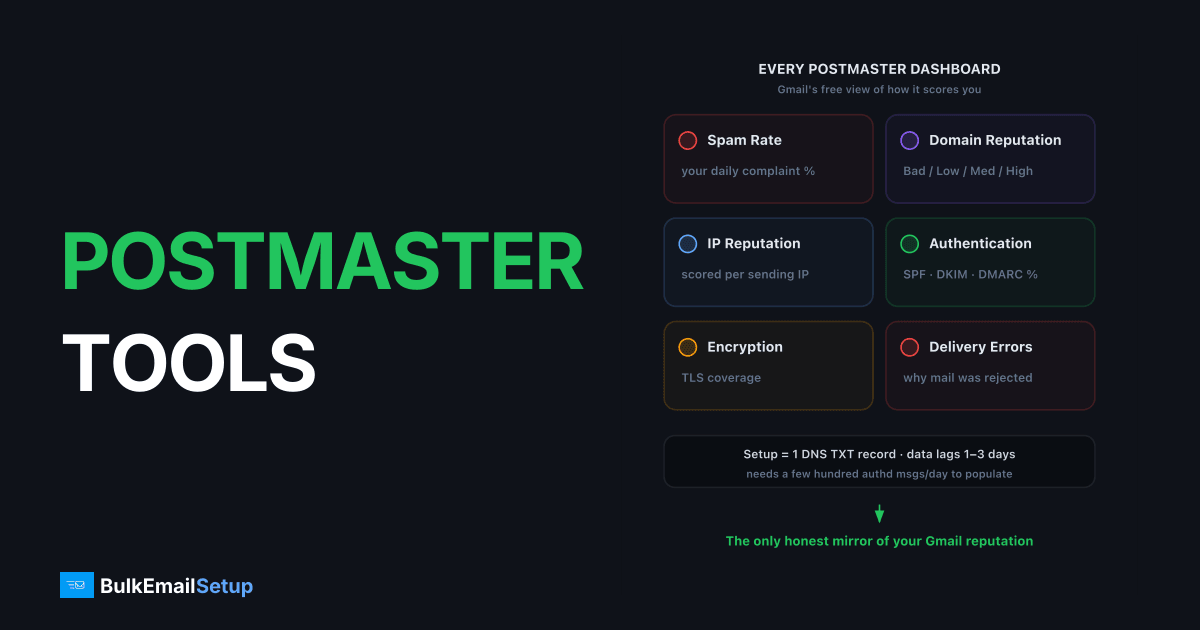
Google Postmaster Tools is Gmail's free dashboard showing how Gmail scores your sending domain and IPs: spam complaint rate, domain and IP reputation, authentication pass rates, encryption, and delivery errors. Setup takes one DNS TXT record, data updates daily with a 1-3 day lag, and most dashboards need a few hundred authenticated messages per day to Gmail before they populate.
Setup in 5 minutes
- Go to postmaster.google.com and sign in with any Google account.
- Add your sending domain, use the domain in your DKIM signature (the d= domain), since that's what Gmail keys reputation on.
- Publish the verification TXT record Google gives you in DNS.
- Add each sending subdomain separately (mail.example.com and example.com are separate ledgers).
If you authenticate with DKIM on a subdomain but From: on the root, add both. Authentication itself must already be live, see SPF, DKIM, DMARC setup.
Dashboard 1: Spam rate
The single most consequential graph. It plots daily user-reported spam complaints divided by mail delivered to the inbox.
| Reading | Meaning |
|---|---|
| < 0.1% | Healthy, Gmail's recommended operating level |
| 0.1-0.29% | Warning zone, find the cause this week |
| ≥ 0.3% | Enforcement threshold under the 2024 bulk sender rules |
Two reading traps: spikes on low-volume days are often just small denominators (3 complaints ÷ 900 inboxed = 0.33%), and a rate that improves while opens fall usually means mail is going to spam where nobody can complain. Full threshold strategy: Gmail's 0.3% complaint threshold.
Dashboard 2: Domain reputation
A four-band score. Bad, Low, Medium, High, summarizing how strongly Gmail associates your domain with spam.
| Band | Practical inbox outcome |
|---|---|
| High | Inbox by default; occasional content-based filtering only |
| Medium | Mostly inbox; some campaigns clipped to spam |
| Low | Significant spam-folder placement |
| Bad | Nearly everything to spam or rejected |
Reputation moves slowly by design. A drop from High to Medium reflects 1-2 weeks of negative signals; climbing back typically takes 2-4 weeks of clean sending to engaged recipients. If you're stuck at Low, the recovery sequence in why emails go to spam applies.
Dashboard 3: IP reputation
Same four bands, scored per sending IP. Read it against domain reputation:
| Domain rep | IP rep | Diagnosis |
|---|---|---|
| High | Low/Bad | IP problem, bad prior tenant, ramped too fast, or shared-pool pollution |
| Low/Bad | High | Domain problem, content, complaints, list quality; changing IPs won't help |
| Low | Low | Systemic, list and infrastructure both need work |
New dedicated IPs show no data, then Low/Medium early in warm-up, that's expected and improves with clean volume.
Dashboard 4: Authentication
Three lines showing the percentage of your traffic passing SPF, DKIM, and DMARC. Healthy senders sit at 99-100% on all three.
- A dip on one line usually means a misconfigured server, a new tool sending unauthenticated, or a DNS change that broke a record.
- A DKIM line below SPF often means some system signs with the wrong domain.
- Sustained sub-100% DMARC alignment is a 2024-requirements violation for bulk senders, fix it before Gmail starts rejecting.
This dashboard is also your spoofing detector: traffic you don't recognize failing authentication is someone else using your domain.
Dashboard 5: Encryption
Shows the share of inbound and outbound traffic using TLS. Modern expectations are ~100%; anything lower means a relay in your path is negotiating plaintext. Gmail flags non-TLS mail with a red open padlock to recipients, which depresses trust and engagement.
Dashboard 6: Delivery errors
The percentage of your connection attempts Gmail rejected or temp-failed, with error categories.
| Error class | Typical cause | Action |
|---|---|---|
| Rate limit exceeded | Sending too fast for your reputation tier | Slow per-connection throughput; smooth sends over hours |
| IP/domain in RBL or policy block | Blacklisting | Identify and delist, see avoiding blacklists |
| DMARC/auth failure | Broken or missing authentication | Fix DNS records, re-test |
| Suspected spam | Content + reputation combination | Reduce volume, improve targeting |
Error spikes here usually precede reputation drops by a few days, it's the earliest warning Postmaster Tools gives you.
Dashboard 7: Feedback loop (FBL)
Only populates if you embed the Feedback-ID header in your mail, designed for high-volume senders who want complaint data broken down by campaign or customer. If you run one brand on one stream, the spam rate dashboard already tells you what you need; if you send for multiple clients or campaign types, Feedback-ID is how you find which one is burning the domain.
A weekly review routine
- Daily (30 seconds): spam rate. Anything over 0.1% gets investigated same day.
- Weekly: domain reputation, IP reputation, delivery errors, screenshot or log the values so you can see month-over-month drift.
- After any infrastructure change: authentication dashboard for 3-4 days (new ESP, new server, DNS edits).
- Pair with seed tests: Postmaster shows Gmail's opinion with a 1-3 day lag; seed-list testing shows actual folder placement today, across providers.
Limits worth knowing
- Gmail only, no Outlook, Yahoo, or Apple data. Microsoft's SNDS covers Outlook IPs.
- Minimum-volume gating: low-volume domains see empty graphs.
- No per-campaign breakdown without Feedback-ID, and no per-recipient data ever.
- 1-3 day lag means it's a trend tool, not an incident tool.
How BulkEmailSetup helps
We wire every dedicated SMTP server we manage into Postmaster Tools from day one and watch the spam-rate and reputation dashboards as part of managed deliverability monitoring, you get an alert when a graph moves, not a surprise when revenue does. See plans and pricing.
Frequently asked questions
Is Google Postmaster Tools free?
Yes. Anyone who can verify domain ownership via a DNS TXT record gets full access. There is no paid tier.
Why does Postmaster Tools show no data for my domain?
Most dashboards need a minimum daily volume of authenticated mail to Gmail, typically a few hundred messages per day, before they populate. Low-volume senders see blank graphs; that's normal, not an error.
What is a good domain reputation in Postmaster Tools?
High is the target, it means Gmail rarely associates your domain with spam and inbox placement is reliable. Medium is workable, Low means a meaningful share of mail goes to spam, and Bad means most of it does.
How often does Postmaster Tools update?
Daily, with a lag of 1-3 days. There is no real-time view, so pair it with seed-list testing when you need same-day placement data.
Does Postmaster Tools show data for other providers like Outlook or Yahoo?
No, it covers Gmail only. Microsoft offers SNDS for Outlook IP data; Yahoo has no equivalent dashboard, only a complaint feedback loop.