
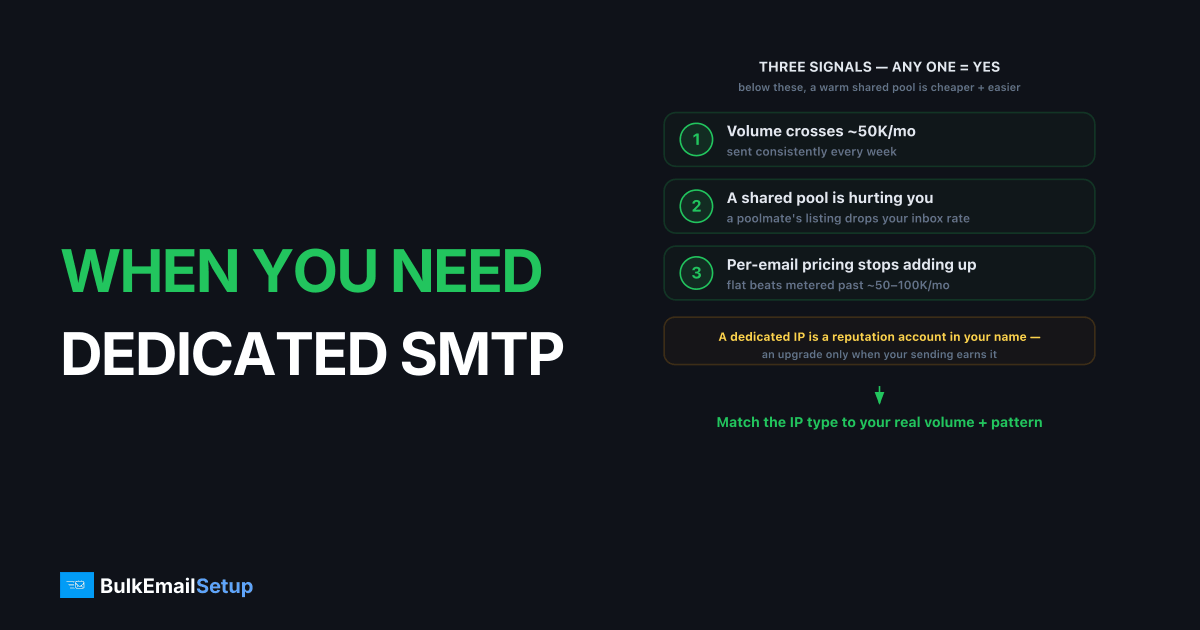
You need a dedicated SMTP server when one of three things is true: you consistently send more than roughly 50,000 emails a month, a shared IP pool is dragging your inbox rate, or per-email ESP pricing has grown more expensive than flat-rate dedicated infrastructure. Below that volume and without those problems, a quality shared pool is cheaper and easier, because a dedicated IP needs steady volume to maintain a reputation. A dedicated SMTP server isn't automatically better, it's a reputation account with your name alone on it, which is only an upgrade when your sending deserves it. Here are the concrete signals.
Signal one: your volume crosses the threshold
The volume threshold is roughly 50,000 emails a month sent consistently. Below it, a dedicated IP can't gather enough sending history to build a stable reputation, so mailbox providers throttle it like a stranger indefinitely. A warm shared pool, with constant traffic from many senders, delivers better at low volume.
Above the threshold, the math flips. A dedicated IP sending steady weekly volume accumulates the history that earns higher per-IP throttle ceilings at Gmail, Yahoo, and Microsoft. Consistency matters as much as the number: 50K spread evenly beats 50K dumped once a quarter, which reads as suspicious to reputation systems.
Signal two: shared-pool deliverability is hurting you
On a shared IP, you inherit the pool's reputation, good and bad. When a poolmate gets blocklisted on Spamhaus or trips a complaint threshold, the spillover can drop your inbox rate even though your own sending is clean. If you've watched your placement fall for no reason you can find in your own metrics, the pool may be the cause.
A dedicated IP makes that problem yours to solve, in both directions. Nobody else can damage your reputation, and when something breaks, it's in your logs, not a black box. Diagnosing a 550 5.7.1 block is trivial when you're the only sender. The trade-off detail is in dedicated IP vs shared IP.
Signal three: per-email pricing stops making sense
ESPs charge per email or per contact, so your bill scales with every campaign. A dedicated SMTP server charges a flat monthly fee. Somewhere around 50,000-100,000 emails a month sent consistently, the flat fee becomes cheaper than the per-email total, and a single big campaign no longer triggers overage charges.
| Situation | What you likely need |
|---|---|
| Under 50K/month, any pattern | Quality shared pool |
| 50K-200K/month, weekly sends | One dedicated IP / SMTP server |
| 50K+/month but bursty or seasonal | Shared, or dedicated with keep-warm traffic |
| Transactional that must always inbox | Dedicated IP, isolated from marketing |
| 100K+/day | Dedicated pool of multiple IPs |
| Cold outreach | Mailbox-level or rotated dedicated IPs |
A break-even example: where the cost flips
Walk the crossover with numbers. Say a per-email ESP costs you roughly $0.0007 per send after add-ons. At 50,000 emails a month, that's about $35. At 150,000, it's about $105. At 300,000, it's roughly $210, and it keeps climbing in a straight line forever, because per-email pricing never rewards scale.
A flat-rate dedicated SMTP plan in the low-to-mid hundreds costs the same at every one of those volumes. So somewhere between 100,000 and 300,000 emails a month, depending on your exact ESP rate and dedicated plan, the flat line drops below the rising line and stays there. Below the crossover, the ESP is cheaper and you skip warm-up. Above it, every extra email you send on the flat plan is effectively free, while the ESP keeps charging. Bursty senders hit the crossover sooner, because overage punishes their peaks hardest.
What a dedicated SMTP server does not fix
A dedicated server is not a deliverability cheat code. It gives you control, not guaranteed inbox placement. Your inbox rate still depends on list hygiene, a complaint rate under 0.3%, valid PTR and authentication, and consistent sending. Move a bad list to a dedicated IP and you just get blocklisted faster, with your name on it. We have watched a sender migrate a stale 200K list to a fresh dedicated IP and start full volume on day two, then trip a 421 4.7.0 throttle from Gmail and a complaint spike past 0.5% inside a week, because the IP had no history to absorb the bad behavior. The same list on a warm shared pool would have degraded slower and hidden the problem longer, which is not a benefit, but it shows the dedicated IP amplifies rather than fixes.
The honest framing: a dedicated IP also costs you a 4-6 week warm-up and ongoing reputation work. If you're crossing the threshold, get SPF, DKIM, and DMARC right first, then decide whether to run it yourself. The full math is in how many emails before you need dedicated infrastructure.
A quick self-check before you switch
Run this checklist before moving to a dedicated SMTP server. If you can't tick most of these, a shared pool is still your better option, and switching early will hurt your inbox rate rather than help it.
- Volume. Are you consistently above roughly 50,000 emails a month?
- Consistency. Do you send steadily every week, not in quarterly bursts?
- List quality. Is your bounce rate low and your complaint rate under 0.3%?
- Authentication. Do you have SPF, DKIM, DMARC, and a valid PTR ready for the sending domain?
- Warm-up tolerance. Can you ramp over 4-6 weeks without needing full volume on day one?
- Cost trigger. Is your per-email or per-contact bill now higher than a flat dedicated plan?
If you ticked volume, consistency, and the cost trigger, dedicated makes financial sense. If list quality and authentication aren't there yet, fix those first. A dedicated IP amplifies whatever sending behavior you bring to it, good or bad. Detailed cost numbers sit in how much a dedicated SMTP server costs.
Signs you're not ready yet
Some senders cross the volume line but still aren't ready for a dedicated SMTP server, and switching early hurts. A dedicated IP starts with zero reputation, so it punishes weak sending faster than a warm shared pool would. Recognize these signs and fix them before you move.
You're not ready if any of these are true:
- Your sending is bursty. A few big campaigns a quarter, silence in between. The IP's reputation decays in the gaps and every send becomes a mini warm-up.
- Your list isn't clean. High bounce rates or complaint rates over 0.3% will list a fresh IP within days.
- Authentication is missing or wrong. No DKIM, an SPF record over the 10-lookup limit throwing PermError, or no DMARC. Fix these first.
- You can't tolerate a ramp. If you need full volume immediately and can't ramp over 4-6 weeks, a warm shared pool serves you better short term.
None of these are permanent. They're a to-do list. Clear them, then a dedicated server rewards the clean sending you've built.
What about cold email and transactional mail?
Cold email and transactional mail each break the simple volume rule, so they need their own answer. Volume alone doesn't decide them; risk profile does.
Cold outreach carries high complaint risk, because recipients didn't ask to hear from you. Putting cold email on one high-volume dedicated IP concentrates that risk and can torch a single reputation fast. Cold senders usually want mailbox-level sending or rotated dedicated IPs across multiple domains instead, spreading risk so one bad day doesn't sink everything. That's a different architecture from a single dedicated server.
Transactional mail goes the other way. Receipts, password resets, and confirmations must always reach the inbox, so even at modest volume you often want them isolated on a dedicated IP, kept entirely separate from marketing. A marketing complaint spike should never threaten a password reset. The rule for transactional is "isolate early," not "wait for volume." Both cases show why the threshold is a starting point, not a law. The trade-off detail is in dedicated IP vs shared IP.
Signal four: you need to see your own logs
A fourth signal has nothing to do with volume: you need raw SMTP logs to do your job and your ESP won't give them to you. On a shared pool, a 550 5.7.1 block or a 421 4.7.0 connection limit shows up as a vague dashboard event, hours late, with no way to see the exact mailbox-provider response. When mail to a key customer silently fails, "contact support and wait" is not an answer your business can accept. A dedicated SMTP server hands you the full session: the receiving server's banner, the exact rejection string, the timing, the IP it left from. If deliverability incidents are costing you revenue and you cannot diagnose them in real time, that operational blindness alone can justify the move, even before the cost crossover does.
How BulkEmailSetup helps
If you're hitting the volume threshold or watching shared-pool deliverability slip, we provision a dedicated SMTP server with a dedicated IP you control, full SMTP access, and authentication set up correctly. We run the 4-6 week warm-up and monitor reputation, so you get the control of dedicated sending without the operational burden. See plans on our pricing page.
Frequently asked questions
When do you need a dedicated SMTP server?
You need one when you consistently send above roughly 50,000 emails a month, when shared-pool deliverability is hurting your inbox rate, or when per-email ESP costs exceed flat-rate dedicated pricing. Below that volume and without those problems, a quality shared pool is usually the better choice.
Is a dedicated SMTP server better for deliverability?
Only if you send enough volume consistently and keep your metrics clean. A dedicated server gives you a dedicated IP whose reputation is yours alone, which is an advantage when your sending practices are good and a liability when they are not. Deliverability still depends on list hygiene and complaint rates.
What volume justifies a dedicated SMTP server?
Roughly 50,000 emails a month sent consistently every week is the common threshold. Below that, a dedicated IP can't accumulate enough sending history to maintain its own reputation, so a warm shared pool usually delivers better and costs less.
Do I need a dedicated SMTP server for cold email?
Cold email has its own rules. You typically want mailbox-level sending or rotated dedicated IPs across multiple domains rather than one high-volume dedicated server, because cold outreach carries higher complaint risk that can damage a single shared reputation.


