
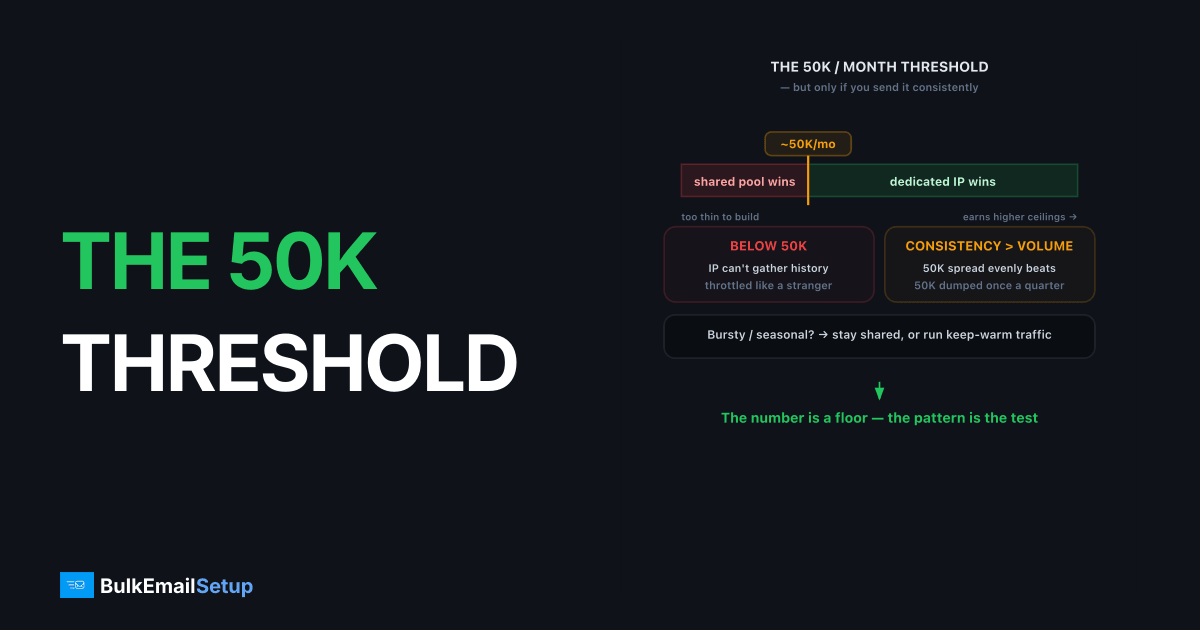
You need dedicated infrastructure at roughly 50,000 emails a month, but only if you send that volume consistently every week. Below the threshold, a dedicated IP can't accumulate enough sending history to hold a stable reputation, so a warm shared pool delivers better and costs less. Above it, two things tip in dedicated's favor: you can build a per-IP reputation that earns higher throttle ceilings, and flat-rate pricing beats per-email ESP costs. The number alone isn't enough, though. Consistency matters as much as volume. Here's the full picture.
Why 50,000 a month is the threshold
Mailbox providers trust IPs with steady, predictable history. Below roughly 50,000 emails a month, a dedicated IP simply doesn't send enough for Gmail, Yahoo, and Microsoft to form a confident opinion of it. It gets throttled like an unknown sender, often indefinitely, because thin data reads as risk.
A shared pool solves this for low-volume senders by borrowing scale. The pool is already warm, with constant traffic from many senders and established throttling relationships, so your small volume rides on a reputation that's already established. That's the genuine advantage of shared sending at low volume, and it's why pushing below the threshold to a dedicated IP usually backfires.
Why consistency matters as much as volume
The threshold isn't just a monthly total, it's a pattern. An IP that sends 12K one week, nothing the next, then 30K reads as suspicious, because reputation systems treat spiky, irregular data as risk. Steady weekly sending builds trust. Bursts and gaps erode it.
This is why seasonal and bursty senders need a different plan. If you mail hard for four days a quarter and go silent in between, a dedicated IP's reputation decays in the gaps and every campaign becomes a mini warm-up. We've seen a sender clear 60,000 a month on paper, but bunched into two days, then watch a fully warmed IP drop to roughly 10 to 15 percent inbox placement on the first send after a three-week gap. The numbers recovered after a few days of steady volume, then cratered again the next quarter. The monthly total was fine. The shape of it was the problem. Those senders either stay on a shared pool or run keep-warm traffic to hold the IP's reputation between campaigns.
The volume decision table
| Monthly volume | Send pattern | Recommendation |
|---|---|---|
| Under 50K | Any | Quality shared pool |
| 50K-200K | Steady weekly | One dedicated IP |
| 50K-200K | Bursty / seasonal | Shared, or dedicated + keep-warm |
| 200K-1M | Steady | Dedicated IP, isolate streams |
| Over 1M or 100K+/day | Steady | Dedicated pool of multiple IPs |
What changes at each volume tier
Each volume tier changes both the deliverability math and the cost math, so the right setup shifts as you grow. Treat these as bands, not hard lines; your send pattern moves the boundaries.
- Under 50K/month. A dedicated IP can't gather enough history to hold a reputation. Stay on a warm shared pool. It's cheaper and delivers better.
- 50K-200K/month, steady. The sweet spot for a single dedicated IP. Enough volume to maintain reputation, not enough to need a pool. Flat pricing starts beating per-email here.
- 200K-1M/month. A dedicated IP earns higher throttle ceilings at Gmail, Yahoo, and Microsoft. Isolate transactional from marketing on separate streams so a bad campaign can't sink your receipts.
- Over 1M/month or 100K+/day. One IP isn't enough headroom. You want a dedicated pool of multiple IPs to spread volume and respect per-IP rate limits like
421 4.7.28.
The pattern across tiers: more volume means more reason to own your reputation and more savings from flat pricing. Less volume means a shared pool's borrowed warmth wins.
The cost crossover
The cost case follows the same threshold. ESPs charge per email or per contact, so the bill scales with volume. Dedicated infrastructure charges a flat monthly fee. Somewhere around 50,000-100,000 emails a month sent consistently, the flat fee undercuts the per-email total, and a big campaign stops triggering overage charges.
Below the crossover, shared ESP pricing is usually cheaper because you only pay for what you send and skip the cost of idle dedicated capacity. The exact crossover depends on your provider and frequency. We work the numbers in cost to send 500,000 emails per month and how much a dedicated SMTP server costs.
Here's the arithmetic in one line. At a typical post-add-on ESP rate near $0.0007 per email, 200,000 sends a month is about $140 and 400,000 is about $280, climbing forever. A flat dedicated plan in the low-to-mid hundreds doesn't move. So the more you send, the wider the gap in dedicated's favor, and your effective cost per email keeps falling on the flat plan while it stays fixed on the ESP. That falling-versus-flat dynamic, not any single magic number, is the real reason high-volume senders move.
What the threshold does not change
Crossing the threshold gives you a reason to consider dedicated infrastructure, not a guarantee of better inbox placement. Deliverability still depends on list hygiene, a complaint rate under the 0.3% Gmail and Yahoo enforce, valid PTR and authentication, and a clean 4-6 week warm-up. Move a bad list to a dedicated IP and you'll get blocklisted faster, with your name on it.
Get the fundamentals right first: SPF, DKIM, and DMARC configured correctly, clean lists, steady sending. Then the threshold decision is about control and cost, which is exactly where dedicated infrastructure earns its place. The decision signals are in when do you need a dedicated SMTP server.
How to estimate your real monthly volume
Estimate your real volume on your peak month, not your average, because reputation and cost both break at the peak. A sender averaging 40,000 a month who spikes to 90,000 every December is a different infrastructure case than a steady 40,000 sender. The peak is what trips overage fees and what a dedicated IP must be warmed to handle.
A quick way to get an honest number:
- Count every stream. Marketing campaigns, transactional mail, automated sequences, and one-off blasts all add up. People routinely forget transactional volume.
- Multiply campaigns by list size. A 30,000-contact list mailed weekly is 120,000 emails a month, not 30,000. Frequency is where the real volume hides.
- Add your peak event. Black Friday, a product launch, a big announcement. Size your infrastructure for that month, not the quiet ones.
- Project six months out. If you're growing 10% a month, today's number understates next quarter's reality.
Run that math and many senders discover they're already past the 50,000 threshold, sometimes well past it, without realizing. Others find their "high volume" is really one busy month a year, which points to a shared pool plus keep-warm rather than full dedicated.
Why bursty senders are the exception
Bursty senders break the volume rule because reputation needs consistency, not just totals. A dedicated IP earns its trust from steady, predictable history. Send 100,000 in one week and nothing for three, and the IP's reputation decays in the silence, so every campaign starts from a colder position than the last.
This is the trap seasonal businesses fall into. A retailer that mails hard for Black Friday and goes quiet until spring technically clears the volume threshold, but the gaps mean a dedicated IP never settles into trusted status. Each big send reads as a stranger waking up, drawing throttling like 421 4.7.28 deferrals at Gmail.
Bursty senders have two honest options. Stay on a warm shared pool, which borrows scale and consistency from other senders. Or run keep-warm traffic, sending steady low-volume mail between campaigns to hold the IP's reputation through the gaps. The wrong move is buying a dedicated IP and letting it go cold between launches, which gives you the cost of dedicated with the deliverability of a cold start. Volume gets you in the door; consistency keeps you there.
A rule of thumb for the daily number
The monthly threshold has a daily companion worth knowing: a dedicated IP wants on the order of a few thousand emails a day, every day, to hold a settled reputation at the big mailbox providers. Roughly 50,000 a month spread across the working days lands near that floor, which is no coincidence. If you run the division and your steady daily figure comes out to a few hundred, the IP spends most of its life looking like an occasional sender, and the providers throttle it accordingly. The practical test is simple. Take your real monthly volume, divide by the number of days you actually send, and ask whether that daily number is high enough and regular enough to look like a known sender rather than a stranger who shows up now and then. If the daily figure is thin or jagged, a warm shared pool will almost always beat a dedicated IP, whatever the monthly total says.
How BulkEmailSetup helps
If you've crossed roughly 50,000 emails a month and you send consistently, we provision a dedicated SMTP server with a dedicated IP you control, full SMTP access, and authentication set up correctly. We run the 4-6 week warm-up and monitor reputation so the IP earns its ceilings cleanly. See plans on our pricing page.
Frequently asked questions
How many emails before you need dedicated infrastructure?
Roughly 50,000 emails a month sent consistently every week is the common threshold. Below that, a dedicated IP can't build enough sending history to maintain its own reputation, so a warm shared pool delivers better and costs less. Above it, dedicated infrastructure starts winning on control and cost.
Does send frequency matter as much as total volume?
Yes. Consistency matters as much as the raw number. 50,000 emails spread evenly across a month builds a stable reputation, while 50,000 sent once and then nothing reads as suspicious to reputation systems. Bursty or seasonal senders often need keep-warm traffic or are better off on a shared pool.
Can I send too few emails for a dedicated IP?
Yes. Below roughly 50,000 a month, a dedicated IP never accumulates enough data for a stable reputation and gets throttled like a stranger indefinitely. Low-volume senders almost always do better on a quality shared pool that's already warm.
At what volume does dedicated infrastructure save money?
Around 50,000-100,000 emails a month sent consistently, flat-rate dedicated infrastructure usually becomes cheaper than per-email or per-contact ESP pricing, because ESP costs scale with volume while a dedicated server's cost stays flat.


