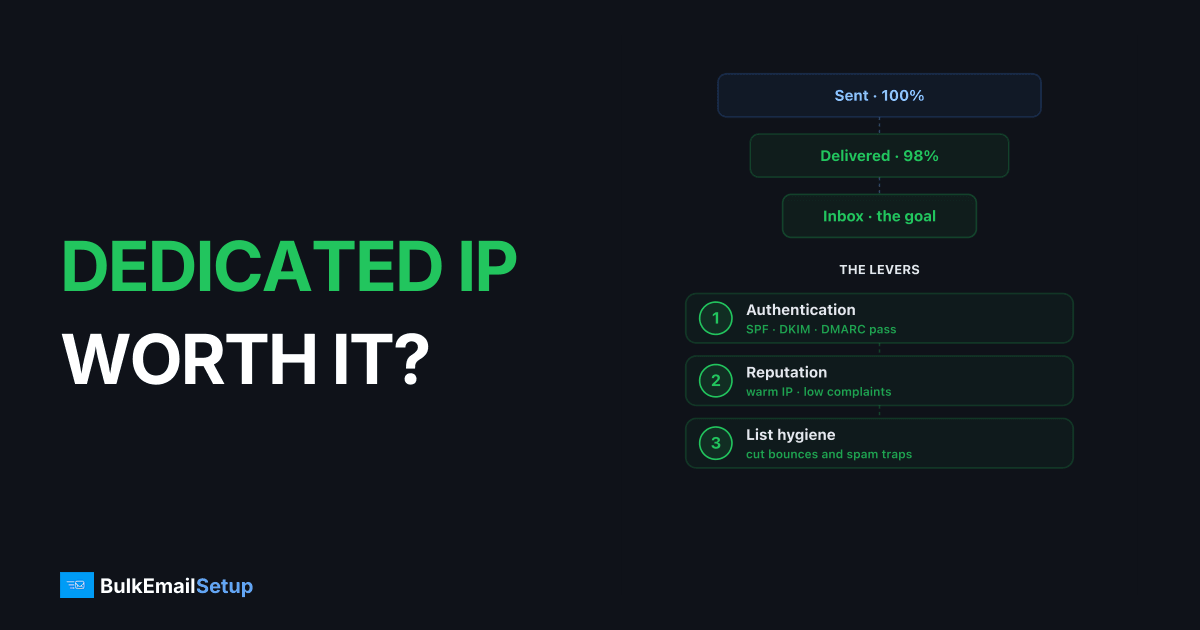
A dedicated IP is worth it once you sustain roughly 50,000 to 100,000 emails per month with consistent volume, and it's a waste of money below that. The $25-30/month most ESPs charge is the small part. The real cost is the warm-up work and the requirement to keep sending steadily forever. So "is dedicated IP worth it" has a numeric answer: above the threshold it gives you control and isolation worth far more than $30; below it, a shared pool delivers better because you can't generate enough signal to build your own reputation.
I've warmed dedicated IPs for cold outreach, transactional mail, and 2M/month newsletters, and I've also talked plenty of small senders out of buying one. Here's where the line actually sits and why.
What a dedicated IP actually costs in 2026
The $30 sticker price hides the real bill. Here's what a dedicated IP costs across the common setups, including the hidden costs.
| Setup | Monthly IP cost | Warm-up handled by | Hidden cost |
|---|---|---|---|
| SendGrid dedicated IP | ~$24.95/mo add-on | You | Must stay on Pro tier ($90+/mo) |
| Mailgun dedicated IP | Included on Foundation+ (~$59+/mo) | You | Tier jump to qualify |
| Brevo dedicated IP | Paid add-on (~$25/mo) | Partial | Lower throughput limits |
| Amazon SES dedicated IP | ~$24.95/mo | You, entirely | No warm-up tooling at all |
| Self-hosted VPS (Postal/Postfix) | Included in $20-40 server | You, entirely | PTR/rDNS, blocklist monitoring, your time |
| Managed dedicated SMTP (BulkEmailSetup) | Folded into flat $50-150/mo | Provider | Higher floor than SES |
Prices are 2026 ballparks, check current pricing before committing.
Two things to notice. First, on most ESPs the IP fee is gated behind a higher plan, so the true marginal cost is the IP fee plus the tier bump. Second, "you handle warm-up" is the line item nobody prices, and it's the expensive one. A botched warm-up that gets your IP onto Spamhaus can cost weeks of deliverability and a domain reputation hit that follows you to the next IP.
The volume threshold that decides
Mailbox providers (Gmail, Microsoft, Yahoo) judge a sending IP by its reputation, and reputation is built from volume and consistency. A dedicated IP isolates you, good if your reputation is strong, bad if you can't build one.
| Monthly volume | Recommendation | Why |
|---|---|---|
| Under 10K | Shared IP, no question | Not enough signal to register reputation |
| 10K-50K | Shared IP | A dedicated IP would sit mostly idle and look stale |
| 50K-100K | Borderline, depends on consistency | Worth it if volume is steady, not spiky |
| 100K-500K | Dedicated IP | Enough volume to build and hold reputation |
| 500K+ | Dedicated IP, often multiple | Isolation and control matter at this scale |
The hard number I use: about 50K emails/month, sent consistently, is the floor. Below that, a dedicated IP barely registers with Gmail's reputation systems. Gmail in particular wants to see a steady stream from an IP before it trusts it. Send 5,000 today, nothing for a week, 20,000 next Tuesday, and the IP never builds a stable profile.
Consistency matters as much as raw volume. A sender doing a flat 60K/month every month is a better dedicated-IP candidate than one doing 150K in one campaign and zero the rest of the month. The spiky sender is better off on a shared pool that's always warm.
If you're weighing the architecture choice underneath this, Dedicated IP vs Shared IP for Email goes deeper on the reputation mechanics.
Why a dedicated IP can make deliverability worse
This surprises people, so it's worth being blunt. A dedicated IP is not automatically better. Below the volume threshold it's usually worse, for three reasons.
First, cold IP penalty. A brand-new IP has no reputation. Mailbox providers treat unknown IPs with suspicion, so your first sends land in spam or get deferred until you've proven yourself over weeks of warm-up.
Second, the stale-IP problem. If you don't send enough, the IP's reputation decays. An IP that goes quiet for two weeks effectively resets and needs partial re-warming. Low-volume senders live in a permanent half-warmed state that delivers worse than a busy shared pool.
Third, you own every mistake. On a shared pool, one bad send is diluted across thousands of senders. On a dedicated IP, a list with a 8% bounce rate is entirely your reputation tanking. That's a feature at scale and a liability when you're small. If bounces are a concern, fix the list first, see How to Reduce Email Bounce Rate.
The flip side: a reputable shared IP pool is curated by the provider, kept warm by aggregate volume, and policed for spammers. For most senders under 50K/month it genuinely outperforms a dedicated IP they'd struggle to maintain.
What you're actually buying at $30/month
When the volume justifies it, the $30 buys real things. Here's what a dedicated IP gives you that a shared pool can't.
- Isolation. Your reputation is yours. No mystery sender in your pool gets you blocklisted on a Monday morning.
- Control over warm-up curve. You decide how fast to ramp, which matters when launching new send streams.
- Stable PTR/rDNS identity. A consistent IP with matching reverse DNS and authenticated DKIM/SPF builds a clean, traceable identity Gmail and Microsoft reward over time.
- Postmaster Tools signal. Gmail Postmaster Tools shows per-IP reputation only when you have a dedicated IP. On a shared pool you're flying blind on the IP dimension.
- Predictable throughput. No noisy-neighbor throttling when someone else in the pool blasts a campaign.
What it does NOT buy: instant inbox placement, immunity from content filters, or a fix for a bad list. Authentication still has to be right, and your domain reputation (separate from IP reputation) still depends on engagement. Getting the domain side right starts with Subdomain vs Root Domain for Email Sending.
The warm-up cost nobody quotes you
The $30 is rent. The warm-up is the work, and it's the part that makes or breaks the investment.
A standard warm-up runs 4-8 weeks:
- Days 1-3: a few hundred sends/day, only to your most engaged contacts.
- Week 1-2: double the daily cap each day while bounce rate stays under 2% and complaints under 0.1%.
- Week 3-4: push toward target volume, watch Postmaster Tools reputation climb.
- Week 5-8: stabilize at full volume; reputation hardens.
Skip steps or ramp too fast and Spamhaus or a Microsoft block is the result, and now you're worse off than when you started on a shared pool. Full breakdown in How Long Does IP Warm-Up Take.
This is the real argument for a managed dedicated SMTP service over a raw IP add-on. SendGrid or SES will rent you the IP and hand you the warm-up. A managed provider delivers the IP already warmed (or warms it for you on a schedule) and monitors blocklists so a delisting doesn't sit unnoticed for a week. You're paying to not be the on-call deliverability engineer.
When self-hosting the IP makes sense, and when it doesn't
The cheapest dedicated IP is on your own VPS. Postal or Postfix on a $20-40/month server gives you a dedicated IP with no per-IP add-on fee. I run mail this way and it works.
The honest catch: the IP is the easy part. You also own rDNS/PTR setup, DKIM/SPF/DMARC, feedback loops, blocklist monitoring, and the warm-up. When Microsoft silently throttles you, there's no support ticket, just you and the SNDS dashboard. For the engine choice underneath this, Postal vs Postfix Mail Server compares the two.
Self-host if you have the time and want full control. Use managed if your time is worth more than the price gap. The total-cost math across all three models is laid out in Self-Hosted vs Managed vs ESP TCO.
Who should pick what
| Sender profile | Pick | Why |
|---|---|---|
| Startup, under 50K/mo | Shared IP (SES, Mailgun, Brevo) | No IP fee, no warm-up, better placement than you'd build |
| Spiky volume, big campaigns then quiet | Shared pool | A dedicated IP would go stale between sends |
| Steady 50K-500K/mo, technical team | Self-hosted dedicated IP | Cheapest at volume if you'll own the work |
| Steady 100K+/mo, no in-house deliverability | Managed dedicated SMTP | Warmed IP, monitoring, flat fee, no on-call |
| Agency sending for many clients | Multiple dedicated IPs | Isolate each client's reputation |
If you're costing this out at scale, Cost to Send 1 Million Emails per Month and Cheapest Way to Send 100K Emails per Month run the dollar comparisons. For the broader build-vs-buy decision, Is Managed SMTP Worth It covers it head-on.
The math: when $30 beats $0
A dedicated IP only pays off when the value of isolation and control exceeds the cost. Here's the rough break-even.
| Volume | Dedicated IP value | Cost (IP + tier) | Worth it? |
|---|---|---|---|
| 25K/mo | Low (can't keep warm) | ~$25 + tier bump | No |
| 60K/mo | Moderate (if steady) | ~$25 + tier bump | Maybe |
| 150K/mo | High (own reputation) | ~$25, or flat managed | Yes |
| 1M/mo | Very high | Flat managed wins on $/email | Yes |
At 1M/month, the pay-per-email ESPs charge several hundred to over a thousand dollars, while a flat-fee managed dedicated SMTP holds steady around $50-150/month with the IP included. That's where the dedicated IP stops being a $30 question and becomes the whole reason to switch architectures. The cost crossover is detailed in SMTP Relay Pricing Comparison.
If you're shopping ESPs around this decision, the alternatives roundups are useful: Amazon SES Alternatives, SendGrid Alternatives, and Mailgun Alternatives. The dedicated-server comparisons go deeper: Amazon SES vs Dedicated SMTP Server and SendGrid vs Dedicated SMTP Server.
How BulkEmailSetup helps
We sell a dedicated IP the way it should be sold: warmed before you send, monitored for blocklists, and priced as a flat monthly fee instead of a $30 add-on bolted onto a $90 ESP tier. At sustained volume (100K+/month) that flat fee usually undercuts per-email ESP pricing by a wide margin, and you skip the 4-8 weeks of warm-up babysitting entirely.
Honest version: if you send under 50K/month, don't buy from us yet, a shared pool on SES or Brevo will serve you better and cheaper. We win once your volume is steady and high enough that owning your IP reputation actually pays off.
See current plans and where the break-even lands for your volume on the pricing page. If you want to compare provider shortlists first, start with Best Dedicated SMTP Server Providers, and when you're ready to build, How to Set Up an SMTP Server for Bulk Email walks through it.
Frequently asked questions
Is a dedicated IP worth it for email?
It's worth it once you sustain roughly 50,000 to 100,000 emails per month with consistent volume. Below that you can't generate enough sending signal to build reputation, so a shared IP pool actually delivers better. Above it, a dedicated IP gives you control and isolates you from other senders' behavior.
How much does a dedicated IP cost in 2026?
Most ESPs charge $25-30/month per dedicated IP as an add-on (SendGrid ~$24.95, Mailgun ~$59 on higher tiers, Brevo as a paid extra). On a self-hosted VPS the IP is included in the $20-40/month server cost. A managed dedicated SMTP service folds a warmed IP into a flat monthly fee, usually $50-150/month all in.
Will a dedicated IP improve my deliverability?
Only if you send enough to keep it warm. A dedicated IP with low, irregular volume looks suspicious to mailbox providers and can deliver worse than a shared pool. At consistent high volume it improves deliverability because your reputation is yours alone and not dragged down by other senders.
How long does it take to warm up a dedicated IP?
Plan on 4 to 8 weeks to reach full volume. You start at a few hundred sends per day and roughly double daily caps each day while watching bounce and complaint rates. Rushing the warm-up is the single most common way new dedicated IPs get blocklisted.
Should a small sender use a dedicated or shared IP?
Shared. If you send under about 50K emails a month, a reputable shared IP pool gives you better inbox placement than you could build alone, with no warm-up work and no monthly IP fee. Switch to dedicated only when your volume and consistency justify it.