
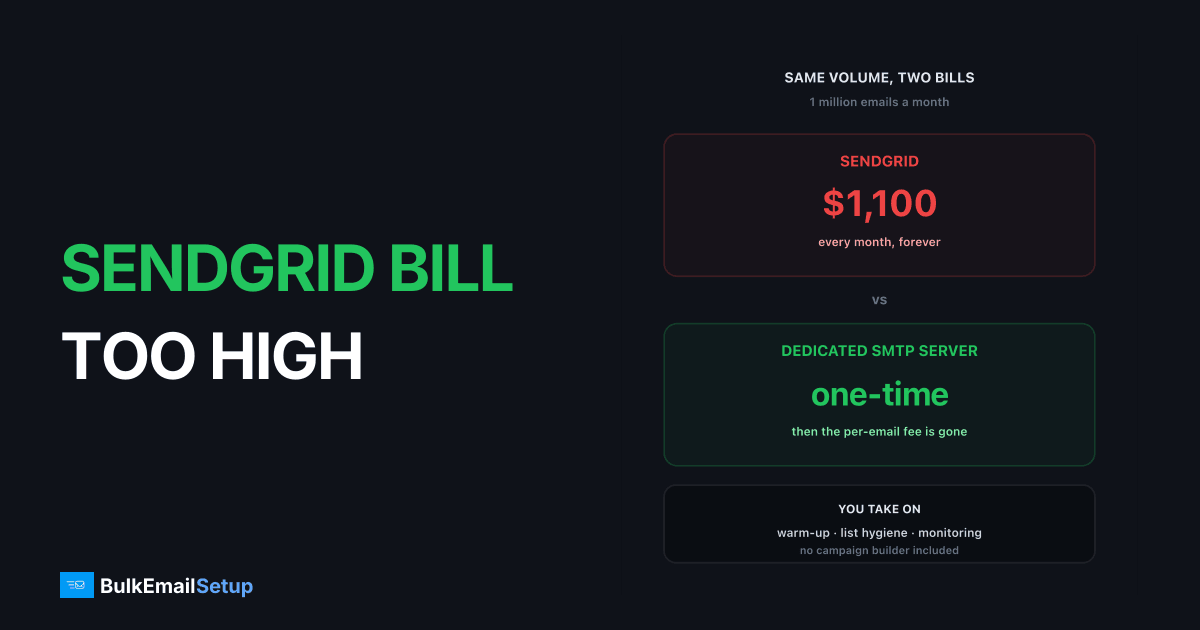
SendGrid's base plan is rarely why the bill is high. Essentials starts at $19.95 a month and Pro at $89.95. What pushes the invoice up is the tier steps, overage billed at $0.0005 to $0.0013 per email, extra dedicated IPs at roughly $30 a month each, and Marketing Campaigns contacts billed separately from the Email API. At volume those routinely exceed the plan they sit on.
Before switching, it is worth seeing where the money actually goes, because some of it is recoverable without migrating.
Where the bill comes from
| Line item | Typical cost | Notes |
|---|---|---|
| Essentials plan | $19.95+/mo | 50K and 100K tiers, no dedicated IP available |
| Pro plan | $89.95+/mo | 100K, 300K, 700K, 1.5M, 2.5M tiers, 1 IP included |
| Premier plan | Quote only | Above 2.5M, multiple IPs, 5,000 free validations |
| Additional dedicated IP | ~$30/mo each | You need several past 500K a month |
| Overage | $0.0005 to $0.0013 per email | $0.50 to $1.30 per 1,000 over the tier |
| Email validation | Per address, sold separately | 2,500 free on Pro, 5,000 on Premier |
| Marketing Campaigns contacts | Separate contact-based plan | Billed on top of the Email API plan |
Four things do the damage, and only one is on the pricing page in large type.
Tier steps. The jump from Essentials at $19.95 to Pro at $89.95 is a 4.5x step. It is triggered by needing a dedicated IP or by crossing 100,000 emails, whichever comes first. Nobody plans for it because the volume tiers inside each plan look gentle.
The dedicated IP trap. Essentials has no dedicated IP option. If your deliverability team decides you need one, you are on Pro at $89.95 whether you send 10,000 or 100,000. Extra IPs on top run about $30 a month each.
Overage. Exceeding your tier is billed per email at $0.0005 to $0.0013, so a campaign that runs long is charged at the worst rate you pay all month. Send 150,000 on a 100,000 tier and the extra 50,000 costs $25 to $65 on top of the plan. More detail in hidden costs of ESP overage fees.
Contact-based add-ons. Marketing Campaigns is priced on contacts stored, separate from the Email API plan priced on emails sent. Teams using both pay two bills for the same audience.
What SendGrid costs by volume
List prices from the Twilio SendGrid Email API pricing page, rounded, checked September 2026. Marketing Campaigns and validation are on top of everything below.
| Monthly volume | Plan | Monthly cost | Dedicated IPs | Effective per 1,000 |
|---|---|---|---|---|
| 25,000 | Essentials 50K | ~$19.95 | None available | $0.80 |
| 50,000 | Essentials 50K | ~$19.95 | None available | $0.40 |
| 100,000 | Essentials 100K or Pro | ~$35 to $90 | 0 or 1 | $0.35 to $0.90 |
| 300,000 | Pro 300K | ~$249 | 1 included | ~$0.83 |
| 700,000 | Pro 700K | ~$449 | 1 included | ~$0.64 |
| 1,000,000 | Pro 1.5M | ~$750 to $1,100 | 1 included, +$30 each | $0.75 to $1.10 |
| 2,500,000 | Pro 2.5M | ~$1,200+ | 1 included, +$30 each | ~$0.48 |
| 5,000,000 | Premier | Quote | Multiple | ~$0.40 to $0.55 |
The curve is the normal shape: the rate improves as you grow, but it never gets near the floor. SendGrid at a million a month is $0.75 to $1.10 per 1,000. Amazon SES is $0.10 flat at every volume. That 7x to 11x gap is the platform layer you are renting.
Notice also that 100,000 is the awkward tier. It sits at the top of Essentials and the bottom of Pro, so the same volume costs $35 or $90 depending on whether you need the IP.
Three ways to cut it without leaving
1. Clean the list. You are paying to mail addresses that will never open. Most lists carry 20 to 30% dead weight, and removing it drops you a volume tier and improves deliverability at the same time. On a 700,000 tier at $449, cutting 25% moves you to the 300K tier band and saves roughly $200 a month. See email list cleaning.
2. Drop extra dedicated IPs if your volume is low. A dedicated IP needs roughly 50,000 emails a month of steady traffic to stay warm. Three IPs on 200,000 a month is 67,000 each, fine. Three IPs on 90,000 a month is 30,000 each, and all three underperform while costing $60 in add-ons. See is a dedicated IP worth it.
3. Right-size the tier. If you pay overage most months, you are on the wrong plan and paying $0.50 to $1.30 per 1,000 for the excess every time. Move up a tier and the excess is billed at the plan rate instead. If you are consistently 30% under your tier, move down.
Those three commonly cut a bill by a third. Do them before comparing providers, because they also make the comparison honest.
What the same volume costs elsewhere
Three volumes, because the answer changes with scale. Relay figures are list prices rounded, checked against each vendor's own pricing page.
| Route | At 100K/month | At 500K/month | At 1M/month | What you also get |
|---|---|---|---|---|
| Amazon SES | ~$10 | ~$50 | ~$100 | Raw sending only |
| SMTP2GO | ~$60 | ~$250 | ~$450 | Reporting, support |
| Mailgun | ~$90 | ~$400 | ~$600 | API, logs, validation |
| Brevo | ~$65 | ~$300 | ~$550 | Campaign builder, automation |
| SendGrid | ~$90 | ~$449 | ~$750 to $1,100 | Full platform |
| Mailchimp (contacts) | ~$310 | ~$1,000 | ~$1,800 | Best builder, contact billing |
| Dedicated SMTP server | $549 one-time | $549 one-time | $549 one-time | Your own IPs, no per-email fee |
SES is roughly a tenth of SendGrid on send fees while doing genuinely less. That gap is not a scandal, it is the cost of the platform layer. The question is whether you use that layer enough to justify it. Cheaper than SendGrid walks the full field if you want more than the six routes above.
Two caveats on the dedicated row. Basic covers 25,000 emails a day, which is 750,000 a month, so the 1M column needs a higher tier or a paced schedule. And you pay VPS hosting of roughly $20 to $40 a month to the host directly, which the one-time figure does not include.
Migration effort by route
Cost is half the decision. The other half is how much of SendGrid you have to rebuild.
| Task | To SMTP2GO or Mailgun | To Amazon SES | To dedicated SMTP + self-hosted mailer |
|---|---|---|---|
| SMTP credentials swap | Change host, port, user, pass. 15 min | Same, plus IAM setup. 1 hour | Same, credentials from the build. 15 min |
| API integration rewrite | Their API differs from SendGrid's. 2 to 6 hours | SES SDK, different payload shape. 4 to 8 hours | SMTP only unless you add an API. 0 to 4 hours |
| Suppression list export | Export bounces and blocks from SendGrid, import. 1 hour | Same, plus SNS bounce topic wiring. 2 hours | Same, plus bounce handler on the server. 1 hour |
| Dynamic templates | Rebuild, no direct import. 2 to 6 hours | Rebuild in your app or mailer. 4 to 8 hours | Rebuild in MailWizz or Mautic. 4 to 8 hours |
| DKIM and SPF | New CNAMEs, new SPF include. 1 hour plus DNS wait | 3 DKIM CNAMEs, custom MAIL FROM. 2 hours | Your own selector, SPF with your IPs, PTR set. Part of the build |
| Event webhooks | Rebuild handler for their event schema. 2 to 4 hours | SNS or Firehose, different shape. 4 hours | Log parsing or mailer webhooks. 2 to 6 hours |
| IP warm-up | None on shared, 4 to 6 weeks on a new dedicated IP | 4 to 6 weeks, SES enforces its own ramp | 4 to 8 weeks across 3 IPs |
| Total hands-on time | 1 to 2 days | 2 to 4 days | 2 to 4 days |
The step people underestimate is the API rewrite. If your application calls /v3/mail/send in twenty places, swapping providers is a code change, not a config change. SMTP-only senders have it far easier, which is why the SMTP row is fifteen minutes and the API row is a day.
Authentication is the step that breaks migrations. Google's bulk sender requirements need SPF or DKIM aligned with your From domain from 5,000 messages a day, and a switch that changes the sending source without updating DNS fails that on day one. Keep the old SendGrid include in SPF during the overlap, add the new source, watch DMARC reports for a week, then remove it. The full sequence is in migrate from SendGrid to a dedicated SMTP server.
Break-even against a one-time server
Divide $549 by the SendGrid bill you would otherwise pay, and round up.
| SendGrid bill | Volume it maps to | Break-even month | Year-one saving |
|---|---|---|---|
| ~$19.95 | 25K to 50K | Month 28 | Negative, stay put |
| ~$89.95 | 100K | Month 7 | ~$530 |
| ~$249 | 300K | Month 3 | ~$2,439 |
| ~$449 | 700K | Month 2 | ~$4,839 |
| ~$750 | 1M | Month 1 | ~$8,451 |
| ~$1,200 | 2.5M | Month 1 | ~$13,851 |
Year-one saving is the SendGrid bill for twelve months minus the $549 build, before VPS hosting of $240 to $480 a year. Below 100,000 a month the payback stretches past half a year and the migration time eats the benefit. Past 300,000 the server is paid off inside a quarter and then stops charging you.
The honest trade with dedicated
A one-time build against $750 to $1,100 a month pays back in the first month at a million emails and then costs nothing per send. That is the whole argument and at that volume it is strong.
What you take on: the 4 to 8 week warm-up, list hygiene, complaint monitoring against Gmail's 0.3% hard line, and the fact that a dedicated server sends mail but does not build campaigns. Most senders who move pair it with self-hosted software such as MailWizz, Sendy or Listmonk, which is another $0 to $99 one-time.
What you stop paying for: per-email pricing, overage at $0.0005 to $0.0013, IP add-ons at $30 a month, validation credits, and the risk of being suspended because your use case looked risky to a shared pool. SendGrid vs a dedicated SMTP server has the feature-level comparison.
Who should stay on SendGrid
| Your situation | Likely fit |
|---|---|
| Under 100K/mo, using the platform features | Stay, and right-size the plan |
| 100K to 250K/mo | Clean the list first, then compare properly |
| Over 250K/mo, steady volume | Dedicated, unless the tooling is load-bearing |
| Engineering team, sending only | SES, and build the rest |
| Heavy API and webhook integration | Stay, or budget a week for the rewrite |
| Volume swings 5x month to month | Stay on metered, an IP goes cold between peaks |
| Nobody owns deliverability | Stay on shared, hire for it first |
Those last two rows matter more than the price. A dedicated IP that sits idle for three weeks then blasts 400,000 in two days will get deferred by Gmail, and the saving is not worth a burned domain. Metered relays absorb that pattern because you are borrowing a pool that never goes quiet.
How BulkEmailSetup helps
We build the dedicated option: your own server, your own IPs, full SPF/DKIM/DMARC/PTR configuration, MTA tuning, bounce handling and a warm-up plan for the first 4 to 8 weeks. No per-email fee, no IP add-on, no overage, and a launch month costs the same as a quiet one.
Basic starts at $549 one-time, covering 1 SMTP server, 3 dedicated IPs, 25,000 emails/day and unlimited contacts. Higher tiers scale to 15 IPs and 200,000 emails/day. See pricing, or SendGrid vs a dedicated SMTP server for the feature-level comparison.
Frequently asked questions
Why is my SendGrid bill so high?
Usually the add-ons and the tier steps rather than the base plan. Essentials starts at $19.95 and Pro at $89.95, but overage is billed at $0.0005 to $0.0013 per email depending on plan, extra dedicated IPs are around $30 a month each, and email validation and Marketing Campaigns contacts are billed separately. At volume those frequently total more than the plan they sit on.
What is the cheapest alternative to SendGrid?
Amazon SES at $0.10 per 1,000 emails on its a la carte rate, which is roughly a tenth of SendGrid's effective rate at a million a month. The catch is that SES provides raw sending only, with no campaign builder, list management or bounce dashboard, so the real cost includes the engineering time to build around it.
At what volume should I leave SendGrid?
The cost case usually becomes clear somewhere between 100,000 and 250,000 emails a month, and is decisive past 500,000. At 100,000 SendGrid Pro is about $89.95 and a $549 server takes 7 months to pay back. At 1 million the bill is $750 to $1,100 and the payback is under a month.
Is a dedicated SMTP server cheaper than SendGrid?
At volume, substantially. A one-time $549 build removes the per-email fee entirely, so the comparison is a fixed cost against $750 to $1,100 every month at a million emails. Payback is typically under a month at that volume and about 3 months at 250,000. The trade is that warm-up, monitoring and list hygiene become your responsibility.
Can I reduce my SendGrid bill without leaving?
Yes, in three ways. Clean the list so you are not paying to mail dead addresses, drop extra dedicated IPs if your volume is too low to keep them warm, and right-size the plan tier so you are not paying $0.0005 to $0.0013 per email in overage every month. Those three often cut a bill by a third without changing provider.
How much does a SendGrid dedicated IP cost?
SendGrid Pro includes one dedicated IP in the plan price, which starts at $89.95 a month. Additional IPs are sold as an add-on at roughly $30 a month each. Essentials plans do not include or offer a dedicated IP at all, so needing one forces the jump from $19.95 to $89.95 regardless of your volume.
How long does migrating off SendGrid take?
One to two days to a hosted relay like SMTP2GO or Mailgun, and two to four days to Amazon SES or a dedicated server with a self-hosted mailer. The work is list and suppression export, template rebuild, DKIM and SPF changes, and API integration updates. Add 4 to 8 weeks of IP warm-up on any route that gives you new dedicated IPs.


