
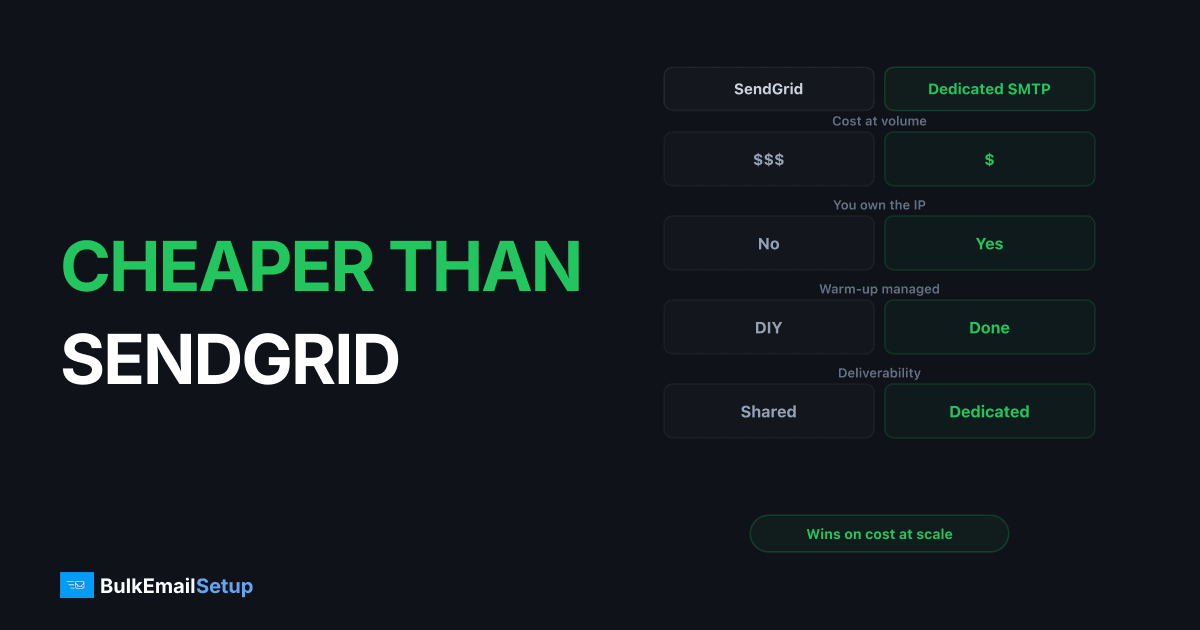
If you want a sendgrid cheaper alternative at 1M+ emails a month, the two real options are Amazon SES at roughly $100/month (cheapest invoice, you own all the deliverability work) or a managed dedicated SMTP server at a flat $100-200/month (warm-up and monitoring handled for you). SendGrid at that volume runs $700-1,500+/month, so most senders cut their bill 80-90% by switching. SES wins on raw price, flat-fee dedicated wins once you count the hours you'd otherwise spend babysitting an inbox-placement problem.
I've run 1M+/month through SendGrid, SES, and dedicated infrastructure. Below is what the bill actually looked like, not the marketing-page math.
What SendGrid actually charges at 1M emails
SendGrid's pricing reads cheap at the bottom and gets ugly at the top. The Essentials tier is fine for 50K. The problem is what happens when you scale.
As a 2026 ballpark (check current pricing), 1M emails/month lands you on Pro or a custom contract somewhere between $700 and $1,500+ depending on add-ons. A dedicated IP is extra. Overage past your plan ceiling is billed per block and adds up fast if your volume is spiky.
Three things make the real number higher than the sticker:
- Dedicated IPs cost extra and you often need two or three to separate transactional from marketing.
- Email validation, dedicated support, and SSO are upsells on higher tiers.
- Overages on a plan you've outgrown get expensive per thousand.
The per-email model is the whole issue. You pay more every month you grow, even though your marginal cost of sending one more email is basically zero.
The honest cost comparison at 1M+/month
Here's what the same 1M monthly sends cost across the options I'd actually recommend. Prices are 2026 ballparks, check current pricing before you commit.
| Option | ~Cost at 1M/mo | Dedicated IP | Who owns deliverability | Best for |
|---|---|---|---|---|
| SendGrid (Pro+) | ~$700-1,500+ | Paid add-on | Shared/managed | Teams already locked in |
| Amazon SES | ~$100 + IP $25 | +$24.95/mo | You, entirely | Engineering teams, cost-driven |
| Mailgun (higher tiers) | ~$600-900 | Included higher up | Shared | API-first dev teams |
| SMTP2GO | ~$500-700 | On top plans | Shared | Easy relay swap, mid volume |
| Self-hosted Postal/Postfix | ~$40-80 (server) | Yes | You, 100% | Sysadmin teams with time |
| Managed dedicated SMTP (BulkEmailSetup) | Flat ~$100-200 | Yes, warmed | Managed for you | Volume senders, agencies |
Two clusters jump out. Per-email providers (SendGrid, Mailgun, SMTP2GO) all sit in the hundreds-to-thousands range at 1M. Flat-fee or near-flat options (SES on price, dedicated/self-hosted on labor) sit far below. The middle is where most people overpay without noticing.
For the full per-volume breakdown see the cost to send 1 million emails per month.
Amazon SES: cheapest invoice, you're the deliverability team
SES is the price floor: about $0.10 per 1,000 emails, so 1M costs roughly $100. Add ~$25/month for a dedicated IP. Nothing on this list beats that per-email number.
What you don't get: warm-up automation, useful analytics, lenient sending policy, or support you can call. SES will auto-pause your account if bounce or complaint rates tick up, and the sandbox-exit review rejects plenty of legitimate bulk senders. You own warm-up, blacklist delisting, bounce processing, and feedback loops.
If you have an engineer who'll own this, SES is excellent and unbeatable on cost. If not, the $100 invoice hides real labor. Full teardown in Amazon SES vs Dedicated SMTP Server and a broader list in Amazon SES alternatives.
Mailgun and SMTP2GO: better UX, still per-email pain
Mailgun's API, logs, and docs beat SendGrid's, and at low volume the gap matters. But the pricing model is the same shape: per-email tiers that punish scale. At 1M you're looking at roughly $600-900/month on higher tiers, with steep jumps between plans. See the Mailgun pricing breakdown and Mailgun alternatives.
SMTP2GO is the cleanest drop-in relay swap, ten minutes to change host and credentials, but you're on shared infrastructure at most tiers and pricing at 1M lands around $500-700. Good if migration effort is your main constraint and volume is moderate, not great as a pure cost play at seven figures.
Both are real upgrades in developer experience. Neither solves the core problem: you keep paying more as you grow.
Self-hosting: near-zero cost, maximum work
Run Postal or Postfix on a $40-80/month VPS with a dedicated IP and your per-email cost approaches zero even at 1M. I've run both in production. Read Postal vs Postfix before picking.
The honest downside: you own everything. IP warm-up over weeks, rDNS, DKIM/SPF/DMARC alignment, feedback loops, blacklist remediation, bounce parsing, queue tuning so 1M doesn't back up. Budget 15-25 hours for setup and a few hours a month after. Get warm-up wrong and you're in spam for weeks, which costs far more than you saved on the server. For the full labor-vs-cost math see self-hosted vs managed vs ESP TCO.
Managed dedicated SMTP: flat fee, deliverability handled
This is the middle path and where most high-volume senders land. You get your own server and dedicated IP, so reputation is entirely yours, but a provider runs warm-up, monitoring, blacklist remediation, and DNS setup. The fee is flat, typically $100-200/month at 1M, and it doesn't move whether you send 500K or 2M.
The trade-off versus SES is a higher floor. At 50K/month, SES is cheaper. The crossover where flat-fee dedicated wins is usually between 100K and 300K/month, and by 1M it's not close: a flat $150 beats both a $100 SES invoice plus engineering hours and a $700+ SendGrid bill. Whether the managed layer is worth it is broken down in is managed SMTP worth it, and vendor evaluation in the best dedicated SMTP server providers.
Why dedicated matters at this volume: a dedicated IP vs shared IP means no one else's spam tanks your placement. The cost is warm-up time, which is exactly the part a managed provider absorbs. See how long IP warm-up takes for the timeline.
Who should pick what
- Under 100K/month, transactional-heavy: stay on SES or a low SendGrid tier, switching isn't worth the migration.
- Engineering team, cost-obsessed, owns deliverability: Amazon SES, hands down on price.
- API-first dev shop, moderate volume: Mailgun, eyes open on cost at scale.
- 1M+/month, want your own reputation without the ops grind: managed dedicated SMTP server.
- Sysadmin time to spare, maximum control: self-host Postal, read how to set up an SMTP server for bulk email first.
Two mistakes I keep seeing at high volume
Counting the invoice, not the hours. SES at $100/month becomes expensive the first weekend you lose to a Microsoft block with no support to call. A senior engineer's time isn't free. Price it in.
Mixing transactional and marketing on one IP. At 1M sends, one bad campaign that spikes complaints can drag your password resets into spam. Separate streams, different subdomains at minimum (see subdomain vs root domain for email sending), ideally different IPs. And watch your bounce rate daily, a clean list is what keeps any of these options cheap.
For related cost comparisons see SendGrid alternatives ranked by price, cheaper than Mailchimp, and SMTP relay pricing comparison.
How BulkEmailSetup helps
BulkEmailSetup runs dedicated SMTP servers with managed IP warm-up, blacklist monitoring, and full DNS setup, your own reputation, none of the 2 a.m. delisting work. At 1M+ emails a month, a flat monthly fee typically beats SendGrid by 80-90% and beats SES once you count your own engineering hours. See pricing for current plans.
Frequently asked questions
What is the cheapest SendGrid alternative for 1M emails per month?
Amazon SES is cheapest on raw price at roughly $100 per 1M emails ($0.10 per 1,000), but you own all deliverability work. A managed dedicated SMTP server is a flat $100-200/month at that volume and handles warm-up and monitoring for you. SendGrid typically runs $700-1,500+/month for 1M.
How much does SendGrid cost at 1 million emails a month?
As a 2026 ballpark, SendGrid's Pro and higher tiers land somewhere between $700 and $1,500+ per month for 1M emails depending on contract and add-ons like dedicated IPs. Check current pricing, but per-email tiers scale badly above 500K.
At what volume does a flat-fee dedicated SMTP server beat SendGrid?
Usually between 100K and 300K emails per month. Below that, SES or SendGrid's lower tiers are cheaper. Above 300K, a flat $100-200/month dedicated server pulls ahead fast because your cost stops scaling with volume.
Is Amazon SES really cheaper than SendGrid at scale?
On the invoice, yes, SES is about 7-10x cheaper per email at 1M. The hidden cost is labor: warm-up, blacklist remediation, bounce handling, and no real support. Price your own engineering hours in before calling SES the winner.
Can I send 1M emails a month from my own server?
Yes, Postal or Postfix on a $40-80/month VPS with a dedicated IP can handle it. The work is warming the IP over weeks, configuring SPF/DKIM/DMARC, and monitoring blacklists daily. Budget real time or use a managed dedicated SMTP provider instead.


