
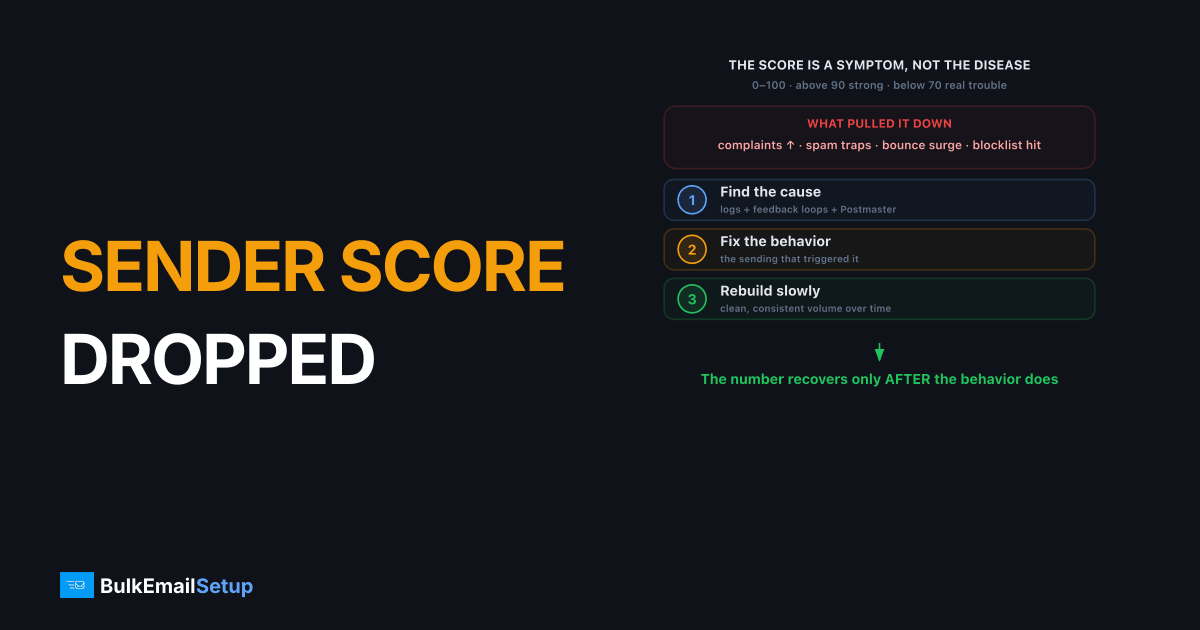
A dropped Sender Score is a symptom, not the disease. The score (Validity's Sender Score, a 0 to 100 reputation rating for your sending IP) falls when complaints rise, you hit spam traps, bounces surge, or your IP lands on a blocklist. Recovery means three things in order: find the specific cause in your logs and feedback loops, fix the sending behavior behind it, then rebuild reputation slowly with clean, consistent volume. The number recovers only after the behavior does.
What is Sender Score and what's a good one?
Sender Score is a 0 to 100 reputation rating Validity assigns to a sending IP, roughly a percentile rank against other senders. Above 90 is strong. 80 to 90 is workable. Below 70 means real trouble that's likely costing you inbox placement. The score is calculated from the same signals mailbox providers watch: complaint rates, spam-trap hits, bounce rates, blocklist appearances, and sending volume consistency.
It's a proxy, not a direct deliverability input. Gmail and Microsoft run their own systems. But because they watch the same behaviors, a falling Sender Score usually mirrors a falling reputation everywhere. See how the two relate in domain reputation vs IP reputation.
Why did my Sender Score drop?
A sudden drop has a specific trigger. Find which one before you fix anything.
| Cause | How to confirm it |
|---|---|
| Spam complaints spiked | Check feedback loops and Google Postmaster complaint rate |
| Hit spam traps | Sudden drop after mailing an old or purchased list |
| Bounce rate surged | Lots of 5.1.1 user-unknown bounces in your logs |
| Blocklist listing | Check Spamhaus, Barracuda, UCEPROTECT for your IP |
| Volume inconsistency | Big spikes or long gaps in your send pattern |
| Sending to inactive recipients | Low engagement drags reputation down over time |
The single biggest lever is complaint rate. Gmail and Yahoo want it under 0.3%, ideally under 0.1%. Cross that and your reputation drops fast. See Gmail's 0.3% complaint threshold.
How do I recover a dropped Sender Score?
Recovery is sequential. Skipping the diagnosis just makes the rebuild fail again.
- Find the root cause. Pull your bounce and complaint data, check feedback loops, and run your IP against the major blocklists. Don't rebuild until you know what dropped it.
- Clean your list. Remove hard bounces, role addresses, and unengaged contacts. A dirty list is the most common root cause. See email list cleaning.
- Delist if blocklisted. If your IP is on Spamhaus or another list, follow the blocklist delisting process. The score can't recover while you're listed.
- Cut complaint sources. Honor unsubscribes instantly, make the unsubscribe obvious, and stop mailing people who don't engage. Set up feedback loops.
- Verify authentication. Confirm SPF, DKIM, and DMARC all pass. Auth failures depress reputation. Use our authentication setup guide.
- Rebuild volume slowly. Drop to your most engaged recipients, send consistently, and ramp back up over a few weeks like a mini warm-up. Steady, clean sending is what lifts the score.
- Monitor weekly. Watch the score and your Postmaster Tools data so you catch the next dip early.
How do I confirm the recovery is holding?
Track three numbers weekly, not just the Sender Score itself. The score lags the behavior, so leading indicators tell you sooner whether the fix took.
| Metric | Where to check | Healthy target |
|---|---|---|
| Complaint rate | Google Postmaster, feedback loops | Under 0.1% |
| Bounce rate | Your sending logs | Under 2% |
| Blocklist status | Spamhaus, Barracuda, UCEPROTECT | Not listed |
When complaints and bounces stay low across a few weeks of steady volume and you're off every blocklist, the Sender Score follows upward. If the number stalls while those metrics look clean, give it more time, reputation rebuilds slowly. If the number drops again, you missed a root cause, so go back to the diagnosis step.
How long until my reputation recovers?
There's no instant fix. Reputation is earned through behavior over time, so expect a few weeks of clean, consistent sending before the score climbs back. If you hit spam traps or got blocklisted, the recovery is slower because you have to prove the bad pattern is gone. The mistake to avoid: blasting your full list again to "make up volume." That just re-triggers the drop. Patience and a smaller engaged audience rebuild faster than volume ever will.
On the IPs we manage, a score that fell from the low 90s into the 70s after a complaint spike typically takes three to four weeks of clean sending to climb back, and that only holds when the sender cuts to their most engaged 20 to 30 percent first. The one case that breaks the pattern is a Spamhaus listing layered on top. There the score barely moves until the delisting clears, because the listing keeps re-poisoning every signal underneath it.
How BulkEmailSetup helps
We give you a dedicated IP whose reputation is entirely yours, with full authentication, feedback loops, and active blocklist monitoring, so a drop gets caught early and recovery is in your hands, not stuck behind a shared-pool provider's queue. We help with delisting and warm-back too. See plans on our pricing page.
Frequently asked questions
What is a good Sender Score?
Sender Score runs from 0 to 100 and roughly tracks percentile. Above 90 is strong, 80 to 90 is acceptable, and below 70 signals real reputation trouble that's likely hurting your inbox placement. The number is relative, so direction matters as much as the value.
Why did my Sender Score drop suddenly?
A sudden drop usually means a specific event: a spike in spam complaints, hitting spam traps from a bad list, a surge in bounces, or a new blocklist listing. Sudden drops have a cause you can find in your logs and feedback loops.
How long does it take to recover a Sender Score?
Reputation rebuilds with consistent good sending, not overnight. Expect a few weeks of clean, steady volume with low complaints and bounces before the score recovers meaningfully. Fixing the root cause first is what makes the recovery stick.
Does Sender Score affect deliverability?
It's a proxy, not a direct input. Mailbox providers run their own reputation systems, but the same signals that lower your Sender Score (complaints, traps, bounces, blocklists) also lower your standing at Gmail, Yahoo, and Microsoft. So a falling score usually mirrors falling inbox placement.


