
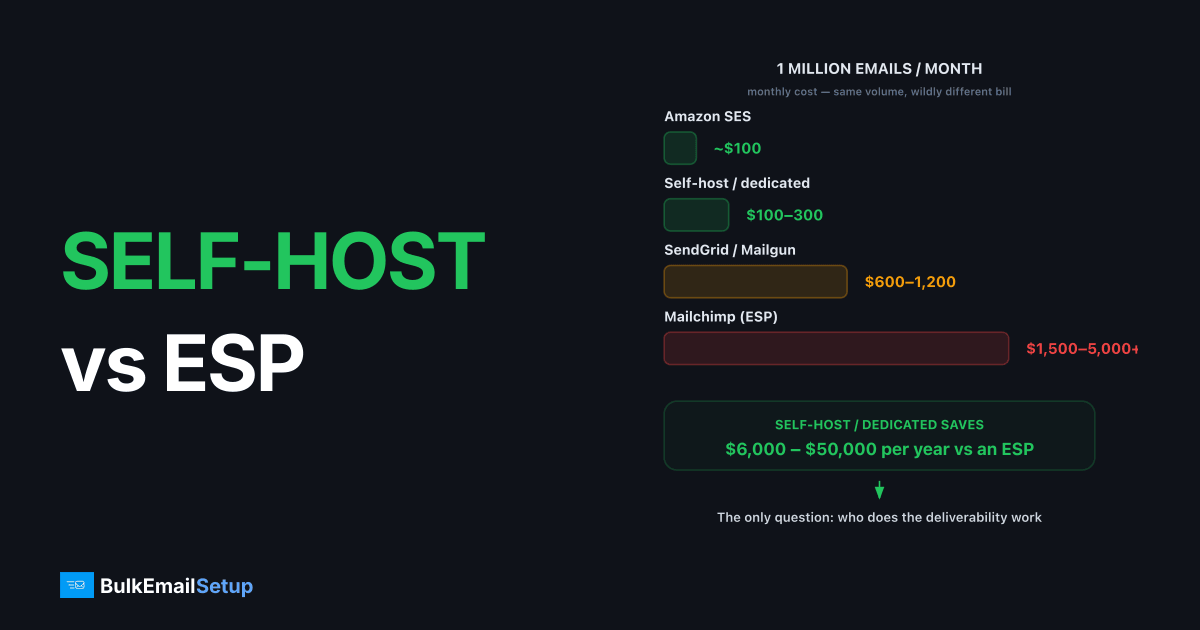
At 1 million emails per month, the cost spread is enormous: roughly $100 on Amazon SES, $100-300 on a self-hosted or managed dedicated SMTP server, $600-1,200 on SMTP relays like SendGrid or Mailgun, and $1,500-5,000+ on contact-priced ESPs like Mailchimp. Self-hosting or a managed dedicated server saves a 1M/month sender $6,000-50,000 per year versus an ESP. The only real question is who does the deliverability work, you, or a provider.
I've migrated three companies off ESPs at this volume. The full ledger, including the line items the pricing pages don't show.
The headline comparison
| Route | Monthly cost at 1M emails | Annual cost | Deliverability owner |
|---|---|---|---|
| Amazon SES (+2 dedicated IPs) | ~$150 | ~$1,800 | You |
| Self-hosted (Postal on VPS) | ~$60-120 | ~$700-1,400 | You |
| Managed dedicated SMTP | ~$100-300 flat | ~$1,200-3,600 | Provider |
| SendGrid / Mailgun (relay) | ~$600-1,200 | ~$7,200-14,400 | Shared |
| Mailchimp / Klaviyo (ESP) | ~$1,500-5,000+ | ~$18,000-60,000+ | Provider |
2026 ballparks; check current pricing. ESP figures assume a contact list large enough to generate 1M monthly sends (roughly 150-250K contacts on a weekly cadence).
Why ESPs cost so much at this volume
ESPs price by contacts, not sends. Mailchimp at ~200K contacts runs well north of $1,500/month as of 2026; Klaviyo similar or higher. You're paying for the campaign builder, segmentation UI, and templates on every single contact, every month, whether you email them or not.
That tooling has value. But at 1M sends/month, most teams have either built their sending logic into their product or run a self-hosted campaign tool like MailWizz or Mautic, making the ESP's UI redundant. Then you're paying $20,000+/year for an SMTP relay with a dashboard. The detailed Mailchimp math is in Mailchimp vs self-hosted SMTP.
The self-hosted ledger, line by line
What running 1M/month yourself actually costs:
| Line item | Monthly cost |
|---|---|
| VPS (4 core, 8GB, Hetzner/OVH class) | $25-50 |
| 2 dedicated IPs | $5-20 |
| Backup/monitoring tooling | $10-20 |
| Domain(s) for sending | $2-5 |
| Postal or Postfix license | $0 (open source) |
| Infrastructure total | $45-95 |
| Your time: warm-up, blacklists, bounces, upgrades (~8-15 hrs) | $400-750 at $50/hr |
| True total | $450-850 |
Two things to notice. Infrastructure is almost free, 1M emails/month is only ~33K/day, light work for any modern VPS. And labor dominates the real cost, which is the dirty secret of every "self-hosting is basically free" article.
The labor is also spiky. Most months it's quiet. Then you land on Spamhaus because a scraped segment got imported, and you lose two days to remediation while campaigns queue. If you want the DIY route, start with how to set up an SMTP server for bulk email and pick your MTA via Postal vs Postfix.
The managed middle path
A managed dedicated SMTP server moves that labor line to a provider: they warm the IPs, configure rDNS/DKIM/SPF/DMARC, monitor blacklists daily, and handle delisting. Typical 2026 cost for 1M/month capacity: $100-300 flat.
Versus pure self-hosting you pay maybe $50-200/month extra and delete the 8-15 hour labor line. Versus an ESP you save four figures monthly. This is the configuration most 1M/month senders I know eventually land on, the economics are covered from the relay side in our SMTP relay pricing comparison.
What the ESPs still do better
Fairness requires saying this plainly. ESPs give you:
- Drag-and-drop builders, template libraries, and preview testing your team can use without engineers.
- Built-in compliance tooling (one-click unsubscribe, consent records, GDPR exports).
- Deliverability handled invisibly, you never think about IP reputation.
- Send-time optimization, A/B testing, and analytics out of the box.
If your marketing team lives in those tools and the $30K/year line item isn't painful, staying put is a legitimate choice. The switch makes sense when the bill hurts, when you've outgrown the builder, or when an ESP's content policies conflict with what you send.
Migration reality check
Moving 1M/month off an ESP isn't a weekend job. Plan for:
- Weeks 1-2: stand up infrastructure, configure authentication, import suppression lists from the ESP (critical, losing your unsubscribe history is a compliance violation).
- Weeks 2-6: warm-up. Start at 1-2K/day on the new IPs, roughly double every 2-3 days, watch bounce codes. The ESP carries the remaining volume during the ramp.
- Week 6+: full cutover, keep the ESP account dormant for a month as a fallback.
Rushing the warm-up is the classic failure mode. Gmail and Microsoft will throttle a cold IP that jumps to 30K/day, and the resulting deferrals get misread as a broken server. For high-throughput targets, see how to send 1 million emails per day.
What actually changes at 1M that didn't matter at 100K
A few operational realities show up at this scale that smaller senders never meet:
Receiver rate limits become your scheduler. Gmail, Microsoft, and Yahoo each throttle per-IP connection and message rates. At 33K/day you're shaping traffic per destination. Postal's IP pools or Postfix transport maps handle it, but someone has to configure them.
Bounce volume is an engineering problem. Even a healthy 1.5% bounce rate is 15,000 bounces a month. Manual handling is impossible; automated parsing and suppression must work flawlessly or your list rots in place.
One blacklist costs real money. At ESP scale a Spamhaus listing was your provider's problem. Now a two-day listing delays a million sends, which is why monitoring and a practiced delisting runbook (or a provider who owns both) stop being optional.
None of these are hard individually. Collectively they're a part-time job, which is the honest argument for the managed row in the table above.
The verdict
| If you are... | Choose |
|---|---|
| Engineering-led, transactional-heavy, cost-obsessed | Amazon SES |
| Sysadmin-capable, want maximum control, time available | Self-hosted Postal |
| Volume sender wanting savings without the ops burden | Managed dedicated SMTP |
| Marketing-team-led, budget tolerant, love the tooling | Stay on the ESP |
At 1M/month the spread between cheapest and most expensive is roughly $50,000/year. Few infrastructure decisions in a company that size pay back faster than this one.
How BulkEmailSetup helps
BulkEmailSetup runs dedicated SMTP servers built for exactly this volume, warmed IPs, managed authentication, daily blacklist monitoring, and a flat fee that doesn't move whether you send 200K or 1M. Most ESP migrants cut their email bill by 80-95%. See the pricing page for current plans.
Frequently asked questions
How much does it cost to send 1 million emails per month?
As of 2026: roughly $100 on Amazon SES, $100-300 on self-hosted or managed dedicated SMTP infrastructure, $600-1,200 on SMTP relays like SendGrid or Mailgun, and $1,500-5,000+ on contact-priced ESPs like Mailchimp or Klaviyo.
How many IPs do I need to send 1 million emails a month?
One well-warmed dedicated IP can handle 1M/month (about 33K/day) comfortably. Most serious senders use 2-4 IPs for redundancy and to separate marketing from transactional streams.
Is self-hosting email worth it at 1 million emails per month?
Financially, almost always, you save $500-4,000+ per month versus ESPs. The catch is operational: warm-up, blacklist monitoring, and bounce handling need real attention, which is why many senders choose a managed dedicated server instead of pure DIY.
Can one server send 1 million emails a month?
Easily. 1M/month is ~33K/day, which a modest 4-core VPS running Postal or Postfix handles without strain. Throughput is rarely the bottleneck, receiver-side rate limits and reputation are.
What deliverability rate should I expect at this volume?
With a warmed dedicated IP, proper authentication, and a clean list, 95%+ acceptance and strong inbox placement are normal. List quality matters more than infrastructure choice at this point.


