
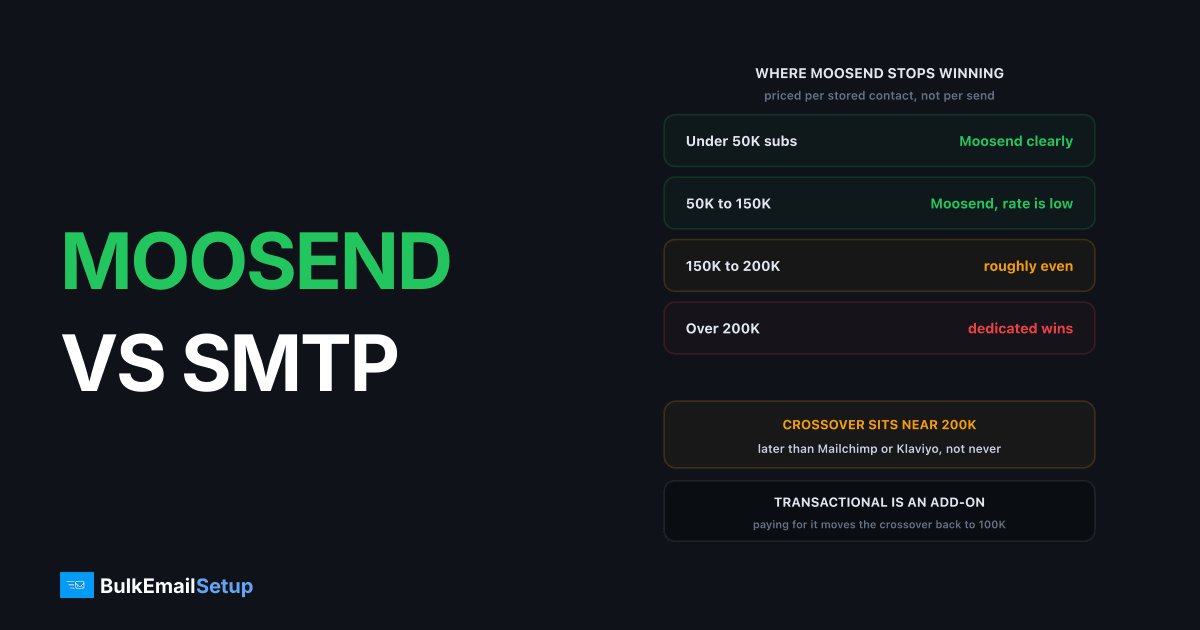
Moosend prices lower per contact than most platforms, which pushes the crossover with a dedicated server further out than usual. Where Mailchimp or Klaviyo start losing on cost around 100,000 contacts, Moosend often holds its value to 150,000 or 200,000. That makes the decision genuinely closer than it is with pricier platforms.
The real comparison here is not platform against server. It is a cheap bundle where everything is included against your own infrastructure where you assemble the tooling yourself. Moosend is unusually good at the bundle, so you have to be honest about what the bundle is worth to you before the cost table means anything.
Side by side
| Factor | Moosend | Dedicated SMTP |
|---|---|---|
| Pricing model | per stored contact | one-time build |
| Cost at 100K contacts | ~$300-500/mo | fixed, no per-contact fee |
| Annual discount | 20% off, 15% biannual | not applicable |
| IP reputation | shared pool | yours alone |
| Dedicated IPs | paid add-on | included |
| Campaign builder | yes | bring your own |
| Automation | yes | no |
| Landing pages, forms | yes | no |
| Transactional email | add-on to Pro | same server, no extra fee |
| Warm-up | handled | yours, 4-8 weeks |
| Suspension risk | real | none, IPs are yours |
The row people miss is the transactional one. Moosend's marketing subscription does not carry your order confirmations and password resets by default, so if you need both you are pricing two things.
How Moosend actually charges
Moosend's pricing page runs a Pro plan priced by stored subscribers, with tier steps at 500, 1,000, 2,000, 3,000, 5,000, 8,000, 10,000, 25,000, 50,000, 75,000, 100,000, 150,000, 200,000, 250,000, 300,000, 400,000, 500,000, 600,000, 700,000, 800,000 and 1,000,000 contacts. Above that there is Moosend+ with add-ons and an Enterprise tier on custom pricing.
The page does not print a monthly figure until you select a tier, so treat any number quoted in a comparison article, including ours, as an estimate and check the tier you actually need.
| Line item | How it is charged |
|---|---|
| Pro plan | by stored contact tier, monthly |
| Biannual billing | 15% off |
| Annual billing | 20% off |
| Transactional email | add-on to Pro, included in Enterprise |
| Dedicated IP | add-on |
| SSO and SAML | add-on |
| Custom reports | add-on |
| Pay-as-you-go credits | $350 for 350k, $500 for 500k, $750 for 750k, $1,000 for 1M |
There is a 30-day free trial with no card, which covers unlimited sends to up to 1,000 contacts.
The pay-as-you-go credits are worth noting separately. At $1,000 for a million email credits you are paying $1 per thousand emails, which is not cheap against a dedicated server but is useful if your sending is spiky rather than monthly.
What the bundle actually contains
This is the part that makes Moosend a harder platform to leave than its price suggests. For one monthly fee you get:
- Drag-and-drop campaign builder with templates
- Automation workflows with triggers and branching
- Landing pages and signup forms, hosted
- Segmentation and list management
- Reporting and A/B testing
- Deliverability handled on their pools, no warm-up
- A support team when a send misbehaves
A dedicated SMTP server gives you exactly one of those: it sends mail reliably from IPs you own. Everything above is yours to assemble.
| What you need | On Moosend | On your own server |
|---|---|---|
| Send mail | included | the server itself |
| Build campaigns | included | MailWizz, Sendy, Mautic, Listmonk |
| Automation | included | your mailer's version, usually weaker |
| Landing pages | included | your website or a separate tool |
| Forms | included | your website |
| Subscriber records | included | your mailer's database |
| Bounce handling | invisible | configured for you at build |
| Warm-up | invisible | 4 to 8 weeks, yours |
| Support | their team | your team, plus build support |
That table is the honest cost of moving. The build is one payment, but the assembly is your time, and a self-hosted mailer's automation is usually a step down from a platform's.
Cost at three list sizes
Prices below are estimates because the tier prices sit behind the picker. Verify yours.
| List size | Moosend, yearly | Dedicated build, year 1 | Year 2 onward |
|---|---|---|---|
| 10,000 subscribers | roughly $500 to $900 | $549 plus server hosting | hosting only |
| 50,000 subscribers | roughly $1,800 to $2,800 | $549 plus server hosting | hosting only |
| 100,000 subscribers | roughly $3,600 to $6,000 | $549 plus server hosting | hosting only |
At 10,000 subscribers Moosend costs less than the build and hands you a full marketing stack. There is no argument to make.
At 100,000 the build pays for itself in the first two or three months, and every month after that is hosting. But you have replaced a stack with a sender, and the software you bolt on top has to earn back the gap.
Full workings for the sending side are in what 500,000 emails a month costs and what 100,000 emails a month costs.
Where the cost crosses over
| Subscribers | Which wins |
|---|---|
| Under 50K | Moosend clearly |
| 50K - 150K | Moosend, the per-contact rate is competitive |
| 150K - 200K | roughly even, depends on send frequency |
| Over 200K | dedicated wins, and the gap widens |
Compare that with MailerLite, where the crossover sits nearer 100,000, or Klaviyo, where it arrives earlier still. The cheaper the platform's per-contact rate, the longer it stays the right answer.
The second variable is send frequency. A 150,000-contact list mailed weekly gets real value from a platform. The same list mailed once a month is paying a subscription for storage.
The third is whether you need transactional as well. If you are paying for the transactional add-on on top of the Pro plan, your effective per-contact rate is higher than the headline, and the crossover moves back toward 100,000.
The shared pool trade
On Moosend your mail leaves from IPs used by many other senders. Receiving networks score those IPs collectively, so your delivery reflects the behaviour of everyone on them.
| What happens | Effect on you |
|---|---|
| Another sender's complaint spike | your mail slows or filters, no notice |
| Moosend's abuse team acting fast | protects you from the above |
| Your own complaint spike | they restrict you to protect the pool |
| Your careful sending | subsidises riskier senders on the same IPs |
That is a fair trade at 20,000 contacts. The provider is doing reputation work you would otherwise do yourself, and you send from day one with no ramp.
It stops being fair when your volume is large enough to hold its own reputation, because then you carry pool risk without needing the pool. See dedicated IP vs shared IP and is a dedicated IP worth it.
The catch on the other side: dedicated IPs need consistent volume to stay warm. At 50,000 emails a month spread thinly, three dedicated IPs will underperform a busy shared pool. Volume is a prerequisite, not a bonus.
What Gmail requires either way
Platform choice does not exempt you from the sender rules. Google's bulk sender guidelines apply to anyone sending over 5,000 messages a day to Gmail addresses, whoever carries the mail:
- SPF and DKIM on the sending domain
- A DMARC record, even at
p=none - From header aligned with the SPF or DKIM domain
- One-click unsubscribe in the header, plus a visible link in the body
- Spam complaint rate under 0.30%, ideally under 0.10%
- Valid forward and reverse DNS on the sending IP
- TLS on the connection
Moosend handles the DNS and IP side. The complaint rate is yours in both models, and it is the requirement that actually breaks campaigns. Those rules became mandatory in February 2024.
The reason to move that is not cost
Cost is the usual trigger, but it is not the only one. On shared pools your delivery depends on other senders' behaviour, and you have no visibility into it. If you have hit unexplained delivery problems, or your use case is bumping into platform policy, dedicated IPs solve something money cannot.
There is also the storage problem that every per-contact platform creates. An unengaged 30% of your list costs exactly what your best customers cost. Cleaning it is the highest-return action on any per-contact plan, and it improves delivery at the same time. See email list cleaning.
What the move actually involves
A dedicated SMTP server sends mail. It does not build campaigns, run automation, host forms or manage subscribers. Senders who move usually run MailWizz, Sendy, Mautic or Listmonk on top, which restores the campaign layer for a one-time or low monthly cost.
The rough shape, in weeks:
Week 1. Server, IPs and authentication on a sending subdomain. SPF, DKIM and DMARC published at p=none. PTR matching the HELO hostname.
Week 2. Install the mailer, import the list, and load Moosend's exported suppression list first. Those opt-outs still bind you legally.
Weeks 3 to 10. Warm up. A few hundred a day per IP to your most engaged segment, ramping around 30% every two days, watching deferrals rather than opens.
Ongoing. Weekly checks on complaint rate, bounce rate and Google Postmaster Tools.
The part people underestimate is weeks 3 to 10. You cannot run your usual send schedule during warm-up, so keep Moosend live until the new path carries full volume.
So the honest shape is: you replace a monthly subscription with a build plus cheaper software, and you take on warm-up and list hygiene. At 200,000 contacts that maths works clearly. At 80,000 it usually does not.
Which to pick
Stay on Moosend under 150,000 subscribers, especially if you mail weekly and use the automation. It is priced well for what it does, and the annual discount at 20% narrows the gap further.
Move to dedicated past 200,000, or sooner if you need reputation control rather than cost savings, and if someone will own warm-up and hygiene.
Run both if your sending splits cleanly: Moosend for automated lifecycle mail, dedicated infrastructure for full-list campaigns where per-contact pricing is worst.
Do not move if nobody on your team will watch complaint rates weekly. Dedicated IPs degrade quietly without an owner, and a busy shared pool is genuinely safer in that case.
Questions worth settling first
How often do you send? Weekly sending to a large list makes a platform look good. Monthly sending to the same list is mostly paying for storage.
Do you need transactional too? If the add-on is on your bill, your real per-contact rate is higher and the crossover comes earlier.
How clean is the list? Dedicated IPs amplify list quality in both directions. Fix a stale list before deciding, because it changes both the bill and the delivery picture.
Who owns warm-up? Eight weeks of daily attention. If that is nobody's job, stay on shared infrastructure. This is the most common reason self-managed sending fails.
What is your growth path? Per-contact pricing compounds. Run the numbers at next year's list size, not today's.
How BulkEmailSetup helps
We build the sending half: your own server, your own IPs, full SPF/DKIM/DMARC/PTR configuration, MTA tuning, bounce handling and a warm-up plan. You keep whatever campaign software suits you.
Basic starts at $549 one-time, covering 1 SMTP server, 3 dedicated IPs, 25,000 emails/day and unlimited contacts, which is the line that matters when you are charged per contact elsewhere. Higher tiers run to 15 dedicated IPs and 200,000 emails a day. See pricing, or when do you need a dedicated SMTP server to size the decision.
Frequently asked questions
Is Moosend good for bulk email?
Yes, up to a point, and further than most platforms. Moosend prices lower per contact than Mailchimp, Klaviyo or ActiveCampaign while including a campaign builder and automation, so the volume at which a dedicated server becomes cheaper arrives later. You are still on shared IP pools throughout.
How much does Moosend cost at 100,000 subscribers?
Roughly $300 to $500 a month depending on plan and features, charged on stored subscribers rather than emails sent. Moosend's own pricing page lists tiers from 500 up to 1,000,000 contacts and only shows the price once you pick a tier, so check it for your exact count.
When should I move from Moosend to my own SMTP server?
Later than with most platforms. The cost case usually appears past 150,000 to 200,000 subscribers rather than the 100,000 typical elsewhere, because Moosend's per-contact rate is lower. Move sooner if you need dedicated IPs for reputation control rather than for cost.
Does Moosend offer dedicated IPs?
Yes, but as a paid add-on rather than something included in the Pro plan, and realistically for accounts with consistent volume. Below that you share IP pools with other senders, so their complaint rates affect your delivery and you cannot see who you are sharing with.
Does Moosend do transactional email?
Transactional sending is an add-on to the Pro plan and is bundled into Enterprise. It is not part of the base marketing subscription, so if you need order confirmations and password resets as well as campaigns, price that separately before comparing against a server that carries both.
What do you lose moving off Moosend?
The drag-and-drop campaign builder, automation workflows, landing pages and signup forms, and the support team. A dedicated SMTP server provides sending only, so most senders pair one with self-hosted software such as MailWizz, Sendy, Mautic or Listmonk.


