
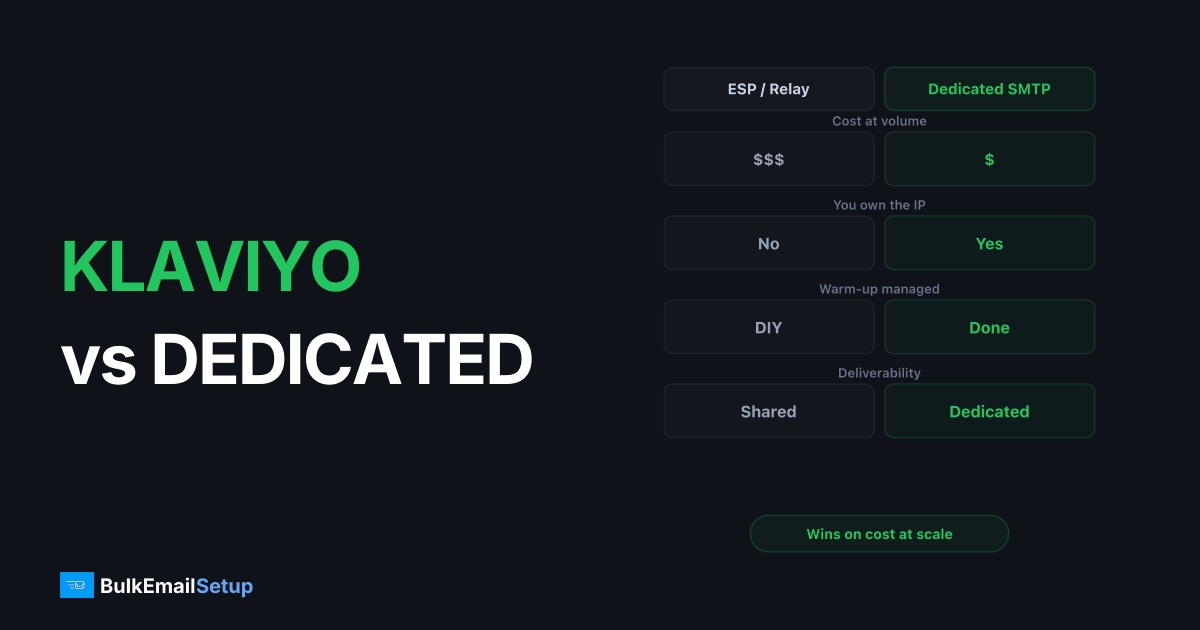
If you're weighing Klaviyo vs an SMTP server for ecommerce, the split is simple: Klaviyo bills by contact count (a 100K-profile list runs roughly $1,300-1,700/month in 2026), while a managed dedicated SMTP server is a flat $50-150/month no matter how many contacts or emails you push. The crossover where your own server wins on cost is usually 50K-100K active profiles. Below that, Klaviyo's flows and Shopify sync are worth the price. Above it, you're paying four-figure sums for a marketing UI you could replace, and the delivery itself costs almost nothing.
I've run ecommerce email both ways: Klaviyo for the automation, and dedicated SMTP for the heavy sending when the contact bill got silly. Here's the honest math and where each one actually fits.
Klaviyo vs SMTP server: what you're actually comparing
These two things aren't the same product, and pretending they are is how people make bad decisions.
| Factor | Klaviyo | Dedicated SMTP server |
|---|---|---|
| What it is | Marketing platform + sender | Delivery pipe only |
| Bills by | Active profiles (contacts) | Flat monthly fee |
| Ecommerce flows | Yes, prebuilt | No, you build them |
| Shopify/BigCommerce sync | Native | None |
| IP reputation | Shared/pooled mostly | Yours, dedicated |
| Segmentation UI | Excellent | None |
| Who owns deliverability | Klaviyo | Managed for you |
Klaviyo is a full marketing stack: it builds emails, syncs your store, segments buyers, runs abandoned-cart flows, and sends. A dedicated SMTP server just delivers mail you hand it. So the real comparison isn't "Klaviyo or a server." It's "Klaviyo doing everything" versus "a server doing delivery plus something cheaper doing the marketing layer."
That distinction is the whole article. The cost gap is huge, but you only capture it if you're willing to rebuild the automation somewhere else.
How Klaviyo pricing actually works
Klaviyo charges by active profiles, not emails sent. This is the trap that catches growing stores.
You pay for every contact in your account whether you email them daily or never. A 100K-profile list costs the same if you send one campaign a month or twenty. Most ESPs that bill this way at least assume you mail the list. Klaviyo charges for contacts sitting idle.
2026 ballparks, check current pricing:
| Active profiles | Klaviyo email-only ~monthly |
|---|---|
| 5K | ~$70 |
| 25K | ~$400-450 |
| 50K | ~$700-800 |
| 100K | ~$1,300-1,700 |
| 250K | ~$2,300+ |
| 500K | custom / $4,000+ |
The SMS add-on stacks on top. So does the cost of stale contacts: people who bought once two years ago and never opened again still count against your tier. I've seen stores paying for 40K dead profiles because nobody ran a sunset flow.
Compare that to delivery cost. Sending 100K emails through raw infrastructure costs single-digit dollars. Klaviyo's price is the marketing software, not the postage. For a teardown of the contact-billing model and cheaper marketing tools, see Klaviyo alternatives.
What a dedicated SMTP server costs
A managed dedicated SMTP server is flat. You get your own server, a dedicated IP that's warmed and monitored, and the provider handles blacklist remediation and DNS. Typical range is $50-150/month, and it doesn't move when your list grows.
| Monthly send volume | Managed dedicated SMTP |
|---|---|
| 100K | ~$50-150 flat |
| 500K | ~$50-150 flat |
| 1M | ~$100-200 flat |
| 5M | flat tier, still cheap per email |
The flat model rewards exactly the situation that punishes Klaviyo users: a big list you mail often. Per-email pricing and per-contact pricing both climb with scale. A flat fee doesn't.
The honest catch: a server only sends. No flows, no Shopify sync, no segment builder. You pair it with a marketing tool that supports custom SMTP, or a self-hosted campaign sender. More on that trade-off below. For the broader cost picture across hosting models, read self-hosted vs managed vs ESP TCO.
The crossover: when volume justifies your own server
Here's the side-by-side at different list sizes, assuming you mail the list a few times a week.
| Active profiles | Klaviyo (email) | SMTP server + cheap marketing tool | Monthly saving |
|---|---|---|---|
| 5K | ~$70 | ~$50-100 (overkill) | none, stay on Klaviyo |
| 25K | ~$400-450 | ~$80-150 | ~$300 |
| 50K | ~$700-800 | ~$100-180 | ~$550 |
| 100K | ~$1,300-1,700 | ~$120-250 | ~$1,200 |
| 250K | ~$2,300+ | ~$150-300 | ~$2,000+ |
2026 ballparks, check current pricing. The marketing-tool line assumes something like a self-hosted sender or a flat-rate campaign app feeding the SMTP server.
The pattern: under 25K profiles, Klaviyo's value is real and the savings are small or negative once you count your own labor. Between 25K and 100K, the gap opens fast. Past 100K, you're leaving four figures a month on the table to keep a UI.
That's the math behind the cost to send 1 million emails per month, where flat delivery pricing crushes any per-contact or per-email model.
What you give up by leaving Klaviyo
I won't pretend this is free. Klaviyo earns its price for the right store.
- Prebuilt ecommerce flows. Abandoned cart, browse abandon, post-purchase, win-back. These drive real revenue and you'd rebuild them by hand elsewhere.
- Native store sync. Shopify/BigCommerce data flows in automatically: orders, products, browsing behavior. An SMTP server has none of this.
- Predictive segments and CLV. Klaviyo's modeling around who's likely to buy next is genuinely good.
- The reporting UI. Revenue per email, per flow, per segment, in one dashboard.
A dedicated SMTP server replaces the delivery only. If your email program is mostly automated flows tied to store events, ripping out Klaviyo means rebuilding that automation, and the savings may not be worth the engineering time. If your program is mostly broadcast campaigns to a big list, the flows matter less and the server wins easily.
The clean split a lot of stores land on: keep a small Klaviyo account for low-volume transactional flows, move the big newsletter blasts to a dedicated server. You pay Klaviyo for 10K active profiles, not 150K.
Deliverability: shared vs owned reputation
Klaviyo runs most accounts on shared or pooled IPs. Dedicated IPs exist on higher tiers but cost extra and you don't fully control the pool below that. So your inbox placement partly depends on other Klaviyo senders.
A dedicated SMTP server gives you one IP that's yours. Nobody else can tank its reputation, and nobody else benefits from your good sending. The trade-off is warm-up: a fresh IP needs ramping over 2-4 weeks before you can blast a full list. See how long IP warm-up takes and dedicated vs shared IP for the mechanics.
For a 150K-buyer store sending several times a week, an owned, warmed IP usually outperforms a shared pool, because high engaged volume builds reputation fast and you never inherit a neighbor's spam complaints. Keep your list clean while you're at it, reducing bounce rate protects the IP you now own outright.
Who should pick what
- Under 25K profiles, automation-heavy store: stay on Klaviyo. The flows and sync earn their keep, and savings are thin.
- 25K-100K profiles, mostly broadcast campaigns: strong case for moving sends to a dedicated SMTP server, keep a tiny Klaviyo for flows if needed.
- 100K+ profiles, mailing often: dedicated SMTP server wins clearly on cost. Rebuild flows in a cheaper tool or self-host.
- Tiny list, want it all in one place, price-insensitive: Klaviyo, no question.
- Engineering team, cost-obsessed, willing to own marketing tooling: SMTP server plus self-hosted sender, see how to set up an SMTP server for bulk email.
If you're comparing the delivery layer specifically, the same logic that applies to Amazon SES vs dedicated SMTP and SendGrid vs dedicated SMTP holds here: flat pricing beats metered pricing once volume is sustained.
Migration notes if you switch
- Export suppressions first. Pull unsubscribes, bounces, and complaints out of Klaviyo before sending a single email from the new setup. Mailing a previously-unsubscribed buyer is a complaint generator and a compliance problem.
- Split your sending domain. Use a subdomain for the new bulk stream so a campaign mistake can't hurt other mail. See subdomain vs root domain for sending.
- Warm the new IP over 2-4 weeks. Start with your most engaged buyers, recent purchasers and openers, while Klaviyo carries the rest. Recent buyers generate the opens that build reputation fastest.
- Keep a small Klaviyo account live for 30 days. Cheap insurance and a home for transactional flows you don't want to rebuild yet.
- Watch bounce codes daily during the ramp. 4xx means slow down, 5xx means stop and diagnose.
For the cheapest viable delivery setup, see bulk email setup under $100 and the cheapest way to send 100K emails per month.
How BulkEmailSetup helps
BulkEmailSetup runs dedicated SMTP servers with managed IP warm-up, blacklist monitoring, and full DNS setup, so your store gets its own warmed reputation without the 2 a.m. delisting work. For a 100K+ profile list, a flat monthly fee typically beats Klaviyo's contact-based pricing by 80-90% on the delivery side, and you keep Klaviyo (or a cheaper tool) only for the flows you actually use. See pricing for current plans, and is managed SMTP worth it if you're still deciding between managed and self-hosted.
Frequently asked questions
Is a dedicated SMTP server cheaper than Klaviyo?
At list sizes above roughly 50K-100K contacts, usually yes. Klaviyo bills by contact count, so a 100K-contact account runs $1,300-1,700/month in 2026 ballparks. A managed dedicated SMTP server is a flat $50-150/month regardless of list size. The catch: you lose Klaviyo's flows, segmentation, and ecommerce integrations, so you'd pair the server with your own or a cheaper marketing tool.
Can I send Klaviyo campaigns through my own SMTP server?
Not directly. Klaviyo is a closed platform that sends through its own infrastructure and won't relay through an external SMTP host. To use a dedicated SMTP server you move campaign building to a tool that supports custom SMTP (like a self-hosted sender or a cheaper marketing app), then relay through the server.
Does switching off Klaviyo hurt deliverability?
Temporarily, while a new dedicated IP warms up over 2-4 weeks. Klaviyo runs you on shared or pooled IPs at most tiers, so its reputation isn't yours to keep. A dedicated IP gives you a clean, owned reputation but needs ramping. Move your most engaged buyers first.
What do I lose by leaving Klaviyo for an SMTP server?
The marketing layer: prebuilt ecommerce flows (abandoned cart, browse abandon, post-purchase), Shopify/BigCommerce sync, predictive segments, and the reporting UI. An SMTP server only handles delivery. You keep the savings but rebuild the automation elsewhere.
At what list size does Klaviyo get expensive?
Around 25K-50K active profiles is where the monthly bill starts to sting, often $400-800/month. Past 100K profiles you're routinely over $1,000/month, and 250K+ profiles can exceed $2,000/month even at modest send frequency, since you pay for contacts whether you mail them or not.


