
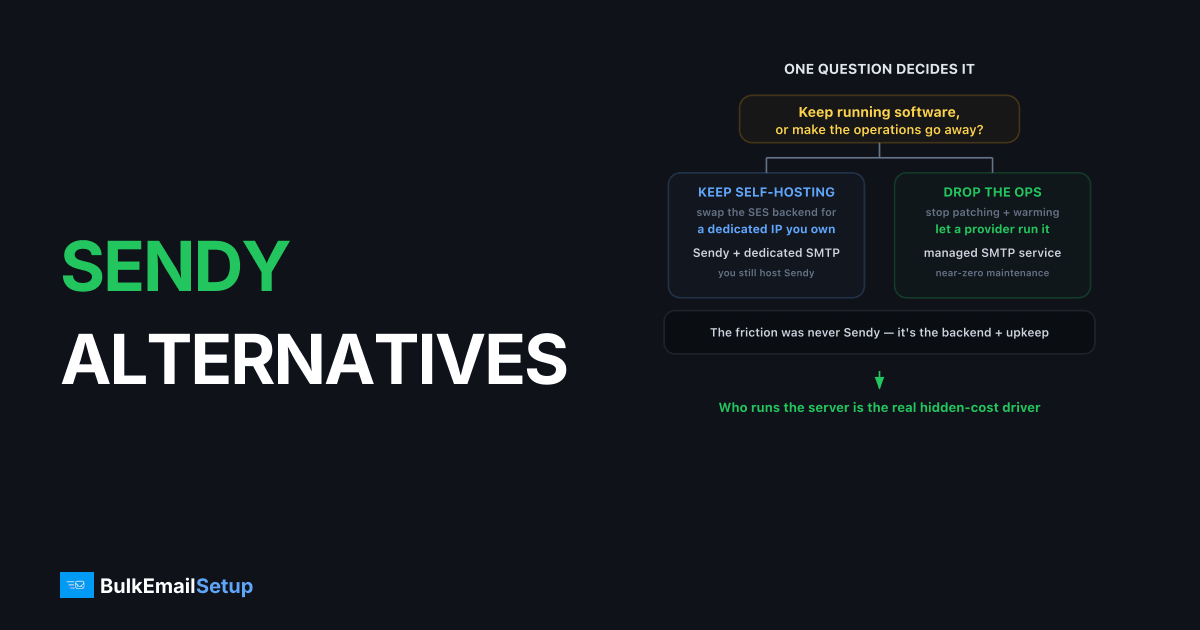
The best Sendy alternative depends on one choice: do you want to keep self-hosting, or do you want the maintenance gone? Sendy is cheap campaign software that leans on a sending backend, usually Amazon SES. The friction is rarely Sendy itself, it's the backend deliverability and the upkeep. If you like owning software, swap the SES backend for a dedicated SMTP server with a dedicated IP you control. If you'd rather stop patching servers and managing warm-up, a managed SMTP service does it for you. Here's the honest comparison, with pricing as of early 2026.
What problem is Sendy actually solving?
Sendy is a one-time-license, self-hosted email app that sends through an external SMTP backend. Its appeal is cost: pay once for the software, then pay cheap per-email rates to a backend like SES. For technical teams sending newsletters at volume, that combination can be very economical.
The trade-offs show up in two places. First, the backend: SES runs shared pools by default, so deliverability isn't fully in your hands, and you build bounce handling, suppression, and feedback loops yourself. Second, the hosting: you keep the Sendy server patched, secured, and online. Both are real work.
Self-hosted vs managed SMTP alternatives
Approximate pricing as of early 2026. Self-hosted costs exclude your time, which is the real variable. Read as ranges.
| Option | Software cost | Backend / IP | Maintenance | Best for |
|---|---|---|---|---|
| Sendy + SES | ~$69 one-time | SES per-email, shared IP | You (high) | Technical newsletter teams |
| Sendy + dedicated SMTP | ~$69 one-time | Flat, dedicated IP you own | You host Sendy | Want IP control, keep Sendy |
| Self-hosted Postfix/Mautic | Free / open source | Your VPS + IP | You (very high) | Engineers who want full control |
| Managed SMTP service | Included | Dedicated IP, managed | Provider | Want volume without ops |
| Amazon SES direct | None | Per-email, shared IP | You (high) | Devs comfortable with AWS |
How to choose a Sendy alternative
Choose your Sendy alternative by answering one question first: do you want to keep running software, or do you want the operations gone? Everything else follows from that. Sendy's whole value is cheap self-hosting, so the alternatives split cleanly into "keep self-hosting, better backend" and "drop the ops entirely."
Score candidates on five axes:
- Who runs the server. You, or the provider? This is the single biggest hidden-cost driver.
- Backend deliverability. Shared pool (like SES default) or a dedicated IP you control?
- Maintenance load. Patching, warm-up, blocklist monitoring, DNS. Count the hours honestly.
- Per-email vs flat cost. Cheap per-email rates look great until a campaign spikes.
- Migration friction. Can you keep your existing campaign interface, or rebuild?
The honest framing most Sendy comparisons skip: the backend, not Sendy, is usually the real problem. Sendy is fine software. SES shared-pool deliverability and the suppression handling you wire yourself are what bite. So one strong option is keeping Sendy and only changing what's behind it.
A worked cost example at 200K emails/month
Take a newsletter team sending 200,000 emails a month. Sendy plus SES looks almost free: a one-time license around $69 and roughly $20 in SES send fees at about $0.10 per 1,000. On paper, that's the cheapest row in any table.
Now price the labor. Warm-up takes weeks of attention. A single Spamhaus CSS listing can eat half a day of delisting work plus the deliverability hit while you're listed. Add OS patching, DNS upkeep, and the occasional 550 5.7.1 block debugged before a send. If that's even four hours a month at a real engineering rate, the true cost passes most flat managed plans. The cheap row only stays cheap if your hours are worth nothing, which they aren't.
The hidden cost of self-hosting
Self-hosted looks cheapest because the visible numbers are small: a license, a VPS, cheap per-email backend rates. The invisible cost is your time. Someone has to warm up the IP over 4-6 weeks, watch Spamhaus and Barracuda for listings, handle delisting, patch the OS, and debug a 550 5.7.1 block at 11pm before a campaign.
That's the honest pitch for managed SMTP: it bundles that labor into a flat fee. Whether self-hosting is cheaper depends entirely on what your hours are worth. The Sendy-plus-SES senders who reach us are rarely chasing a lower per-email rate, they are tired of the upkeep. The recurring trigger is a Spamhaus CSS listing that cost them a launch window, the kind of half-day delisting scramble that turns a "nearly free" stack into a real cost the moment it happens. For a deeper breakdown, see managed SMTP vs DIY time cost and the broader self-hosted vs managed vs ESP TCO analysis.
When to keep Sendy and when to leave it
You can keep Sendy and just upgrade the backend. Point Sendy at a dedicated SMTP server instead of SES, and you keep the cheap, familiar interface while gaining a dedicated IP whose reputation is yours alone. That fixes the deliverability half of the problem without changing your campaign workflow.
Leave Sendy entirely when the hosting maintenance outweighs the savings, or when you want streams isolated and reputation managed for you. Either way, deliverability still depends on list hygiene, correct SPF, DKIM, and DMARC, and complaints under 0.3%. No backend swap fixes a bad list.
How to swap the Sendy backend without breaking sends
Swapping Sendy's backend from SES to a dedicated SMTP server is a configuration change, not a rebuild, because Sendy speaks plain SMTP. You keep the campaigns, lists, and templates you already have. Only the credentials Sendy sends through change, and the upside is a dedicated IP whose reputation is yours.
The steps are short:
- Add a new SMTP brand or sending profile in Sendy pointing at your dedicated server: host, port 587 with STARTTLS, and auth credentials.
- Publish authentication for the sending domain: SPF, DKIM, and DMARC, plus a valid PTR record on the new IP.
- Warm the IP over 4-6 weeks, throttling Sendy's send rate down at first and ramping up.
- Watch the logs. A
421 4.7.0means too many connections; back off concurrency. A550 5.7.1means a reputation or policy block to investigate. - Keep suppression tight. Honor bounces and complaints so a fresh IP doesn't get listed in week one.
Because Sendy stays in place, your team's workflow doesn't change. Only the deliverability and cost profile improves, assuming your list and authentication are clean.
One Sendy-specific gotcha catches people on the very first send through a new backend: Sendy's per-brand send rate. Sendy throttles sends with a "send rate" setting per brand, and people leave it at the old SES-tuned value when they switch to a fresh dedicated IP. A fresh IP wants a low, slow rate for the first week, not the throughput SES granted a warmed account. Set the brand's send rate down to a trickle for the warm-up, then raise it weekly as the IP earns headroom. The other gotcha is autoresponders and scheduled campaigns that fire mid-cutover. Pause them before you swap credentials, or a queued blast can hit the cold IP at full volume the moment you save the new backend and undo a careful warm-up in one send.
What swapping the backend does not fix
Changing Sendy's backend fixes the IP and the cost, not your list or your sending habits. This is the honest limit of any backend swap. Move a stale, unverified list onto a shiny dedicated IP and you'll get blocklisted faster than you did on SES, because now the bad reputation is yours alone with nowhere to hide.
The fundamentals that decide inbox placement don't change with the backend. Over 5,000 sends a day, Gmail and Yahoo require SPF, DKIM, and DMARC, one-click unsubscribe (RFC 8058), valid reverse DNS, and a complaint rate under 0.3%. A dedicated IP gives you the control to meet those cleanly, but you still have to do the work: clean the list, honor unsubscribes, watch complaints. The swap removes the shared-pool ceiling. It does not remove the need to send well. That's the same caveat whether you keep Sendy or move to managed SMTP entirely.
How BulkEmailSetup helps
If you like Sendy but the SES backend keeps you on a shared pool, point Sendy at a dedicated SMTP server from us: a dedicated IP you control, full SMTP access, and authentication set up correctly. If you'd rather drop the self-hosting entirely, we run the server, warm-up, and reputation monitoring for you. See plans on our pricing page.
Frequently asked questions
What is the best alternative to Sendy?
It depends on whether you want to keep self-hosting. If you like owning the software, a dedicated SMTP server replaces the SES backend with a dedicated IP you control. If you want less maintenance, a managed SMTP service handles the server, warm-up, and reputation for you.
Why do people move off Sendy?
Sendy is one-time-license software that relies on a sending backend, usually Amazon SES. The friction is the backend: SES shared-pool deliverability, suppression and bounce handling you wire yourself, and the maintenance of keeping a self-hosted app patched and secure. Many senders want the IP control and hands-off operation that Sendy alone doesn't provide.
Is self-hosted SMTP cheaper than managed?
Self-hosted looks cheaper on paper because you only pay for the server and per-email backend. But the real cost includes your time on patching, warm-up, blocklist monitoring, and DNS. Managed SMTP bundles that labor into a flat fee, which is often cheaper once you price your hours honestly.
Can I keep Sendy and just change the sending backend?
Yes. Sendy works with any SMTP service, so you can keep the Sendy interface and point it at a dedicated SMTP server instead of SES. That gives you a dedicated IP you control while keeping the cheap, familiar campaign software.


