
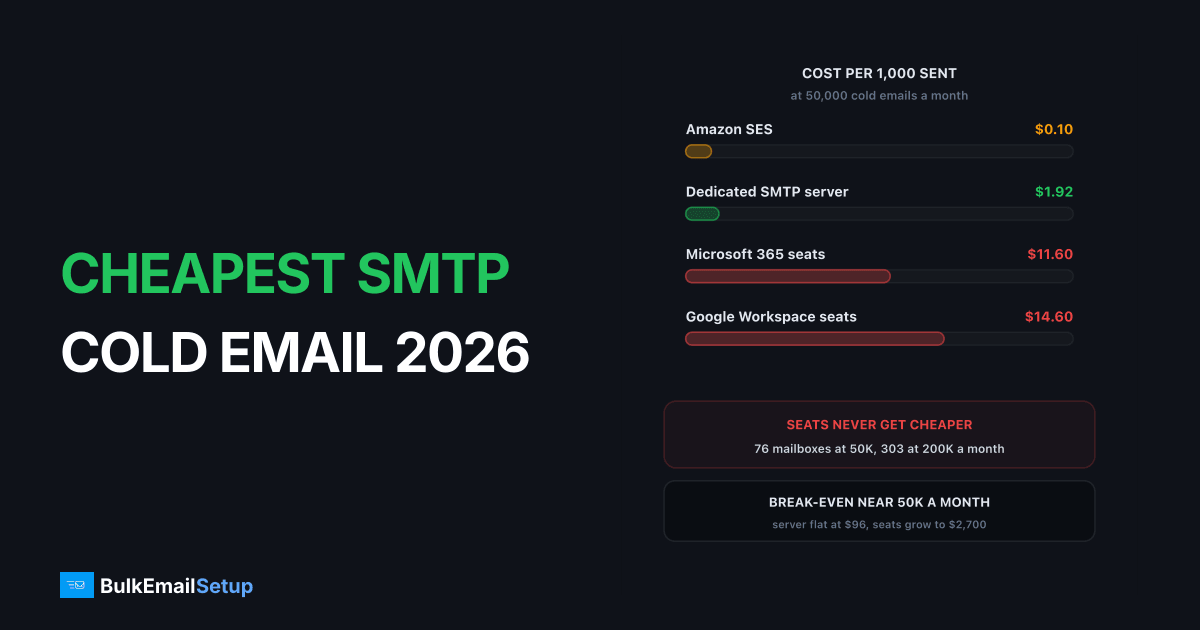
The cheapest SMTP for cold email per message sent is Amazon SES at $0.10 per 1,000, and a dedicated SMTP server at $549 one-time is cheapest once you pass roughly 50,000 emails a month. Google Workspace mailboxes cost $14 to $17 per 1,000 sends, the most expensive option on this page by a factor of 100. The catch is that cheapest per send is not cheapest per reply. Mailbox sending caps at 30 to 50 emails a day per seat, so volume is bought in $8 chunks forever, while cheap infrastructure needs 4 to 8 weeks of warm-up before it carries any volume at all. Here are the real numbers at 10K, 50K and 200K a month.
What each option actually costs to send with
Price per 1,000 emails is the number every vendor quotes and the one that misleads most. It ignores the seats, the domains and the warm-up time each option demands before it delivers anything.
| Option | Sending price | What else you pay | Volume ceiling |
|---|---|---|---|
| Google Workspace mailboxes | about $8 per mailbox per month | sequencer $37 to $97, domains, warm-up tool | 30 to 50 a day per mailbox |
| Microsoft 365 mailboxes | about $6 per mailbox per month (Business Basic) | same stack, plus 10,000 recipients a day tenant cap | 30 to 50 a day per mailbox |
| Amazon SES | $0.10 per 1,000 emails | $24.95 a month per dedicated IP, your own sending code or tool | quota-based, request increases |
| Dedicated SMTP server | $549 one-time plus about $50 a month VPS | domains, reply mailboxes, your own warm-up time | 25,000 a day on Basic |
Microsoft 365 Business Basic undercuts Workspace on the seat price, and in practice it is not the bargain the sticker suggests. The tenant-wide 10,000 external recipients a day cap sits above what cold sending should use anyway, but Microsoft's outbound filtering on new tenants is aggressive, and buying 40 seats in one tenant is itself a flag. Most outbound teams I have seen run Workspace for the primary rotation and 365 as a second pool, not as a cheaper replacement.
A note on scope: this article is about cost. Which providers permit cold outreach at all is a separate question with a different answer, covered in SMTP providers that actually allow cold email. Do not pick on price alone before checking that the provider's terms allow the sending.
Total cost at 10K, 50K and 200K cold emails a month
Year-one monthly totals, rounded, including the sequencer and the seat fees but before domains, warm-up tools and verification. Mailbox counts assume a safe 30 sends per mailbox per day over 22 working days, which is about 660 a month per seat.
| Monthly volume | Workspace mailboxes | Microsoft 365 mailboxes | Amazon SES | Dedicated SMTP server |
|---|---|---|---|---|
| 10,000 | 16 seats, about $170 | 16 seats, about $135 | about $1 sending | about $96 |
| 50,000 | 76 seats, about $730 | 76 seats, about $580 | about $5 sending | about $96 |
| 200,000 | 303 seats, about $2,700 | 303 seats, about $2,100 | about $20 sending | about $96 |
The dedicated figure is the $549 one-time fee spread over 12 months plus a $50 VPS. In year two it drops to about $50 a month flat, because the one-time fee has already been paid. 200,000 a month is under 7,000 a day, comfortably inside Basic's 25,000 daily cap, so the same $549 covers all three rows.
Now the same numbers as cost per 1,000 sent, which is the comparison that actually ranks the options.
| Monthly volume | Workspace | Microsoft 365 | Amazon SES | Dedicated server |
|---|---|---|---|---|
| 10,000 | $17.00 | $13.50 | $0.10 | $9.60 |
| 50,000 | $14.60 | $11.60 | $0.10 | $1.92 |
| 200,000 | $13.50 | $10.50 | $0.10 | $0.48 |
Read the mailbox columns carefully. They barely improve with scale, because each extra 660 emails a month costs another $8 whether you send 10,000 or 200,000. That is the whole problem with seat-priced sending: there is no volume discount, ever. The dedicated column drops by a factor of 20 across the same range because the cost is fixed and the volume is not.
Cost per positive reply, which is the number that matters
Nobody buys emails. You buy conversations. At a 2% positive reply rate, 10,000 sends produce about 200 replies, and here is what each option costs to get them.
| Reply rate | Replies from 10,000 sends | Workspace at $170 | Dedicated at $96 | SES at $1 |
|---|---|---|---|---|
| 1% | 100 | $1.70 per reply | $0.96 per reply | $0.01 per reply |
| 2% | 200 | $0.85 per reply | $0.48 per reply | under $0.01 |
| 3% | 300 | $0.57 per reply | $0.32 per reply | under $0.01 |
Two things fall out of that table. First, halving your reply rate doubles your cost per reply on every option, and reply rate moves with list quality, targeting and copy, none of which your SMTP choice touches. A 3% reply rate on expensive infrastructure beats a 1% reply rate on free infrastructure every time. Second, at these volumes the infrastructure cost per reply is under two dollars on the most expensive option, which means the sales time spent handling those replies costs more than the sending. Optimising a $1.70 line item while your list is stale is the wrong fight.
Where cost per reply does bite is at the top of the range. 200,000 a month at a 2% reply rate is 4,000 replies, and $2,700 of Workspace seats against $96 of server puts $2,600 a month back on the table. Same replies, same list, different infrastructure.
The hidden costs nobody puts on the pricing page
Every quoted price above is incomplete. Cold email carries a set of running costs that sit outside the SMTP line item entirely, and together they add 30% to 50% on top.
| Hidden cost | Typical price | Why you need it |
|---|---|---|
| Sending domains | $10 to $15 a year each | 1 domain per 2 to 3 mailboxes, never your main domain |
| Warm-up service | $30 to $50 a month | keeps new mailboxes engaged before real sending |
| Email verification | $0.004 to $0.01 per address | bounce rate over 5% triggers review everywhere |
| Replacement domains | 20 to 30% of domains a year | burned domains cannot be recovered, only replaced |
| Reply mailboxes on a server | about $8 each | a dedicated server sends, it does not host inboxes |
| Warm-up time before revenue | 4 to 8 weeks | new IPs and domains carry no volume on day one |
Run those against the 10,000 a month mailbox setup. Sixteen mailboxes need 6 to 8 domains, so about $100 a year in registrations, a $40 a month warm-up tool, and a 10,000-record list costs $40 to $100 to verify. That turns $170 a month into roughly $220. Then budget replacements: burn 2 domains a year out of 8, and you are re-warming from scratch each time, which costs weeks not dollars.
The verification line is the one people skip and regret. A 50,000-record list at $0.008 an address is $400, and that feels expensive right up until a 12% bounce rate gets the SES account paused or the mailbox rotation flagged. Email list cleaning covers what verification catches and what it does not.
Why the cheapest option stops being cheapest at scale
The mailbox model fails on operations before it fails on price. Look at what each volume tier means as a job.
| Monthly volume | Mailboxes | Domains | Daily admin reality |
|---|---|---|---|
| 10,000 | 16 | 6 to 8 | one person, a spreadsheet, an hour a week |
| 50,000 | 76 | 25 to 30 | a part-time role, constant reconnects and warm-up checks |
| 200,000 | 303 | 100+ | a full-time operations hire, plus tooling to manage the tooling |
Three hundred mailboxes is not a bigger version of sixteen. Every mailbox needs a Workspace seat, an app password or OAuth connection that silently expires, DNS records on its domain, a warm-up slot, and an inbox somebody reads. Every domain needs SPF, DKIM, DMARC and a registration that renews. At 100 domains you have 300 DNS records to keep correct and a renewal calendar that will fail you at least once.
Amazon SES is the mirror image. Almost no operations load, near-zero cost, and a single point of failure: the account. SES reviews near a 0.1% complaint rate or a 5% bounce rate, and a review can end in a sending pause with no warning. At 200,000 cold emails a month through one account, that pattern is exactly what draws the review. Cheap sending you cannot rely on is not cheap sending. Amazon SES vs a dedicated SMTP server works through where that trade lands.
The dedicated server sits between the two. Real setup work up front, 4 to 8 weeks of warm-up before full volume, and then flat cost with the policy risk removed because you own the IPs. If an ESP has already closed your account for outreach, what to do after an ESP bans cold email covers the move.
The break-even and the compliance floor
The crossover sits around 50,000 emails a month. Below it, mailbox sending usually wins on total cost of ownership once you price your own time, because 16 seats is a manageable number and a server needs warm-up before it earns anything. Above it, the arithmetic is not close: at 200,000 a month the seat model costs 28 times what the server costs and needs a hire to run.
| Monthly volume | Recommendation | Reasoning |
|---|---|---|
| Under 10,000 | Workspace or 365 mailboxes plus a sequencer | about $170 a month, native inbox reputation, replies handled |
| 10,000 to 50,000 | mailboxes, with a server warming in parallel | seat costs still tolerable, start the 4 to 8 week warm-up now |
| 50,000 to 200,000 | dedicated SMTP server on separate domains | under $2 per 1,000, no seat growth, no shared-pool policy |
| Any volume, verified B2B list, engineers on staff | Amazon SES | $0.10 per 1,000, but you carry the pause risk |
| Scraped or bought lists | none of these | every option pauses you, and CAN-SPAM liability follows the list |
None of this changes the rules underneath. The FTC's CAN-SPAM compliance guide requires honest headers and subject lines, a valid physical postal address in every message, and an opt-out honoured within 10 business days, with penalties up to $53,088 per email in violation. The company being promoted is liable alongside whoever pressed send. Google's email sender guidelines require SPF, DKIM and DMARC for anyone sending 5,000 or more a day to Gmail, a spam rate under 0.3% in Postmaster Tools, and one-click unsubscribe, and cold senders should treat 0.1% as their real ceiling.
Both of those are floors, not features. They cost the same on a $2,700 mailbox stack as on a $96 server, and breaching either one makes the cheapest infrastructure on the page worth nothing. Whichever route you pick, run cold outreach on separate sending domains and keep your main domain out of it. Cold email with multiple domains covers how many to run and how to split the volume, and dedicated SMTP for cold email outreach has the isolation setup.
How BulkEmailSetup helps
We build dedicated SMTP infrastructure you own: your own server, your own IPs, full SPF/DKIM/DMARC/PTR configuration, MTA tuning, bounce handling and a warm-up plan sized for outreach volume. The cost is fixed, so it does not grow with your send count the way seat fees do, and because the IPs are yours alone there is no shared pool and no acceptable use policy deciding whether your compliant cold email is too risky for someone else's customers.
Basic starts at $549 one-time, covering 1 SMTP server, 3 dedicated IPs, 25,000 emails/day and unlimited contacts. Higher tiers scale to 15 IPs and 200,000 emails/day. See pricing, or read SMTP providers that actually allow cold email for the policy side of the decision.
Frequently asked questions
What is the cheapest SMTP for cold email in 2026?
Per email sent, Amazon SES at $0.10 per 1,000 is cheapest, and a dedicated SMTP server at $549 one-time plus about $50 a month VPS is second once you pass roughly 50,000 emails a month. Google Workspace mailboxes are the most expensive at $14 to $17 per 1,000 sends because you pay about $8 per seat and each seat safely sends only 30 to 50 a day. Cheapest per send and cheapest per reply are different answers.
How much does it cost to send 10,000 cold emails a month?
About $170 a month on Google Workspace mailboxes, because 10,000 a month needs roughly 16 seats at $8 each plus a $37 to $97 sequencer. On Amazon SES the sending itself is $1. On a dedicated SMTP server it is about $96 a month in year one once you spread the $549 one-time fee over 12 months. Add $12 a year per sending domain and $30 to $50 a month for warm-up tools on top of any mailbox setup.
What is the real cost per positive reply on cold email?
At a 2% positive reply rate, 10,000 sends produce about 200 replies. Google Workspace at $170 a month works out to roughly $0.85 per reply, a dedicated server at $96 to about $0.48, and Amazon SES at $1 of sending to under a cent. Reply rate swings the number far harder than infrastructure does: dropping from 3% to 1% triples your cost per reply on every option.
At what volume does a dedicated SMTP server become cheaper than mailboxes?
Around 50,000 emails a month. At that volume mailbox sending needs roughly 76 seats and costs about $730 a month, while a dedicated server stays flat at about $96 in year one and about $50 in year two. Below 20,000 a month the mailbox route is usually cheaper and simpler; above 50,000 the seat fees never stop growing and a server does not.
What are the hidden costs of cold email nobody quotes?
Domain registrations at $10 to $15 a year each, and you need one per 2 to 3 mailboxes. Warm-up services at $30 to $50 a month. Email verification at $0.004 to $0.01 per address, so a 50,000-record list costs $200 to $500 to clean. Replacement domains after burn, typically 20 to 30% of your domains per year. These add 30 to 50% on top of the seat and sending prices.
Is Amazon SES really the cheapest option for cold email?
On price, yes, at $0.10 per 1,000 emails. On risk, no. SES reviews accounts near a 0.1% complaint rate or a 5% bounce rate and can pause sending with no warning, and cold lists cross those lines faster than opt-in lists. It suits verified, tightly targeted B2B sending. It is a poor fit for scraped lists at any price.
How many mailboxes do I need for 200,000 cold emails a month?
About 303 at a safe 30 sends per mailbox per day over 22 working days, spread across 100 or more domains. That is roughly $2,700 a month in seats and tool fees before domains and warm-up, and the admin load alone needs a dedicated person. This is the point where mailbox sending stops being a cost question and becomes an operations problem.
What compliance rules apply no matter which SMTP I pick?
CAN-SPAM requires honest headers and subject lines, a valid physical postal address in every message, and an opt-out honoured within 10 business days, with penalties up to $53,088 per email. Gmail requires SPF, DKIM and DMARC for anyone sending 5,000 or more a day, a spam rate under 0.3% in Postmaster Tools, and one-click unsubscribe. Neither depends on which infrastructure you buy.


