
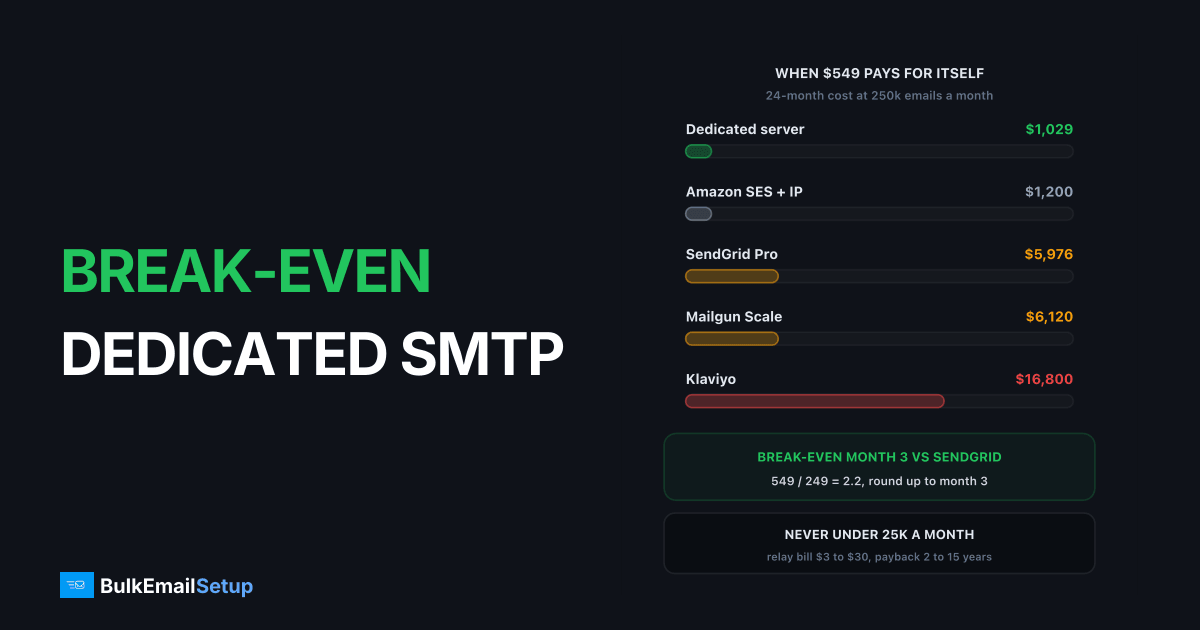
A $549 one-time dedicated SMTP server pays for itself in month 3 against SendGrid, Mailgun or SMTP2GO at 250,000 emails a month, in month 1 against Mailchimp or Klaviyo at the same volume, and in month 22 against Amazon SES. The formula is one line: $549 divided by the monthly bill you would stop paying, rounded up. Against every relay except SES the crossover sits around 100,000 emails a month, where the payback is 6 to 8 months. Below 50,000 a month the payback stretches past a year on every route, and the dedicated IP can't stay warm at that volume anyway.
The dedicated SMTP break even formula
Break-even month equals the one-time fee divided by the monthly bill, rounded up to the next whole month.
| Input | Where the number comes from |
|---|---|
| One-time fee | $549 for Basic (3 IPs, 25K/day), $1,199 for Advance (15 IPs, 200K/day) |
| Monthly bill avoided | Your current relay or ESP invoice, including any dedicated IP add-on |
| Ongoing cost to subtract | VPS hosting, roughly $11 to $30 a month on Basic |
| Answer | 549 / (bill minus hosting), round up |
Worked example. SendGrid Pro at 250K is about $249 a month. Hosting for the dedicated server is $20. So 549 / (249 - 20) = 2.4, which rounds up to month 3. From month 4 you keep the $229 difference every month, and by month 12 you're $2,200 ahead.
The hosting subtraction barely moves a $249 relay bill. It matters a lot against SES, where $20 of hosting eats most of a $25 send fee.
Break-even month by volume and provider
Monthly bills are the ones we use in the tier-by-tier posts: SES at $0.10 per 1,000 from the Amazon SES pricing page, SendGrid Pro tiers, and Mailchimp and Klaviyo on the contact counts that typically go with each send volume. The bill is the number you divide $549 by. Hosting is not subtracted here, so the SES column reads a month or two better than reality.
| Volume per month | SES | SMTP2GO | Mailgun | SendGrid | Brevo | Mailchimp | Klaviyo |
|---|---|---|---|---|---|---|---|
| 50K (bill) | $5 | ~$30 | ~$35 | ~$20 | ~$45 | ~$100 | ~$150 |
| 50K (break-even) | 9+ years | Month 19 | Month 16 | Month 28 | Month 13 | Month 6 | Month 4 |
| 100K (bill) | $10 | ~$85 | ~$90 | ~$90 | ~$75 | ~$300 | ~$400 |
| 100K (break-even) | 4.5 years | Month 7 | Month 7 | Month 7 | Month 8 | Month 2 | Month 2 |
| 250K (bill) | $25 | ~$225 | ~$255 | ~$249 | ~$300 | ~$550 | ~$700 |
| 250K (break-even) | Month 22 | Month 3 | Month 3 | Month 3 | Month 2 | Month 1 | Month 1 |
| 500K (bill) | $50 | ~$400 | ~$400 | ~$400 | ~$250 | ~$900 | ~$1,200 |
| 500K (break-even) | Month 11 | Month 2 | Month 2 | Month 2 | Month 3 | Month 1 | Month 1 |
| 1M (bill) | $100 | ~$650 | ~$750 | ~$900 | ~$550 | ~$1,600 | ~$2,400 |
| 1M (break-even, Advance $1,199) | Month 12 | Month 2 | Month 2 | Month 2 | Month 3 | Month 1 | Month 1 |
Three things to read off that table.
The 1M row uses the Advance tier, because 1M a month is 33,000 a day and Basic caps at 25,000. Basic carries up to 750K a month at full tilt, so everything from 50K to 500K is priced at $549.
Mailchimp and Klaviyo break even in a month or two at every volume from 100K up, because they bill on contacts rather than sends. A 60,000-contact list on Klaviyo costs about $700 a month whether you send to it once or four times. That is the strongest break-even case in the table and it's not close.
SES is the outlier in the other direction. At $0.10 per 1,000 there is no volume where the server beats bare SES on cash inside a year. Add the $24.95 dedicated IP that SES charges, and 250K becomes $50 a month with an 11-month payback. The SES decision is about hours, not the invoice, and I've covered that in Amazon SES vs a dedicated SMTP server.
What you still pay after the one-time fee
"One-time" covers the setup, the server build, DNS, MTA tuning and warm-up plan. It does not make the server free to run. Three costs stay.
| Line item | Dedicated server (Basic) | Typical relay | Notes |
|---|---|---|---|
| Hosting | $11 to $30/month, paid to the VPS provider | Included in the bill | Rises to ~$170/month on the largest tier |
| Dedicated IP rental | $0, 3 IPs included | $24.95 (SES) to $59 (Mailgun) per IP per month | Two IPs on Mailgun is $118/month on its own |
| Your ops hours | 2 to 5 hours/month | 1 to 3 hours/month | Bounce reports, Postmaster Tools, complaint rate |
| Ops hours at $50/hour | $100 to $250/month | $50 to $150/month | The gap is 1 to 2 hours, not 10 |
| Mailer software | Mautic free, MailWizz ~$99 one-time | Included campaign UI | Only if you leave a marketing platform |
| Overage | None below the daily cap | $1.10 to $1.80 per 1K over plan | A 100K spike on Mailgun is $110 to $180 |
The line people get wrong is ops hours. They compare a relay at zero hours to a server at ten. Neither is true. A relay still needs someone to clean the list and watch complaints, or the account gets suspended. The honest gap is an hour or two a month.
Self-hosting is a different story. A bare VPS with Postfix, or SES with nothing on top, is where the 10-hour months live, because you own warm-up, bounce parsing, feedback loops and blocklist checks with no one to call. Managed SMTP vs DIY time cost prices that out. This post assumes the managed version, where the hard parts are done for you.
The 24-month total at 250,000 a month
Two years is long enough to show the shape. Cash column is bills only. The right-hand column adds ops time on every route at $50 an hour: 5 hours a month on bare SES where you run everything, 3 on the managed server, 2 on a relay.
| Route | Monthly | 24-month cash | 24-month with ops hours |
|---|---|---|---|
| Amazon SES, bare | $25 | $600 | $6,600 (5 hrs/mo, you run everything) |
| Amazon SES + dedicated IP | $50 | $1,200 | $7,200 |
| Dedicated server (Basic) + $20 hosting | $549 once + $20 | $1,029 | $4,629 |
| SMTP2GO | ~$225 | ~$5,400 | ~$7,800 |
| SendGrid Pro | ~$249 | ~$5,976 | ~$8,376 |
| Mailgun Scale | ~$255 | ~$6,120 | ~$8,520 |
| Brevo Business + IP | ~$300 | ~$7,200 | ~$9,600 |
| Mailchimp Standard | ~$550 | ~$13,200 | ~$15,600 |
| Klaviyo | ~$700 | ~$16,800 | ~$19,200 |
On cash the server is $1,029 for two years against $5,400 to $16,800 for anything that isn't SES. With hours priced in it still beats every relay and even edges bare SES, because SES with no tooling costs you far more in time than it saves in fees. If you already have an engineer who enjoys AWS and has the hours, SES wins. Most teams at 250K don't.
At 100K the two-year cash figures are roughly $2,000 for SMTP2GO or Mailgun, $7,200 for Mailchimp, and $1,029 for the server, detailed in the 100K cost breakdown. At 25K the sums flip.
When the server never pays for itself
The maths has a floor, and pretending otherwise sells servers to people who should keep their relay.
Under 25,000 a month. A relay bill at that volume is $3 to $30. The payback on $549 is somewhere between 18 months and 15 years, and you'd pay $11 to $30 a month in hosting on top, which can exceed the relay bill outright. SES at $2.50 for 25K is unbeatable. See cost to send 25,000 emails per month before you buy anything.
25K to 50K a month. The cash case starts to appear against Mailchimp and Klaviyo, at 4 to 6 months, but not against the relays. And a dedicated IP at this volume can't accumulate enough history to hold a reputation. Gmail and Yahoo treat a low-volume IP as a stranger, so you get throttled more on your own IP than on a warm shared pool. The full argument is in how many emails before you need dedicated infrastructure.
Bursty senders at any volume. If your 250K a month lands as two 125K blasts with nothing between, the IPs cool off in the gap and each send starts a small re-warm. The break-even table assumes steady daily volume, ideally spread across 15 or more sending days. A shared pool absorbs the burst pattern because it never goes quiet. Spreading the blast across 3 IPs and 5 days fixes most of this, but only if your campaign schedule can bend.
Nobody to watch it. If no one on the team will spend an hour a week on bounce reports and Postmaster Tools, a relay that emails you when things break is the safer buy even at $250 a month. Is managed SMTP worth it draws that line in more detail.
The break-even that isn't money
The tables above stop at the invoice. Two things don't show on it and both push the crossover earlier.
Suspension risk. Every shared relay polices complaint rates tighter than Google's published 0.3% limit in its sender guidelines, because your complaints land on IPs their other customers use. SendGrid and Mailgun act at roughly 0.1%. A suspension pauses sending for 1 to 6 weeks and the re-warm on new infrastructure adds 4 to 8 more. If email drives even $2,000 a month of revenue, one suspension costs more than the server.
Policy. Cold outreach, affiliate offers, and a list of restricted categories are banned on shared pools regardless of your complaint rate, because the provider is managing risk for everyone on the IP. On IPs that are yours alone that objection disappears. You still answer to Gmail and the law, but not to a provider's risk team. For senders in those categories the break-even is month 1 at any volume, because the relay option isn't reliably available.
| Factor | Shared relay | Dedicated server |
|---|---|---|
| Complaint threshold that gets you paused | ~0.1%, set by the provider, unpublished | 0.3% at Gmail, published |
| Who decides if your use case is allowed | Provider's policy team | Receiving networks and the law |
| Cost of a suspension | 5 to 14 weeks of reduced sending | Not applicable, no account to suspend |
| Reputation shared with | Every other customer on the IP | Nobody |
| Overage on a spike month | $110 to $180 per extra 100K on Mailgun | $0 under the daily cap |
None of that means the server fixes a bad list. A 0.4% complaint rate follows your domain to any route. Fix the list first, then move.
The decision rule
Cut through the tables with three questions.
- Steady volume above 100,000 a month? Yes, and you're on anything other than SES: the server pays back in 6 to 8 months, faster at higher volume. Buy it.
- On Mailchimp or Klaviyo with 20,000+ contacts? The bill is $300 to $700 a month for sends that cost $10 to $25 on Amazon SES. The server pays back in 1 to 2 months. Move the sending, keep the platform for design if you must.
- On Amazon SES and happy there? Stay, unless you're spending more than 5 hours a month on deliverability chores or you've been auto-paused for bounces. Then the hours decide, not the fee.
If you answered no to all three, you're under 100K, bursty, or on cheap SES. Keep the relay and re-read this when volume doubles. When do you need a dedicated SMTP server lists the non-cost signals that bring that day forward.
How BulkEmailSetup helps
We build dedicated SMTP infrastructure you own: your own server, your own IPs, SPF/DKIM/DMARC/PTR configured, MTA tuned, bounce handling wired up and a warm-up plan for the first 4 to 8 weeks. There's no per-email meter and no overage, so the break-even maths above is the whole cost picture apart from $11 to $30 a month in hosting.
Basic is $549 one-time, covering 1 SMTP server, 3 dedicated IPs, 25,000 emails/day and unlimited contacts, which carries up to 750K a month. Higher tiers scale to 15 IPs and 200,000 emails/day. See pricing, or check your own tier's monthly bill in cost to send 250,000 emails per month and divide.
Frequently asked questions
How do I calculate the break-even point for a dedicated SMTP server?
Divide the one-time fee by the monthly bill you would stop paying and round up. A $549 server against a $249 SendGrid Pro plan is 549 / 249 = 2.2, so it pays for itself in month 3. Against Amazon SES at $25 a month for 250K sends the same sum gives 22 months, which is why SES is the only route where the cash case is weak.
At what monthly volume does a dedicated SMTP server pay for itself?
Against any relay other than Amazon SES, the crossover is around 100,000 emails a month, where a $549 server breaks even in 6 to 8 months. At 250,000 a month it breaks even in 1 to 3 months against SMTP2GO, Mailgun, SendGrid, Brevo, Mailchimp and Klaviyo. Below 50,000 a month the payback stretches past 12 months on every relay, and the IP cannot stay warm anyway.
What ongoing costs remain after the one-time fee?
Three lines. VPS hosting at roughly $11 to $30 a month for the Basic tier, paid to the hosting provider. Your own time at 2 to 5 hours a month for reading bounce reports and Postmaster Tools, which at $50 an hour is $100 to $250. And nothing for IPs, because the 3 dedicated IPs come with the server rather than being rented at $25 to $59 each like on SES or Mailgun.
Does a dedicated SMTP server ever beat Amazon SES on cost?
On cash alone, rarely inside the first year. SES charges $0.10 per 1,000, so 500K a month is $50 and the $549 server takes 11 months to pay back. Add the $24.95 a month SES dedicated IP and the payback drops to 8 months. The real SES comparison is hours, because SES gives you no warm-up, no bounce processing and no support, and 10 hours a month at $50 is $500, ten times the send fee.
When does a dedicated SMTP server never pay for itself?
Under about 25,000 emails a month, where a relay bill is $3 to $30 and the payback runs 2 to 15 years. Also for bursty senders who push 200K in two days a quarter and nothing between, because a dedicated IP goes cold in the gaps and each campaign becomes a fresh warm-up. Those senders are better on a warm shared pool regardless of the maths.
Should I count my own time in the break-even calculation?
Yes, but count it on both sides. A relay still needs someone to clean the list, watch complaint rates and handle a suspension. A managed dedicated server needs 2 to 5 hours a month of the same monitoring. The difference in hours is small, so the cash difference in the bill is what decides it. The exception is self-hosting on SES or a bare VPS, where the hours roughly triple.


