
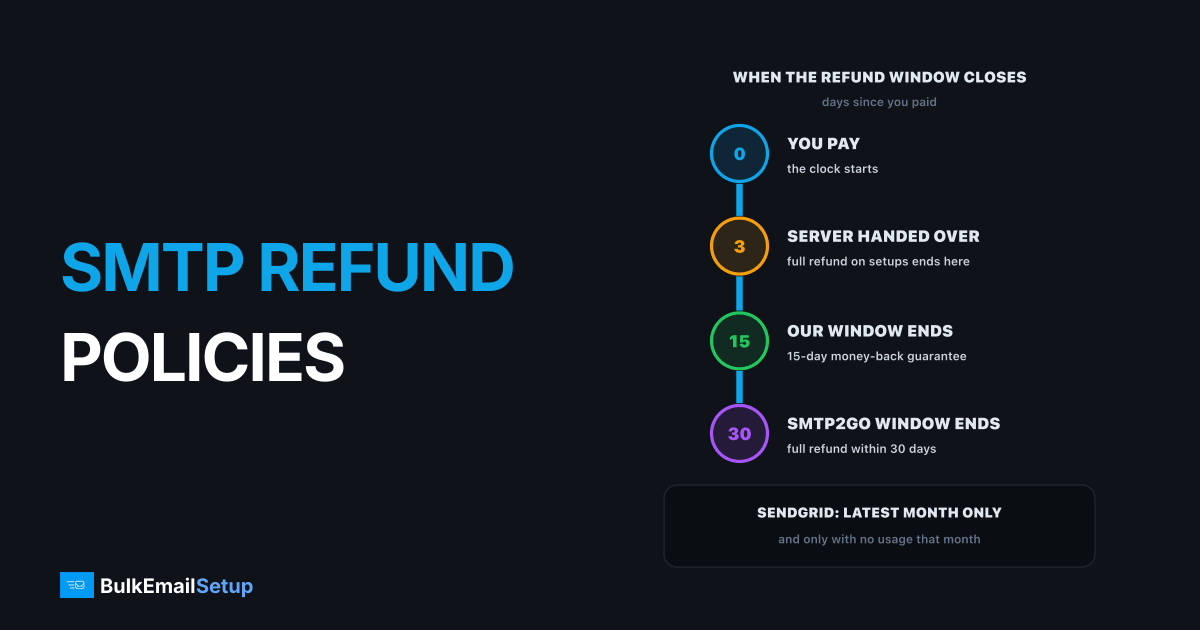
Most SMTP providers do offer refunds, but the conditions decide whether you get one. SMTP2GO promises a full refund within 30 days. SendGrid refunds only the latest month's subscription, and only if you sent nothing that month. Setup services, including ours, refund in full until the server is handed over. Before you pay, find out three things: when the window starts, what counts as "used", and which costs were never the provider's to refund.
Why the refund page matters more than the pricing page
The pricing page tells you what you pay. The refund page tells you what you can get back, and when that stops. For bulk email the gap between the two is wider than most buyers expect, because a sending account starts to "use" itself the moment you warm up a single IP.
Three patterns cover almost every provider:
| Pattern | Who uses it | What decides the refund |
|---|---|---|
| Time window, full refund | SMTP2GO (30 days) | days since payment |
| No usage that month | SendGrid | whether you sent any mail this calendar month |
| Before delivery | setup services, including BulkEmailSetup | whether the server has been handed over |
The first is the easiest to use. The second is close to no refund at all for an active sender, since sending a single test email counts as usage. The third depends entirely on how fast the provider delivers.
When the window really closes
A "15-day" or "30-day" guarantee sounds like a fixed period. In practice there is usually a second trigger that can end it sooner.
The calendar window and the handover point are two different clocks
On our own plans the window is 15 calendar days from payment, and a full refund applies while credentials have not been handed over. A build usually takes 1 to 3 days, so in practice the full-refund period is the time before handover. After setup work starts, the refund policy allows a partial refund minus the cost of work already done, and the deduction is shown to you before anything is processed.
That is a fair model for a service. It is also why you should ask every setup provider the same question: at what moment does the full refund end?
What a money-back guarantee usually excludes
Read the exclusions line by line. These are the ones that catch bulk senders.
Six lines to find in the fine print before you pay
| Exclusion | Typical wording | What it means for you |
|---|---|---|
| Usage | "no usage in the current month" | one test send can void it |
| Overages | "overage charges are not refundable" | the bill above your plan stays paid |
| Third-party costs | "domains, IPs, DNS charges" | anything bought for you is gone |
| Delivered work | "once credentials are handed over" | the window can close on day 2 |
| Chargebacks | "will not honour a refund after a chargeback" | disputing first loses the refund |
| Hosting | "paid directly to your provider" | ask the host, not the setup company |
SendGrid's own refund article is a good example of the usage rule. It refunds only the latest month's subscription, excludes overages and contact storage from earlier months, and refuses a refund if the account was used in the same calendar month.
How the main providers compare
| Provider | Refund promise | Main condition | Good for testing? |
|---|---|---|---|
| SMTP2GO | full refund within 30 days | stated on the pricing page | yes, at real volume |
| SendGrid | latest month only | no usage that month, no overages | barely |
| Amazon SES | pay per use, nothing to refund | you pay only for mail sent | yes, small risk |
| Setup services | full until handover | partial after work starts | depends on the build time |
| BulkEmailSetup | 15 days from payment | full before credentials are handed over | yes, ask for a test plan |
Pay-as-you-go pricing like Amazon SES has the lowest refund risk because there is almost nothing to refund. You pay $0.10 per 1,000 emails and stop whenever you like. The trade-off is that SES has its own review process before you can send at volume, which we cover in SES sending limit increase denied.
Same word, three very different refunds
Can you get a refund after a blacklist?
This is the refund question bulk senders ask most, and the honest answer depends on whose sending caused it.
- Your list caused it. A complaint spike or a spam trap hit from your own contacts is your usage. No shared platform refunds for that, and a setup provider will help you delist rather than pay you back. Start with our blocklist delisting guide.
- The IP was dirty before you sent. A new dedicated IP that is already listed on day one is the provider's problem. Check every IP on a blocklist checker before warm-up and ask for a replacement in writing.
- A shared pool neighbour caused it. You get no refund, because the platform's terms put pool reputation outside their promise. This is one of the real costs of shared infrastructure.
Most delisting is free anyway. Spamhaus and Barracuda charge nothing to remove an IP, so a refund conversation about a blacklist is usually a conversation about time lost, not money.
Five things to confirm before you pay
- Start date. Payment date, account activation, or handover? A window that starts at payment shrinks if setup takes a week.
- What counts as use. One test email, one warmed IP, or a whole campaign?
- Which costs are excluded. Domains, IPs, hosting and DNS fees are the usual ones.
- How to ask. Ticket, email or form, and how fast they reply. We acknowledge refund requests within 24 hours on business days and approve them within 24 to 48 hours.
- How long the money takes. Card refunds usually land in 5 to 10 business days.
Ask these in writing and keep the answers. A provider who will not answer them clearly before you pay is telling you something. Our list of red flags in cheap SMTP providers covers the other warning signs, and questions to ask before buying has the full pre-purchase list.
A refund window you can actually use
The best way to use a refund window is to plan the test before you pay. Decide what a pass looks like (authentication passing, mail landing in Gmail and Outlook inboxes, support replying within a working day) and run it inside the window. For a full test plan, see how to test an SMTP provider before you commit.
| Check | When | Pass |
|---|---|---|
| SPF, DKIM, DMARC pass | day 1 after handover | all three aligned |
| Seed test to Gmail and Outlook | day 2 | inbox, not spam |
| Support ticket | day 2 | reply within 1 business day |
| First real batch, engaged contacts | day 3 to 5 | bounces under 2% |
How BulkEmailSetup helps
We build a dedicated SMTP server you own, on hosting you pay for directly, and the setup fee is paid once.
| Plan | One-time fee | Emails per day | Dedicated IPs | Hosting you pay your host |
|---|---|---|---|---|
| Basic | $549 | 25,000 | 3 | about $11 a month |
| Advance | $1,199 | 200,000 | 15 | about $49 a month |
| Custom | $2,997 | 1,000,000 | 60 | about $170 a month |
Every plan has a 15-day money-back guarantee. The full refund applies until credentials are handed over, and a partial refund after work starts is always quoted to you first. Read the full refund and cancellation policy, then see pricing.
Frequently asked questions
Do SMTP providers give refunds?
Some do, on narrow terms. SMTP2GO advertises a full refund within 30 days. SendGrid refunds only the latest month's subscription and only if the account had no usage that calendar month. Setup services usually refund until the work is delivered. Read the refund page before paying, because the headline guarantee and the real conditions are often different.
What does a money-back guarantee usually exclude?
Usage, third-party costs and delivered work. Monthly platforms exclude any month you sent mail in, plus overages. Setup services exclude work already done and costs paid to others, such as domains, IPs and hosting. Refunds also stop once you file a chargeback. The guarantee covers the provider's own fee, rarely anything they bought on your behalf.
Can I get a refund after a blacklist?
Rarely on a shared platform, because a listing caused by your own list is treated as your usage, not their failure. On a dedicated setup, a listing on day one from a dirty IP is a fair refund or replacement request, so check new IPs before warm-up. If your sending caused it, expect delisting help, not money back.
How long should a refund window be?
Long enough to send real mail. A 14 to 30 day window lets you test authentication, inbox placement and support on a platform you can use straight away. For a setup service, the window that matters is the time before handover, because once credentials are delivered most providers treat the job as done. Ask when that happens.
What is the BulkEmailSetup refund policy?
BulkEmailSetup offers a 15-day money-back guarantee from the payment date. A full refund applies while the server credentials have not been handed over. If setup work has started, a partial refund is possible after the cost of that work is deducted, and you are told the amount first. Hosting paid to your own provider is refunded by that provider, not by BulkEmailSetup.
Does a chargeback get my money back faster?
Usually the opposite. SendGrid says it will not honour a refund request once a chargeback is filed, and most providers suspend the account straight away, which also stops your sending. A chargeback is a last resort for a provider that ignores you. Ask for the refund in writing first and keep the invoice and ticket number.
Is a free trial better than a refund guarantee?
They test different things. A free trial caps volume, often at 100 emails a day, so it shows setup and API but not real deliverability. A money-back guarantee lets you use the full product at your own volume and get your money back if it fails. For bulk senders the guarantee is usually the more useful test.


