
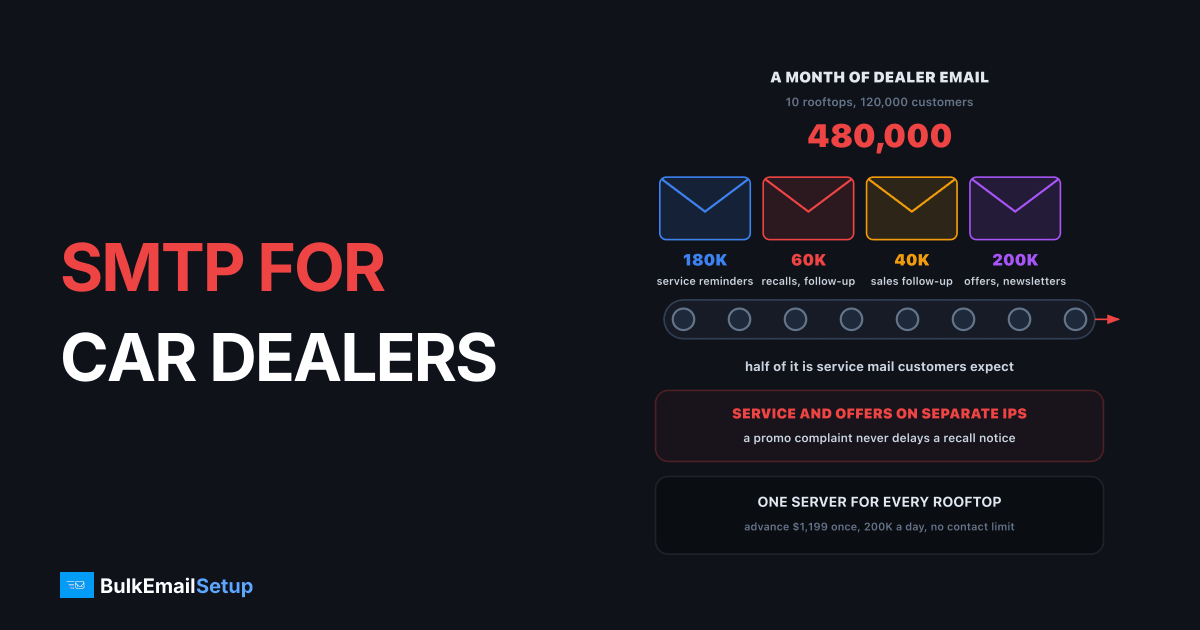
Email marketing for car dealerships is mostly service mail, not offers: maintenance reminders, recall notices and appointment confirmations go to every customer on the books, every few months. For an auto group that adds up fast, often several hundred thousand emails a month, and per-contact email platforms charge for every customer in the DMS. The setup that holds up is a dedicated email server with service mail and offers on separate streams, each rooftop domain authenticated, and the old DMS list cleaned before the first big send.
What dealerships actually send
| Trigger | How often per customer | Stream | |
|---|---|---|---|
| Service reminder | mileage or months since last visit | every 3 to 6 months | service |
| Recall notice | manufacturer recall on the VIN | when issued | service |
| Appointment confirmation | booking in the service scheduler | per visit | service |
| Sales follow-up | test drive, quote, website lead | days after the lead | sales |
| Lease-end and trade-in offer | months left on the lease or loan | a few times near the end | marketing |
| Monthly newsletter or event | the marketing calendar | monthly | marketing |
The pattern matters for deliverability. Service mail is expected and wanted, so it gets opened. Offers get ignored or reported. Sent from the same IP, the offers drag down the service mail.
Most of the emails a dealer sends one customer are service mail, not offers
How much email an auto group sends
Here is a worked example for a group with 10 rooftops and about 12,000 active customers each. Treat it as a planning model, not a benchmark.
| Stream | Emails per customer a month | Customers | Emails a month |
|---|---|---|---|
| Service reminders and confirmations | about 1.5 | 120,000 | 180,000 |
| Recalls and service follow-up | about 0.5 | 120,000 | 60,000 |
| Sales follow-up | leads only | about 6,000 leads | 40,000 |
| Offers and newsletter | about 1.7 | 120,000 | 200,000 |
| Total | about 480,000 |
Half the volume is service mail that customers actually want
At 480,000 a month that is about 16,000 emails on an average day. Campaign days run higher, which is why headroom matters more than the average.
How dealer groups stay out of spam
- Split streams. Service and recalls on one subdomain and IP set, offers on another. A promo complaint never delays a recall.
- Authenticate every rooftop. SPF, DKIM and DMARC on each store's sending domain. Gmail and Yahoo require it for bulk senders.
- Clean the DMS list first. Dealer databases hold customers from a decade ago. Suppress hard bounces and anyone with no visit or click in two to three years before you send.
- Warm up new IPs. Start with the most recent service customers, a few hundred a day per IP, and ramp over 4 to 8 weeks.
- Watch complaints per store. Keep each rooftop under 0.1%, well inside Gmail's 0.3% ceiling.
Our email list cleaning guide covers step 3, and the IP warm-up schedule covers step 4.
One server for every rooftop
Each store keeps its own name and records; the sending stays in one place
A single setup can send for the whole group. Each rooftop keeps its own domain and authentication records, so customers see the store they bought from, and DMARC reports tell you which store has a problem. Complaints and bounces are tracked per domain.
DMS, CRM and your own email server
Dealer software varies. Some dealer CRM and marketing modules let you set a custom SMTP relay or authenticate your own sending domain; others send only from their own platform. Check with your DMS or CRM vendor:
- Can I point outbound email at my own SMTP server?
- Can I export service segments (due date, last visit, VIN) on a schedule?
- Do you process unsubscribes and bounces, or do I?
If the answer to the first question is no, the usual pattern is to keep the CRM for one-to-one sales email and send service reminders and campaigns from your own server using scheduled exports.
Customer data and the FTC Safeguards Rule
Most US dealers that finance or lease vehicles are treated as financial institutions under the FTC Safeguards Rule, according to the FTC's 2025 guidance for auto dealers. For email that means a few practical rules:
| Do | Don't |
|---|---|
| Send credit apps through a secure portal | Attach credit apps or deal files to plain email |
| Use TLS on every hop | Let the marketing tool hold finance data |
| Limit who can export customer lists | Share one login across the store |
This is general guidance, not legal advice. Your compliance team or attorney should confirm what applies to your stores.
What it costs for an auto group
| Setup | 100,000 contacts | Monthly | 3-year total |
|---|---|---|---|
| Mailchimp Standard, list price | per contact | about $800 | about $28,800 |
| Own server, Advance plan | no contact limit | about $49 hosting | about $2,963 including the $1,199 setup |
The Mailchimp figure comes from our Mailchimp bill breakdown, and it rises as the customer base grows. The server cost does not. If you are already near a tier, see what happens when you hit your Mailchimp contact limit.
How BulkEmailSetup helps
We set up dedicated SMTP servers in your own hosting account, with each rooftop domain authenticated, service and marketing on separate IP sets, bounce and unsubscribe handling, a campaign platform and a warm-up plan.
| Plan | One-time fee | Emails per day | Dedicated IPs | Fits |
|---|---|---|---|---|
| Basic | $549 | 25,000 | 3 | a single store |
| Advance | $1,199 | 200,000 | 15 | a multi-rooftop group |
| Custom | $2,997 | 1,000,000 | 60 | a large regional group |
There is no monthly fee to us and no contact limit. Each plan comes with a 15-day money-back guarantee, which applies until server access is handed over. See the Advance plan or compare all pricing.
Frequently asked questions
What email do car dealers send most?
Service email, by a wide margin. Oil change and maintenance reminders, recall notices, appointment confirmations and service follow-ups go to every customer on the books every few months. Sales follow-ups, lease-end and trade-in offers, and monthly newsletters come next. For a group with 10 rooftops and 120,000 customers, that can add up to around 480,000 emails a month.
How do dealer groups avoid spam filters?
They split streams and clean the DMS list. Service and transactional mail goes out on its own subdomain and IPs, offers on another, so a promo complaint never delays a recall notice. Each rooftop domain gets SPF, DKIM and DMARC. Old DMS records are the biggest risk: customers from years ago bounce, so suppress hard bounces and anyone with no service visit or click in two to three years.
Can a DMS send through my own email server?
It depends on the vendor and the module. Some dealer CRM and marketing tools let you set a custom SMTP relay or an authenticated sending domain; others send everything from their own servers. Ask your DMS or CRM provider whether it supports a custom SMTP relay, and if it does not, export the service segments and send them from your own server instead.
What does email cost for a multi-rooftop group?
On a per-contact platform, a 100,000-contact group pays roughly $800 a month on Mailchimp Standard at list price, and the bill grows with every new customer. A dedicated server for the same group is $1,199 one-time on BulkEmailSetup's Advance plan, with about $49 a month in hosting, and no contact limit. Over three years that is about $28,800 against $2,963.
Do dealers have to follow the FTC Safeguards Rule for email?
Most do. The FTC's guidance says dealers who finance or lease vehicles are financial institutions under the Safeguards Rule, so customer information such as credit applications must be protected. In practice: never send credit apps or deal files as plain email attachments, use TLS on every hop, and keep marketing systems away from finance data. This is guidance, not legal advice.
Should each dealership rooftop have its own sending domain?
Usually yes, or at least its own subdomain. Customers recognise the store name, complaints stay attached to the store that caused them, and DMARC reports show you which rooftop has a problem. One shared SMTP server can still send for every rooftop, with each one authenticated separately.


