
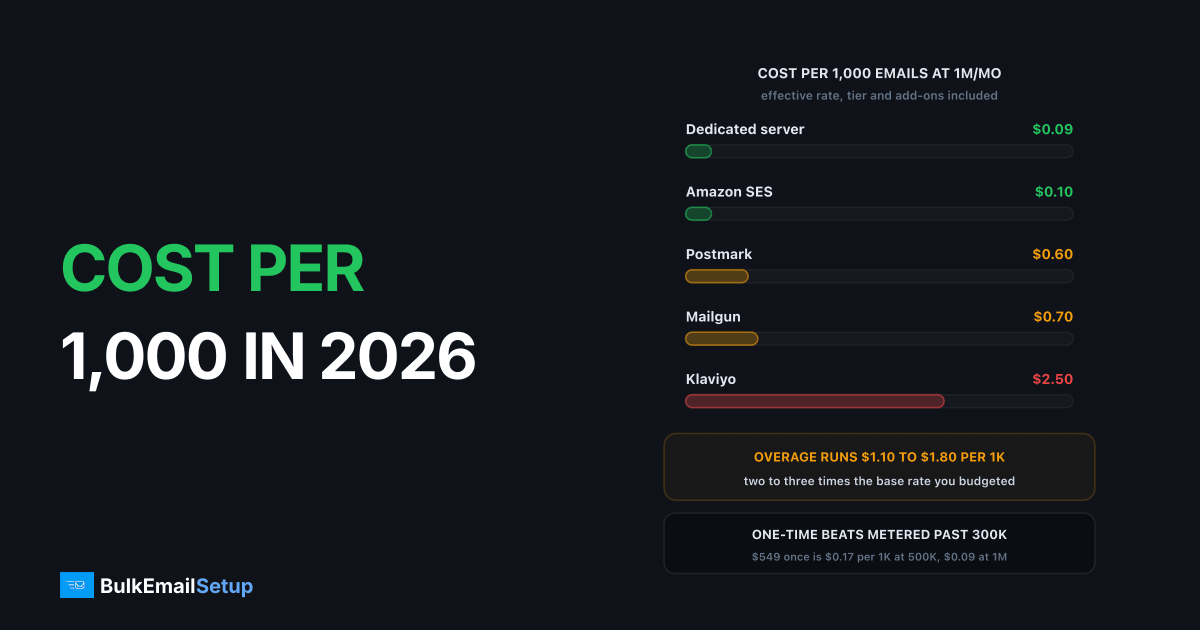
In 2026 the effective cost per 1,000 emails runs from $0.10 on Amazon SES to about $4.00 on Klaviyo, and the number you pay depends far more on your monthly volume than on the provider's headline rate. At 100K a month most metered ESPs land between $0.35 and $1.00 per 1,000. At 1M the same plans drop to $0.50 to $0.75 because you climb into a cheaper tier. A dedicated server bought once for $549 falls to about $0.09 per 1,000 at 1M and keeps falling, because its cost never moves. Below are the numbers at three volumes, the overage rates that quietly double them, and the checklist I use to decide which price to believe.
I've paid every one of these bills. The rates are from each vendor's pricing page as of September 2026, rounded, and where a provider hides the top tier behind "contact sales" I've marked it as an estimate from real quotes.
Effective cost per 1,000 emails at 100K, 1M and 5M a month
The short version: the per-1,000 rate is not one number. It is a curve, and the slope of that curve is the whole comparison.
| Provider | 100K/mo | 1M/mo | 5M/mo | Pricing model |
|---|---|---|---|---|
| Amazon SES | $0.10 | $0.10 | $0.10 | flat per 1,000 |
| Elastic Email | ~$0.29 | ~$0.15 | ~$0.13 | volume tiers |
| Resend | $0.35 | $0.65 | ~$0.44 | volume tiers |
| SendGrid (Essentials at 100K, Pro above) | $0.35 | ~$0.75 | ~$0.55 | volume tiers |
| Mailjet | ~$0.65 | ~$0.40 | ~$0.30 | volume tiers |
| MailerSend | ~$0.50 | ~$0.40 | ~$0.35 | volume tiers |
| Brevo | ~$0.65 | ~$0.50 | ~$0.40 | per-send credits |
| SMTP2GO | $0.75 | ~$0.60 | ~$0.45 | volume tiers |
| Mailgun | $0.90 | ~$0.70 | ~$0.50 | volume tiers |
| Postmark | ~$1.00 | ~$0.60 | ~$0.60 | volume tiers |
| Mailchimp Standard | ~$2.00 | ~$1.30 | ~$1.00 | per contact |
| Klaviyo | ~$4.00 | ~$2.50 | ~$1.60 | per active profile |
| Dedicated server ($549 one-time) | $0.86 | $0.09 | ~$0.08 | one-time plus VPS |
A few notes on how the cells were built, because the method matters more than any single figure.
- Amazon SES is $0.10 per 1,000 outbound with no tiers, so the row is flat. Add one dedicated IP at $24.95 a month and the 100K cell becomes $0.35, the 1M cell $0.12.
- Postmark is the clearest example of a tier curve. Its published overage sits at $1.20 to $1.80 per 1,000 depending on plan, but the plan tiers themselves bring the rate down to roughly $0.60 once you are buying 1M or more a month.
- Resend goes up from 100K to 1M. Pro covers 100K for $35, but Scale at 1M is $650. That is the only provider in the table where the per-1,000 rate rises before it falls, and it catches people out.
- SendGrid at 100K is $34.95 on Essentials, which has no dedicated IP. Anything above that is Pro, where 1M costs roughly $750.
- Mailchimp and Klaviyo price on contacts, so I converted at 4 sends per contact per month. 100K emails is 25,000 contacts, 1M is 250,000, 5M is 1.25M. If you send twice a month, double every figure in those two rows.
- Dedicated server is Basic at $549 one-time divided across 12 months, plus about $40 a month of VPS hosting you pay the host directly. Basic is capped at 25,000 emails a day, so the 5M cell assumes a higher tier (up to 200,000 a day, $1,199 to $2,997 one-time) with a bigger VPS around $170 a month. In year two the setup fee is gone and only the VPS remains.
The pattern is obvious once it is in one table. Metered providers get cheaper as you grow, but slowly, and they never go below about $0.10. The one-time server starts expensive at 100K and is the cheapest line in the table by 1M. That is the whole argument for owning infrastructure, and the rest of this article is about the ways the table above still flatters the metered providers.
Why the per-1,000 number is misleading
The advertised rate assumes you send exactly the tier volume, on shared IPs, with no add-ons, every month. Nobody does that. Three things move the real number.
Tier boundaries. You pay for the tier, not the sends. Sending 100K on a plan that includes 125K means you paid for 25K you never used. Sending 130K on a 125K plan means 5K at the overage rate. Either way the effective rate is higher than the cell above.
Dedicated IP add-ons. Once you pass about 100K a month, every provider either pushes you onto a dedicated IP or you want one anyway so a neighbour's spam run does not throttle your campaign. The price is a fixed monthly line, so it hurts most at low volume.
Contact pricing. Mailchimp bills 12x contacts in sends on Standard, Klaviyo caps included sends at 10x profiles. If you send less than that you are paying for capacity you do not use, and the per-1,000 figure climbs. A 50,000 contact Klaviyo account sending twice a month is $720 for 100K emails, which is $7.20 per 1,000. Same account, four sends, is $3.60.
Here is what the dedicated IP add-on does to the 100K column.
| Provider | Dedicated IP price | 100K rate before | 100K rate with 1 IP |
|---|---|---|---|
| Amazon SES | $24.95/mo per IP | $0.10 | $0.35 |
| Resend | $30/mo (Scale plan only) | $0.35 | $1.20 (Scale is $90) |
| Elastic Email | $40 to $50/mo | ~$0.29 | ~$0.74 |
| Postmark | $50/mo per IP, 300K/mo minimum | ~$1.00 | not offered at 100K |
| Mailgun | included on Scale, $59/mo extra | $0.90 | $0.90 |
| SMTP2GO | included on Professional | $0.75 | $0.75 |
| SendGrid | Pro plan only, ~$90 base | $0.35 | ~$0.90 |
| Dedicated server | 3 IPs included | $0.86 | $0.86 |
The SendGrid row is the one to stare at. Essentials looks cheap at $0.35 until you want an IP, at which point the cheapest route is Pro and the rate more than doubles. The dedicated IP or shared decision is worth making before you pick a provider, because it changes which provider is cheapest.
Overage rate per 1,000 by provider
Overage is where the per-1,000 rate stops being a comparison and becomes a penalty. The base rate might be $0.50. The overage rate is two to three times that.
| Provider | Overage per 1,000 | Ratio to base at 100K | Notes |
|---|---|---|---|
| Postmark Basic | $1.80 | 1.8x | drops to $1.30 on Pro, $1.20 on Platform |
| Mailgun Basic | $1.80 | 2.0x | $1.30 Foundation, $1.10 Scale |
| MailerSend Hobby | $1.50 | 3.0x | $0.90 on Starter and above |
| SMTP2GO Starter | $1.00 | 1.3x | $0.85 on Professional |
| Amazon SES | $0.10 | 1.0x | no tiers, so no overage |
| Resend | none | n/a | hard stop, upgrade or sends fail |
| Elastic Email | auto-upgrade | n/a | bumps you to the next tier |
| Mailchimp | per-contact jump | 1.5x to 2x | exceed contacts and the whole plan reprices |
| Dedicated server | none | n/a | daily cap on the tier, no per-email meter |
Two shapes of overage exist, and they hurt differently. The per-1,000 model (Postmark, Mailgun, SMTP2GO, MailerSend) is at least predictable: a 20% spike over tier costs you 20% of your volume at double rate, so roughly a 20 to 40% bigger bill that month. The reprice model (Mailchimp, Klaviyo, Elastic Email) is worse, because going 1 contact over a boundary moves the entire bill to the next tier for the whole month.
I've covered the mechanics of that in hidden costs of ESP overage fees. The one-line version: budget for your peak month, not your average, because the overage rate is what your peak month pays.
Hidden line items that never make the per-1,000 rate
Beyond overage and IPs, these show up on invoices from senders I've audited. None of them appear in the headline rate on any pricing page.
| Line item | Typical cost | Who charges it |
|---|---|---|
| Email validation | $1.20 per 100 addresses on Mailgun, similar elsewhere | Mailgun, SendGrid, Brevo, Elastic Email |
| Log retention beyond 3 to 7 days | $20 to $100/mo or a tier jump | Mailgun, SendGrid, Postmark |
| Inbound parsing | tier-gated | Mailgun, SendGrid, Postmark |
| Extra sending domains | plan limits of 1 to 10 | Postmark, SMTP2GO, MailerSend |
| Extra users or seats | $10 to $30 per seat | Mailchimp, Klaviyo, Brevo |
| Priority support | enterprise tier only | Everyone except SES (AWS Support plan from $29/mo) |
| SMS or push credits bundled in | 10 to 30% of plan price | Klaviyo, Brevo, Mailchimp |
| Annual commitment for the quoted rate | 12 months locked | SendGrid Premier, Mailgun custom, Klaviyo |
The last row is the one people forget when they compare a monthly SES bill to a "from $0.50" enterprise quote. The enterprise quote is a 12-month commitment at a volume you promised. Fall short and you still pay it.
The crossover volume where one-time beats per-email
The crossover sits between 300K and 500K emails a month for most senders. Below it, metered pricing wins on convenience and often on price. Above it, a one-time server is cheaper every month and the gap widens.
Here is the arithmetic, year one, dedicated server versus the median metered provider at each volume.
| Monthly volume | Median metered ESP (with 1 IP) | Dedicated server year 1 | Dedicated server year 2 |
|---|---|---|---|
| 100K | ~$85/mo, $0.85/1K | ~$86/mo, $0.86/1K | ~$40/mo, $0.40/1K |
| 300K | ~$220/mo, $0.73/1K | ~$86/mo, $0.29/1K | ~$40/mo, $0.13/1K |
| 500K | ~$330/mo, $0.66/1K | ~$86/mo, $0.17/1K | ~$40/mo, $0.08/1K |
| 1M | ~$650/mo, $0.65/1K | ~$86/mo, $0.09/1K | ~$40/mo, $0.04/1K |
| 5M | ~$2,500/mo, $0.50/1K | ~$420/mo, $0.08/1K | ~$170/mo, $0.03/1K |
At 100K the two columns are a wash in year one, and the metered ESP wins on the hours you do not spend. At 300K the server is already a third of the price. At 1M you are paying the ESP roughly $7,800 a year for what the server does for about $1,030, and in year two the server number drops to under $500.
Amazon SES is the exception that proves it. At $0.10 flat it beats the year-one server until about 1M, and it stays close after that. People leave SES for reasons other than price: it pauses accounts on bounce spikes, offers no warm-up help, and puts you on your own for everything. Amazon SES vs a dedicated SMTP server goes through that trade in detail, and cost to send 1 million emails per month has the full stack costed at that volume.
The honest caveat on the server side: a dedicated IP needs 4 to 6 weeks of warm-up before it carries full volume, and it only holds a reputation if you send steadily. If your volume is 500K one month and 20K the next, the metered ESP absorbs that better than an IP that goes cold.
Which price to trust, a checklist
Run this before you believe any per-1,000 figure, including mine.
- Find your peak month, not your average. Overage is priced on the peak. If December is 2x June, price December.
- Add one dedicated IP unless you are certain you will stay under 100K a month forever. That is $24.95 to $59 a month on top.
- Check the tier you actually land in. Sending 100K on a 125K tier means you pay for 125K. Divide the plan price by your real sends.
- Convert contact pricing to sends. Contacts times sends per month equals emails. Bill divided by that, in thousands, is the real rate.
- Look up the overage rate per 1,000 and multiply it by your worst overshoot of the last 12 months.
- Ask what happens at 3x. Resend hard-stops. Mailchimp reprices. Mailgun bills $1.10 to $1.80. A server has a daily cap and no meter.
- Price two years, not one. Any one-time cost looks bad in month 1 and good in month 13.
- Read the commitment terms on any "contact sales" quote. A $0.40 rate on a 12-month commitment is not a $0.40 rate if you send half the volume.
If a provider's rate survives all eight, it is a real number. If it survives three, it is a brochure. The broader per-1,000 picture, including how validation and support tiers shift the ranking, is in SMTP pricing per 1,000 emails compared, and the per-email version of the same math is in cost per email, dedicated SMTP vs ESP.
How BulkEmailSetup helps
We set up dedicated SMTP infrastructure you own: your own server on a VPS you control, your own IPs, SPF, DKIM, DMARC and PTR configured, MTA tuning, bounce handling and a warm-up plan. There is no per-email meter, no overage rate and no contact count, so your effective cost per 1,000 falls every month your volume grows instead of staying flat.
Basic is $549 one-time, covering 1 SMTP server, 3 dedicated IPs, 25,000 emails/day and unlimited contacts. Higher tiers scale to 15 IPs and 200,000 emails/day. See pricing, or start with cost to send 1 million emails per month if you want the full stack costed at your volume.
Frequently asked questions
What is the average cost per 1,000 emails in 2026?
Across the metered providers, roughly $0.10 to $1.00 per 1,000 at 1M emails a month. Amazon SES sits at the floor at $0.10, Elastic Email and Mailjet land around $0.15 to $0.40, SendGrid, Mailgun, Brevo and Postmark run $0.50 to $0.75, and contact-priced tools like Mailchimp and Klaviyo work out to $1.30 to $2.50 per 1,000 sent.
Which email provider is cheapest per 1,000 emails?
Amazon SES at $0.10 per 1,000, flat at any volume, is the cheapest published rate. Elastic Email is the cheapest full-service ESP at roughly $0.13 to $0.29. A dedicated server bought one-time works out lower than both above about 500K a month, because its cost does not grow with sends.
Why is my cost per 1,000 higher than the advertised rate?
Three reasons. Overage is billed at $1.10 to $1.80 per 1,000, often double your base rate. A dedicated IP adds $24.95 to $59 a month per IP. And tier boundaries mean you pay for a 125K plan when you send 100K. Add those in and a $0.50 headline rate lands at $0.70 to $0.90 on the invoice.
How do I convert Mailchimp or Klaviyo contact pricing to cost per 1,000 emails?
Multiply your contact count by sends per contact per month, then divide the monthly bill by that number of thousands. A 25,000 contact Mailchimp Standard plan at about $200 with 4 sends a month is 100,000 emails, so $2.00 per 1,000. The same list on Klaviyo at about $400 is $4.00 per 1,000.
At what volume does a one-time server beat per-email pricing?
Around 300K to 500K emails a month. A $549 one-time setup plus about $40 a month of VPS hosting is roughly $86 a month in year one, which is $0.17 per 1,000 at 500K and $0.09 at 1M. Below 100K the metered providers are cheaper or equal, so stay put until you cross the line.
Does Amazon SES really cost only $0.10 per 1,000?
Yes for the sending itself, and the price is the same at 10,000 or 10 million. What it excludes is everything else: a dedicated IP is $24.95 a month, there is no warm-up help, no marketing UI, and no human support without a paid AWS plan. At 100K a month one IP alone triples the effective rate to about $0.35.


