
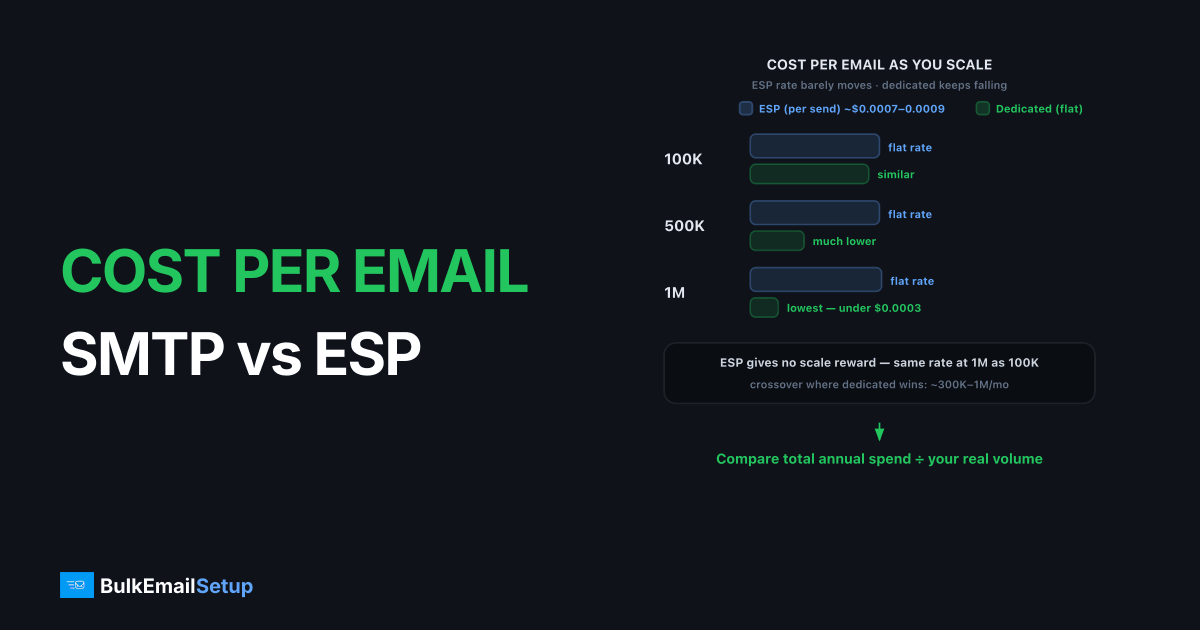
Cost per email on an ESP is roughly $0.0004 to $0.001 per send on metered plans, and it stays flat no matter how big you get. A dedicated SMTP server flips that: you pay a fixed monthly price, so your cost per email drops as volume rises. The crossover where dedicated SMTP gets cheaper than an ESP usually sits between 300,000 and 1,000,000 emails per month. Below it, ESP convenience wins. Above it, per-email pricing quietly drains your budget while a flat plan rewards every extra send.
How is cost per email actually calculated?
Cost per email is your total monthly sending spend divided by emails sent. On an ESP that number is basically fixed by the plan tier, because you pay per send. On a dedicated SMTP server the same formula produces a falling curve, since the monthly cost is fixed and the denominator (emails sent) keeps growing.
Here's the part teams miss. The ESP "cost per email" you see on a pricing page is the list rate. Real cost includes overage charges, dedicated IP add-ons ($20 to $80/month each), and the validation or warm-up upsells that appear once you grow. Your effective rate is almost always higher than the headline.
The right way to compare is not "price per 1,000 on the brochure." It's total annual spend at your projected volume, including every add-on, divided by emails you'll actually send. That single calculation reorders most provider rankings.
What does each model cost at 100K, 500K, and 1M per month?
At 100K emails/month, a typical ESP runs roughly $50 to $120 depending on plan and dedicated IP add-ons, while a small dedicated SMTP server runs a flat fee in a similar or slightly lower range. The gap is small here, so convenience often wins below ~300K.
The picture changes fast at higher volume. These are illustrative ranges as of early 2026, not quotes from any one provider.
| Monthly volume | Typical ESP cost | Implied ESP cost/email | Flat dedicated SMTP | Dedicated cost/email |
|---|---|---|---|---|
| 100K | $50 - $120 | ~$0.0007 | flat monthly plan | falling |
| 500K | $300 - $600 | ~$0.0009 | same flat plan + capacity | much lower |
| 1M | $600 - $1,200+ | ~$0.0009 | same flat plan tier | lowest |
Notice the ESP per-email number barely moves. That's the trap. You're paying the same rate at 1M that you paid at 100K, so there's no scale reward. A flat dedicated plan spreads its cost across every send, so a million emails can land well under $0.0003 each.
Cost per email on a metered ESP stays near $0.0006 to $0.0009 regardless of volume, because billing is per send (provider pricing pages, early 2026). A flat-rate dedicated SMTP server spreads one fixed monthly cost across all sends, so at one million emails per month its effective per-email cost commonly falls below $0.0003.
Where do ESP costs hide at scale?
The list price is only the start. ESP bills at scale grow through overage fees, per-IP add-ons, and feature gating that pushes you up tiers you didn't plan for. We dug into the worst of these in hidden costs of ESP overage fees.
We've watched senders budget for a $400 ESP plan and pay $700 in a launch month, because a one-day spike blew past the tier and triggered overage at a punishing per-email rate. In one case the base plan billed around $0.0006 per email, but the overage band on the same provider charged closer to $0.0015, roughly 2.5 times the headline rate, for every email past the tier cap. The flat-plan equivalent simply absorbed the same spike at no extra cost.
Common cost leaks on ESPs at volume:
- Overage charges billed per email above your tier, often at a higher rate than your base.
- Dedicated IP add-ons, $20 to $80/month each, required once you need reputation control.
- Validation and warm-up upsells sold as separate line items.
- Support tiers, where real engineering help sits behind enterprise pricing.
A dedicated SMTP server folds the IP, the SMTP access, and the authentication setup into one flat number. There's no per-send meter running while you sleep.
Does cheaper per email mean worse deliverability?
No, and this is the misconception that keeps senders overpaying. Deliverability comes from authentication, list hygiene, complaint rates, and a properly warmed IP, not from the billing model. A flat dedicated plan and a metered ESP can both inbox well or both fail, depending entirely on sender behavior.
What a dedicated IP buys you is control. Your reputation is yours alone, so a noisy neighbor can't drag you down, and you can isolate transactional mail from marketing. We cover the threshold in dedicated IP vs shared IP for email.
The honest caveat: a dedicated IP needs a 4 to 6 week warm-up, and it only sustains a good reputation if you send consistently above ~50K/month. Cheaper per email is real, but only if your sending practices earn the inbox.
How do you calculate your real crossover point?
Calculate your crossover by comparing your ESP's total annual cost at projected volume against a flat dedicated plan's annual cost, then dividing each by emails sent. The provider whose effective cost per email is lower at your volume wins. It's arithmetic, not vibes, and it usually surprises people who only compared headline rates.
Work it in four steps:
- Project your real monthly volume, including peak months, not your average.
- Tally every ESP line item: base plan, dedicated IP add-ons, expected overage, validation, support tier.
- Multiply by 12 for the annual ESP figure, then divide by annual emails sent.
- Compare against a flat dedicated plan's annual cost divided by the same email count.
Across the senders we've helped migrate, the recurring pattern is that effective ESP cost runs 40% to 80% higher than the headline per-email rate once add-ons and one or two overage months are averaged in. The brochure rate and the annual bank statement almost never agree, and the gap widens with volume.
The crossover where dedicated SMTP gets cheaper usually lands between 300K and 1M emails a month. The exact point depends on how many dedicated IPs you need and how spiky your sending is. Bursty senders hit the crossover sooner, because overage punishes their peaks. Steady senders hit it a little later but still hit it.
What about the cost of switching providers?
The cost of switching is mostly one-time and front-loaded: reconfiguring your sending application, re-authenticating your domain, and warming a new dedicated IP over 4 to 6 weeks. After that, the lower per-email cost compounds every month. For high-volume senders, the recurring savings dwarf the one-time switch within a few months.
The switching tasks are concrete and finite:
- Point your app at the new SMTP endpoint, host, port 587, and credentials.
- Re-authenticate: publish SPF, DKIM, and DMARC on your domain. See SPF vs DKIM vs DMARC.
- Warm the new IP, ramped over 4 to 6 weeks before full volume.
- Monitor reputation and bounce codes during the transition.
The honest part: warming a new IP means you can't dump full volume on day one, so plan the switch ahead of a quiet period, not a launch. A managed provider absorbs most of this work, which is why the switch is less daunting than it sounds. For the full self-host comparison, see buy an SMTP server vs build one.
A quick gut check before you switch for cost
Before you move providers purely on cost, sanity-check three things, because the savings only land if your sending earns the inbox. A cheaper per-email cost on paper means nothing if the mail goes to spam.
- Volume. Are you consistently above ~50K/month, ideally past 300K, where the crossover clearly favors a flat plan?
- Consistency. Do you send steadily, so a dedicated IP can hold its reputation between sends?
- List quality. Is your complaint rate under the 0.3% Gmail and Yahoo enforce and your bounce rate low, so a fresh IP doesn't get listed in week one?
If all three are yes, the lower effective per-email cost of a flat dedicated plan is real money, compounding every month. If any is no, fix it before you switch. A dedicated IP rewards good sending and punishes bad sending faster than a shared pool ever would. The threshold detail is in how many emails before you need dedicated infrastructure.
How BulkEmailSetup helps
If your volume has pushed past the point where per-email pricing hurts, a dedicated SMTP server flips the math: one flat monthly cost, a dedicated IP you control, full SMTP access, and SPF, DKIM, DMARC, and PTR set up correctly. We run the warm-up and reputation monitoring so the savings don't come with a six-week babysitting project. See plans on our pricing page.
Frequently asked questions
What is the average cost per email on an ESP?
Most ESPs land between $0.0004 and $0.001 per email on metered plans, before overage. That sounds tiny until you multiply: at $0.0006 per email, one million sends a month is roughly $600, and it scales linearly forever.
Is a dedicated SMTP server cheaper than an ESP?
Above roughly 300K to 500K emails a month, usually yes. A flat-rate dedicated SMTP server costs the same whether you send 400K or 900K, so your effective cost per email keeps dropping as volume climbs, while ESP cost stays linear.
Why does ESP cost per email rise at scale?
It does not rise, it stays flat per email, which is the problem. ESPs charge per send, so doubling volume doubles the bill. A flat infrastructure cost spreads across more emails, so its per-email cost falls as you grow.
At what volume should I leave an ESP for cost reasons?
Cost alone usually justifies a move somewhere between 300K and 1M emails per month, depending on your ESP plan. Below that, the convenience of a managed ESP is often worth the premium. Run your own numbers against a flat plan first.


