
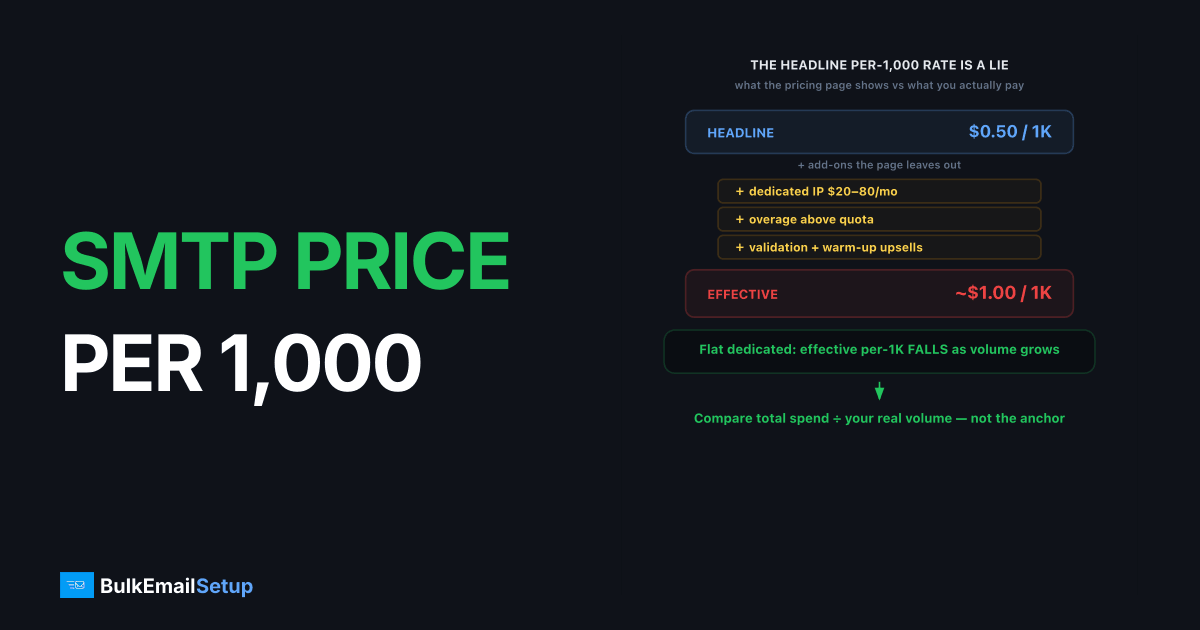
Price per 1,000 emails on metered ESPs typically runs roughly $0.40 to $1.00 as of early 2026, before add-ons like dedicated IPs and overage. That rate stays flat no matter how much you send, which is its weakness at scale. A flat-rate dedicated SMTP plan has no fixed per-1,000 rate; its effective cost per 1,000 falls as volume rises, often dropping below $0.30 at high volume. The fairest comparison isn't the headline rate, it's effective cost per 1,000 at your real volume with every add-on included.
What is the typical price per 1,000 emails?
The typical metered price is roughly $0.40 to $1.00 per 1,000 emails on ESP plans as of early 2026, before dedicated IP add-ons and overage. The exact rate depends on plan tier and commitment, and the headline number almost always excludes the extras you'll need at scale.
Here's how the models compare at common volumes. These are illustrative ranges, not quotes from any single provider.
| Monthly volume | Metered ESP per 1,000 | Effective flat dedicated SMTP per 1,000 |
|---|---|---|
| 100K | ~$0.50 - $1.00 | competitive |
| 500K | ~$0.50 - $0.90 | lower |
| 1M | ~$0.50 - $0.90 | often under $0.30 |
| 5M+ | ~$0.40 - $0.80 | far lower |
The pattern is the whole story. The metered per-1,000 rate barely moves as you scale, so there's no volume reward. A flat plan's effective per-1,000 rate falls every time you send more, because you're dividing one fixed cost across a bigger number.
Why is the headline per-1,000 rate misleading?
The headline rate is misleading because it rarely includes the add-ons you need at scale: dedicated IPs at $20 to $80/month each, validation, and overage. A plan advertising $0.50 per 1,000 can have an effective rate near $1.00 once those line items land on the bill.
Two providers quoting the same per-1,000 rate can have wildly different real costs, because one bundles a dedicated IP and warm-up while the other meters them separately. The per-1,000 number is a marketing anchor, not a budget. The only honest comparison is total spend at your volume divided by emails sent.
The add-ons that distort the headline:
- Dedicated IP, often required for reputation control, $20 to $80/month each.
- Overage, billed above quota at a premium, covered in hidden costs of ESP overage fees.
- Validation and warm-up, sometimes separate line items.
Metered ESP pricing of roughly $0.40 to $1.00 per 1,000 emails (provider pricing pages, early 2026) typically excludes dedicated IP add-ons of $20 to $80/month and overage charges billed above quota. A flat-rate dedicated SMTP plan spreads one fixed cost across all sends, so at one million emails per month its effective price per 1,000 can fall below $0.30.
How does flat pricing change the per-1,000 math?
Flat pricing changes the math by making your effective per-1,000 rate a function of how much you send, not a fixed number. At 100K you and the metered ESP look similar. At 1M the flat plan's effective per-1,000 cost has fallen by more than half while the ESP's hasn't moved at all.
We've watched senders treat the per-1,000 rate as fixed and budget linearly, then discover that on a flat plan their real cost per 1,000 dropped every month they grew. One sender we moved off a metered plan was paying an effective $0.71 per 1,000 at 900K/month once a dedicated IP and overage were added in; the same volume on a flat plan landed near $0.22 per 1,000, and kept falling as they crossed 1.4M. That falling curve is the entire reason high-volume senders move off metered pricing. The full per-email breakdown is in cost per email - dedicated SMTP vs ESP.
The crossover where flat beats metered usually sits between 300K and 500K emails a month. Below it, metered convenience often wins. Above it, the falling flat curve pulls ahead and keeps widening.
How should you compare providers fairly?
Compare providers by effective cost per 1,000 at your real projected volume, with every required add-on included, not by the advertised headline rate. That single calculation strips out the marketing anchor and shows what you'll actually pay.
A fair comparison checklist:
- Project your real monthly volume, including peak months.
- Add every required line item: dedicated IP, validation, expected overage.
- Divide total monthly spend by emails sent to get effective cost per 1,000.
- Repeat for each provider at the same volume.
Remember that price isn't the only axis. A clean dedicated IP you control protects your reputation in a way a cheap shared pool can't, regardless of the per-1,000 rate. See dedicated IP vs shared IP for email for that trade-off.
What's included in a per-1,000 rate, and what isn't?
A per-1,000 rate usually includes the raw delivery attempt and little else. What it typically excludes is a dedicated IP, validation, warm-up support, advanced analytics, and human support, all of which become necessary at scale and all of which are billed separately. The rate covers the cheapest part of the job.
What's commonly in and out of the headline rate:
| Component | In the per-1,000 rate? |
|---|---|
| Delivery attempt | Yes |
| Shared IP sending | Usually yes |
| Dedicated IP | No, add-on |
| List validation | Often no |
| Warm-up support | Often no |
| Priority / human support | Often no, higher tier |
The senders we've audited consistently find their included feature set thins out as volume rises: the per-1,000 rate holds, but the things they now need (a dedicated IP, real support, validation) all sit outside it. The rate looks stable while the real bill climbs through add-ons. That's why two providers at the same per-1,000 number can differ by 2x in practice.
How does volume commitment change the per-1,000 rate?
A volume commitment can lower your per-1,000 rate, but it locks you into projected volume you may not hit, and overage above the commitment is often billed at a premium. Committing makes sense only when your volume is genuinely predictable; if it's spiky, the commitment can cost more than it saves.
The trade-offs of committing:
- Lower per-1,000 rate in exchange for a minimum volume promise.
- Overage risk if you exceed the commitment, often at a higher rate. See hidden costs of ESP overage fees.
- Waste risk if you fall short, you've paid for sends you didn't use.
- Less flexibility to switch providers mid-term.
The honest comparison: a flat dedicated plan also asks you to size capacity, but it doesn't bill per-send overage or strand you with unused volume the same way. You pay for capacity, use it or not, with no per-email meter punishing your peaks. For spiky senders especially, that predictability often beats a discounted-but-committed per-1,000 rate.
What does the effective-rate calculation look like worked through?
Run the numbers once and the headline rate stops mattering. Take a sender pushing 1M emails a month who needs a dedicated IP and some validation. The $0.50 per-1,000 plan looks cheapest until you add the line items the rate excludes, at which point the effective number climbs well past it.
| Line item | Metered ESP at 1M/month | Flat dedicated SMTP |
|---|---|---|
| Base sending (1M @ ~$0.50/1K) | ~$500 | included in flat fee |
| Dedicated IP add-on | +$20 - $80 | included |
| List validation | +$50 - $150 | bring your own |
| One overage month (averaged in) | +variable | none |
| Effective monthly total | ~$570 - $730+ | one flat fee |
| Effective cost per 1,000 | ~$0.57 - $0.73 | often under $0.30 |
The headline said $0.50. The bank statement says $0.57 to $0.73 once the required extras land. The flat plan, sized to the same million sends, spreads one fixed cost and lands lower per thousand, and it keeps falling if volume grows.
The effective rate is the only number that survives a real invoice. Everything on a pricing page above it is an anchor designed to win the comparison shopping step. Do this one calculation at your real volume and most provider rankings reorder, because the cheapest headline is rarely the cheapest bill. For the per-email version of the same exercise, see cost per email - dedicated SMTP vs ESP.
How BulkEmailSetup helps
If your volume has made per-1,000 metered pricing the expensive option, a flat-rate dedicated SMTP server resets the math: one fixed monthly cost whose effective price per 1,000 falls as you grow, plus a dedicated IP you control with SPF, DKIM, DMARC, and PTR configured correctly. We handle warm-up and reputation monitoring. See flat plans on our pricing page.
Frequently asked questions
What is a good price per 1,000 emails?
On metered ESPs, typical rates run roughly $0.40 to $1.00 per 1,000 emails as of early 2026, before add-ons. A flat dedicated SMTP plan has no fixed per-1K rate; its effective cost per 1,000 falls as your volume rises, often below $0.30 at high volume.
Why does price per 1,000 emails vary so much?
Because plans bundle different things. A low headline per-1K rate may exclude dedicated IPs, validation, and overage, while a higher one includes them. Compare effective cost at your real volume with all add-ons, not just the advertised per-1K number.
Is flat pricing cheaper than per-1,000 pricing?
Above roughly 300K to 500K emails per month, usually yes. Flat pricing spreads one fixed cost across all sends, so the effective price per 1,000 keeps dropping as you grow, while metered per-1K pricing stays constant no matter your volume.
How do I compare SMTP providers fairly?
Project your real monthly volume, add every required line item (dedicated IP, validation, expected overage), then divide by emails sent to get effective cost per 1,000. That single number reorders most provider rankings versus the headline rate.


