
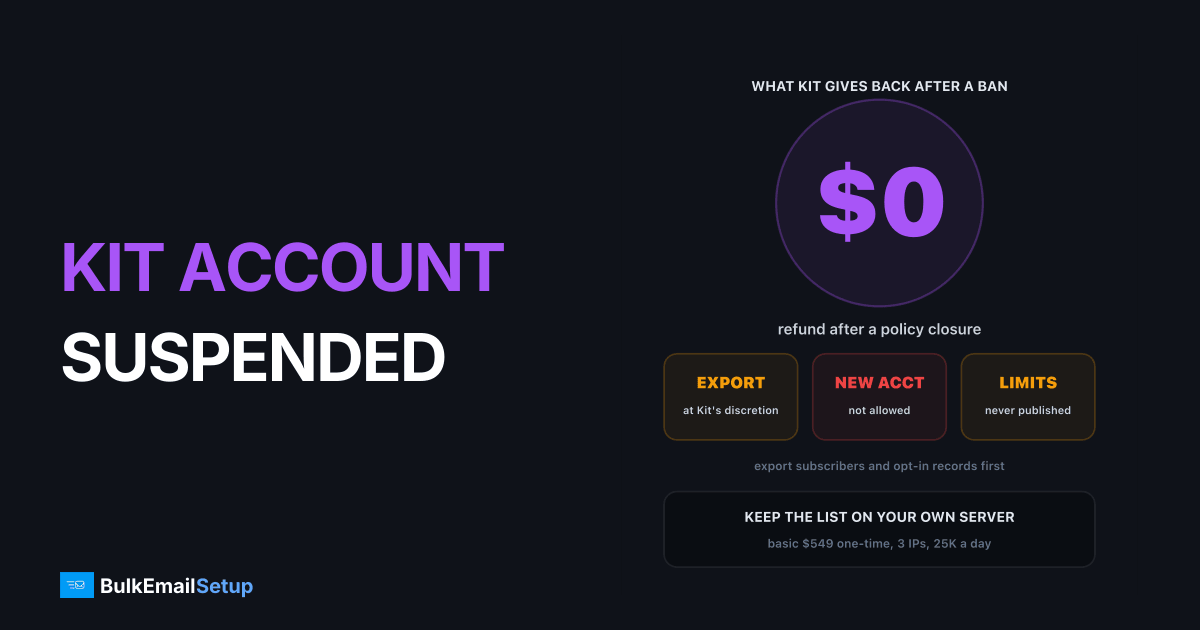
Kit suspends or closes accounts when bounce, complaint or unsubscribe rates rise, when it can't see proof of permission, or when your niche is on its banned list. Kit does not publish the numbers that trigger a review, and its policy is blunt about the result: accounts closed for policy reasons get no refund, export is at Kit's discretion, and you cannot open a new account. So the first job is to export everything you still can, and the second is to decide whether to appeal or move.
What Kit's policy actually says
These points come from Kit's acceptable use policy.
| Policy point | What it means for you |
|---|---|
| New accounts go through review | Kit can deny an account during it |
| Elevated bounces, complaints or unsubscribes | manual review, suspension or termination |
| Proof of permission for every subscriber | you must be able to show how each one opted in |
| Purchased or scraped lists banned | any bought list breaks the policy |
| Closure without notice | possible for violations |
| No refund for policy closures | money paid is gone |
| Export at Kit's discretion | your list may not come back |
| No new account after termination | a second account will be closed |
The last two rows are why speed matters. If you still have access, export now, before a review becomes a closure.
What a Kit closure costs beyond the pause in sending
Why it usually happens
Most Kit suspensions trace back to one of four things.
| Cause | What it looks like |
|---|---|
| Imported list | an old or bought list added in one go, bounces jump |
| Niche on the banned list | CPA affiliate, network marketing, get-rich-quick |
| Affiliate-heavy content | mostly other people's offers, little of your own |
| Complaints | people who forgot they signed up mark you as spam |
Kit's help center gives a rule of thumb for affiliate content: about 70 to 80% of email about your own products and 20 to 30% affiliate. A list built mostly for affiliate offers is a common review trigger. Our guide to SMTP for affiliate marketing covers where that kind of sending is allowed.
Appeal or move?
Pick the path based on why you were stopped
Appeal when the account is under review, not terminated, and you can point to a specific cause you have fixed. Give support three things: which segment caused it, what you removed, and the opt-in records for everyone left.
Move when your niche is on the banned list, the account is terminated, or your sending pattern (affiliate offers, high volume, frequent sends) will keep tripping a shared-platform review.
Don't appeal for a banned niche. The policy answer is already no, and the time is better spent moving.
What to export, right now
If you can still log in, take all of it:
- Subscribers with tags and custom fields.
- Opt-in records: form or landing page, signup date and, if you used double opt-in, the confirm date.
- Unsubscribes and bounces, so you never mail them again.
- Sequences and broadcasts you want to rebuild.
- Engagement data, if you can get it: last open and last click per subscriber.
Our guide on exporting your list before an ESP ban has the step-by-step for each platform.
Clean before you send anywhere
A list that got you closed on Kit will get you closed on the next platform, or burn the IPs on your own server. Before the first send:
| Step | Cut |
|---|---|
| Remove hard bounces | every one, permanently |
| Remove unsubscribes and complainers | every one, permanently |
| Remove anyone without opt-in proof | the imported segment, usually |
| Set aside 12-month inactives | mail them last, or not at all |
On a typical creator list this removes 15 to 30% of addresses. Those are the addresses causing your bounces and complaints. See our list cleaning guide for the method.
The 30-day path back to sending
From suspension to steady sending in about a month
| Days | What you do |
|---|---|
| 1 to 3 | export everything, find the segment that caused it |
| 4 to 7 | clean the list, keep opt-in records |
| 8 to 14 | set up the new sending path with SPF, DKIM, DMARC |
| 15 to 30 | warm up, most engaged readers first |
New IPs start cold, so ramp volume over a few weeks rather than sending to the whole list on day one. Our IP warm-up schedule has the numbers.
Kit vs your own server
| Factor | Kit | Your own SMTP server |
|---|---|---|
| Who can stop your sending | Kit's compliance team | only you (and inbox providers) |
| Niche rules | banned and restricted lists | your country's email laws |
| Pricing | rises with subscriber count | one-time setup plus hosting |
| Your list after a dispute | export at Kit's discretion | always on your server |
| Creator tools | forms, sequences, landing pages | campaign platform, you build the rest |
Kit's creator tools are good, and many creators stay. If you move, keep your landing pages wherever they work and send through infrastructure you own. Our comparison of Kit vs a dedicated SMTP server goes deeper on cost.
How BulkEmailSetup helps
We set up a dedicated SMTP server that you own, with your own IPs, SPF, DKIM, DMARC and PTR done, bounce handling, a campaign platform and a warm-up plan. Your list lives on your server, not on a platform that can close it.
| Plan | One-time fee | Emails per day | Dedicated IPs | Hosting you pay your host |
|---|---|---|---|---|
| Basic | $549 | 25,000 | 3 | about $11 a month |
| Advance | $1,199 | 200,000 | 15 | about $49 a month |
No monthly fee to us, no subscriber limit and a 15-day money-back guarantee. Inbox providers still judge your complaint rate, so a clean opt-in list still matters. See the Basic plan or compare all pricing.
Frequently asked questions
Why did Kit suspend my account?
Kit's acceptable use policy says elevated bounce, complaint or unsubscribe rates can lead to manual review, suspension or termination. It also bans purchased and scraped lists, requires proof of permission for every subscriber, and blocks some niches outright, such as CPA affiliate sites, network marketing and get-rich-quick offers. Most suspensions trace back to an imported list or a niche on that list.
What does Kit's compliance review check?
New accounts go through a verification step, and Kit says it can deny an account during that review. Kit looks at where your subscribers came from, whether you can prove each one opted in, what you sell, and your sending metrics. Kit does not publish numeric limits for bounces or complaints, so a single bad import can be enough to trigger a review.
Can I import a Kit list into another platform?
Yes, if you can export it. Kit's policy says data export is at its discretion for accounts closed over policy violations, so export subscribers, tags and consent records the moment you see a warning. Any new platform will ask how the list was collected. Bring the opt-in records, not just the addresses, and expect to remove anyone you cannot vouch for.
Is my own SMTP server safer for a creator list?
It removes the platform policy layer, not the rules. On your own server, no platform can close your account over a niche or a shared-pool metric, and your list stays on your machine. Gmail and Yahoo still judge your complaint rate, so a clean opt-in list matters just as much. BulkEmailSetup's Basic plan is $549 one-time for 3 IPs and 25,000 emails a day.
Can I open a new Kit account after a ban?
No. Kit's policy says users whose accounts are terminated for a listed compliance reason will not be allowed to open a new account. Trying anyway usually ends in a second closure, and it can make support less willing to talk to you about the first one. Put that effort into cleaning the list and moving it.
Does Kit give a refund after a suspension?
Not when the closure is for a policy violation. Kit's acceptable use policy says accounts closed for those reasons are not eligible for a refund. If your account is only under review and not closed, keep paying until the review ends, because cancelling during review can cost you access to your subscriber data.
Does Kit allow affiliate marketing?
Partly. Kit's help center says you need your own business or content outside affiliate marketing, and suggests a mix of about 70 to 80% of email content about your own products and 20 to 30% affiliate content. CPA affiliate sites are banned outright. Lists built mainly around affiliate offers are a common cause of reviews.


