
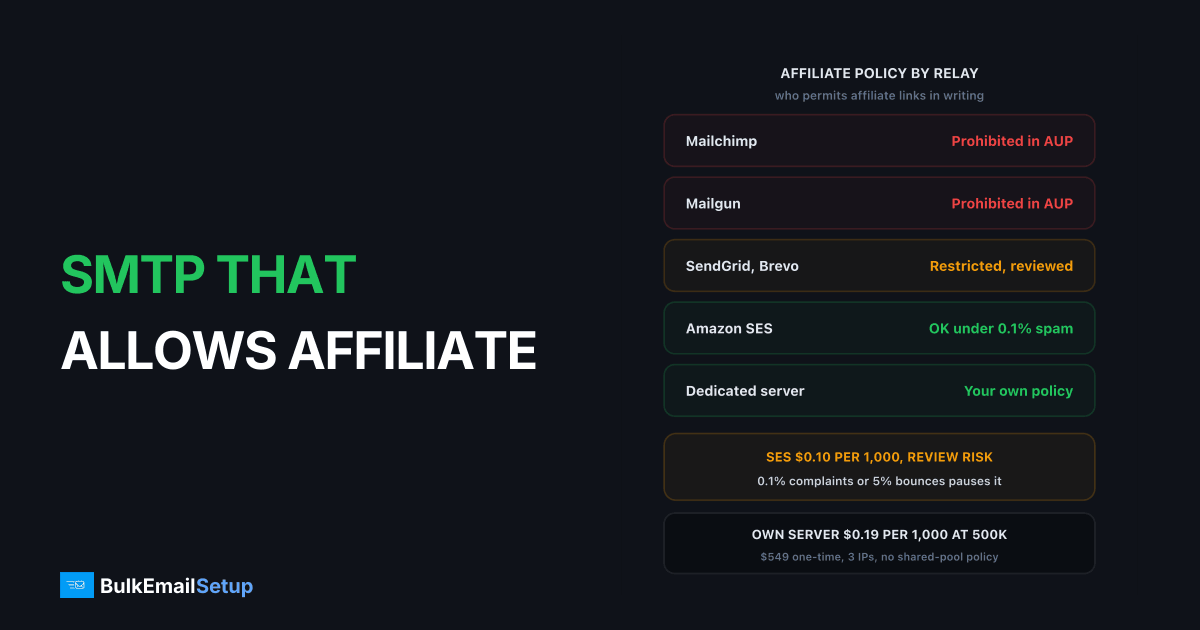
Most shared-pool SMTP relays either ban affiliate marketing outright or review it case by case. Mailchimp prohibits it in its acceptable use policy, Mailgun names affiliate marketing among the content it does not work with, and SendGrid, Brevo, Elastic Email and SMTP2GO treat it as restricted. The routes that reliably permit affiliate sending are Amazon SES at $0.10 per 1,000 with consented lists and complaints under 0.1%, or a dedicated SMTP server where you set the policy. Here is the written position of eight providers, how each enforces it, and what the permitted routes cost at 100,000 and 500,000 emails a month.
What each provider's policy says about affiliate marketing
The pattern is simple: if the provider shares IP space between customers, affiliate content is either banned or gated. Your complaints land on the same IPs as their transactional customers, and affiliate lists complain more. This table reflects the providers' own acceptable use and terms pages as of writing. Where I am not certain of the exact wording, I say restricted rather than guess at a ban.
| Provider | Affiliate marketing policy | How it is enforced |
|---|---|---|
| Mailchimp | Prohibited (affiliate marketing named in the AUP) | Omnivore abuse detection at list import, content scanning, account closure |
| Mailgun | Prohibited (affiliate marketing named among content it does not work with) | Signup review, complaint and bounce monitoring, account disable |
| SendGrid | Restricted, case by case (unsolicited email and purchased lists banned outright) | Automated complaint and bounce triggers near 0.1%, human review, suspension |
| Brevo | Restricted (opt-in required, affiliate content reviewed) | List import checks, manual review of sending content, complaint monitoring |
| Amazon SES | Permitted in practice when consented and low complaint | Metrics only: review near 0.1% complaints or 5% bounces, sending pause |
| Elastic Email | Restricted, check AUP | Reputation scoring, throttled sending limits, suspension |
| SMTP2GO | Restricted, check AUP | Signup vetting, complaint and bounce monitoring |
| Dedicated SMTP server | Your own policy, within the law and receiver rules | You enforce it; receivers enforce blocklists and complaint rates |
Two mistakes cost people accounts here. The first is assuming "legal" means "permitted". A CAN-SPAM compliant campaign to a consented list still breaks Mailchimp's terms, because that is a contract question. The second is describing affiliate sending as something else at signup. Providers spot it from link patterns and complaint curves inside a week, and that suspension is usually permanent and attaches to your domain.
For the campaign side, list building and offer selection, dedicated SMTP for affiliate email marketing covers the operational half. This page is only about who will let you send.
Why affiliate links get filtered even when your list is clean
Link reputation is scored separately from IP reputation, and for affiliate sending it is usually the binding constraint. A filter looks at the destination domain in your message. If that domain is a shared network redirect used by ten thousand other publishers, you inherit the worst behaviour among them. You can have perfect authentication, a dedicated IP with eight weeks of warm-up and a 0.02% complaint rate, and still land in spam because the redirect domain in your call to action is listed.
| Link setup | What the filter sees | Risk |
|---|---|---|
| Raw network redirect link | A shared domain with thousands of senders' history | High, frequently listed |
| Shortener (bit.ly and similar) | A generic shortener, destination hidden | High, many are blocked outright |
| Your own tracking subdomain via CNAME | A domain whose reputation you own and built | Low |
| Bare advertiser landing page | The advertiser's domain, no attribution | Low risk, but you lose the commission |
Use your own tracking subdomain, something like go.yourbrand.com, pointed by CNAME at the network's tracking host. Most affiliate networks support this and document the exact CNAME target. It costs nothing and it moves the reputation you are being judged on from a stranger's domain to yours. Keep the redirect chain to one hop. Every extra hop adds a domain that can be listed, and filters penalise long chains on their own.
One more rule: warm a fresh tracking subdomain the way you warm an IP, a few thousand sends to your best segment, before it carries a full campaign.
The list source problem that ends most affiliate accounts
Nearly every affiliate suspension I have seen traced back to list source, not to content or infrastructure. Co-registration data, rented lists and "opt-in" data bought from a broker are the usual cause. These lists are dense with recycled spam traps, and a trap hit gets the sending domain listed on Spamhaus within 48 hours regardless of how good the rest of your setup is.
The numbers that decide whether an account survives:
| Metric | Safe | Review territory | Account ending |
|---|---|---|---|
| Complaint rate | under 0.05% | 0.1% | 0.3% and above |
| Hard bounce rate | under 2% | 5% | 10% and above |
| Spam trap hits | zero | any recurring hit | a live trap on a clean IP |
| Unknown-user rejections per send | under 1% | 3% | 5% and above |
Co-reg data fails the bounce test before the complaint test. A typical co-reg file returns 8% to 15% unknown users on first send, enough on its own to trigger a review at SendGrid, Brevo or SES. What SMTP providers allow for purchased lists has the detail; the short answer is that no shared relay permits it and dedicated infrastructure does not make the traps go away.
Send only to addresses you collected yourself with a record of consent, verify the file before the first send, and suppress anyone with no open or click in 90 days.
Cost at 100,000 and 500,000 emails a month
These are the routes that permit affiliate sending. Year-one monthly figures, rounded, based on published list pricing at the time of writing. Providers that ban affiliate content are excluded, because their price is irrelevant if the account gets closed.
| Route | 100,000 a month | 500,000 a month | Notes |
|---|---|---|---|
| Amazon SES | about $10 | about $50 | $0.10 per 1,000, plus $24.95 a month per dedicated IP |
| Amazon SES with 1 dedicated IP | about $35 | about $75 | The dedicated IP is worth it above 100K |
| SMTP2GO (if approved) | about $100 to $150 | about $400 to $500 | Approval is not guaranteed for affiliate content |
| Elastic Email (if approved) | about $70 to $110 | about $250 to $350 | Reputation scoring can throttle you mid-campaign |
| Dedicated SMTP server, Basic | about $96 | about $96 | $549 one-time over 12 months plus about $50 VPS |
| Dedicated SMTP server, year two | about $50 | about $50 | One-time fee already paid |
Per thousand, that is roughly $0.96 on a dedicated server at 100K a month and $0.19 at 500K, against $0.10 on SES either way. SES wins on raw price and loses on risk: one bad import and the account pauses with no warning, mid-campaign, with your offers live. Note that 500,000 a month is only about 16,000 a day, well inside Basic's 25,000 daily cap. For the full breakdown across every route, see the cost of sending 100,000 emails a month.
Deliverability setup specific to affiliate sending
Affiliate campaigns need more separation than ordinary marketing, because one bad offer should not take the rest of the program with it. Here is what that looks like in practice.
- Your own tracking domain, properly CNAMEd. Covered above. This is the highest-value single change most affiliate senders can make.
- A separate sending subdomain per offer vertical. Finance offers, health offers and software offers get different subdomains: fin.yourbrand.com, hlt.yourbrand.com and so on. Each carries its own domain reputation. When one vertical draws complaints, the others keep delivering.
- Never the root domain. Your invoices and your support replies live there. Affiliate sending never touches it.
- Full auth on every subdomain. SPF, DKIM at 2048-bit, DMARC, and a matching PTR on each IP, before the first send. Missing DKIM alone produces
550 5.7.26rejections at Gmail. - Engagement suppression at 90 days. No open, no click, no send. Affiliate lists decay faster than newsletter lists because the relationship is with the offer, not with you.
- Complaint rate under 0.1%. Google's email sender guidelines set 0.3% as the hard ceiling and recommend staying below 0.1%. For affiliate content, treat 0.1% as the line where you stop and clean the list, not as a target to approach.
- One IP per vertical once you have three or more. Basic's 3 dedicated IPs map cleanly onto three verticals or three offer tiers.
Warm each new IP over 4 to 8 weeks, starting at a few hundred a day to your best-engaged segment and ramping about 30% every two days while watching 4xx deferrals rather than opens. Affiliate content makes warm-up harder, so take the longer end of that range.
What the law requires in every affiliate email
Provider policy is a contract. The law is separate and applies whatever infrastructure you use, including your own server.
FTC endorsement guides. If you earn a commission on what you recommend, you must disclose that material connection clearly and conspicuously, close to the recommendation itself. A line in the footer next to the unsubscribe link does not meet the standard. Put it above or beside the offer, in the same size text as the surrounding copy.
CAN-SPAM. Honest From line and subject, a valid physical postal address in every message, a working opt-out honoured within 10 business days, and an opt-out mechanism that keeps working for at least 30 days after the send. The FTC's CAN-SPAM compliance guide puts penalties at up to $53,088 per email in violation. Both you and the advertiser whose product is promoted can be liable.
The advertiser's own terms. Most networks have rules about subject lines, from-name usage, brand claims and which creatives may be emailed at all. Breaking those gets you removed from the program and, in some networks, the commission clawed back. Consent rules are stricter outside the US: GDPR and PECR require prior consent for marketing email to individuals, and that consent has to cover the affiliate promotion, not only your newsletter.
Which route to pick by volume
| Situation | Pick | Why |
|---|---|---|
| Under 50,000 a month, testing offers | Amazon SES | $5 a month, no commitment, exits fast if the offer flops |
| 100,000 to 250,000 a month, consented list, engineering on hand | Amazon SES with a dedicated IP | About $35 to $50 a month, but you own the review risk |
| 250,000 a month and up, several verticals | Dedicated SMTP server | Under $0.40 per 1,000, 3 IPs for vertical separation, no policy conflict |
| Already suspended by Mailchimp or Mailgun | Dedicated SMTP server on new subdomains | Shared relays share suspension signals; your own IPs start clean |
| Co-reg, rented or bought data | Nothing on this page | Trap hits list your domain in 48 hours whoever the sender is |
The pattern I see most often: people start on SES because it is cheap, run fine for six months, then one list import puts complaints over 0.5% and the account pauses on a Friday with three campaigns queued. If your affiliate revenue matters more than $50 a month, own the infrastructure. SMTP providers that actually allow cold email walks through the parallel case for outreach.
How BulkEmailSetup helps
We build dedicated SMTP infrastructure you own: your own server, your own IPs, full SPF/DKIM/DMARC/PTR on every sending subdomain, tracking-domain CNAMEs configured, MTA tuning, bounce handling and a warm-up plan sized for affiliate volume. Because the IPs are yours alone, there is no shared pool and no acceptable use policy deciding whether your compliant affiliate campaign is too risky for someone else's transactional customers. The FTC disclosure rules, CAN-SPAM and the receivers' complaint thresholds still apply, and we set the server up so you can meet them.
Basic starts at $549 one-time, covering 1 SMTP server, 3 dedicated IPs, 25,000 emails/day and unlimited contacts. Higher tiers scale to 15 IPs and 200,000 emails/day. See pricing, or read dedicated SMTP for affiliate email marketing for the campaign-side setup.
Frequently asked questions
Which SMTP providers allow affiliate marketing?
Mailchimp prohibits affiliate marketing in its acceptable use policy, and Mailgun names affiliate marketing among the content it does not work with. SendGrid, Brevo, Elastic Email and SMTP2GO treat it as restricted and decide case by case at signup or on review. Amazon SES permits it in practice when the list is consented and complaints stay under 0.1%, and a dedicated SMTP server has no shared-pool policy at all because you set it.
Why do so many SMTP providers ban affiliate marketing?
Two reasons, and neither is about the offer itself. Affiliate campaigns share redirect domains and IP space with known spam operations, so a clean sender inherits the reputation of everyone else using the same tracking network. Complaint rates on affiliate lists also run well above the 0.1% that shared pools can absorb, which puts the provider's transactional customers at risk on the same IPs.
Can I use Amazon SES for affiliate marketing?
Yes, if the sending is consented and the metrics stay clean. SES enforces by numbers rather than by reading your copy: a complaint rate near 0.1% or a bounce rate near 5% triggers an account review, and 0.5% complaints can pause sending. At $0.10 per 1,000 emails it is the cheapest permitted route, but one bad list import can end the account.
Do affiliate links hurt email deliverability?
Raw affiliate network redirect links do, yes. Filters score the destination domain, and the big network redirect domains carry years of spam history from thousands of other senders. Use your own tracking subdomain with a proper CNAME to the network so the link a filter sees belongs to a domain whose reputation you own.
What does the FTC require in an affiliate email?
The FTC endorsement guides require a clear and conspicuous disclosure of your material connection to the advertiser, near the recommendation, not buried in a footer. CAN-SPAM adds honest headers and subject lines, a valid physical postal address in every message, and a working opt-out honoured within 10 business days. Penalties run up to $53,088 per email in violation.
Should I tell my SMTP provider I am sending affiliate offers?
Always. Providers detect affiliate content from link patterns and complaint spikes within days, and a suspension for misrepresenting your use case is usually permanent and follows your domain. If a provider's written policy bans affiliate marketing, the answer is to use a route that permits it, not to disguise the sending.
What does a dedicated SMTP server cost for affiliate sending?
Basic from BulkEmailSetup is $549 one-time for 1 server, 3 dedicated IPs and 25,000 emails a day, plus roughly $50 a month for the VPS. At 500,000 emails a month that works out under $0.20 per 1,000 in year one. You still need 4 to 8 weeks of IP warm-up and separate sending subdomains per offer vertical before you run at that volume.


