
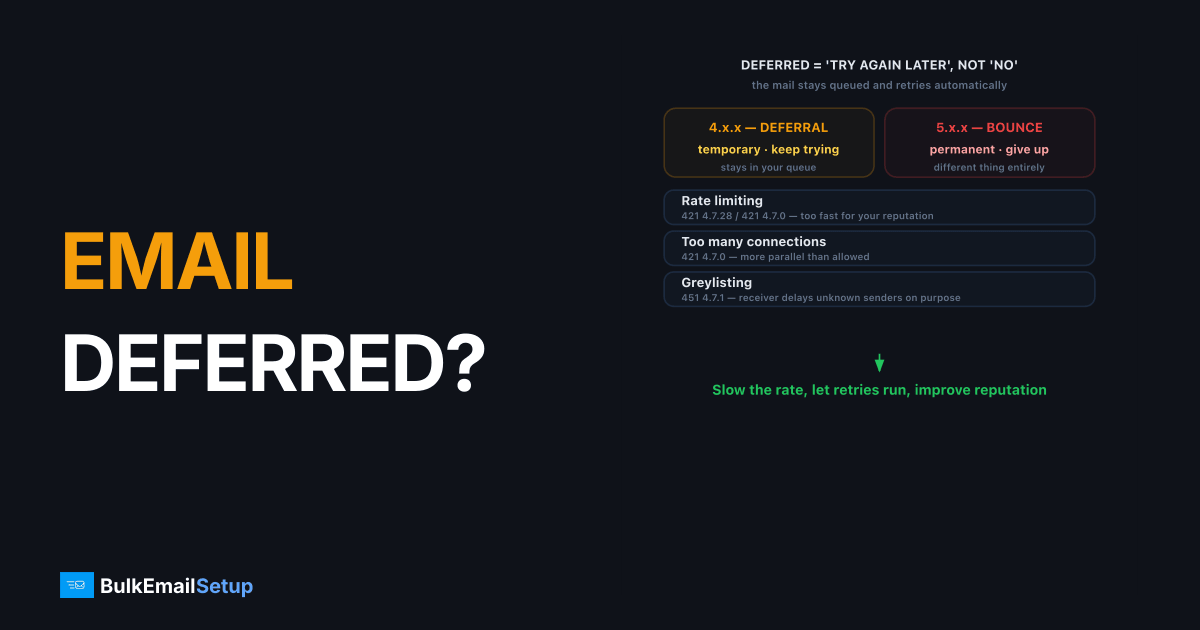
A deferred email means the receiving server returned a temporary 4.x.x response telling your server to try again later, rather than accepting or rejecting the message. It's not a bounce. The mail stays in your outbound queue and retries automatically. Deferrals come from rate limiting, greylisting, or reputation throttling. The fix is to slow your send rate, let retries run, and improve your IP reputation so receivers stop holding you off.
What does "email deferred" mean?
A deferral is a 4.x.x SMTP reply: a temporary failure. Per RFC 3463, any 4.x.x code means "try again later, the condition may clear." The receiving server isn't saying no. It's saying not right now. Your sending server queues the message and retries on a schedule, often every few minutes at first, then backing off over hours.
This is the key difference from a bounce. A bounce is 5.x.x, permanent, give up. A deferral is 4.x.x, temporary, keep trying. Most deferrals resolve themselves without you touching anything. The message only converts to a bounce if retries keep failing until your queue timeout (commonly a few days). For the full code map, see SMTP bounce code classes.
Why is my email being deferred?
Deferrals come from a few specific receiver behaviors. The reply string usually names the reason.
| Cause | Typical reply | What's happening |
|---|---|---|
| Rate limiting | 421 4.7.28 (Gmail), 421 4.7.0 | You're sending too fast for your IP's reputation |
| Too many connections | 421 4.7.0 Too many concurrent connections | You opened more parallel connections than allowed |
| Greylisting | 451 4.7.1 | Receiver delays unknown senders, expecting a legit retry |
| Reputation throttling | 421 with policy text | Your IP's standing limits how much the receiver accepts |
| Receiver-side issue | 421 4.3.x | The receiving server is busy or temporarily down |
Greylisting is the friendliest one. The receiver deliberately defers the first attempt from an unknown sender, knowing spammers often don't retry. Your server retries, passes, and gets accepted. See what is greylisting.
How do I fix deferred emails?
Most deferrals fix themselves, but you can clear the persistent ones.
- Let retries run first. For greylisting and brief throttling, do nothing. Your queue retries and the mail delivers within minutes. Don't resend manually, that creates duplicates.
- Slow your send rate. If Gmail returns 421 4.7.28 or you see steady deferrals, lower messages per connection and reduce send speed. See the 421 4.7.28 fix.
- Cut concurrent connections. A
421 4.7.0 too many connectionsmeans you opened too many at once. Reduce parallelism in your sending software. See the 421 4.7.0 fix. - Warm up new IPs. A fresh IP with no history gets deferred a lot. Ramp volume over 4-6 weeks so receivers build trust. See how long IP warm-up takes.
- Improve reputation. Persistent reputation deferrals mean your IP or domain standing is weak. Clean your list, cut complaints, and authenticate fully with SPF, DKIM, and DMARC.
- Check your retry config. If you run the server, confirm your queue retry intervals are sane (minutes, not hours) and your queue lifetime is a few days, not a few hours.
How do I confirm a deferral cleared?
Check the mail log for the message's final status. A deferral logs a deferred line with the 4.x.x reply; once it delivers, the same message ID logs status=sent with a 250 acceptance. That transition is your confirmation:
status=deferred (host gmail-smtp-in ... 421 4.7.28 ...)
... (retry) ...
status=sent (250 2.0.0 OK ... gsmtp)
Watch your queue depth alongside it. A healthy queue rises briefly during deferrals, then drains as retries succeed. A queue that keeps climbing means the deferrals aren't clearing, so the cause is reputation or rate, not a transient blip. The clearest case we see is a new IP throwing 421 4.7.28 on roughly half its Gmail volume in week one, then under 5% by week four as the warm-up earns trust. Same list, same content, the only thing that changed was sending history.
When does a deferral become a real problem?
Occasional deferrals are normal and healthy, every busy sender sees them. Worry when deferrals are sustained and growing, because that signals a reputation or rate problem the receiver is using to hold you back. If most of your volume to one provider is deferring for hours, treat it as throttling, slow down, and investigate your standing in Google Postmaster Tools or Microsoft SNDS. A deferral that never clears eventually bounces, so don't ignore a rising trend.
Prevent chronic deferrals
Persistent deferrals trace back to rate, reputation, or queue config. Keep all three in check.
- Pace sends to each provider. Cap messages per hour so you never outrun your IP's ceiling and trip
421 4.7.28. - Warm new IPs fully. A cold IP gets deferred constantly. Ramp over 4 to 6 weeks before full volume.
- Hold complaints under 0.3 percent. Reputation throttling eases only when the underlying behavior is clean.
- Tune queue retry once. Exponential backoff with a multi-day lifetime lets transient deferrals self-heal without duplicating mail.
How BulkEmailSetup helps
We run your dedicated SMTP server with proper retry and concurrency settings, a warmed IP, and full authentication, so deferrals stay rare and the ones you get clear on their own. We monitor reputation so throttling deferrals don't creep up unnoticed. See plans on our pricing page.
Frequently asked questions
What does it mean when an email is deferred?
Deferred means the receiving server returned a temporary 4.x.x response asking your server to retry later instead of accepting or rejecting the message. The mail isn't lost. It sits in your queue and your server retries automatically over the next minutes or hours.
Is a deferred email the same as a bounce?
No. A bounce is a permanent 5.x.x failure that gives up. A deferral is a temporary 4.x.x hold that retries. Most deferrals clear on their own. A deferral only becomes a bounce if retries keep failing past the timeout, usually a few days.
Why does Gmail keep deferring my mail?
Usually rate limiting. Gmail returns 421 4.7.28 when you send too fast from an IP with limited reputation. Slow your send rate, reduce concurrent connections, and let your IP warm up. Reputation deferrals ease as your sending history improves.
How long does a deferred email take to deliver?
It depends on your retry schedule and the receiver. Most servers retry every few minutes at first, then back off. Greylisting clears on the first retry, often within 5 to 15 minutes. Rate-limit deferrals clear as you slow down.


