
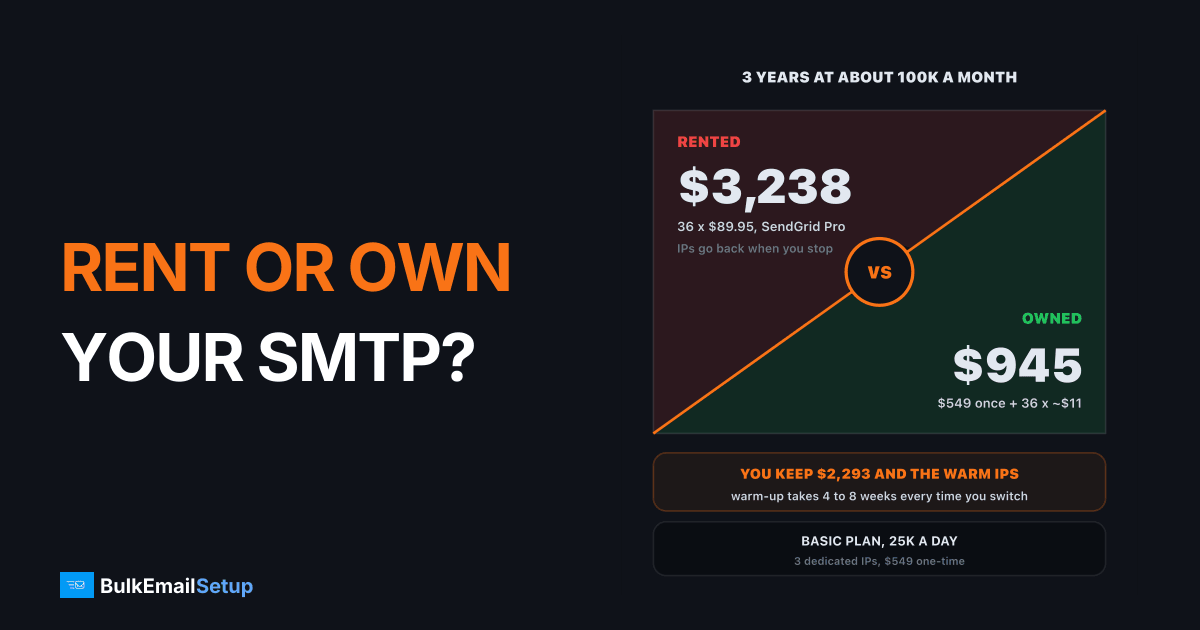
Renting an SMTP server costs less in month one and more by month six. A rented setup with dedicated IPs typically runs from about $90 to $600 a month, and none of it is yours when you cancel. A server you control costs a one-time setup plus hosting: our Basic plan is $549 once and about $11 a month, so over three years it comes to roughly $945, against about $3,238 for a rented SendGrid Pro plan at similar volume.
What "renting SMTP" actually means
The word covers three different products, and they price very differently.
| Rental type | Example | How you pay | What you get |
|---|---|---|---|
| Shared relay | SendGrid Essentials, Mailgun Basic | per plan or per email | a slot on shared IPs |
| Relay with dedicated IP | SendGrid Pro, SES dedicated IPs | plan plus per-IP fee | your own IP inside their system |
| Rented SMTP server | managed hosting vendors | flat monthly fee | a server they run, you log into |
All three have one thing in common: the provider owns the hardware, the IP addresses and the configuration. You are a tenant. That matters less for cost than for what happens when you leave, which we come back to below.
The prices for the second type are public. From Amazon SES pricing, you pay $0.10 per 1,000 emails and $24.95 a month for each dedicated IP. SendGrid's Pro plan starts at $89.95 a month with one dedicated IP. Mailgun charges $59 a month per extra dedicated IP.
What owning costs instead
"Owning" an SMTP server means the server lives in your own hosting account. You pay the host directly, and you pay once to have it built and configured.
| Plan | One-time setup | Hosting you pay your host | Emails a day |
|---|---|---|---|
| Basic | $549 | about $11 a month | 25,000 |
| Advance | $1,199 | about $49 a month | 200,000 |
| Custom | $2,997 | about $170 a month | 1,000,000 |
The hosting line is small because it is just a VPS or dedicated server plus IPs at about $2 each a month. There is no per-email fee and no contact limit, so the bill does not move when the list grows.
How three years of owning adds up, next to three years of renting
The 3-year totals at two volumes
Monthly prices hide the comparison. Put them on a 36-month line and the gap is obvious.
| Volume | Rented option | 36-month rent | Owned option | 36-month total |
|---|---|---|---|---|
| About 100K a month | SendGrid Pro, 1 dedicated IP | about $3,238 | Basic | about $945 |
| About 1M a month | SES + 3 dedicated IPs | about $6,295 | Advance | about $2,963 |
| About 1M a month | SendGrid at that volume | $21,600 or more | Advance | about $2,963 |
The SES row is the cheapest rental by a long way, and owning still costs less than half. SES is cheap per email but the dedicated IPs are billed every month forever, and you still build bounce handling, suppression and a campaign tool yourself. We broke those hidden lines down in Amazon SES vs a dedicated SMTP server.
For a longer look at paying once versus paying monthly, including the payback month, see one-time fee vs monthly email platform.
What you keep when you stop paying
This is the part a monthly price cannot show. When a rental ends, everything that lives on the provider's side ends with it.
| Asset | Rented setup, after you cancel | Server in your account |
|---|---|---|
| IP addresses | returned and reassigned | stay on your server while you pay the host |
| IP reputation you built | stays with IPs you no longer use | stays with you |
| Server configuration | deleted | yours, in your account |
| Sending domain and DNS | yours | yours |
| Domain reputation | yours | yours |
| Contact list | yours only if you exported it | on your own server |
Be precise about the IP row. On your own server the IPs are still leased from your hosting company, so you do not own them like a deed. What you own is the control: they are assigned to your account, they do not move when you switch mailer software, and nobody else's sending lands on them. Our guide on who owns the IP reputation you build goes through this in detail.
What leaves with the provider when a rental ends
The warm-up loss is the expensive one. Bringing new IPs to full volume takes 4 to 8 weeks of careful ramping. Every time you switch rented providers, you pay that again in reduced sending and lost campaigns.
When renting is the right call
Renting is not always wrong. It wins in a few clear cases:
- Under about 50,000 emails a month. A $549 setup takes longer to pay back when the rented plan is $20 a month.
- Short projects. A three-month campaign or a product pilot does not need a server.
- No one to watch the numbers. A shared relay polices your list for you, harshly. On your own server you read bounce and complaint rates yourself.
- Content the rental allows. If your mail fits the provider's policy and volume stays low, the simplicity is worth something.
It stops making sense when volume is steady, when the provider's content policy restricts mail you are legally allowed to send, or when you have already been through one forced migration. SMTP contracts vs pay-as-you-go covers the commitment side of the same choice.
How to move from renting to owning
The safe switch overlaps the two for a few weeks:
- Set up the new server on a sending subdomain with SPF, DKIM, DMARC and a PTR record that matches the HELO name.
- Keep the rental live. It carries your normal volume while the new IPs warm.
- Move your most engaged contacts first, a few hundred a day per IP, growing about 30% every two days. Our IP warm-up schedule has the week-by-week numbers.
- Shift volume gradually until the new IPs carry everything without deferrals.
- Cancel the rental last, after a full campaign cycle on the new server.
Your domain reputation comes with you the whole way, because Gmail and Microsoft score the domain, not the provider.
How BulkEmailSetup helps
We build the server in your own hosting account and hand it over: dedicated IPs with rotation, SPF, DKIM, DMARC and PTR, bounce handling, a campaign platform with stats, and a warm-up plan. You pay us once. After that, the only bill is your host's.
Basic is $549 one-time for 3 dedicated IPs and 25,000 emails a day, with hosting around $11 a month. Advance is $1,199 one-time for 15 IPs and 200,000 a day, with hosting around $49 a month. There is no contact limit on any plan, and the 15-day money-back guarantee applies until server access is handed over. Compare the plans on pricing, or start with the Basic plan cost breakdown.
Frequently asked questions
What does it cost to rent an SMTP server monthly?
It depends on how the rental is sold. SendGrid's Pro plan, which includes one dedicated IP, starts at $89.95 a month. Amazon SES charges $0.10 per 1,000 emails plus $24.95 a month for each dedicated IP. Mailgun adds dedicated IPs at $59 a month each. At 1 million emails a month, a rented setup usually lands between about $175 and $600 a month before support add-ons.
What do you own when you rent SMTP?
Nothing that survives cancellation. The provider owns the servers, the IP addresses and the configuration. You keep your sending domain, its DNS records and its domain reputation, plus your contact list if you exported it. The IP reputation you spent weeks warming stays attached to IPs you no longer use.
Is buying an SMTP setup cheaper over 3 years?
At most volumes, yes. At about 100,000 emails a month, three years of SendGrid Pro is around $3,238, against about $945 for BulkEmailSetup's Basic setup ($549 once plus about $11 a month hosting). At 1 million a month, SES with three dedicated IPs is around $6,295 over three years, against about $2,963 on Advance.
What happens to my IPs if I stop renting?
They go back to the provider and are reassigned, usually after a cooling-off period. Any warm-up you did on them is lost to you. On a server in your own hosting account the IPs are still leased from the host, but they stay assigned to your server for as long as you pay the host, so switching mailer software does not reset them.
Is renting ever the better choice?
Yes, below roughly 50,000 emails a month or for short projects. A one-off campaign, a pilot, or a product that may not last a year does not justify a setup fee. Renting also suits teams with nobody to watch bounce rates and blocklists, as long as they accept the provider's content rules.
Do I need technical staff to own an SMTP server?
Less than people expect, if the setup is done properly once. A configured server with SPF, DKIM, DMARC, PTR, bounce handling and a campaign panel runs largely on its own. The weekly work is reading bounce and complaint numbers and keeping the list clean, which you have to do on a rented service too.
Can I move from renting to owning without losing deliverability?
Yes, if you overlap. Keep the rented service running while new IPs warm up over 4 to 8 weeks, moving your most engaged contacts first. Your domain reputation travels with you because it belongs to the domain, not the provider. Cancel the rental only once the new IPs carry full volume cleanly.


