
A pay-as-you-go SMTP plan costs roughly 20 to 40% more per email than a negotiated contract at the same volume, and it never strands money. A contract buys the lower rate by making you carry the volume risk: you pay the minimum whether you send it or not, and anything above it usually bills at 1.5 to 2x the contract rate. The test is not which rate is lower. It is whether you can forecast your monthly volume within 20%. If you cannot, metered wins on total cost even though it loses on every per-email comparison.
The two models, side by side
These are different products wearing similar pricing pages. One sells emails. The other sells a promise.
| Factor | Pay-as-you-go (metered) | Annual contract (minimum commit) |
|---|---|---|
| What you buy | emails actually sent | a minimum volume or spend, for 12 months |
| Rate | list price, no negotiation | typically 20 to 40% below list |
| Minimum | none | the whole point of the deal |
| Send below forecast | you pay less | you pay the minimum anyway |
| Send above forecast | same rate keeps applying | overage, commonly 1.5 to 2x contract rate |
| Unused volume | does not exist | forfeited, usually monthly |
| Exit | stop sending | remaining months, or a termination fee |
| Price certainty | list price can change with notice | locked for the term, then 5 to 10% uplift |
| Who carries volume risk | the provider | you |
Amazon SES is the clearest metered example on the market. Its published pricing lists outbound email at $0.10 per 1,000 on the a la carte option, standard dedicated IPs at $24.95 per IP per month, and states plainly that there are no contract negotiations and no upfront commitments. Mailgun's Scale plan sits in the same family: a monthly base with per-1,000 overage and no term. Those numbers are the baseline any contract has to beat by enough to pay for the risk it hands you.
The volume-risk table
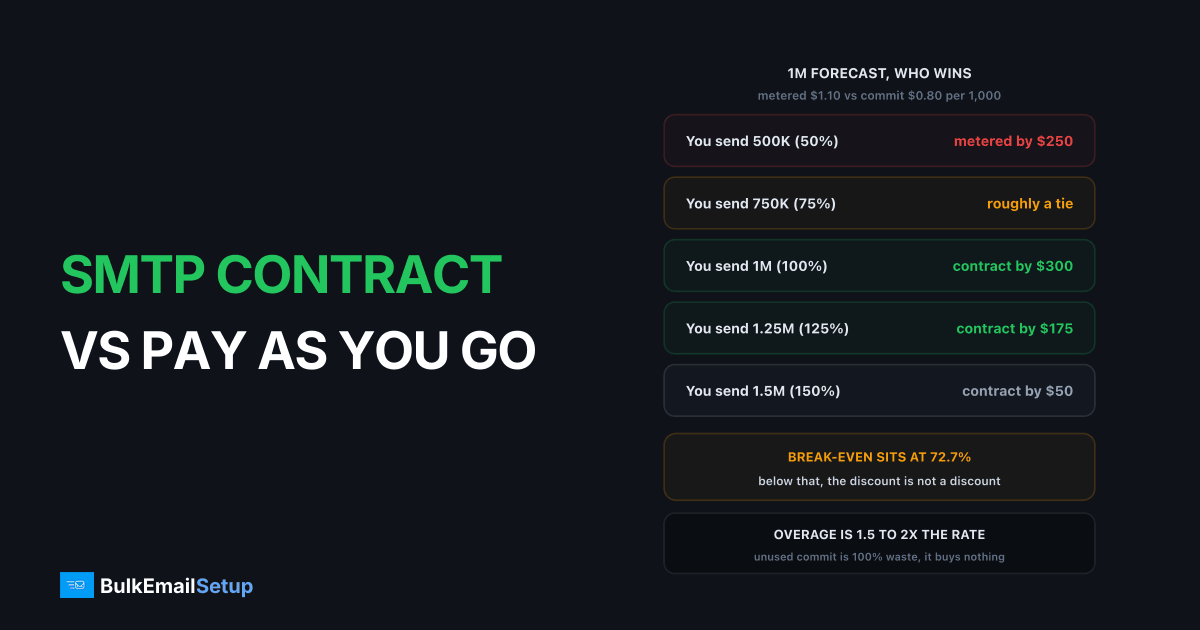
Here is the entire argument in one table. Forecast is 1 million emails a month. Metered rate $1.10 per 1,000. Contract rate $0.80 per 1,000 on a 1 million minimum, overage at $1.60.
| Actual volume | Pay-as-you-go cost | Contract cost | Which wins |
|---|---|---|---|
| 500,000 (50% of forecast) | $550 | $800, paying for 500K never sent | metered, by $250 |
| 750,000 (75%) | $825 | $800 | roughly a tie |
| 1,000,000 (100%) | $1,100 | $800 | contract, by $300 |
| 1,250,000 (125%) | $1,375 | $1,200 ($800 + 250K at $1.60) | contract, by $175 |
| 1,500,000 (150%) | $1,650 | $1,600 ($800 + 500K at $1.60) | contract, by $50 |
Read the shape, not the rows. The contract wins by a wide margin only in a narrow band around the forecast, roughly 90 to 115% of it. Undershoot and you lose fast, because every unsent email is 100% waste. Overshoot and the overage rate eats the discount until the two models converge.
The break-even is just the ratio of the two rates: $0.80 divided by $1.10 is 0.727, so 72.7% of the commit is where they cross. Below three quarters of your forecast, a 27% discount stops being a discount.
Why unused commitment is pure loss
Overage at least buys you something. Unused commit buys nothing at all, and that asymmetry is what people underestimate when they sign.
Say the commit is 1 million a month at $0.80 per 1,000, so $800. You send 600,000. You paid $800 for $480 of email. The $320 gap is not a worse rate, it is money that produced zero sends. Do that for twelve months and it is $3,840 gone, on a contract whose whole selling point was saving you about $300 a month against metered.
Standard terms reset the allowance monthly. No bank, no carry-forward, no credit at renewal. I have never seen rollover in a first-draft order form, and I have seen it granted several times just for asking before signature.
The seasonal case makes it brutal. A retailer sending 1.8 million in November and 400,000 in February has a 4.5x swing. Size the commit to November and ten months are half-empty. Size it to February and every quarter four bills overage at penalty rates.
Keep this separate from the annual vs monthly billing question. That one is about when you pay. This one is about whether you promise a volume at all, and you can be billed monthly and still be locked into a minimum.
The forecast-accuracy test
Everything above collapses into one question. How accurately can you predict next month's send?
| Your situation | Forecast confidence | Model to pick |
|---|---|---|
| 12 months of history, swing under 20% | high | contract, negotiate the clauses |
| 12 months of history, swing 20 to 50% | medium | metered, or a commit sized to your floor |
| Under 6 months of history | low | metered |
| List clean or re-engagement sweep planned | low, volume will drop | metered |
| Funding round or hiring plan pending | low, volume will jump | metered |
| Vertical near a provider's restricted list | irrelevant, you may be suspended | metered |
Pull your last twelve monthly send totals. If the lowest is under 80% of the average, you do not have a forecast, you have a hope.
One filter that is not about numbers. If a provider might suspend you, a commit is a prepayment for something you may not be allowed to use. Complaint rate is the usual trigger, and Gmail's sender guidelines put the ceiling at 0.3% with 0.1% recommended. Shared-pool providers act well below that, because your complaints land on IPs their other customers share.
Worked example: 1M forecast, 600K actual
This is the scenario I see most often, and it is not a disaster scenario. It is a normal year.
A B2C sender forecasts 1 million emails a month for the coming year. They sign a 12-month commit at $0.80 per 1,000, quoted against a metered alternative at $1.10. On paper that is $3,600 a year saved. In month three they run a re-engagement sweep, suppress the non-openers, and volume settles at 600,000.
| Line | Pay-as-you-go | Contract at 1M commit |
|---|---|---|
| Months 1 to 2 at 1M | $2,200 | $1,600 |
| Months 3 to 12 at 600K | $6,600 | $8,000 (minimum billed) |
| Dedicated IPs, 2 at $59 | $1,416 | $1,800 at $75 each |
| Onboarding fee | $0 | $3,000 one-time |
| 12-month total | $10,216 | $14,400 |
| Emails actually sent | 8 million | 8 million |
| Effective cost per 1,000 | $1.28 | $1.80 |
| Volume paid for, never sent | 0 | 4 million |
The contract's headline rate was 27% cheaper and the actual bill came in 41% higher. Four million emails were paid for and never sent. The onboarding fee, which the rep described as a formality, cost roughly what the discount was supposed to save in year one.
Run it the other way for honesty. At 1.3 million the contract finishes near $12,900 against metered's $13,700, a real saving of about $800. Growth rewards the commit. The problem is that a list clean is more predictable than growth, and most senders do one within eighteen months. The overage mechanics cap the upside even when you do grow.
The clauses that make a contract safe
I am not against commits. I am against unhedged ones. Three clauses turn a contract from a bet into a discount, and none of them cost the rep anything against quota.
| Ask | What it protects against | Wording to push for |
|---|---|---|
| Rollover of unused volume | the 600K-on-a-1M-commit case | "unused volume carries forward for one quarter" |
| One mid-term downsize | a permanent volume drop | "one step down per 12 months, no penalty" |
| Overage at contract rate | the 1.5 to 2x penalty | "overage billed at the committed per-1,000 rate" |
| Commit sized to floor, not average | seasonality | "minimum set at my lowest month, not my mean" |
| Termination for convenience | suspension or a bad year | "60 days notice, fee capped at one month" |
| No uplift, or capped at 3% | year two costing more than list | "renewal price capped in writing" |
Ask for terms before price. Once a rep has given you 25% off, they have spent their room and will say the legal template is fixed. Rollover first, discount second. The full clause-by-clause read is in hidden fees in ESP contracts.
Get rollover, a downsize right and capped overage, and the volume-risk table above mostly stops applying. That is the deal worth signing, and the one most people never ask for.
Where a one-time server sits
Neither model, and that is the point. A dedicated SMTP server is capacity, not commitment. You pay once for the build, and the only recurring bill is the VPS, which costs the same whether you send 50,000 or 500,000 that month.
| Factor | Pay-as-you-go | Annual contract | One-time dedicated server |
|---|---|---|---|
| Commitment | none | 12 months minimum | none |
| Cost at 600K/month | about $660 | $800 minimum | about $60 VPS |
| Cost at 1.5M/month | about $1,650 | about $1,600 with overage | about $60 VPS |
| Unused capacity cost | none | forfeited monthly | none |
| Dedicated IPs | $24.95 to $59 each per month | $30 to $80 each per month | 3 included on Basic, up to 15 |
| Keep IPs on exit | no | no | yes, allocated to you |
| Volume risk carried by | provider | you | nobody, capacity is fixed |
| Support and SLA | ticket queue | named contact, SLA | yours to run |
The third column has no volume risk in either direction, because there is no per-email meter. What it does have is responsibility: warm-up, blocklist monitoring, bounce handling and list hygiene sit with you, even when the build is done for you. The break-even maths shows the volume where it starts paying.
Decision table by sender profile
| Sender profile | Volume pattern | Pick | Why |
|---|---|---|---|
| Seasonal retail or travel | 3x to 5x peak-to-trough | pay-as-you-go | any commit is wrong ten months of the year |
| Steady SaaS transactional | under 15% monthly swing | contract | the forecast holds, take the rate |
| Early-stage, growing fast | doubling every two quarters | pay-as-you-go | you will outgrow every tier you sign |
| Flat and mature | under 10% swing, no growth | contract with downsize right | lowest rate, hedge the downside |
| Post-list-clean or unpredictable | volume about to move, direction unclear | pay-as-you-go | you have no forecast to commit to |
| High volume, cost-driven | over 1 million a month, steady | own the infrastructure | neither model beats fixed capacity at scale |
The middle rows are where reps do their best work, because a merely plausible forecast is enough to get a signature. Would you bet $3,840 of your own money on next February's number? That is exactly what the commit is.
The checklist before you sign anything
- Pull twelve months of actual sends. Highest, lowest, average. No history means no contract.
- Divide contract rate by metered rate. That percentage of your commit is the break-even. Below it, metered wins.
- Ask what the overage rate is and whether it bills or suspends mid-send. Suspension is a walk-away.
- Ask whether unused volume rolls over. Get the answer in the order form, not in an email from the rep.
- Size the commit to your floor month, not your average and never your peak.
- Check the onboarding fee. A $3,000 one-time charge can consume a full year of discount.
- Count the IP fees separately. At $30 to $80 per IP per month, three IPs is $1,080 to $2,880 a year on top.
- Confirm the auto-renewal window and diary the notice date the day you sign.
- Ask what happens if you are suspended. If the answer is that the commit still stands, stay metered.
- Price the one-time server alongside both. If fixed capacity is cheaper than either at your volume, the billing model question was the wrong question.
Answer 1, 2 and 4 honestly and the decision makes itself. Most senders who think they want a contract want the rate without the risk, and the way to get that is the clause list, not a bigger discount.
How BulkEmailSetup helps
We build dedicated SMTP infrastructure you own, so there is no commitment model to choose. No minimum to miss, no overage rate, no unused allowance to forfeit in a quiet month, no renewal window to diary. Your server, your IPs, full SPF, DKIM, DMARC and PTR configuration, MTA tuning, bounce handling and a warm-up plan. The only recurring bill is the VPS, paid to the host, not to us, and it does not move with your volume.
Basic is $549 one-time, covering 1 SMTP server, 3 dedicated IPs, 25,000 emails/day and unlimited contacts. Higher tiers scale to 15 IPs and 200,000 emails/day. See pricing, or work the crossover yourself with the break-even calculation.
Frequently asked questions
What is the difference between an SMTP contract and pay-as-you-go?
Pay-as-you-go is metered: you are billed for the emails you actually send, with no minimum and no term, the way Amazon SES bills at $0.10 per 1,000. A contract is a commitment: you promise a minimum volume or spend for 12 months in exchange for a rate 20 to 40% lower, and you pay the minimum whether or not you send it. The rate difference is real, and so is the risk transfer.
Is pay-as-you-go more expensive per email?
Yes, typically 20 to 40% more per email than a negotiated annual commit at the same volume. At 1 million a month, a metered rate around $1.10 per 1,000 against a contract rate near $0.80 is a difference of about $300 a month. Pay-as-you-go earns that back the moment your actual volume falls below about 75% of what you forecast.
What happens if I send less than my SMTP contract minimum?
You pay the minimum anyway. Unused commit does not roll over on standard terms, so a 1 million a month commit used at 600,000 forfeits 400,000 of paid volume every month it happens. Over twelve months at $0.80 per 1,000 that is $3,840 spent on emails that were never sent. Rollover is the clause to ask for before you sign.
How much is overage on an SMTP contract?
Commonly 1.5 to 2x the contract rate. A contract at $0.80 per 1,000 bills overage at $1.20 to $1.60, which is often above the pay-as-you-go list price you turned down. That is why sizing a commit to your peak month is a trap in one direction and sizing to your floor is a trap in the other unless you cap the overage rate in writing.
When should I choose pay-as-you-go over a contract?
If you cannot predict your monthly volume within about 20%, choose metered. Seasonal senders, early-stage companies, anyone whose list is about to be pruned, and anyone in a vertical a provider might restrict all fall in that group. The premium per email is cheap insurance against paying for volume you never send or overage at penalty rates.
Does a one-time dedicated SMTP server count as a contract?
No. A one-time build is capacity, not commitment: you buy a server with its own IPs, and the recurring bill is the VPS, which does not change whether you send 50,000 or 500,000 that month. There is no minimum to miss and no overage rate, so the volume risk that both billing models argue about stops existing. The trade is that warm-up, monitoring and list hygiene are yours.
What should I negotiate to make an SMTP contract safe?
Three clauses do most of the work: rollover of unused volume for at least one quarter, one mid-term downsize to a lower tier per year, and overage billed at the contract rate rather than 1.5 to 2x. Get all three and the commit becomes close to risk-free. Get none and you are underwriting a forecast you have no way to guarantee.


