
SMTP for recruitment and job-board email has to serve three streams that behave very differently: high-frequency job alerts (the riskiest), transactional candidate updates (application received, interview scheduled), and recruiter outreach (often cold). Each needs different handling, but all need correct SPF, DKIM, and DMARC, tight list hygiene, and a complaint rate under 0.3 percent. Below roughly 50,000 emails a month a quality shared relay works; above it, a dedicated SMTP server with a dedicated IP you control gives your alerts a stable reputation and isolates the high-risk streams so one doesn't poison the others.
The three email streams a job board sends
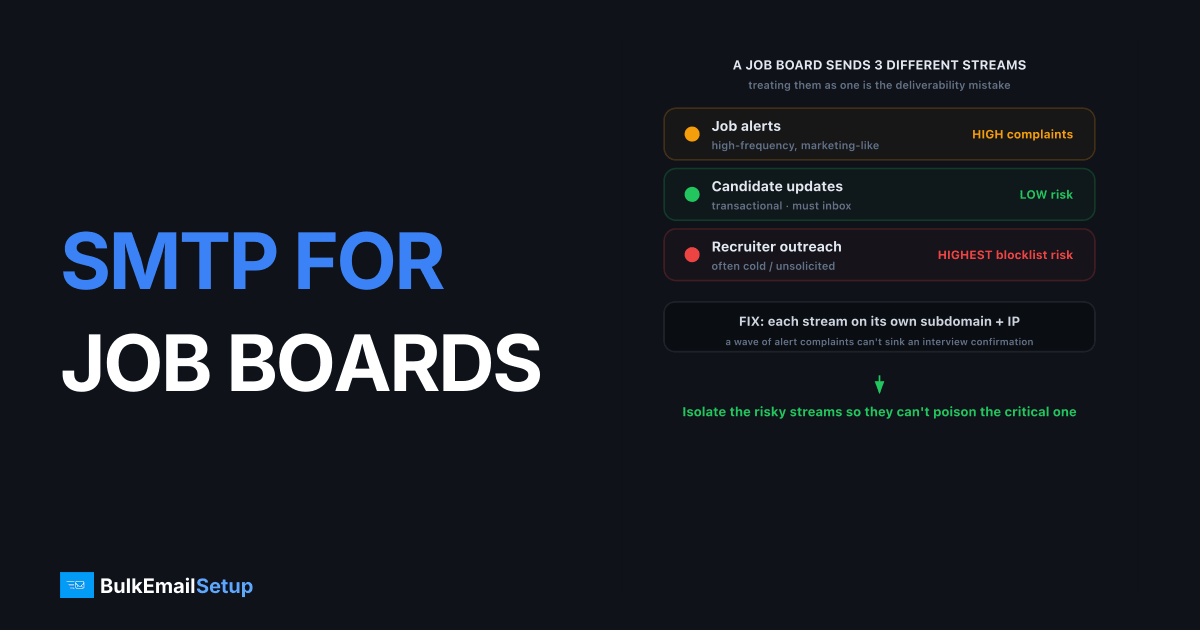
A recruitment platform sends three distinct streams, and treating them as one is the most common deliverability mistake. Job alerts are frequent, marketing-like, and complaint-prone. Candidate updates are transactional and must inbox. Recruiter outreach is often cold and carries the highest blocklist risk.
| Stream | Behavior | Risk level | Should inbox? |
|---|---|---|---|
| Job alerts | High-frequency, marketing-like | High (complaints) | Yes, but expect Promotions tab |
| Candidate updates | Transactional | Low | Critical, must inbox |
| Recruiter outreach | Often unsolicited / cold | Highest (blocklists) | Best on a separate domain |
The fix is separation. Route each stream through its own subdomain, and on a dedicated server its own IP, so a wave of job-alert complaints can't drag down an interview-confirmation email. This follows the subdomain vs root domain pattern.
A clean three-stream setup looks like this:
| Stream | Subdomain | Auth posture | Volume pattern |
|---|---|---|---|
| Candidate updates | mail.yourboard.com | Aligned SPF + DKIM, DMARC reject | Steady, must inbox |
| Job alerts | alerts.yourboard.com | Same, plus RFC 8058 unsubscribe | High frequency |
| Recruiter outreach | Separate domain entirely | Own SPF/DKIM, warmed slowly | Cold, blocklist risk |
Keeping these on distinct subdomains (and a distinct domain for cold outreach) means each builds its own reputation. A complaint spike on alerts stays contained to the alerts subdomain.
Why job alerts are your biggest complaint risk
Job alerts generate complaints because they're frequent and easy to forget signing up for. A daily digest to a subscriber who found a job three weeks ago is exactly the mail people mark as spam. Gmail and Yahoo bulk sender rules cap complaint rate at 0.3 percent, and crossing it damages your entire sending domain.
Controls that actually work:
- Confirmed opt-in. Double opt-in for alerts cuts spam-trap hits and fake signups.
- User-set frequency. Let subscribers choose daily, weekly, or instant. Forced daily mail drives complaints.
- Suppress dormant subscribers. Stop alerts to anyone who hasn't opened in 60-90 days. Inactivity is itself a spam signal. See email sunset policy.
- RFC 8058 one-click unsubscribe. Required, and a fast opt-out beats a spam complaint every time.
Monitor complaint rate per stream in Google Postmaster Tools so a single bad alert batch doesn't blindside you.
Is recruiter outreach the same as cold email?
Often, yes. When recruiters message candidates who never opted in, that mail behaves exactly like cold email: it draws complaints, spam-trap hits, and blocklist listings, and it can torch the reputation of any domain it shares. Keep it isolated.
Practical isolation:
- Separate domain. Send recruiter outreach from a distinct domain, never the one carrying candidate updates and job alerts. A blocklist hit then can't touch your transactional mail.
- Separate IP. On a dedicated server, route outreach through its own IP. Our cold email multiple domains setup covers the multi-domain pattern.
- Volume discipline. Cold outreach blasted from one fresh IP triggers
550 5.7.1policy blocks fast. Warm slowly and keep lists clean.
This isn't optional hygiene. A single careless outreach campaign on a shared sending domain can land your candidate-update mail in spam for weeks.
When a job board needs dedicated infrastructure
The threshold is roughly 50,000 emails a month, sent consistently, and most active job boards clear it easily. At that steady volume a dedicated IP accumulates enough history to hold a stable reputation, and it isolates your high-risk alert and outreach streams from your must-deliver candidate updates.
Steady high volume is actually the ideal case for a dedicated IP, because it never sits idle long enough for reputation to decay. You also get clean per-IP logs: when an alert batch bounces you see exactly which provider and why, instead of guessing about a shared pool. The decision framework is in how many emails before you need dedicated infrastructure. A new dedicated IP still needs a 4-6 week warm-up before it carries full volume.
The pattern we see most often on job boards is a slow complaint creep nobody watches until it is too late. One board we worked with let recruiter cold outreach run from the same domain as its candidate updates. The outreach drew enough complaints to push the domain past 0.3 percent in Postmaster Tools, and interview-confirmation emails, the mail that matters most, started landing in Promotions and then spam for about two weeks. Splitting cold outreach onto its own domain and IP stopped the bleed, but the reputation recovery was slow. Separation is far cheaper before the complaints than after.
Mistakes that tank job-board deliverability
Recruitment platforms make a recognizable set of errors, and almost all of them trace back to treating three different streams as one. Avoid these and you avoid most of the spam-folder pain.
- Forced daily alerts with no frequency control. The fastest way to push complaint rate over 0.3 percent. Let subscribers pick daily, weekly, or instant, and default to weekly.
- Never sunsetting dormant subscribers. A job seeker who got hired three months ago still receives daily alerts and eventually marks them spam. Suppress anyone with no opens in 60 to 90 days.
- Cold recruiter outreach on the main domain. One blocklist hit from unsolicited outreach and your interview-confirmation mail lands in spam for weeks. Keep cold outreach on a separate domain and IP, always.
- Single opt-in on alerts. Open signup forms collect spam traps and fake addresses. Confirmed opt-in keeps the list clean and your bounce rate low.
- No PTR or partial authentication. Sending high volume from an IP without reverse DNS, or with SPF but no DKIM, triggers filtering at Gmail and Yahoo immediately.
Each of these is a frequency or hygiene problem, not a content problem. Job-alert deliverability is won by sending less to the right people, not more to everyone.
How BulkEmailSetup helps
We provision dedicated SMTP servers with a dedicated IP you control, full SMTP access, and SPF, DKIM, DMARC, and PTR configured correctly, so you can route job alerts, candidate updates, and recruiter outreach through separate IPs that don't poison each other. We run the warm-up and monitor reputation and blocklists, which matters most for the high-frequency alert stream that drives complaints. Plans and volume tiers are on our pricing page.
Frequently asked questions
Why do job-board alert emails land in spam or the Promotions tab?
High-frequency job alerts to stale subscribers drive complaints and inactivity signals, both of which push mail to spam or Promotions. The fix is list hygiene, suppressing dormant subscribers, honoring unsubscribes fast, and keeping complaint rate under 0.3 percent. Frequency control matters as much as authentication.
Do recruitment platforms need a dedicated SMTP server?
Once you send more than roughly 50,000 emails a month consistently, yes. Job boards generate steady high volume, which is exactly when a dedicated IP holds a stable reputation and isolates your alerts from other senders. Below that threshold a quality shared pool delivers better.
Is recruiter outreach treated like cold email?
Often, yes. Unsolicited recruiter messages to candidates who never opted in behave like cold email and carry the same risks: complaints, blocklists, and domain reputation damage. Keep cold outreach on a separate domain and stream from transactional candidate updates and opted-in job alerts.
How do I keep job-alert complaint rates low?
Use confirmed opt-in for alerts, let users set frequency, suppress subscribers who haven't engaged in 60-90 days, and add RFC 8058 one-click unsubscribe. A complaint rate above 0.3 percent at Gmail or Yahoo damages your whole sending domain, not just one campaign.


