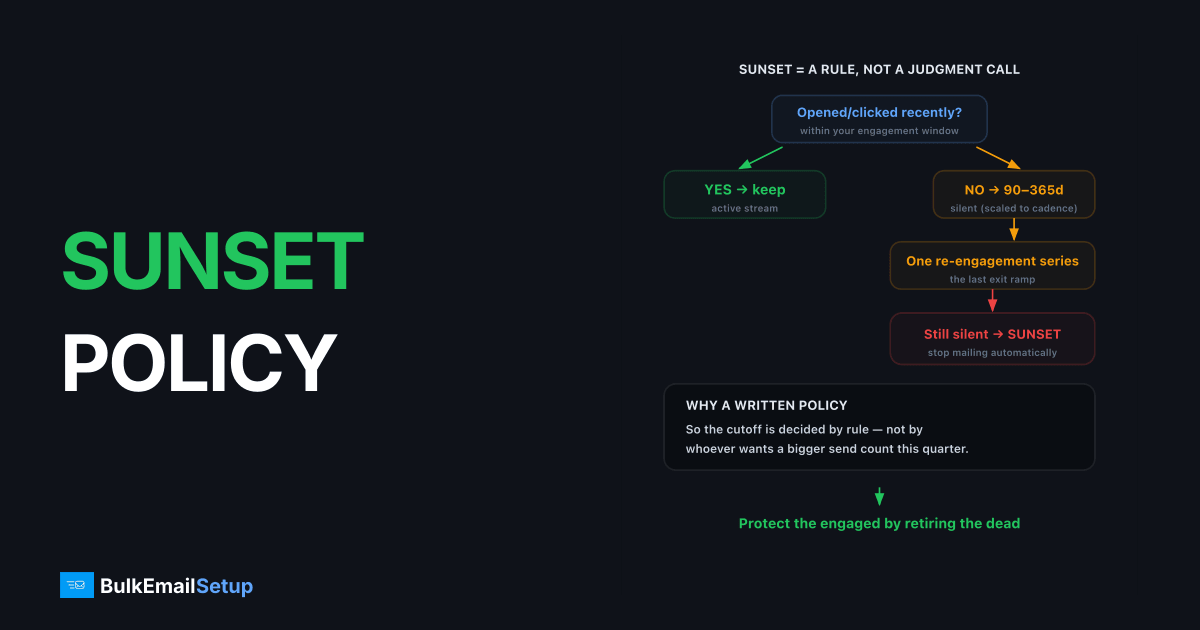
An email sunset policy is a written, automated rule defining exactly when a non-engaging subscriber stops receiving mail, typically after 90-365 days without an open, click, or purchase, scaled to your sending cadence, with one re-engagement series as the last exit ramp. It exists so the decision is made by policy, not by whoever wants a bigger send count this quarter.
Why a policy, not a judgment call
Every quarter, someone argues for mailing the full list "just this once." A sunset policy ends that argument in advance.
The math it encodes: Gmail and Yahoo rank you on engagement rates. Subscribers at 12 months of silence open at roughly nothing, complain at several times the active-subscriber rate, and include the abandoned mailboxes that become recycled spam traps. Mailing them taxes deliverability for everyone else.
Setting your thresholds
Scale the inactivity window to cadence, a daily sender gives a subscriber 90 chances to engage in 90 days; a monthly sender gives 3.
| Sending cadence | Re-engagement trigger | Sunset (suppress) point |
|---|---|---|
| Daily | 60-90 days inactive | 120 days |
| 2-3x weekly | 90-120 days | 180 days |
| Weekly | 120-180 days | 240 days |
| Monthly | 6-12 months | 15 months |
Adjust for purchase cycle: a subscriber who buys annually but never clicks marketing mail isn't dead, include purchases and site logins in your engagement definition, not just email metrics.
What counts as "engaged"
Post-Apple Mail Privacy Protection, opens alone over-count engagement for the 40-50% of consumer recipients on Apple Mail.
| Signal | Weight in sunset decision |
|---|---|
| Click | Strong, definitive engagement |
| Purchase / login / app activity | Strong, they're a customer even if not a reader |
| Open (non-Apple) | Moderate |
| Open (Apple MPP) | Weak, machine-generated |
| Reply or forward | Strong |
A practical definition: engaged = any click, purchase, or non-MPP open within the window.
The sunset pipeline
- Trigger: subscriber hits the inactivity threshold for your cadence.
- Re-engage: they enter a 3-email re-engagement series over 2-3 weeks, value reminder, preference/incentive offer, dated goodbye.
- Decide: any click or preference update returns them to the active list; silence means suppression on the stated date.
- Suppress, don't delete: move to the suppression list so re-imports can't resurrect them; keep them for ad-audience matching if useful.
- Report: log suppressed counts and next-campaign open rate, so the policy's effect is visible.
This pipeline is the automated half of the broader list cleaning cycle, sunset handles engagement decay continuously; verification handles technical decay every 6 months.
What changes after you enforce it
| Metric | Typical movement |
|---|---|
| List size | -15% to -40% one-time, then a steady small trickle |
| Open rate | +20-40% |
| Spam complaint rate | Falls, often by half |
| Bounce rate | Falls, dead mailboxes exit before they bounce |
| Gmail domain reputation | Climbs over 2-4 weeks of cleaner signals |
The complaint reduction is the strategic one: chronic mailing of the unengaged is a top driver of creep toward Gmail's 0.3% complaint ceiling, and a sunset policy removes the driver structurally.
Objections you'll hear, and the answers
- "We paid for those leads." Sunk cost. They produce no revenue and tax placement for leads that do.
- "What if they were about to buy?" Then they'll buy from your site, ads, or the re-engagement series, which exists precisely to catch them.
- "Can't we just email them less?" A reduced-frequency tier is a legitimate middle stage (see frequency segmentation), but it delays, not replaces, the sunset point.
- "Our list is our valuation." An inboxing 60K list outperforms a spam-foldered 100K list on every revenue metric; placement fundamentals in why emails go to spam.
How BulkEmailSetup helps
Our dedicated SMTP servers come with an email marketing platform and campaign statistics, so you can segment by engagement and run the sunset rules above on infrastructure that keeps your reputation yours alone. Basic is $549 one-time plus about $11 a month hosting. See pricing.
Frequently asked questions
What is an email sunset policy?
A sunset policy is a documented rule that automatically stops mailing subscribers after a defined period of zero engagement, typically 90-365 days depending on sending frequency, usually after one re-engagement attempt.
Why not just keep emailing inactive subscribers? It's free.
It isn't free. Inactive recipients drag down the engagement rates Gmail uses for folder placement, complain at several times the rate of active ones, and include recycled spam traps. The cost is paid in inbox placement for your entire list.
Should I delete sunset subscribers or just suppress them?
Suppress, don't delete. Keep the record so the address can't be accidentally re-imported, and so you can still reach them through other channels like ad matching. Deleting suppression history is how old contacts sneak back in.
How long before an inactive subscriber should be sunset?
Roughly 90-120 days of zero engagement for daily senders, 180 days for weekly senders, and 12 months for monthly senders, each after a short re-engagement series gets one last response chance.
Does a sunset policy reduce revenue?
Measured programs almost always find the suppressed segment was producing near-zero revenue while suppressing inbox placement for buyers. Open rates typically rise 20-40% post-sunset, and revenue per email rises with them.