
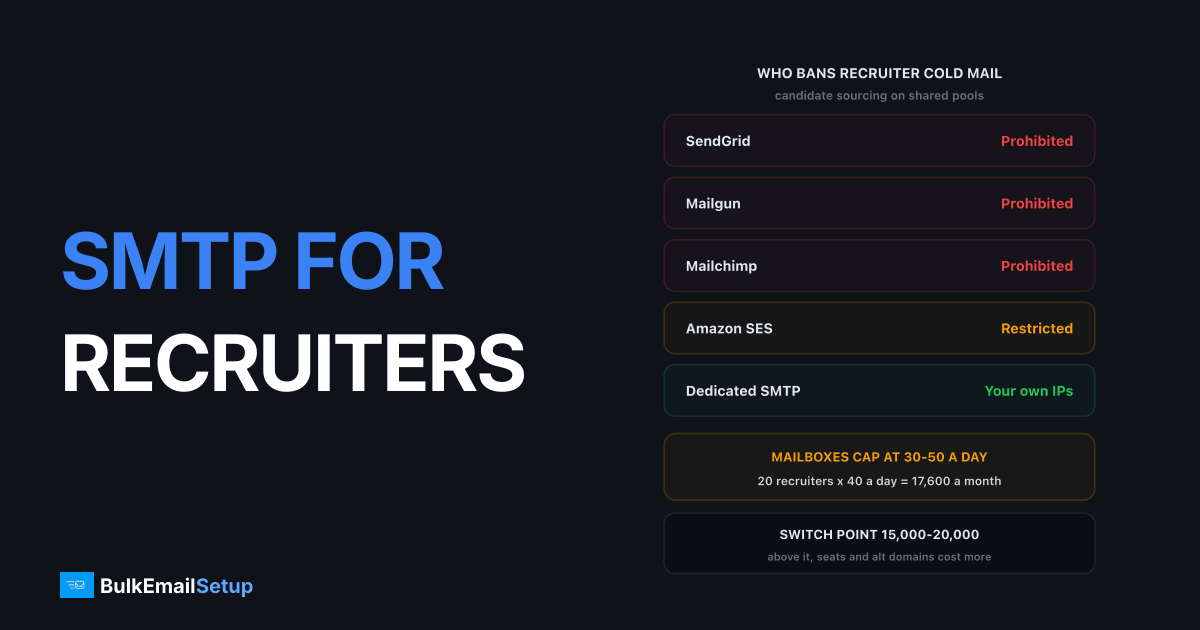
A recruiting agency sends three kinds of mail, and two of them are banned on shared ESP pools. Candidate sourcing and client business development are both cold outreach, which SendGrid, Mailgun, Mailchimp and Brevo all prohibit in their acceptable use policies. Only placement and interview mail is safely transactional. Ten recruiters sending 40 candidate emails a day is 400 sends daily, or roughly 8,800 a month, and a single Workspace mailbox tops out around 30 to 50 cold sends a day before deliverability falls apart. That arithmetic, not the price per email, is what decides your infrastructure.
I have set up sending for staffing firms from 4 recruiters to 60. The pattern is always the same: they start on a couple of Workspace mailboxes, add a sequencing tool, hit a wall around 8,000 sends a month, and then discover their ESP will not take the overflow.
The three streams a staffing agency sends
Separate these before you buy anything. They have different legal bases, different complaint profiles, and different provider rules.
| Stream | Consent basis | Volume share | Complaint risk |
|---|---|---|---|
| Candidate sourcing | Cold, from CVs or LinkedIn | 60-75% | High |
| Client business development | Cold B2B to hiring managers | 15-25% | High |
| Placement and interview mail | Transactional, both parties known | 10-20% | Very low |
Candidate sourcing is the volume driver and the risk driver at the same time. It is also the one most agencies push through whatever relay their ATS was already configured with, which is how the interview confirmations end up in spam.
Job boards face a related but different problem, since their volume is opted-in alerts rather than cold sourcing. If that is your model, SMTP for recruitment and job boards covers the alerts side.
What each provider's policy actually says
Read the acceptable use policy, not the pricing page. Every shared-pool provider bans unsolicited mail, because your complaints land on IPs shared with their other customers.
| Provider | Cold candidate outreach | Practical outcome |
|---|---|---|
| SendGrid | Prohibited, AUP requires recipient permission | Suspension, usually within weeks |
| Mailgun | Prohibited, no purchased or scraped recipients | Account review then closure |
| Mailchimp | Prohibited, opt-in required for all lists | Fastest to ban of the four |
| Brevo | Prohibited, consent required | Suspension on complaint spike |
| Amazon SES | Restricted, tight complaint and bounce ceilings | Sandbox exit refused or account paused |
| Dedicated SMTP server | Your own policy on your own IPs | You carry your own reputation |
The distinction that matters: these bans are commercial, not legal. Cold B2B outreach is lawful in the US under CAN-SPAM if you follow the rules. The provider still bans it because on a shared pool your complaint rate is everyone else's problem. Dedicated IPs remove the policy conflict. They do not remove CAN-SPAM, GDPR, or the receiving network's filters.
If you have already been shut off, ESP banned cold email, what now walks the recovery.
Why the per-recruiter mailbox model hits a wall
Google Workspace allows 3,000 external recipients per user per day, on top of a 10,000 total recipient cap. That number is irrelevant to cold outreach.
The real ceiling is what Gmail's filters tolerate from a mailbox that mostly sends to strangers. Gmail's email sender guidelines put the spam complaint ceiling at 0.30% and the target under 0.10%, and cold sourcing has no consent buffer to absorb that. In practice that is 30 to 50 sends a day per mailbox, and only after a 3 to 4 week warm-up from 10 a day. Push past it and reply rates drop before the bounces even start.
Run the arithmetic for a 20-recruiter agency:
| Line item | Figure |
|---|---|
| Recruiters | 20 |
| Candidate emails per recruiter per day | 40 |
| Daily sends | 800 |
| Monthly sends, 22 working days | 17,600 |
| Safe cold sends per mailbox per day | 40 |
| Mailboxes needed | 20 primary plus 8-10 alternates |
| Workspace seats at $14/user/month | $392-420 |
| Sequencing tool at $60-100/seat | $1,200-2,000 |
The mailbox count is the part people get wrong. Twenty recruiters do not need twenty mailboxes if any of them wants to burst above 40 a day, and holiday cover, weekend queues and campaign launches all cause bursts. You end up buying alternate domains and extra seats, and the sequencing tool bills per seat regardless.
Comparing the three routes at 20 recruiters
| Factor | Workspace plus sequencer | ATS-bundled email | Dedicated SMTP server |
|---|---|---|---|
| Setup time | 1-2 days | Hours | 3-5 days including warm-up start |
| Monthly cost at 20 seats | $1,600-2,400 | $200-600 on top of ATS | Flat, one-time build |
| Ceiling | ~40/day per mailbox | Usually 200-500/day account-wide | 25,000-200,000/day |
| Cold outreach allowed | Yes, within Gmail limits | Often restricted by the ATS relay | Yes, your IPs |
| IP control | None | None | Full, you delist yourself |
| Reply handling | Native inbox | Native in ATS | Needs mailbox or IMAP setup |
| Blast radius of a problem | One mailbox | Whole agency | One IP or domain |
ATS-bundled email is the quiet trap. Bullhorn, Loxo and similar tools will happily send through their own shared relay, which means your agency's sourcing volume is pooled with every other agency on that relay. When one of them gets sloppy, your mail slows down and you have no visibility and no lever to pull.
The blend that works at 20 recruiters: mailboxes for the top-of-funnel, highest-personalisation sequences where the reply lands in the recruiter's own inbox, and a dedicated SMTP server for the scaled candidate campaigns, the shortlist blasts and every piece of transactional placement mail. Best SMTP that allows cold email compares the providers that permit it.
Wiring SMTP into your ATS
Every major recruiting ATS accepts outbound SMTP. The settings are boring and the mistakes are consistent.
| Setting | Value |
|---|---|
| Host | smtp.yoursendingdomain.com |
| Port | 587 |
| Security | STARTTLS |
| Auth | LOGIN |
| From | [email protected] |
| ATS | Where to set it | Gotcha |
|---|---|---|
| Bullhorn | Admin, Email Settings, per-user or account SMTP | Reply-to must match the recruiter's real inbox or replies vanish |
| JobAdder | Account, Integrations, Email | Bulk sends throttle at the account level, not per user |
| Recruit CRM | Settings, Email, custom SMTP | Sends the envelope from your SMTP user, so align SPF to it |
| Loxo | Settings, Email, SMTP or OAuth | OAuth uses the recruiter's Gmail limit, SMTP uses yours |
Three rules that prevent most of the failures I see:
- Align the envelope sender. If the ATS sends
From: [email protected]but the SMTP envelope is[email protected], SPF alignment fails and DMARC breaks. Publish SPF and DKIM on the exact domain in the From header. - Route replies to a real inbox. Candidate replies are the entire point. An ATS that sends via SMTP but has no IMAP or forwarding configured loses them silently.
- Use a subdomain for sourcing.
sourcing.youragency.comfor cold, root domain for placement mail. One blocklist listing then never touches an interview confirmation.
Compliance a recruiting agency cannot skip
This is the section agencies skim and then pay for. Four separate regimes apply, and dedicated infrastructure does not exempt you from any of them.
CAN-SPAM, US, both candidate and client outreach. Accurate From and subject lines, a working opt-out honoured within 10 business days, and a real physical postal address in every message. There is no B2B exemption. The FTC's CAN-SPAM compliance guide is the authority, and the penalty runs to five figures per email.
GDPR, EU and UK candidate data. Cold candidate outreach usually relies on legitimate interest, which requires a documented balancing test you can produce on request. At first contact you must tell the candidate what data you hold and where you got it. Sourcing a CV from a job board does not inherit that board's consent, and this is the single most common failure: agencies treat a downloaded CV as permission when it is only a source.
Data retention. Holding candidate records forever is a breach in its own right. Set a retention period, typically 12 to 24 months from last contact, and delete or re-consent at the end of it. An automated suppression and purge job is cheaper than a complaint to a regulator.
Anti-discrimination in the copy itself. EEOC rules in the US and equivalent law elsewhere apply to your outreach text, not just the job advert. Age-coded phrasing like "recent graduate" or "digital native", gendered role titles and nationality preferences all create exposure. Have someone review the sequence templates, not just the job posts.
Deliverability specifics for recruiting outreach
Recruiting mail behaves differently from marketing mail, and the metrics that predict trouble are different too.
| Metric | Marketing benchmark | Recruiting outreach target |
|---|---|---|
| Reply rate | Not tracked | 8-15% candidate, 2-5% client |
| Open rate | Primary KPI | Unreliable, Apple Mail Privacy inflates it |
| Complaint rate | Under 0.3% | Under 0.1%, you have no consent buffer |
| Bounce rate | Under 5% | Under 3%, CV data ages fast |
| Sends per domain per day | Thousands | 200-400 across mailboxes |
Reply rate is the number to run the operation on. Opens have been unusable since Apple Mail Privacy Protection started prefetching images, and a sequence with a 12 percent open rate and a 0.4 percent reply rate is not working, it is just being delivered. Candidate data also decays roughly 25 to 30 percent a year as people change jobs, so a CV database untouched for 18 months will bounce hard.
Three controls that keep the domains alive:
- Separate domains for outbound and transactional. Sourcing on its own domain, placement mail on the root. The multiple domains setup pattern applies directly.
- Suppress on engagement, not just opt-out. Anyone with no reply after a full sequence goes into a 6 month cooldown. Re-sequencing non-responders is where complaint rates spike.
- Cap per domain, rotate across domains. 200 to 400 a day per sending domain even after warm-up, spread across the rotation by the sequencer.
For the underlying warm-up mechanics, dedicated SMTP for cold email and outreach covers the ramp schedule.
What it costs at 20,000 and 100,000 a month
| Route | 20,000/month | 100,000/month |
|---|---|---|
| Workspace mailboxes plus sequencer | $1,600-2,400/mo | Not viable, needs 100+ mailboxes |
| ATS-bundled relay | $200-600/mo on top of ATS | Usually throttled or refused |
| SendGrid or Mailgun | $90-200/mo, policy risk | $400-900/mo, high ban risk |
| Amazon SES | ~$2/mo plus engineering | ~$10/mo plus engineering and risk |
| Dedicated SMTP server | One-time build, flat | Same build, same flat cost |
SES looks unbeatable on the per-email line and it is, right up to the point where your complaint rate crosses their ceiling and the account is paused with no appeal path worth the wait. Price the risk, not just the rate. SMTP relay pricing comparison has the full per-provider breakdown.
Decision by agency size
| Agency size | Monthly sends | What to run |
|---|---|---|
| 1-5 recruiters | Under 5,000 | Workspace mailboxes plus a sequencer, nothing more |
| 6-15 recruiters | 5,000-20,000 | Mailboxes for sourcing, dedicated SMTP for transactional and blasts |
| 16-40 recruiters | 20,000-80,000 | Dedicated SMTP with 3-5 IPs, mailboxes only for top-of-funnel |
| 40+ recruiters | 80,000+ | Dedicated SMTP, 8-15 IPs, separate outbound and transactional domains |
The switch point is around 15,000 to 20,000 sends a month. Below it, the mailbox model is simpler and the seat cost is tolerable. Above it, you are buying alternate domains and extra seats to work around a per-mailbox cap, and paying a sequencing tool per seat for the privilege. That is the moment dedicated infrastructure stops being an upgrade and starts being the cheaper option.
How BulkEmailSetup helps
We build dedicated SMTP infrastructure you own: your own server, your own IPs, SPF, DKIM, DMARC and PTR configured for every sending domain, MTA tuning, bounce handling and a warm-up plan. Because the IPs are yours alone, there is no shared pool to protect and no policy team deciding whether candidate sourcing is too risky for their other customers. Point Bullhorn, JobAdder, Recruit CRM or your sequencer at it and route sourcing, business development and placement mail through separate domains.
Basic is $549 one-time, covering 1 SMTP server, 3 dedicated IPs, 25,000 emails/day and unlimited contacts. Higher tiers scale to 15 IPs and 200,000 emails/day. See pricing, or read best SMTP that allows cold email for the provider-by-provider policy comparison.
Frequently asked questions
Can I use SendGrid or Mailgun for recruiter candidate outreach?
No, not for cold sourcing. SendGrid's and Mailgun's acceptable use policies both prohibit sending to recipients who have not asked to hear from you, and candidates sourced from LinkedIn or a CV database have not. You can use them for transactional placement mail like interview confirmations, but the sourcing volume needs different infrastructure.
How many candidate emails can one recruiter send per day from a Google Workspace mailbox?
Google's published limit is 3,000 external recipients a day per Workspace user, but that is the hard cap, not the safe one. For cold outreach the practical ceiling is 30 to 50 a day per mailbox before reply rates fall and Gmail starts filtering. Ten recruiters at 40 a day is 400 sends, which needs 8 to 12 warmed mailboxes, not two.
What does a 20-recruiter agency actually need to send 20,000 emails a month?
Either 25 to 30 warmed Workspace mailboxes plus a sequencing tool at roughly $500 to $900 a month, or a dedicated SMTP server with your own IPs at a one-time build cost. Below about 15,000 sends a month mailboxes usually win on simplicity. Above 50,000 the mailbox count and the seat licences make dedicated infrastructure cheaper.
Is cold candidate outreach legal in the UK and EU under GDPR?
It can be, under legitimate interest, but the bar is real. You must be able to show a documented balancing test, tell the candidate where you got their data at first contact, and honour erasure requests. Sourcing a CV from a job board does not transfer that board's consent to you, and holding candidate data indefinitely is the most common failure we see.
Should candidate outreach and interview confirmations use the same domain?
No. Cold outreach carries complaint and blocklist risk that will drag transactional mail down with it. Run outreach on separate sending domains and interview or placement mail on your main domain, so a blocklist hit on a sourcing domain never stops a candidate getting their interview time.
Can I put SMTP credentials into Bullhorn or Recruit CRM?
Yes. Bullhorn, JobAdder, Recruit CRM and Loxo all accept either per-user mailbox OAuth or an outbound SMTP host, port, username and password at the account level. Use port 587 with STARTTLS, and set the envelope sender to a domain you control with matching SPF and DKIM, or the ATS mail will fail alignment.
What reply rate should recruiting outreach hit?
A well-targeted candidate sequence lands 8 to 15 percent replies; client business development to hiring managers runs 2 to 5 percent. Below 2 percent on candidate mail your targeting is wrong, and the volume is only buying you complaints. Reply rate, not open rate, is the number that predicts whether your domains survive.


