
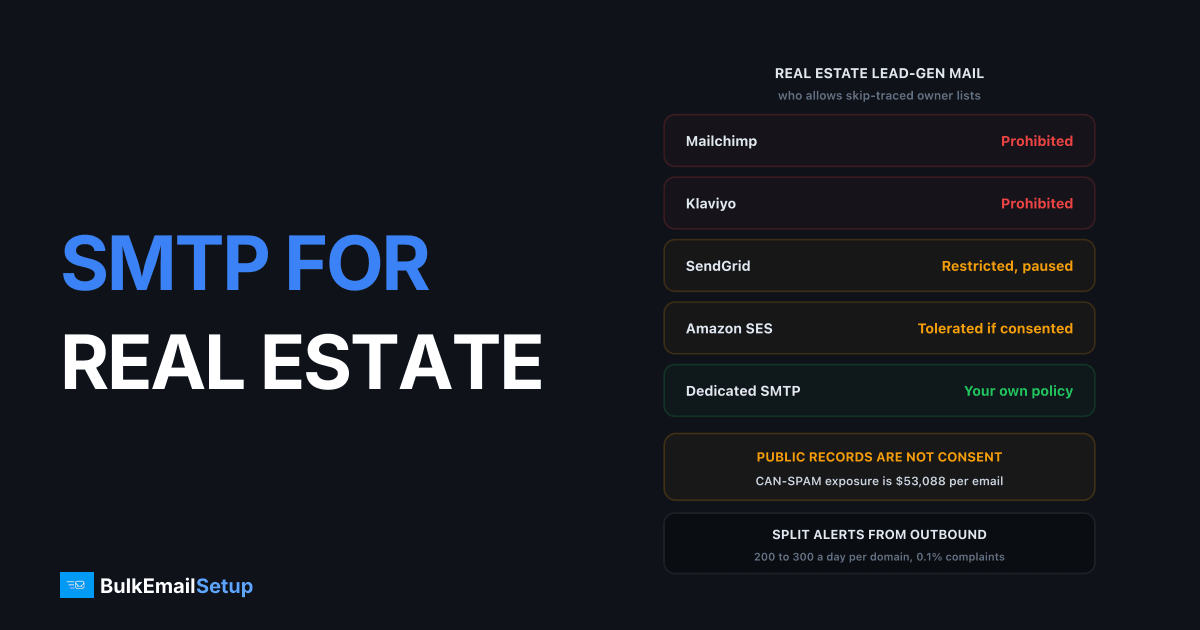
Real estate lead generation email, meaning absentee-owner, pre-foreclosure, farmed-list and "we buy houses" outreach, is prohibited on Mailchimp, Klaviyo and Brevo because the lists come from public records and skip tracing, restricted on SendGrid and Mailgun, and tolerated on Amazon SES only to consented addresses with complaints under 0.1%. A dedicated SMTP server removes the provider policy because there is no shared pool to protect. It does not remove CAN-SPAM, GDPR, or your state's advertising rules, and it does not make a skip-traced owner who gets 15 offers a month open yours. What works is many small domains, 200 to 300 messages a day each, and dropping every address after 2 unopened sends.
I've rebuilt sending for wholesalers, investors and brokerages after Mailchimp or SendGrid closed the account. Same story every time: county records, skip-trace vendor, 30,000 addresses uploaded as if they were subscribers.
Who permits real estate lead-gen mail
Ask in writing, and ask about the outbound list specifically. Listing alerts are welcome everywhere. The absentee-owner list is what gets refused.
| Provider | Outbound to skip-traced or scraped lists | Listing alerts to site sign-ups | Notes |
|---|---|---|---|
| Mailchimp | Prohibited | Allowed | Purchased, scraped and public-record lists named in the acceptable use policy |
| Klaviyo | Prohibited | Allowed | Ecommerce focus, lead-gen accounts refused at review |
| Brevo | Prohibited | Allowed | List provenance checked on upload, accounts closed on complaint spike |
| SendGrid | Restricted | Allowed | Outbound paused after first complaint spike over roughly 0.1% |
| Mailgun | Restricted | Allowed | Transactional favoured, promotional to non-opt-in reviewed |
| Amazon SES | Tolerated if consented | Allowed | Production review, account paused on complaints over 0.1% |
| Dedicated SMTP | Your own policy | Allowed | IPs are yours, the law and receiver rules still apply |
The shape matches insurance lead-gen exactly. Outbound to a list you assembled is where the account dies, licence or not.
Why public records are not consent
Providers file real estate outbound under purchased lists for four reasons, and each shows up in the stats within a fortnight.
The address was never given to you. A county assessor record has no email. The skip-trace vendor matched the name to a data broker file and returned its best guess. Nobody ticked a box.
Match quality is poor. In the vendor files I've audited, 20 to 40% of skip-traced emails are wrong person, dead mailbox, or a spam trap. Hard bounces above 5% on the first send are normal, and 5% is where SendGrid starts its review.
The owner is saturated. An absentee owner in a hot market gets 5 to 15 offers a month from other investors pulling the same records. Complaint rates of 0.5% to 2% are typical, against Google's 0.3% hard limit and 0.1% target in the bulk sender guidelines.
Receivers score the pattern. An owner who reported 3 investor emails this month will report yours too, and Gmail scores the domain on that.
See purchased lists and what is allowed for the provenance tests they apply.
The legal line by market
Legal in the US, mostly unlawful in the EU and UK, with licence rules on top in every state.
| Market | Rule | Skip-traced owner list usable for email? | Requirements | Exposure |
|---|---|---|---|---|
| US, unlicensed investor or wholesaler | CAN-SPAM | Yes, opt-out basis | Accurate headers, physical address, working opt-out, honest subject line | $53,088 per email |
| US, licensed agent or broker | CAN-SPAM plus state advertising rules | Yes | All of the above plus name, brokerage and licence number | Licence discipline, fines |
| EU | GDPR plus ePrivacy | Rarely, no consent | Consent naming you, or a narrow B2B exception | Up to 4% of global turnover |
| UK | UK GDPR plus PECR | Rarely for individuals | Consent, or soft opt-in from a prior sale | Up to £17.5m |
| Canada | CASL | Only with express consent | Consent naming you, identification, unsubscribe | Up to CAD 10m |
CAN-SPAM is opt-out law. The FTC's compliance guide lists the test: no false headers, no deceptive subject lines, the message identified as an ad, a valid physical postal address, an opt-out that works for 30 days after sending and is honoured within 10 business days, and responsibility for anything a vendor sends for you. "Regarding your property at 14 Oak St" is a fine subject; "Offer accepted" when nothing was accepted is not.
State real estate advertising rules. If you hold a licence, your state commission almost certainly requires your name, brokerage and licence number on every advertisement, and email is advertising. Texas requires the broker name and TREC licence number. California requires the DRE number on first-contact solicitation. Florida and Arizona have equivalent rules. Unlicensed wholesalers must not imply they are agents, and Oklahoma, Illinois and Pennsylvania now require them to disclose that they are marketing an equitable interest, not the property itself.
GDPR and PECR. Consumer marketing email needs consent that names the sender. A land registry extract does not give it, and the soft opt-in only covers people you already sold to. For an EU or UK property business, post is the channel that remains.
Suppression lists. State DNC registries cover calls, not email, but your own opt-outs are binding and permanent. One suppression list, checked before every send, fed by every domain you run. Any "remove me", "stop" or "not interested" reply goes on it the same day, with the whole household at that property.
What actually works for outbound
Small volumes on many domains, owned IPs, and a hard engagement cut-off.
| Setting | Number | Why |
|---|---|---|
| Messages per sending domain per day | 200 to 300 | Gmail throttles new domains above this in the first 90 days |
| Messages per mailbox per day | 30 to 50 | Mailbox-level rate limits and reputation are tracked separately |
| Domains for a 20,000 address list | 8 to 10 | One full pass in 7 to 10 days without any domain over the ceiling |
| Warm-up before full volume | 5 to 8 weeks | Ramp roughly 30% every 2 to 3 days per domain and IP |
| Engagement suppression | 2 unopened sends | Third send to a cold address is where complaints cluster |
| Complaint ceiling | 0.1% per domain | Google target, and the point shared providers act at |
| Hard bounce ceiling | 2% per send | Above that, verify the list again before continuing |
Buy domains you can afford to lose. Outbound never goes out from your brand domain. Use variants like oakstreethomebuyers.com and oakstreetoffers.net, each with SPF, DKIM, DMARC at p=quarantine moving to reject, and a matching PTR on the IP. Rotation is covered in cold email with multiple domains.
Own the IPs. A shared pool means someone else's complaint rate becomes yours. On your own IPs, no policy desk decides your list is too risky for other customers.
Verify before the first send. Drop anything a verification service does not confirm deliverable. On the files I've seen this removes 25 to 40% and takes first-send bounces from 8 to 12% down to under 2%.
Suppress at 2 unopened sends. Two messages, no open, no reply, off the list for 6 months. This one rule holds complaints under 0.1% on lists that would otherwise run at 1%, and halves volume after the first pass. Re-test the dormant segment later with re-engagement campaigns, one send, one chance.
Footer that satisfies the law and the filter. Physical address, plain-text unsubscribe link plus a "reply STOP" line, your name, and for licensed agents the brokerage name and licence number. An empty footer is the shape of every scam offer the recipient already deleted.
Split listing alerts from outbound before anything else
A real estate sender has two kinds of mail, and they behave nothing alike.
| Stream | Domain | Contains | Complaint tolerance | Where it can live |
|---|---|---|---|---|
| Listing alerts and transactional | alerts.yourbrand.com | Saved-search matches, showing confirmations, offer updates, document requests | Under 0.02% | Any provider, or your own server |
| Outbound lead-gen | Separate throwaway domains | Absentee-owner offers, pre-foreclosure letters, farmed-list intros, wholesaler deal blasts | Under 0.1% | Own IPs only |
Buyers who signed up for alerts open at 30% or better and almost never complain. Absentee owners complain 20 to 50 times as often. Mixed on one IP, the first bad outbound batch throttles a showing confirmation to a buyer under contract. On a 3-IP starter, one IP carries alerts, two carry outbound, and the brand domain never appears in an outbound From address. DNS layout is in subdomain vs root domain for sending.
What it costs at 100K and 500K a month
A wholesaler working 20,000 owners with a 4-touch sequence is at 80,000 a month before suppression. A 30-agent brokerage with farmed lists passes 500K fast.
| Provider | 100K per month | 500K per month | Dedicated IP | Policy risk on outbound |
|---|---|---|---|---|
| Amazon SES | ~$10, ~$35 with IP | ~$50, ~$75 with IP | $24.95 per IP add-on | tolerated, pauses on complaints over 0.1% |
| SendGrid Pro | $89.95 | ~$350 to $450 | 1 on Pro | restricted, outbound paused |
| Mailgun Scale | $90 | ~$350 to $500 | 1 included | restricted, reviewed |
| Brevo Business | ~$65 to $150 by contacts | ~$300 to $600 | add-on | prohibited |
| Klaviyo | ~$150 to $400 by contacts | ~$1,000+ | not offered | prohibited |
| Dedicated server | $549 one-time plus ~$30 to $80 hosting | same server, same price | 3 included | none from a provider |
Brevo and Klaviyo price by contact, and a database of 20,000 to 200,000 owners is the shape that hurts most, before either refuses the list. SES is the cheapest bill, but its review pauses the whole account, listing alerts included, when outbound complaints spike. The dedicated server beats SendGrid Pro inside 7 months at 100K and inside 2 months at 500K. Full working in cost to send 100,000 emails a month and 500,000 a month.
Deliverability specifics for real estate
Plain text wins. A one-paragraph message about a specific property beats a designed template by 2 to 3 times on replies, and complains less. No images or tracking pixels on the first touch, one link at most.
Personalise on the property, not the person. "Your property at 14 Oak St, Springfield" is data you hold. "Hi FIRSTNAME" from a file with a 30% mismatch rate emails the wrong person by name.
Watch reply rate, not open rate. Apple Mail Privacy Protection inflates opens. A reply rate of 1 to 3% is healthy. Below 0.5% with bounces climbing, rest the domain for 30 days.
Postmaster Tools on every domain. Free, one TXT record each. Pull a domain from rotation at Low before it reaches Bad. Setup is in our Google Postmaster Tools guide.
DMARC at enforcement on the brand domain. Real estate brands are impersonated for wire fraud. A brand domain at p=none lets a criminal send "updated closing wire instructions" from your exact From address.
Seasonality. Pre-foreclosure and tax-lien lists refresh monthly. Send within 14 days of the record date or not at all. A 90-day-old distressed-owner list has already been worked by everyone.
What to do after a termination
- Export while you still can. Suppression lists, bounce logs, complaint reports, DKIM keys. Access closes within 48 hours on most platforms.
- Find the cause. Complaints over 0.1%, bounces over 5%, or the list category itself.
- Check the brand domain. Postmaster Tools, domain and IP reputation separately. If outbound went from the brand domain, that damage follows you.
- Clean. Drop hard bounces, every address with 2 unopened sends, every reply-STOP, and every record older than 90 days. Re-verify the rest.
- Rebuild on dedicated IPs. New outbound domains, brand domain reserved for alerts, SPF, DKIM, DMARC, matching PTR.
- Warm up over 5 to 8 weeks. Alerts first. Then outbound to the freshest 30 days of records. Ramp roughly 30% every 2 to 3 days per domain.
- Fix the intake. Verified skip-trace only, 2-send suppression from day one, licence and address in every footer.
Step 4 is the one people skip. A list that closed a Mailchimp account will get dedicated IPs listed at Spamhaus just as fast, with no provider to blame.
How BulkEmailSetup helps
We build dedicated SMTP infrastructure for senders in restricted categories: your own server, your own IPs, full SPF/DKIM/DMARC/PTR configuration, MTA tuning, bounce handling and a warm-up plan, with listing alerts and outbound lead-gen separated onto their own domains and IPs from day one.
No shared pool means no category policy weighing your sending against other customers. Meeting CAN-SPAM, GDPR and your state's advertising rules stays yours. Basic starts at $549 one-time, covering 1 SMTP server, 3 dedicated IPs, 25,000 emails/day and unlimited contacts. Higher tiers scale to 15 IPs and 200,000 emails/day. See pricing.
Frequently asked questions
Which SMTP providers allow real estate lead generation email?
Mailchimp, Klaviyo and Brevo prohibit mail to scraped or skip-traced lists and close accounts when they find them. SendGrid and Mailgun restrict the category and usually pause the outbound stream after the first complaint spike. Amazon SES carries it only to consented addresses with complaints under 0.1%. A dedicated SMTP server applies only the law in your markets, because there is no shared pool to protect.
Is it legal to email absentee owners from public records?
In the US, yes under CAN-SPAM, as long as the message has accurate headers, a physical postal address, a working opt-out honoured within 10 business days, and no deceptive subject line. In the EU and UK it is normally unlawful, because GDPR and PECR require consent for consumer marketing email. Legal does not mean deliverable: skip-traced lists complain at 0.5% to 2%, against a Gmail limit of 0.3%.
Why do skip-traced lists get such high complaint rates?
The owner never gave you the address. A skip-trace vendor matched a county record to an email found in a data broker file, and 20 to 40% of those matches are wrong or dead. The rest belong to people who get 5 to 15 similar offers a month from other investors. Complaint rates of 0.5% to 2% are normal, and 0.3% ends a shared account.
How many real estate lead emails can I send per domain per day?
Keep each sending domain under 200 to 300 outbound messages a day, and each mailbox under 50. A 20,000 address absentee list therefore needs 8 to 10 domains and 5 to 8 weeks of warm-up before it can be covered in a single pass. Sending 20,000 from one domain in a day gets that domain blocked at Gmail inside a week.
Do I need my licence number in a real estate marketing email?
If you are a licensed agent or broker, most state real estate commissions require your name, brokerage name and licence number on all advertising, and email counts. Texas, California, Florida and Arizona all enforce it. Wholesalers who are not licensed must not imply they are, and several states now require wholesalers to disclose that they hold only an equitable interest in the property.
Should listing alerts and outbound investor mail share an SMTP server?
Same server, separate subdomain and IP. Listing alerts go to buyers who signed up on your site and open at 30% or better. Outbound absentee-owner mail complains 20 to 50 times as often. Put alerts on alerts.yourdomain.com and outbound on a second domain, each with its own IP, so a bad outbound campaign never stops a buyer's showing confirmation.
What does real estate lead-gen email cost at 100,000 a month?
Amazon SES is about $10, or $35 with a dedicated IP. SendGrid Pro is $89.95 and Mailgun Scale $90. Brevo and Klaviyo price by contact and land around $65 to $400. A dedicated server is $549 one-time plus $30 to $80 a month hosting, which beats SendGrid Pro within 7 months and any per-contact platform much sooner.


