
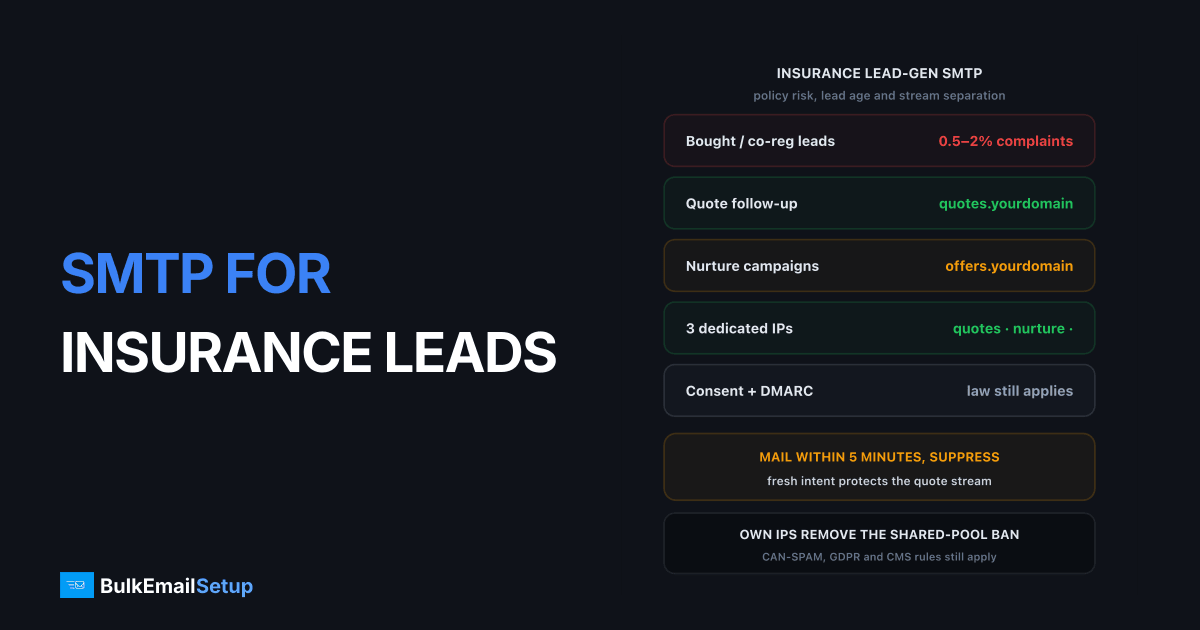
Insurance lead generation, meaning Medicare, auto, life and health quote follow-up, is prohibited on Mailchimp when the list comes from co-registration or a lead vendor, restricted on SendGrid, Brevo and Klaviyo, and allowed on Amazon SES only for addresses that consented to hear from you. A dedicated SMTP server removes the provider policy because there is no shared pool to protect. It does not remove CAN-SPAM, GDPR, or the CMS Medicare marketing rules, and it does not make a 60-day-old vendor lead open your email.
I've moved several agencies and lead-gen shops off shared relays after a termination notice. The cause is nearly always the same: leads bought from a vendor treated as opt-ins.
Who permits insurance lead-gen mail
Get the answer in writing before you pay. "Restricted" in practice means a review that starts the first time complaints spike, and it usually ends with the nurture stream paused.
| Provider | Insurance lead-gen mail | Notes |
|---|---|---|
| Mailchimp | Prohibited | Affiliate and lead-gen sending banned, co-reg lists named as a violation |
| Klaviyo | Restricted | Built for ecommerce, lead-gen accounts reviewed and often refused |
| SendGrid | Restricted | Transactional quote mail tolerated, nurture to vendor leads declined |
| Brevo | Restricted | Review required, list provenance checked |
| Amazon SES | Allowed if consented | Production access review, pauses on complaint spikes |
| Mailgun | Case by case | Favours transactional, promotional reviewed |
| Dedicated SMTP | Your own policy | IPs are yours, the law and receiver rules still apply |
The pattern matches affiliate email marketing: the transactional slice is fine everywhere, the promotional slice to a bought list is where the account dies. Providers do not distinguish a licensed agency from a lead reseller because the traffic looks identical from the outside.
Why ESPs file insurance under affiliate
Four things make this sector expensive to host on a shared IP.
Co-registration lists. A consumer ticks a box on a sweepstakes page and their address goes to 20 advertisers, one of which is your agency. They have no memory of you. Mail to co-reg addresses complains at 0.5% to 2%, against a Gmail hard limit of 0.3% and a target of 0.1%.
Third-party lead vendors. Shared leads are sold to 3 to 8 buyers at once. The consumer gets 8 quote emails in an hour and reports the last few as spam. Exclusive leads behave better, but the vendor's consent form still names the vendor, not you.
Lead age. A quote request is a burst of intent that fades in days. Agencies keep mailing the same lead for a year, and after 30 days the open rate drops under 5% while complaints climb 5 to 10 times.
CMS scrutiny on Medicare. CMS regulates how Medicare Advantage and Part D plans are marketed, and it treats agencies and lead sellers as third-party marketing organisations. A provider hosting a Medicare mailer is hosting regulatory exposure it cannot check, so it restricts the category and moves on.
None of this is about whether your agency is licensed. It is about the risk the traffic poses to everyone else on the IP.
The consent problem with purchased leads
A lead you bought is not an opt-in you collected, and the law in each market draws that line differently.
| Market | Rule | Vendor lead usable for email? | Exposure |
|---|---|---|---|
| US, general | CAN-SPAM | Yes, opt-out basis, no prior consent needed | $53,088 per email |
| US, Medicare | CAN-SPAM plus CMS TPMO rules | Yes, with opt-out in every message and TPMO disclaimer | Carrier termination, CMS penalties |
| EU | GDPR + ePrivacy | Rarely, consent was given to the vendor | Up to 4% of global turnover |
| UK | UK GDPR + PECR | Rarely for consumers | Up to £17.5m |
| Canada | CASL | Only with express consent naming you | Up to CAD 10m |
CAN-SPAM is opt-out law. The FTC's compliance guide lists the requirements: accurate From and subject, a physical postal address, a clear opt-out that works for 30 days after sending and is honoured within 10 business days, and the message identified as an ad. Legal is the floor. A vendor lead that never heard of you still complains, and complaints are what end accounts.
CMS Medicare marketing. CMS publishes communications and marketing guidance every plan year, and the rules for third-party marketing organisations have tightened since 2022. In words: marketing email to a beneficiary is allowed only if every message carries an opt-out, marketing materials must carry the standard disclaimer that you do not offer every plan available in the area and that beneficiaries can contact Medicare directly for all options, the carrier you sell for must approve marketing materials before use, and unsolicited contact rules limit what you can do with a lead before the beneficiary has agreed to be contacted. The details change annually, so treat this as a description, not the rule, and read the current year's guidance before the annual enrolment period.
GDPR and PECR. Consent has to name the sender. "I agree to receive offers from partners" on a vendor's page does not cover you unless you were listed. Our guide to purchased lists and what is allowed walks through the per-market tests.
Suppression lists. State and federal do-not-call registries do not cover email, but your own opt-outs do, and under CMS rules a beneficiary's opt-out has to apply across every carrier you represent. One suppression list, fed by every stream, checked before every send.
Split the streams before you send anything
An insurance sender has two very different kinds of mail, and they belong on separate subdomains and separate IPs.
| Stream | Subdomain | Contains | Volume shape | Complaint tolerance |
|---|---|---|---|---|
| Quote follow-up | quotes.yourdomain.com | quote confirmations, agent replies, document requests, policy docs | steady, tied to lead flow | under 0.02% |
| Nurture | offers.yourdomain.com | renewal reminders, cross-sell, enrolment-period campaigns | scheduled bursts | under 0.1% |
The quote stream is transactional in every sense that matters: the consumer asked for it minutes ago and opens it at 40% or better. The nurture stream carries all the risk. If a Medicare enrolment-period blast draws complaints, the damage stops at offers.yourdomain.com and the quote confirmations keep landing. Mixing them means one campaign can stop a signed application reaching a customer.
Give each subdomain its own DKIM selector, its own DMARC record and its own IP. A 3-IP starter maps cleanly: one for quotes, one for nurture, one spare for a second carrier or a warm-up lane. The DNS layout is in subdomain vs root domain for email sending.
What it costs at 250K and 1M a month
Lead-gen volume grows with lead spend, so price both tiers before you choose. A shop buying 2,000 leads a day with a 7-email sequence is already past 400K a month.
| Provider | 250K per month | 1M per month | Dedicated IP | Policy risk |
|---|---|---|---|---|
| Amazon SES | ~$25, ~$50 with IP | ~$100 + $24.95 per IP | add-on | review, pauses on spikes |
| SendGrid Pro | ~$249 | ~$700 to $1,500 | 1 on Pro | restricted |
| Mailgun Scale | ~$255 | ~$600 to $900 | 1 included | case by case |
| Brevo Business | ~$250 to $350 | ~$400 to $700 | add-on | restricted |
| Klaviyo | ~$700 by contact count | ~$2,000+ | not offered | restricted |
| Dedicated server | $549 one-time plus ~$30 to $80 hosting | same server, same price | 3 included | none from a provider |
Klaviyo prices by contact, and a lead-gen database of 60,000 to 250,000 addresses is exactly the shape that punishes. SES is the cheapest bill on paper and a fair choice if you have someone to own warm-up and monitoring, but its automated review pauses the whole account on a complaint spike, quote stream included. At 250K the dedicated server beats SendGrid inside 3 months; at 1M it is the cheapest option by a wide margin. Full working in cost to send 250,000 emails per month.
Deliverability specifics for insurance
Lead age under 7 days for the sequence, 90 days for the list. Send the first quote email inside 5 minutes of the form submit, finish the sequence inside 7 days, and move the lead to a monthly touch after that. Age leads out of nurture at 90 days with no engagement. Agencies that keep mailing 12-month-old vendor leads are the reason the category is restricted.
Engagement suppression. Anyone with no open or click in 6 months comes off the nurture stream. On a typical lead database this removes 30 to 50% of addresses, and those addresses were producing most of the complaints and nearly all of the bounces.
Per-carrier subdomains where volume justifies it. If you sell for 3 carriers and one runs a campaign that draws complaints, a per-carrier subdomain keeps the other two clean. Below 50K a month per carrier, a shared nurture subdomain with per-carrier tagging is enough.
DMARC at enforcement. Insurance brands are impersonated for phishing, and a domain at p=none lets a criminal send a perfect fake "your policy has lapsed" from your exact From address. Start at none, read the reports for 2 to 4 weeks, then move to quarantine and reject. Path in DMARC none vs quarantine vs reject.
Google's thresholds. The bulk sender guidelines require SPF, DKIM and DMARC for anyone over 5,000 messages a day, one-click unsubscribe on marketing mail, and a complaint rate under 0.3% with 0.1% as the target. In a category filters already distrust, treat 0.1% as the ceiling for nurture and 0.02% for quotes.
Content. Rate figures in the subject line, "final notice" urgency and shortened links all score badly here. Use your own tracking domain, put the TPMO disclaimer in plain text, and name the carrier honestly.
What to do after a termination
- Export while you still can. Suppression lists, bounce logs, complaint reports, DKIM keys. Access usually closes within 48 hours.
- Find the cause. Complaint rate over 0.1%, bounces over 5%, or the category itself. The notice names one, the stats confirm it.
- Check domain reputation. Google Postmaster Tools, domain and IP separately. A Low or Bad domain follows you to the next provider.
- Clean before moving. Drop hard bounces, leads over 90 days with no engagement, and every address whose consent you cannot trace to a form naming you.
- Rebuild on dedicated IPs. Fresh quotes and offers subdomains, SPF, DKIM, DMARC at
p=none, matching PTR. - Warm up over 4 to 8 weeks. Quote follow-up first, because engagement is highest, then nurture to the most recent 30 days of leads, then the rest. Ramp roughly 30% every two days per IP.
- Fix the intake. Add your agency name to the vendor consent form, or stop buying from that vendor. Nothing else in this list holds without it.
The step people skip is 4. A vendor list that got a SendGrid account closed will get dedicated IPs blacklisted just as fast, and the second time there is no provider to blame.
How BulkEmailSetup helps
We build dedicated SMTP infrastructure for senders in restricted categories: your own server, your own IPs, full SPF/DKIM/DMARC/PTR configuration, MTA tuning, bounce handling and a warm-up plan, with quote follow-up and nurture streams separated onto their own subdomains and IPs from day one.
No shared pool means no category policy weighing your sending against other customers. Meeting CAN-SPAM, GDPR and the CMS Medicare marketing rules in your markets remains yours. Basic starts at $549 one-time, covering 1 SMTP server, 3 dedicated IPs, 25,000 emails/day and unlimited contacts. Higher tiers scale to 15 IPs and 200,000 emails/day. See pricing.
Frequently asked questions
Which SMTP providers allow insurance lead generation email?
Mailchimp prohibits lead-gen and affiliate sending and closes accounts when it finds co-registration or vendor lists. SendGrid, Brevo and Klaviyo restrict the category and review case by case, usually declining the nurture stream. Amazon SES carries lawful insurance mail to consented addresses after a production review. A dedicated SMTP server applies only the law in your markets, because there is no shared pool to protect.
Can I email insurance leads I bought from a lead vendor?
In the US, CAN-SPAM allows it if every message has accurate headers, a physical address and a working opt-out honoured within 10 business days. In the EU and UK it is normally unlawful, because the consent the vendor collected was given to the vendor, not to you. Legal or not, vendor leads complain at 0.5% to 2%, against a Gmail limit of 0.3%, so they burn any shared IP quickly.
What are the CMS rules for Medicare marketing email?
CMS treats agencies and lead sellers as third-party marketing organisations. Marketing email to beneficiaries is permitted only with an opt-out in every message, marketing materials must carry the standard TPMO disclaimer that you do not offer every plan in the area, and the carrier you sell for has to approve the material. Check the current CMS Medicare communications and marketing guidance for the year you are sending in, because it changes annually.
How fast should I email a new insurance lead?
Inside 5 minutes for the first quote email and inside 7 days for the whole follow-up sequence. A lead under 24 hours old opens at 40% or better; the same lead after 30 days opens under 5% and complains 5 to 10 times as often. Age the leads out of the nurture stream at 90 days.
Should insurance quote emails and marketing emails use the same SMTP server?
Same server is fine, same subdomain and IP is not. Put quote confirmations and agent replies on quotes.yourdomain.com with its own IP, and the nurture stream on offers.yourdomain.com with its own IP. If the nurture stream draws complaints, the damage stops there and the transactional stream keeps landing.
What does insurance lead-gen email cost at 250,000 a month?
Amazon SES is around $50 a month with a dedicated IP, SendGrid Pro about $249, Mailgun Scale about $255, and Klaviyo about $700 because it prices by contact. A dedicated server is $549 one-time plus hosting, which beats SendGrid inside 3 months and Klaviyo in the first month. At 1M a month the flat-cost server is cheapest by a wide margin.
What do I do after SendGrid terminates my insurance agency account?
Export suppression lists, bounce logs and stats in the first 48 hours, then check Google Postmaster Tools for your domain reputation. Drop every lead older than 90 days and every address with no engagement in 6 months. Rebuild on dedicated IPs under fresh subdomains, warm up over 4 to 8 weeks starting with quote follow-up, and never open a replacement account under the same domain.


