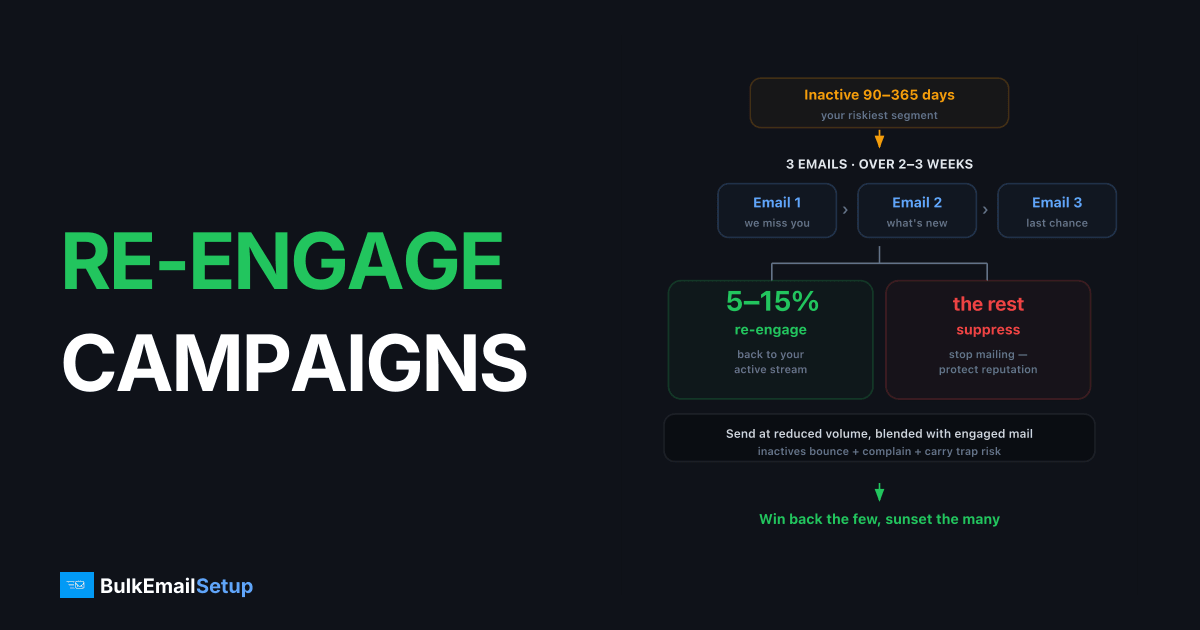
A re-engagement campaign is a short series, typically 3 emails over 2-3 weeks, sent to subscribers who've gone 90-365 days without opening or clicking, with the goal of winning back the 5-15% who'll respond and suppressing the rest. Run it at reduced volume blended into your engaged sends, because inactive segments bounce more, complain more, and contain your recycled-spam-trap risk.
Why this is your riskiest send
The inactive segment concentrates every negative signal at once.
| Risk | Why it's elevated in inactive segments |
|---|---|
| Hard bounces | Abandoned mailboxes get deactivated; some have already died |
| Spam complaints | People who forgot you treat your mail as unsolicited |
| Recycled spam traps | Long-dead mailboxes get converted to traps |
| Engagement drag | Near-zero opens pull down your domain-wide engagement rate |
That's why the volume rules below matter as much as the copy.
Volume and sequencing rules
- Verify the segment first. Run inactive addresses through email verification before mailing; drop invalids. This alone removes most of the bounce risk, details in the list cleaning guide.
- Never blast the whole segment in one day. Cap re-engagement mail at 10-20% of any day's total volume, blended with engaged traffic.
- Start with the least-stale. Mail the 90-180-day inactives first; only proceed to the 365-day tier if bounce and complaint metrics hold.
- Stop on bad numbers. Bounce over 2% or complaints over 0.1% on a re-engagement send: pause, tighten the segment, resume smaller.
If you're on a fresh IP still in warm-up, don't run re-engagement at all yet, warm-up traffic should be your most engaged, not your least.
The 3-email series
| Timing | Job | Subject line pattern | |
|---|---|---|---|
| 1. Reminder | Day 0 | Re-establish who you are and the value they signed up for | "Still want emails from us?" |
| 2. Incentive / preferences | Day 7 | Offer a reason to stay, discount, best content, or a frequency choice | "One click to stay on the list" |
| 3. Goodbye | Day 14-21 | Clear deadline: click to stay or be removed | "We're removing you in 7 days" |
Copy principles that move the numbers:
- Ask for a click, not an open. Post-Apple-MPP, opens are unreliable; a "keep me subscribed" button gives you a clean engagement signal.
- Offer a downgrade, not just on/off. A monthly-digest option retains 2-3x more people than a binary stay/go.
- Mean the goodbye. Subscribers who ignore email 3 get suppressed on the stated date. Sending email 4, 5, and 6 anyway is how complaint rates climb past Gmail's 0.3% threshold.
Defining "inactive" correctly
| Your sending cadence | Re-engagement trigger | Suppression point (non-responders) |
|---|---|---|
| Daily | 60-90 days no open/click | ~120 days |
| 2-3x weekly | 90-120 days | ~180 days |
| Weekly | 120-180 days | ~240 days |
| Monthly | 6-12 months | ~15 months |
Use clicks, site visits, and purchases alongside opens. Apple Mail Privacy Protection auto-fires opens for a large share of consumer lists, so "opened everything, clicked nothing for a year" can still be inactive.
These trigger/suppression pairs are the heart of a sunset policy; the re-engagement series is the mechanism that executes it.
What success looks like
- 5-15% win-back of the mailed segment (click or preference update).
- Bounce under 2%, complaints under 0.1% on every send in the series.
- The rest suppressed on schedule, which is also success. A 10% win-back plus a 90% clean suppression typically lifts list-wide open rates 20-40% within two campaigns.
If win-back exceeds 20%, your inactivity window was too tight and you spent risk budget on people who weren't gone. If it's under 3%, the segment was too stale to mail, next cycle, trigger earlier.
Common failure modes
- Re-engaging forever. Looping non-responders back into the series monthly converts a hygiene tool into a complaint generator.
- Leading with the discount. Email 1 should reaffirm value; discount-first trains inactives to ignore you until coupons appear.
- Skipping suppression because "list size." A 100K list that inboxes beats a 160K list in the spam folder, placement basics in why emails go to spam.
How BulkEmailSetup helps
On our managed dedicated SMTP servers, we throttle and blend risky segments like re-engagement sends automatically, and our deliverability monitoring catches bounce or complaint spikes mid-series so one campaign never burns the domain. See plans and pricing.
Frequently asked questions
What is a good re-engagement campaign success rate?
Winning back 5-15% of genuinely inactive subscribers is realistic. Anything above 20% usually means your inactivity definition was too aggressive and you were re-engaging people who weren't really gone.
How many emails should a re-engagement campaign have?
Three is the standard: a value-led reminder, an incentive or preference-update offer, and a final goodbye with a clear deadline. More than 3-4 attempts pushes complaint risk past the point of diminishing returns.
When should a subscriber enter a re-engagement campaign?
After 90-180 days without an open or click for frequent senders, or 6-12 months for monthly senders. The trigger should fire before engagement-based spam filtering makes them unreachable.
Should I send re-engagement emails from the same domain and IP?
Send them at reduced daily volume mixed with your engaged traffic, never as one big blast. Some high-volume senders use a separate subdomain to isolate the risk, which works but means that subdomain carries lower reputation by design.
What do I do with subscribers who don't respond to re-engagement?
Suppress them. The campaign's purpose is a clean decision, non-responders go to your suppression list under your sunset policy, which protects deliverability for everyone who stayed.