
Political and advocacy email is legal and permitted on Mailchimp, SendGrid, Mailgun and Amazon SES, but it gets paused more often than almost any other lawful category. The reasons are structural: voter files are not opt-in, complaint rates run 0.3% to 1% against a Gmail limit of 0.3%, and fundraising volume jumps 5x to 10x in the last 72 hours of an FEC quarter, which trips the automated review at every shared provider. A dedicated SMTP server removes the provider's policy from the equation. It does not remove the FEC, PECR or Gmail's complaint threshold.
I've built sending for campaigns, PACs and advocacy groups on both sides of the Atlantic. The failure mode is always the same: everything works in a quiet month, then the account gets paused at 4pm on the last day of the quarter with 800,000 messages queued.
Who permits political email
Most providers allow it. The difference is what happens when the numbers spike.
| Provider | Political and advocacy mail | Notes |
|---|---|---|
| Mailchimp | Allowed with rules | Standard consent policy applies, purchased and voter-file lists prohibited |
| SendGrid | Allowed after review | Volume spikes trigger review, dedicated IP needed above ~100K a day |
| Mailgun | Allowed after review | Case by case, expect a compliance questionnaire |
| Amazon SES | Allowed if lawful | Production access review, will pause on complaint spikes |
| Klaviyo | Poor fit | Built for ecommerce, no committee disclaimer tooling, complaint enforcement is strict |
| Some regional providers | Refused | Campaign mail declined outright to avoid the complaint exposure |
| Dedicated SMTP | Your own policy | IPs are yours, the law and the receivers still apply |
The pattern differs from forex or dating, where the ban is written into the acceptable-use policy. Here the policy says yes and the automated systems say no. A committee at 200,000 a day that pushes 1.5 million on 30 September looks exactly like a compromised account to a fraud model, and a fraud model does not know what an FEC deadline is.
Why political mail is high risk
Providers are protecting their other customers on the shared IP, and three things make campaign mail expensive to host.
The lists were never opt-in. A voter file is public data. A petition signature is consent to the petition, not to a fundraising list. A rally sign-up is somewhere in between. When you mail 500,000 people who do not remember subscribing, complaint rates of 0.3% to 1% are normal. Google's bulk sender guidelines set 0.3% as the hard limit and 0.1% as the target, and a shared pool sees your 0.8% land on everyone.
Volume is bursty by design. FEC quarters end 31 March, 30 June, 30 September and 31 December. The last three days of each one carry 30% to 50% of the quarter's fundraising volume. Every provider runs an anomaly detector, and a 5x jump is exactly what it is tuned to catch.
Recipients report instead of unsubscribing. Someone who gets six "we're going to lose if you don't act NOW" messages in a day does not scroll to the footer. They press the spam button. That reaction is what the 0.3% limit measures.
None of this is about legality. A fully compliant committee gets paused for the same reason a sloppy one does: the traffic looks dangerous to the pool.
Compliance that survives a move to your own server
Dedicated infrastructure removes the provider's policy. It does not touch the law, and the law here is split across several bodies.
CAN-SPAM. It covers commercial content, and pure political messaging is generally outside its scope. That is not a licence to skip the unsubscribe link. Gmail and Yahoo require one-click list-unsubscribe from anyone sending over 5,000 messages a day, and the complaint rate that follows a missing opt-out is the thing that gets political mail junked. Treat every message as if CAN-SPAM applied: honest headers, physical address, unsubscribe honoured within 10 days. Merchandise mail (t-shirts, mugs) is commercial and CAN-SPAM does apply.
FEC disclaimers. Under the FEC advertising and disclaimer rules, more than 500 substantially similar emails sent by a political committee need a disclaimer stating who paid for the message and whether a candidate authorised it. It has to be in the email itself, clear and conspicuous, not behind a link. Put "Paid for by" in plain text in every template footer, including donor receipts and volunteer mail.
State and local law. Many states add their own disclaimer wording, a handful add text-message and robocall rules that campaigns sometimes misread as covering email, and some require disclaimers on issue advocacy that the FEC does not touch. Get each race checked. This is not legal advice.
UK: PECR, GDPR and the Electoral Commission. PECR requires prior consent for unsolicited marketing email to individuals, and the ICO has fined UK political parties for emailing and texting supporters without it. GDPR governs the storage and processing of the voter data. The Electoral Commission's digital imprint rules require campaign material to state who is promoting it. The electoral register is available to parties for electoral purposes, but that is not consent for a fundraising list.
Suppression. Unsubscribes, complaints, hard bounces and do-not-contact requests must feed every stream, including receipts and volunteer mail. One suppression list, shared across all subdomains.
The Gmail political sender pilot and why it ended
There is no political exemption at Gmail, and there was only briefly one. In 2022 Google asked the FEC for an advisory opinion on a pilot that let approved committees bypass the spam filter for new subscribers, with a prominent unsubscribe prompt in exchange. The FEC approved it in August 2022. Google closed the pilot in January 2023, citing low participation, and has not replaced it.
The practical read: campaign mail is scored on exactly the same signals as everything else. Authentication, complaint rate, engagement, list-unsubscribe. The only thing that changed is that everyone now knows the filter treats the category on its merits. See Gmail's 0.3% spam complaint rate for what the threshold does when you cross it.
The three streams and how to split them
A campaign sends three kinds of mail, and they belong on separate subdomains and separate IPs.
| Stream | Subdomain | Contains | Complaint risk |
|---|---|---|---|
| Transactional | receipts.yourdomain.com | donation receipts, event tickets, RSVP confirmations | near zero |
| Fundraising | action.yourdomain.com | asks, deadline pushes, matching offers | high, lives here |
| Volunteer and field | team.yourdomain.com | shift reminders, canvass packs, internal updates | low |
The reason is containment. Donation receipts have legal and tax significance, and a donor who cannot find the receipt calls the treasurer. If a deadline push draws 1% complaints, the damage stops at the fundraising subdomain and the receipts keep landing. Give each subdomain its own DKIM selector and its own DMARC record. A 3-IP starter setup maps one IP per stream, with the fundraising IP group growing as volume does.
Planning the deadline spike
This is the section most campaigns skip, and it is the one that decides whether the last 72 hours of the quarter work.
A warm dedicated IP sending to a mixed list of Gmail, Microsoft and Yahoo addresses carries around 50,000 to 100,000 messages a day before receivers start deferring. The full reasoning is in how many emails per day per IP. Size for the peak, then warm every IP you will need before you need it.
| Campaign size | Quiet-month daily | Deadline-day peak | Warm IPs for baseline | Warm IPs for peak |
|---|---|---|---|---|
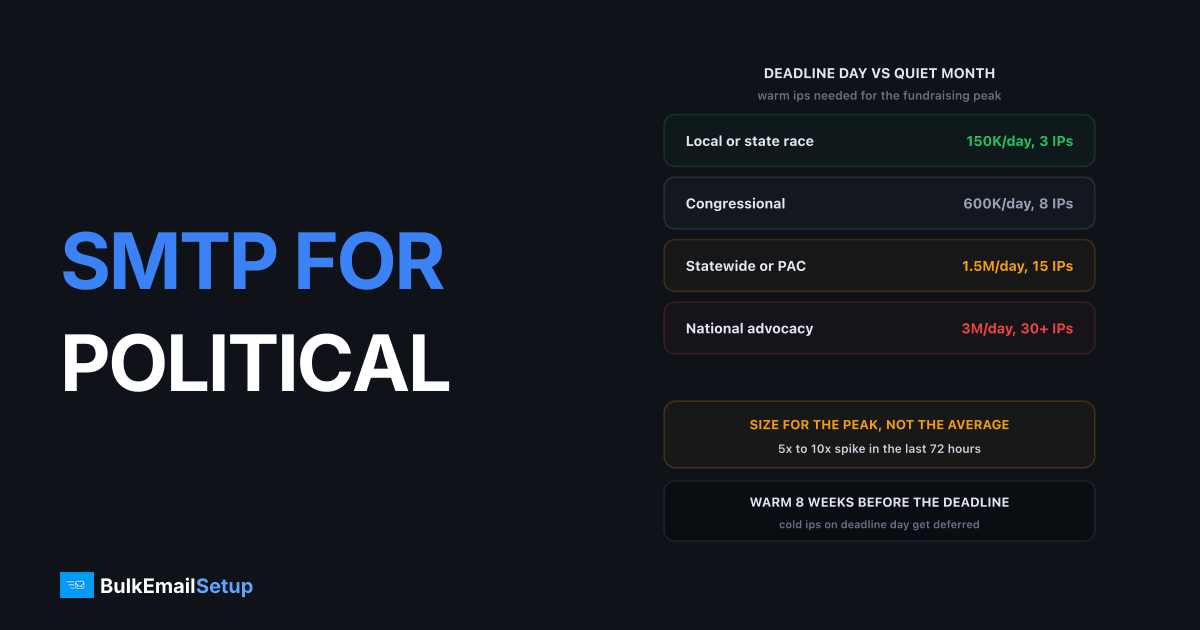
| Local or state race | 20,000 | 150,000 | 1 | 3 |
| Congressional | 100,000 | 600,000 | 2 | 8 |
| Statewide or large PAC | 250,000 | 1,500,000 | 3 to 5 | 15 |
| National advocacy org | 500,000 | 3,000,000 | 5 to 10 | 30 or more |
Two rules make the table work.
Warm 8 weeks before the season starts. An IP ramps roughly 30% every two days, so a cold IP takes 4 to 8 weeks to carry a full day's load. For a 30 September deadline, the extra IPs need traffic from early August. Warm them on the transactional and volunteer streams first, because engagement is highest there, then move fundraising onto them. There is a full ramp in ip warm-up schedule.
Keep the IPs warm between deadlines. An IP that goes quiet for six weeks cools down. Spread the quiet-month volume across every IP you own rather than concentrating it, so each one keeps a live reputation. That is the argument for owning the IPs rather than renting a burst.
What a quarter costs at 1M and 5M
Campaign volume is seasonal, so price a quarter rather than a month. A congressional race at 100,000 a day baseline sends roughly 1M in a quiet quarter and 3M to 5M in a deadline quarter. A statewide race or large PAC sends 5M to 15M.
| Provider | 1M in a quarter | 5M in a quarter | Dedicated IPs | Spike behaviour |
|---|---|---|---|---|
| Amazon SES | ~$100 + $24.95 per IP per month | ~$500 + IPs | add-on | pauses on complaint spikes, quota raise needed |
| Mailgun | ~$300 to $450 | ~$1,500 to $2,500 | higher tiers | review on volume jumps |
| SendGrid | ~$260 to $900 | ~$1,400 to $4,000 | high tier | review on volume jumps |
| Mailchimp | ~$1,100 to $2,000 | overage pricing, often $6,000 or more | not offered | contact-count billing, purchased lists banned |
| Dedicated server | $549 one-time plus ~$30 to $80 a month hosting | same server, same price | 3 to 15 included | none from a provider |
Mailchimp bills on contacts, not sends, so a 400,000-contact list costs the same in a quiet month as in a deadline month, and a bump to the next contact tier can double the bill overnight. SES is cheapest on paper and a fair choice for a national organisation with in-house deliverability staff, though the sending quota has to be raised before the spike, not during it. At 5M a quarter the dedicated server is the cheapest option by a wide margin and the only one where an anomaly detector cannot pause the last-day push. Full monthly breakdown in cost to send 1 million emails per month.
Deliverability specifics for campaigns
Never send to the whole voter file. Ever. A voter file mailed cold produces 1% or more complaints and a blacklisting inside a week. Mail people who gave you an address directly: donors, event attendees, petition signers who ticked the box. Everyone else gets a postcard.
Suppress on engagement. Anyone with no open or click in 90 days comes off the fundraising stream. Anyone who has never engaged in 30 days after joining comes off. This typically cuts a campaign list by 25% to 40% and cuts complaints by more than half, because the disengaged segment is where the reports come from.
Cap frequency on deadline day. Three fundraising messages in 24 hours is the practical ceiling before complaints climb. Six is where the 0.3% line breaks. Rotate the ask across segments rather than hammering the same 200,000 people.
Authenticate everything. SPF, DKIM and DMARC on every subdomain, DMARC at p=quarantine or reject on the fundraising domain, because campaigns are impersonated by scam fundraisers and receivers know it. PTR must match the HELO hostname.
Watch deferrals, not opens. On deadline day the number that matters is the 4xx rate per receiver. A rising deferral rate at Gmail means slow the IP down, not add another message to the queue.
What to do after a termination
- Export while you still can. Suppression lists, complaint logs, bounce logs, DKIM keys. Access usually closes within 48 hours.
- Find the cause. Complaint rate over 0.3%, bounce rate over 5%, or a volume anomaly. The notice names one, the stats confirm it.
- Check domain reputation. Google Postmaster Tools, domain and IP separately. A Low or Bad domain reputation follows you to the next provider.
- Clean before moving. Drop hard bounces, complaints and anyone unengaged for 90 days. Typically removes 25 to 40% of a campaign list.
- Rebuild on dedicated IPs. Three subdomains, SPF, DKIM, DMARC at
p=noneto start, matching PTR, one shared suppression list. - Warm over 4 to 8 weeks. Receipts first, then volunteer mail, then fundraising. Ramp roughly 30% every two days per IP.
- Do not open a replacement account. The provider links by domain, payment method and pattern, and the second closure damages every later appeal.
The sibling guide on SMTP for nonprofit mass mailing covers the charity side, which shares the list-quality problem but not the deadline spikes.
How BulkEmailSetup helps
We build dedicated SMTP infrastructure for campaigns and advocacy organisations: your own server, your own IPs, full SPF/DKIM/DMARC/PTR configuration, MTA tuning for deadline-day throughput, bounce and complaint handling, a shared suppression list, and a warm-up plan timed to your quarter. Transactional, fundraising and volunteer streams are separated onto their own subdomains and IPs from day one, so a bad ask never stops a receipt.
No shared pool means no anomaly detector pausing your last-day push. Meeting FEC, state, PECR and Electoral Commission rules in your jurisdiction remains yours. Basic starts at $549 one-time, covering 1 SMTP server, 3 dedicated IPs, 25,000 emails/day and unlimited contacts. Higher tiers scale to 15 IPs and 200,000 emails/day. See pricing.
Frequently asked questions
Which SMTP providers allow political campaign email?
Most do, with conditions. Mailchimp allows political mail under its standard consent rules, SendGrid and Mailgun allow it after account review, Amazon SES allows lawful campaign mail after production access, and Klaviyo is built for ecommerce and a poor fit. A dedicated SMTP server has no shared pool to protect, so the only rules that apply are the law and the receivers. Confirm in writing before a deadline quarter.
Why do email providers treat political senders as high risk?
Three things. Voter files and petition lists are not opt-in, so complaint rates run 0.3% to 1% against a Gmail hard limit of 0.3%. Fundraising volume jumps 5x to 10x in the last three days of an FEC quarter, which trips the automated review every provider runs. And recipients who feel harassed report the mail rather than unsubscribe. The combination gets accounts paused on the day that matters most.
Does CAN-SPAM apply to political fundraising email?
Not in the strict sense. CAN-SPAM covers commercial content, and pure political messaging is generally outside it. In practice you still need a one-click unsubscribe, a physical address and honest headers, because Gmail and Yahoo require list-unsubscribe for anyone over 5,000 messages a day and a complaint rate above 0.3% gets your mail junked regardless of what the law says.
What disclaimer does a US political email need?
Under FEC rules, more than 500 substantially similar emails sent by a political committee must carry a disclaimer stating who paid for the message and whether a candidate authorised it, inside the email body where the reader sees it without clicking. State and local races have their own rules on top. Put the disclaimer in plain text in the footer of every template, including donor receipts.
What are the rules for political email in the UK?
PECR requires consent before sending unsolicited electronic marketing to individuals, and the ICO has fined political parties for emailing and texting people without it. GDPR governs how you store and process the data, and Electoral Commission rules require an imprint on digital campaign material stating who is promoting it. A canvassing record or petition signature is not consent to a fundraising list.
How many IPs does a campaign need for deadline day?
Size for the peak, not the average. A warm dedicated IP carries around 50,000 to 100,000 messages a day to mixed receivers, so a campaign at a 200,000 a day baseline that spikes to 1.5 million on the last day of a quarter needs roughly 15 warm IPs, not the 3 that cover the baseline. Those IPs must be warmed 8 weeks before the spike, because a cold IP on deadline day gets deferred, not delivered.
What happened to the Gmail political sender program?
Gmail ran a pilot from late 2022 that let approved political committees bypass its spam filter for new subscribers, after the FEC allowed it as a non-partisan program. Google ended the pilot in early 2023 citing low uptake. There is no exemption today. Political mail is scored on the same complaint, authentication and engagement signals as everything else, and the 0.3% complaint limit applies.


