
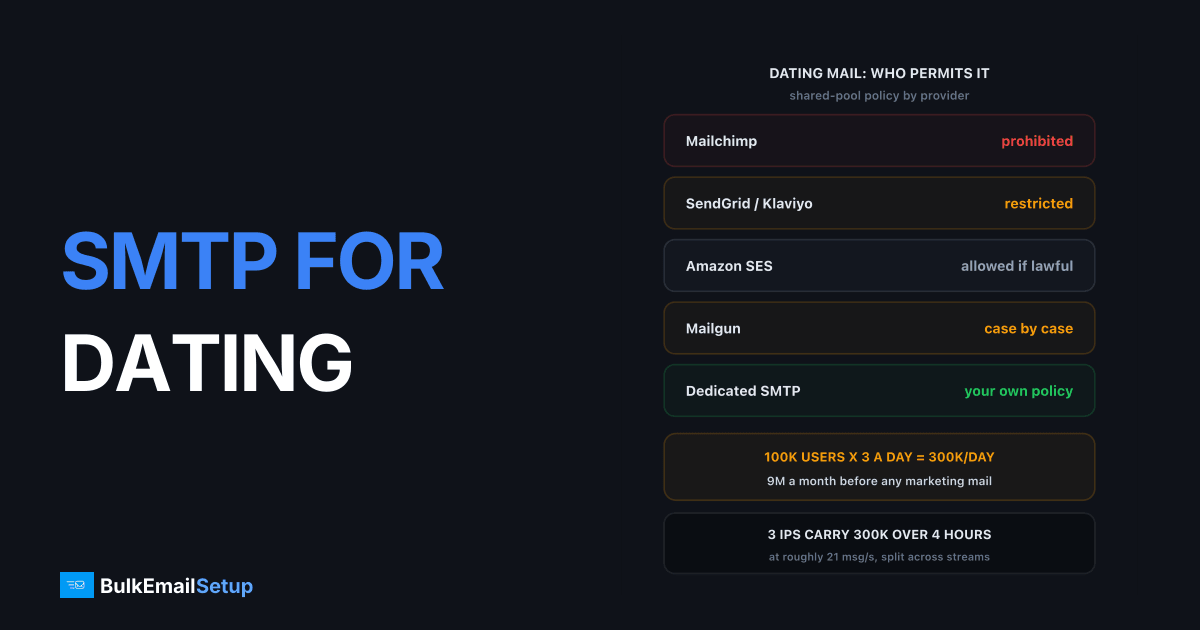
Dating and adult-adjacent platforms are prohibited on Mailchimp, restricted on SendGrid, Klaviyo and Brevo, permitted on Amazon SES if the service is lawful, and decided per account on Mailgun. The bans are written into acceptable-use policies, so a clean sender gets the same answer as a spammy one. The bigger problem is usually volume: 100,000 active users at 3 notifications a day is 300,000 emails a day, which is a shared-pool problem before any policy team looks at you. A dedicated SMTP server removes the provider policy. It does not remove CAN-SPAM, GDPR, 18+ verification or Gmail's 0.3% complaint limit.
I've moved a handful of dating apps off shared relays, some after a termination and some before the bill got silly. Same shape every time.
Who permits SMTP for dating sites
Get the answer in writing before you pay. "Restricted" usually means a quiet review that ends with a paused account on the first complaint spike.
| Provider | Dating and adult-adjacent mail | Notes |
|---|---|---|
| Mailchimp | Prohibited | Named in the acceptable-use policy alongside adult content |
| Klaviyo | Restricted | Case by case, adult-adjacent usually declined |
| SendGrid | Restricted | Transactional sometimes approved, marketing rarely |
| Brevo | Restricted | Review required, high-frequency notifications often refused |
| Amazon SES | Allowed if lawful | Production access review, pauses on complaint spikes |
| Mailgun | Case by case | Per-account decision, volume matters as much as category |
| Dedicated SMTP | Your own policy | IPs are yours, the law and receiver rules still apply |
Same split as iGaming and forex: account mail is tolerated, engagement and marketing mail is where the bans bite. A password reset is expected. "3 people liked you today" to a user who has not opened the app in 6 months is not.
Why dating is treated as high risk
Providers are protecting the other customers on the IP, and three things make this category expensive to host.
Fake-profile spam history. For 15 years the category's worst operators mailed "someone viewed your profile" to bought lists, from bot accounts, to drive sign-ups. Complaint rates on that traffic ran 1% to 3%, against a Gmail hard limit of 0.3% and a target of 0.1%. Filters score by category, so a legitimate app pays for that history on day one.
Phishing and romance-scam lookalikes. Dating brands are impersonated constantly. "You have a new message, log in to read it" is one of the most copied phishing templates there is. Anything from a dating domain starts with a lower trust score until DMARC and reputation prove otherwise.
Volume per user. A SaaS app sends a user 2 emails a week. A dating app sends 2 to 5 a day. One mid-sized platform can be 40% of a shared IP's daily traffic, which means one bad week from you is a bad week for everyone on that IP.
None of this is about legality. A lawful, age-verified app gets refused for the same reason a sketchy one does: the category is a risk to the pool.
The three mail streams
A dating platform sends three very different kinds of mail. They belong on separate subdomains and separate IPs.
| Stream | Subdomain | Contains | Volume shape |
|---|---|---|---|
| Notifications | notify.yourdomain.com | matches, likes, messages, profile views | huge, continuous, complaint risk lives here |
| Account and security | account.yourdomain.com | sign-up verification, password reset, login alerts, billing | steady, must never pause |
| Marketing | news.yourdomain.com | promotions, subscription offers, re-engagement | scheduled, lower volume |
The order matters. In most sectors marketing is the risky stream. In dating it is notifications, because that is 90% of the volume and the mail users complain about when it gets too frequent. Keeping account mail on its own IP means a notification complaint spike can never stop a password reset landing. See subdomain vs root domain for email sending for the DNS layout.
Notification volume is the real infrastructure problem
This is the number most founders get wrong by 10x. Run it before you choose anything.
| Active users | Notifications per user per day | Emails per day | Emails per month |
|---|---|---|---|
| 10,000 | 3 | 30,000 | 900,000 |
| 50,000 | 3 | 150,000 | 4.5 million |
| 100,000 | 3 | 300,000 | 9 million |
| 100,000 | 1 (digest) | 100,000 | 3 million |
Three notifications a day is conservative for an active app. Match, new message, "someone liked you" and a nudge when the user goes quiet is 4 to 6. The last row shows why per-user caps and digests are an infrastructure decision, not a product nicety: one daily digest instead of three real-time pushes cuts the sending bill and the IP count by two thirds.
Throughput maths for the 300,000-a-day case, assuming you want most of it out inside the evening peak:
| Daily volume | Peak window | Required rate | IPs needed at ~20 msg/s per IP |
|---|---|---|---|
| 30,000 | 4 hours | 2 msg/s | 1 |
| 150,000 | 4 hours | 10 msg/s | 1 to 2 |
| 300,000 | 4 hours | 21 msg/s | 2 to 3 |
| 300,000 | 1 hour | 83 msg/s | 5 to 6 |
A tuned Postfix or PowerMTA instance on 3 dedicated IPs handles 300,000 a day comfortably when spread across the evening. The limit is the receiver, not your server: Gmail and Microsoft throttle per IP, so spreading load across IPs is what keeps the 4xx deferral rate down. Shared relay mid-tier plans often cap at a few hundred messages a minute, which turns a 4-hour window into most of a day. Full sizing in how many emails per day per IP.
Compliance that stays after you leave the shared pool
Dedicated infrastructure removes the provider's policy. It does not touch the law, and dating has more of it than most categories.
18+ verification. Every user must be verified as an adult at sign-up, and that verification must exist before the first notification is sent. Sending match notifications to an unverified account is how "adult-adjacent" becomes "adult" in a receiver's eyes and a regulator's.
CAN-SPAM. The FTC compliance guide requires accurate headers, a physical address, and an opt-out honoured within 10 business days. Penalties run up to $53,088 per email in violation. Notifications about a specific match are transactional, but a "come back, 5 new singles near you" nudge is commercial and needs the full opt-out.
GDPR special-category data. Sexual orientation is special-category data under Article 9. Any email that reveals it, such as "men seeking men near you" in a subject line, needs explicit consent for that specific use, not the general sign-up consent. Keep the consent record next to the address, and never put orientation in a subject line that a shared inbox can read.
Frequency caps and easy opt-down. This is the one that saves your reputation. Give users a per-type control: matches daily, messages instantly, likes as a weekly digest, marketing off. Users who can turn things down do not hit the spam button. Users whose only option is "unsubscribe from everything" report you instead, because they still want the app. Our email sending frequency guide covers the caps that work.
Suppression. Deleted accounts, banned accounts, unsubscribes and complaint feedback loop hits feed every stream, including notifications. A deleted user still getting "you have a new match" is a complaint and, under GDPR, a breach.
What it costs at 1M and 5M a month
Dating platforms cross 1M a month with under 15,000 active users. Price the 5M tier before you pick, because you will be there faster than you expect.
| Provider | 1M per month | 5M per month | Dedicated IP | Policy risk |
|---|---|---|---|---|
| Amazon SES | ~$100 + $24.95 per IP | ~$500 + $24.95 per IP | add-on | review, pauses on spikes |
| Mailgun | ~$600 to $900 | ~$2,500 to $4,000 | higher tiers | case by case |
| SendGrid | ~$700 to $1,500 | ~$3,000 to $6,000 | high tier | restricted |
| Dedicated server, Basic | $549 one-time plus ~$30 to $80 a month hosting | needs a higher tier | 3 included | none from a provider |
| Dedicated server, higher tier | same one-time model | up to 200,000 a day, 15 IPs | up to 15 included | none from a provider |
SES is the cheapest bill on paper and a reasonable choice for a platform with in-house deliverability staff. What you pay for is the risk that an automated review pauses password resets on the same day a notification bug spikes complaints. At 5M a month the dedicated server is the cheapest option by a wide margin and the only one where no third party can stop account mail. Full breakdown in cost to send 1 million emails per month and on the pricing page.
Deliverability specifics for dating
Per-user frequency caps, enforced at the MTA. Not in the app logic where a bug can bypass them. A hard rule of no more than N notifications per address per day, with N set per stream, catches the loop that sends 400 emails to one user when a matching job misfires. That single bug is the most common cause of dating-app terminations I've seen.
Engagement-based suppression. A user who has not opened the app or any email in 30 days gets moved to a weekly digest. At 90 days, notifications stop and one re-engagement mail goes out. At 180 days, suppress. Dating users churn hard, and mailing the churned segment is where complaints come from. Do not wait for Gmail's 0.3% limit: keep the notification stream under 0.1% and the account stream under 0.02%.
DMARC at p=reject. A dating domain at p=none lets a scammer send a perfect "new message from Anna" from your exact From address, and Gmail will deliver it. Start at none, read the aggregate reports for 2 to 4 weeks, move to quarantine, then reject. The path is in DMARC none vs quarantine vs reject.
Google's bulk sender rules. Anyone over 5,000 messages a day to Gmail, which is every dating app on day one, must have SPF, DKIM and DMARC, one-click unsubscribe headers on all marketing and subscribed mail, and a spam rate under 0.3% in Postmaster Tools. The Google sender guidelines are the primary source. Put List-Unsubscribe headers on the notification stream too, even though it is arguably transactional. Cheaper than arguing.
Content patterns. Photos of profiles in the email body, "hot singles" language and shortened links all score badly. Use your own tracking domain, plain subject lines, and keep the profile photo behind the login.
What to do after a termination
- Export while you still can. Suppression lists, bounce logs, complaint reports, DKIM keys. Access usually closes within 48 hours.
- Find the cause. Complaint rate over 0.1%, a notification loop, or the category itself. The notice names one, the stats confirm it.
- Check domain reputation. Google Postmaster Tools, domain and IP separately. A Low or Bad domain follows you to the next provider.
- Fix frequency before moving. Add per-user caps and engagement suppression. A list that got you terminated at 3 emails a day will get dedicated IPs blacklisted at 3 emails a day.
- Rebuild on dedicated IPs. Fresh subdomains for the three streams, SPF, DKIM, DMARC at
p=none, matching PTR. - Warm up over 4 to 8 weeks. Account mail first, because engagement is highest, then notifications to the most active 20% of users, then everyone else, then marketing. Ramp roughly 30% every two days per IP.
- Do not open a replacement account. The provider links by domain, payment method and sending pattern, and the second closure damages every later appeal.
The mistake I see most is skipping step 4. Moving infrastructure without cutting frequency just relocates the complaints.
How BulkEmailSetup helps
We build dedicated SMTP infrastructure for senders in restricted categories: your own server, your own IPs, full SPF/DKIM/DMARC/PTR configuration, MTA tuning for sustained notification volume, per-user rate limits at the MTA, bounce and feedback-loop handling, and a warm-up plan, with notification, account and marketing streams separated onto their own subdomains and IPs from day one.
No shared pool means no category policy weighing your sending against other customers. Meeting CAN-SPAM, GDPR and 18+ verification rules in your markets remains yours. Basic starts at $549 one-time, covering 1 SMTP server, 3 dedicated IPs, 25,000 emails/day and unlimited contacts. Higher tiers scale to 15 IPs and 200,000 emails/day. See pricing.
Frequently asked questions
Which SMTP providers allow dating sites?
Confirm in writing before paying, because policies change. Mailchimp prohibits dating and adult-adjacent services in its acceptable-use policy, SendGrid, Klaviyo and Brevo restrict the category and review case by case, Amazon SES permits lawful dating mail after a production access review, and Mailgun decides per account. A dedicated SMTP server has no shared pool to protect, so the only rules that apply are the law and the receiving networks.
Why do email providers treat dating platforms as high risk?
Three reasons. The category has a long history of fake-profile spam, where bots mail 'someone viewed your profile' to bought lists, which pushed complaint rates well above the 0.1% target. Dating brands are heavily impersonated by phishing and romance-scam mail. And the mail volume per user is very high, often 2 to 5 notifications a day, so one platform can dominate a shared IP pool.
How much email does a dating app actually send?
Far more than most operators expect. 100,000 active users receiving 3 notifications a day is 300,000 emails a day, or about 9 million a month, before any marketing. At that rate a shared relay bill runs into thousands a month, and the volume alone triggers provider reviews. Per-user frequency caps and daily digests usually cut it by 40 to 60%.
What compliance rules apply to dating email?
CAN-SPAM in the US, which requires a working opt-out honoured within 10 business days and carries penalties up to $53,088 per email. GDPR in the EU and UK, where sexual orientation is special-category data and needs explicit consent before you use it in email. Plus 18+ age verification at sign-up and a real opt-down control so users can reduce notifications without deleting their account.
Do dating apps need DMARC at p=reject?
Yes, in practice. Dating domains are a favourite for romance-scam phishing, and a domain at p=none lets a criminal send 'you have a new message' from your exact From address. Start at p=none, read the aggregate reports for 2 to 4 weeks, move to quarantine, then reject. Only reject tells Gmail and Microsoft to drop the forgeries.
What should a dating platform do after an ESP termination?
Export suppression lists, bounce logs and complaint data while you still have access, usually within 48 hours. Check Google Postmaster Tools for your domain reputation. If the cause was complaints, cut notification frequency and clean the list before moving. If the cause was category policy, move to dedicated IPs on fresh subdomains, put account and security mail on its own stream, and warm up over 4 to 8 weeks.


