
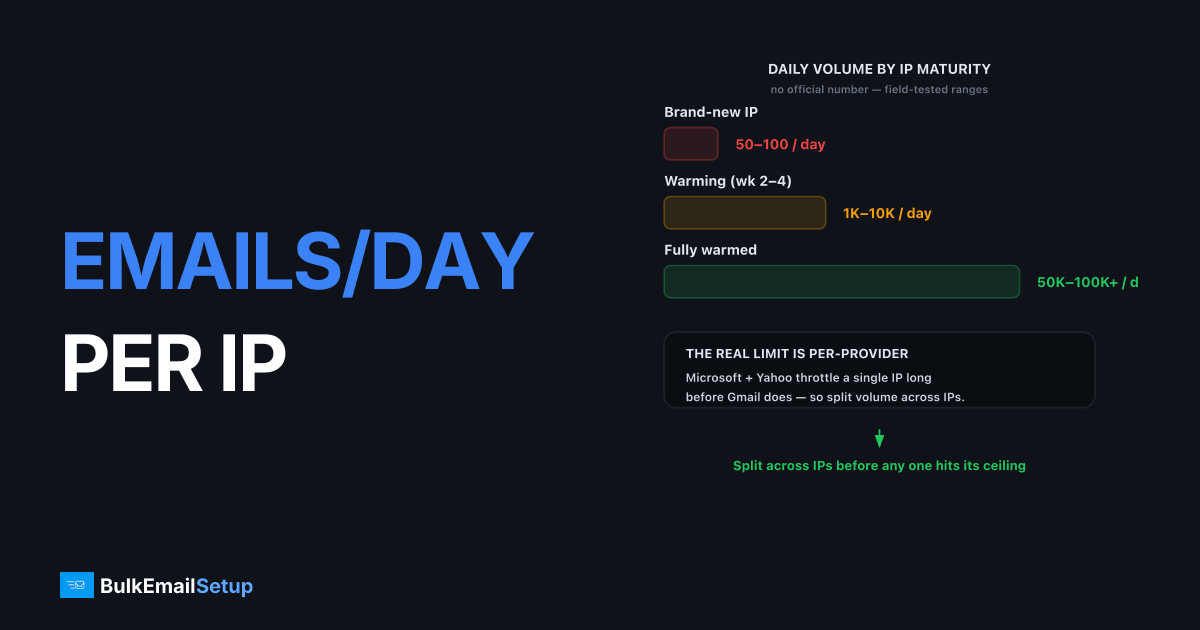
There is no official number, but the field-tested answer is: a fully warmed dedicated IP with clean metrics can move 50,000-100,000+ emails a day in total, while a brand-new IP should start at 50-100. The real constraint is per-provider. Microsoft (Outlook/Hotmail) and Yahoo throttle individual IPs long before Gmail does, which is why senders split volume across multiple IPs well before any single IP hits its technical ceiling.
Effective daily volume by IP maturity
| IP status | Safe total volume/day | Notes |
|---|---|---|
| Brand new (day 1) | 50-100 | Anything more risks instant throttling |
| Week 2 of warm-up | 500-1,500 | Engaged recipients only |
| Week 4 | 4,000-7,000 | Watch SNDS and Postmaster daily |
| Week 6+ (warmed) | 10,000-50,000 | Per-provider caps now the limit |
| Mature, 6+ months clean | 50,000-100,000+ | Earned headroom at strict providers |
These are aggregates. The next table is the one that actually governs your architecture.
Observed per-provider tolerance per IP
No provider publishes fixed caps, throttling is dynamic and reputation-based. These are working ranges for a warmed IP in good standing:
| Provider | Comfortable/day/IP | Behavior when exceeded |
|---|---|---|
| Gmail | 20K-50K+ (domain reputation matters more) | 421-4.7.0 / 450 rate deferrals |
| Microsoft (Outlook/Hotmail) | 5K-20K | 421 RP-001/S3140 deferrals, then blocks |
| Yahoo/AOL | 5K-20K | 421 4.7.0 "temporarily deferred" |
| Apple iCloud | 2K-10K | Quiet junking more than deferrals |
| B2B (mixed corporate MX) | Varies; Barracuda/Proofpoint gateways | Per-gateway reputation blocks |
Microsoft is consistently the tightest for young IPs, it can hold a new IP to a few hundred per day for weeks. Gmail throttles by IP too, but weighs the sending domain heavily, so a good domain on a young IP recovers faster there.
Watch your logs for the deferral signatures:
# Yahoo
421 4.7.0 [TSS04] Messages from 203.0.113.10 temporarily deferred

# Microsoft
421 RP-001 The mail server IP connecting to Outlook.com has exceeded
the rate limit allowed

# Gmail
450-4.2.1 The user you are trying to contact is receiving mail at a
rate that prevents additional messages from being delivered
All three mean the same thing: slow this IP down to this provider. MTAs that back off recover in hours; MTAs that hammer retries convert deferrals into blocks.
How many IPs for your target volume
Working backward from the per-provider ranges (assuming a typical consumer-heavy list):
| Target volume/day | Warmed IPs needed |
|---|---|
| 10K | 1-2 |
| 50K | 2-4 |
| 100K | 4-8 |
| 500K | 15-25 |
| 1M | 25-40 |
The driver is rarely total capacity, it is keeping each IP under the Microsoft/Yahoo comfort zone with failover headroom. The full architecture for the 100K row is in our 100K/day infrastructure guide, and the million-a-day version in how to send 1 million emails per day.
What raises (and lowers) your per-IP ceiling
Throttles are dynamic, which means they are negotiable through behavior:
- Raises it: months of consistent daily volume, complaint rate under 0.1%, bounce rate under 2%, full SPF/DKIM/DMARC alignment, low spam-trap contact.
- Lowers it: volume spikes (>50% day-over-day), sending gaps of 30+ days (reputation decays), trap hits, complaint bursts, any blocklisting.
- Resets it: a Spamhaus or Barracuda listing. After delisting you re-enter reduced throttling and effectively re-warm.
Consistency is the most underrated lever. An IP sending 20K every day gets more headroom than one alternating between 0 and 60K, even at identical monthly totals.
Per-IP limits vs per-mailbox limits
Don't confuse infrastructure limits with mailbox-account limits. Google Workspace caps each account at 2,000 recipients/day and Microsoft 365 at 10,000, those are account rules, not IP reputation. Bulk volume belongs on your own SMTP infrastructure, not relayed through workspace accounts; our SMTP server setup guide covers the right way.
How BulkEmailSetup helps
We size IP pools to your real volume, warm each IP on schedule, and tune per-provider throttles so deferrals stay rare and your effective ceiling keeps rising. See pricing for plans by daily volume.
Frequently asked questions
How many emails can one IP send per day?
A fully warmed dedicated IP with a clean reputation can send 50,000-100,000+ emails per day in aggregate. The binding constraints are per-provider: Microsoft and Yahoo start deferring far below an IP's technical capacity.
How many emails can a new IP send per day?
Start at 50-100 on day one. A brand-new IP has no reputation, and every major provider throttles or junks unknown IPs that open with volume. Reaching 10K/day takes 4-6 weeks of warm-up.
Do Gmail and Outlook publish official per-IP limits?
No. All major providers use dynamic, reputation-based throttling rather than fixed published caps. The numbers senders work with are field-observed ranges, not official quotas.
What happens if I exceed my IP's effective limit?
You get 4xx deferrals first (mail queued and retried), and if you keep pushing, blocks and blocklistings. Deferrals are the warning; treat them as a signal to slow down, not an obstacle to retry harder.


