
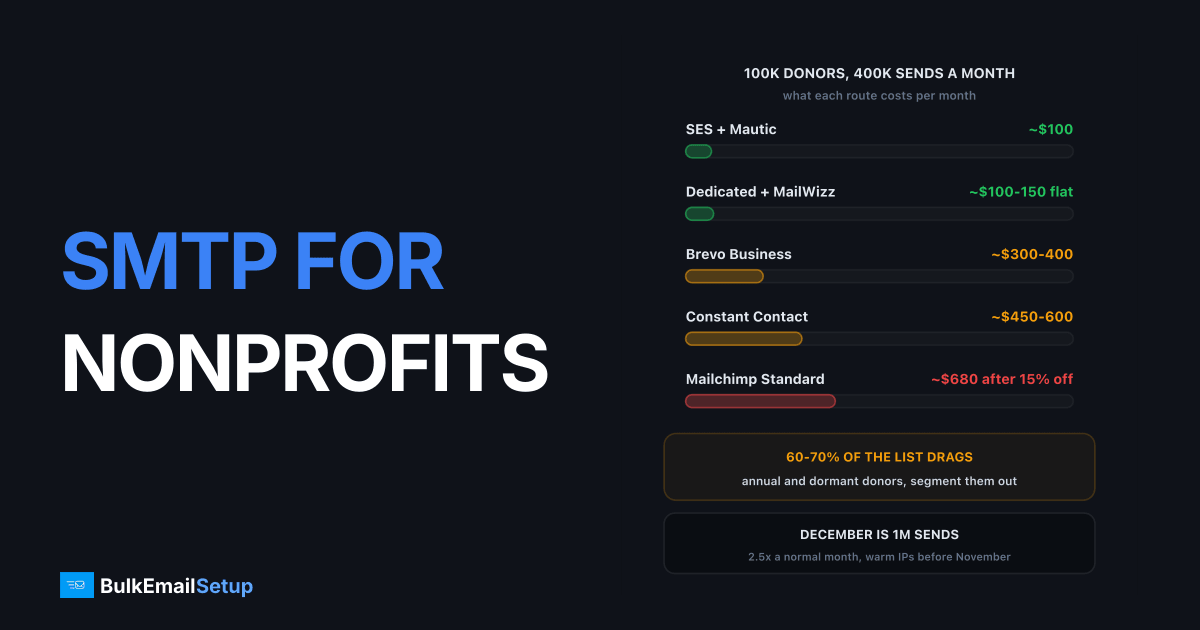
Every mainstream provider accepts nonprofits, so this is not a policy problem. It is a billing problem. A 100,000-donor list costs roughly $680 a month on Mailchimp Standard even after the 15% nonprofit discount, $300 to $400 on Brevo, around $100 on Amazon SES with Mautic, and a flat $100 to $150 on a dedicated SMTP server. The reason the per-contact platforms hurt is that 60 to 70% of a typical donor list opens twice a year, and you are paying full price to store and mail people who are dragging your reputation down.
I have set up sending for several charities and membership organisations. The pattern is the same every time: a big list built over a decade, a small engaged core, and a monthly bill sized to the whole list. Here is how to think about SMTP for nonprofits before renewing whatever you have.
What the nonprofit discounts actually are
The discounts are real but smaller than people expect, and two of the five platforms below offer nothing at all.
| Provider | Nonprofit discount | Condition | Verified |
|---|---|---|---|
| Mailchimp | 15% off | Registered nonprofit, request via billing | Yes, on Mailchimp's pricing page |
| Constant Contact | 20% off (6-month prepay), 30% off (12-month prepay) | Verified nonprofit, prepaid | Check current |
| Brevo | None advertised | n/a | Check current |
| Amazon SES | No SES discount, but AWS credits via nonprofit programmes (TechSoup and similar) | Eligibility varies by country | Check current |
| Klaviyo | None | n/a | Check current |
Two things stand out. The Constant Contact discount is the biggest headline number, but it requires paying 6 or 12 months up front, which is exactly what a cash-constrained charity does not want to do. And the 15% off Mailchimp is applied to a per-contact price, so it shrinks the bill without changing the thing that makes the bill big.
What a 100K donor list costs per month
Assume 100,000 contacts and four sends a month, which is 400,000 emails. That is a monthly newsletter, two appeals and a programme update, a normal cadence for a mid-sized charity.
| Provider | Billing model | Cost at 100K contacts, 400K sends/month | Notes |
|---|---|---|---|
| Mailchimp Standard | Per contact | ~$800, ~$680 after 15% off | Send limit is 12x contacts, so 400K fits |
| Constant Contact | Per contact | ~$450 to $600, minus 20 to 30% if prepaid | Quote-based above 50K contacts, check current |
| Brevo Business | Per send | ~$300 to $400 | Contacts free, you pay for 400K emails |
| Amazon SES + Mautic | Per send + your server | ~$40 send + $25 dedicated IP + $30 to $50 VPS = ~$100 | Plus your admin time |
| Dedicated server + MailWizz | Flat | ~$100 to $150/month flat, $549 one-time setup, MailWizz licence ~$79 once | Unlimited contacts, no per-send cost |
| Klaviyo | Per profile | ~$1,300+ | No discount, built for ecommerce |
Amazon SES pricing is public at $0.10 per 1,000 emails, with a standard dedicated IP at $24.95 a month. The per-contact platforms are 5 to 8 times the cost of the per-send or flat options at this size. Over a year that gap is $6,000 to $8,000, which for most charities is a part-time salary or a programme line.
For the same maths at a slightly higher volume, what it costs to send 500,000 emails a month breaks down every provider line by line.
The engagement problem nobody prices in
The bigger cost is not the invoice. It is what a low-engagement list does to delivery of the emails that matter.
A donor list is unusual. Commercial lists churn, so dead addresses fall off. Donor lists accumulate: every event signup, every petition, every one-off gift from 2017 is still on there because nobody wants to delete a potential donor. The result on a typical 100,000-name list looks like this.
| Segment | Share of list | Behaviour | Effect on reputation |
|---|---|---|---|
| Monthly and regular donors | 10 to 15% | Open most emails, click, give | Strongly positive |
| Active supporters (opened in 90 days) | 15 to 20% | Open newsletters, occasional gift | Positive |
| Annual donors | 30 to 40% | Open the year-end appeal, ignore the rest | Neutral to negative most of the year |
| Dormant (no open in 12+ months) | 30% | Nothing, some addresses dead | Negative, feeds bounces and spam traps |
Gmail scores your domain on how recipients react to your mail. When 60 to 70% of every send goes to people who do not open it, the engaged 30% get filtered too, because the domain looks ignored. I have watched charities with a genuinely loved newsletter sit at 15% opens purely because they mailed the whole list every time. Google's own sender guidelines set the spam complaint line at 0.3%, and a dormant list is where complaints come from: people who forgot they ever signed up.
The segmentation fix
The fix is to stop mailing the whole list for everything, and it costs nothing.
- Build an "engaged" segment: any open, click or gift in the last 90 days. Mail this group everything.
- Build an "annual" segment: gave in the last 24 months but no recent opens. Mail them the year-end appeal, a mid-year impact report, and nothing else.
- Build a "dormant" segment: no open, click or gift in 12 months. Run one re-engagement campaign of 2 to 3 emails. Anyone who does not respond gets suppressed.
- Set a written sunset policy so the dormant pile does not rebuild.
The board will object to step 3. The honest answer is that a dormant address has not given in a year and is actively reducing the chance the engaged donors see the next appeal. Suppressing is not deleting. Keep the record in the CRM, just stop sending to it.
On a per-contact platform, step 3 also cuts the bill by about 30% because suppressed contacts can be archived. On a per-send or flat platform the bill barely moves, but delivery improves, which is the point.
Compliance basics for nonprofit email
Nonprofits get a lighter legal load than businesses, but the receivers apply the same rules to everyone.
| Rule | Applies to nonprofits? | What you must do |
|---|---|---|
| CAN-SPAM (US) | Only if the email promotes goods or services (merch, ticketed events, paid membership) | Working opt-out honoured within 10 business days, physical address, honest subject |
| Gmail and Yahoo bulk sender rules | Yes, above 5,000 messages a day | SPF, DKIM, DMARC, one-click unsubscribe, complaint rate under 0.3% |
| GDPR (EU and UK) | Yes | Lawful basis for each contact, usually consent or legitimate interest, records kept |
| PECR (UK) | Yes for marketing email | Consent required unless the soft opt-in applies, and it rarely does for donations |
| Fundraising Regulator Code (UK) | Yes, for registered charities | Respect the Fundraising Preference Service, clear opt-out in every fundraising email |
A pure donation appeal is generally not "commercial" under CAN-SPAM, so many US charities assume opt-out is optional. It is not, because Gmail and Yahoo require one-click unsubscribe from any sender over 5,000 a day, and ignoring an unsubscribe is what produces the spam complaints that get you filtered. Build the opt-out in and process it within 48 hours, the receiver rules are stricter than the law here.
UK charities have it harder. PECR treats fundraising email as marketing, so you need consent, and the ICO has fined charities for mailing without it. Keep the consent record next to the contact and be able to show it.
The year-end spike and IP capacity
Giving Tuesday through 31 December carries about 30% of a typical nonprofit's annual email volume and a larger share of its donations. That five-week window is where infrastructure gets tested.
| Month | Sends on a 100K list | Notes |
|---|---|---|
| Normal month | 400,000 | 4 sends |
| November | 700,000 | Giving Tuesday sequence, 3 to 4 extra sends |
| December | 1,000,000 | 27 to 31 December alone can be 3 sends |
On a per-contact ESP the volume spike is usually inside the plan's send allowance, but check. Mailchimp Standard allows 12 times your contact count per month, so 1.2 million on a 100K list, and overage above that is billed per email. Constant Contact plans have send caps too.
On your own IPs the constraint is different: an IP that normally does 15,000 a day cannot suddenly do 60,000 on 30 December without deferrals. A single dedicated IP carries roughly 25,000 to 50,000 a day once warmed, so plan the peak. With 3 IPs and a realistic 30,000 a day each, you cover 90,000 a day, which handles a 100K list on the busiest day if you split the send across the morning and evening. Start raising daily volume in early November, around 20% every few days, so the IPs are at peak rate before Giving Tuesday, not after it.
The other thing December exposes is reply and bounce handling. Three sends in five days to a whole list generates thousands of out-of-office replies and every dead address bounces three times. Make sure hard bounces are suppressed automatically after the first one.
Receipts and tax acknowledgements are a separate stream
Donation receipts, tax acknowledgement letters and Gift Aid confirmations are transactional mail. They must arrive, they arrive one at a time, and donors expect them within minutes. Do not send them from the same IP and subdomain as the appeals.
| Stream | Subdomain | IP | Why separate |
|---|---|---|---|
| Appeals and newsletters | news.charity.org | Bulk IPs | Reputation swings with campaign engagement |
| Receipts and acknowledgements | receipts.charity.org | Its own IP, or a transactional relay | Must not be filtered because a December appeal drew complaints |
The receipt stream is small, maybe 5 to 10% of volume, and its reputation is excellent because people open receipts. Keeping it on its own subdomain means a bad appeal cannot take it down. If your donation platform (Raiser's Edge, Blackbaud, Donorbox, GiveWP on WordPress) sends receipts itself, point its SMTP settings at the transactional subdomain and leave the bulk tool on the other one.
Decision by list size
The right answer changes with the list, because the per-contact tax only bites at scale.
| List size | Recommendation | Monthly cost | Why |
|---|---|---|---|
| Under 10,000 | Mailchimp with the 15% discount, or Brevo | $0 to $60 | Cheap, easy, staff can use it without help |
| 10,000 to 50,000 | Brevo, or Constant Contact if you can prepay | $60 to $250 | Per-send billing beats per-contact once the list has dead weight |
| 50,000 to 150,000 | Amazon SES + Mautic if you have a technical volunteer, otherwise a dedicated SMTP server + MailWizz | $100 to $150 | Per-contact platforms now cost $500 to $800 a month for the same sends |
| Over 150,000 | Dedicated SMTP server, 3+ IPs, MailWizz or Mautic in front | $150 to $300 | Flat cost, capacity for the December peak, you own the reputation |
The SES route is cheapest on paper and I have seen it work well for charities with a developer on the board. It also fails badly when that person leaves, because nobody else knows how to fix a bounce webhook. If you do not have someone who can run a Linux server, pay for a managed dedicated server instead. The difference is $50 to $100 a month and the phone rings somewhere when it breaks.
The mechanics of moving a large regular send onto your own infrastructure are the same as for a publisher, and SMTP server for newsletter publishers covers the pacing and warm-up detail.
How BulkEmailSetup helps
We build dedicated SMTP infrastructure that a nonprofit owns outright: server, IPs, SPF, DKIM, DMARC and PTR configured, bounce handling wired in, and a warm-up plan timed to your calendar rather than the vendor's. Unlimited contacts means the 2017 petition signers cost nothing to keep in the CRM while suppressed, and the December spike is a capacity question we plan for in advance, not an overage line on an invoice.
Basic is $549 one-time, covering 1 SMTP server, 3 dedicated IPs, 25,000 emails/day and unlimited contacts. Higher tiers scale to 15 IPs and 200,000 emails/day. See pricing, or compare it against your current renewal quote using the 500,000 emails a month cost breakdown.
Frequently asked questions
Does Mailchimp give nonprofits a discount?
Yes. Mailchimp offers 15% off to registered nonprofits and charities. You sign up for a free account, then contact billing with your username and a link to your organisation's website. At 100,000 contacts on the Standard plan that turns roughly $800 a month into roughly $680, still billed per contact whether the donor opens or not.
Does Constant Contact have a nonprofit discount?
Constant Contact has historically offered 20% off for a 6-month prepay and 30% off for a 12-month prepay to verified nonprofits. Check the current terms before budgeting, because the prepay condition matters: you pay the year up front. Pricing above 50,000 contacts is quote-based.
Can a nonprofit use Amazon SES?
Yes, and it is the cheapest per-email option at $0.10 per 1,000 emails, so 400,000 emails a month costs about $40 in sending. There is no nonprofit discount on SES itself, but AWS runs credit programmes for eligible nonprofits through partners such as TechSoup. You still need a sending tool like Mautic or Sendy on top, and someone to run it.
How much does it cost to email 100,000 donors four times a month?
Roughly $680 on Mailchimp Standard after the 15% discount, $300 to $400 on Brevo, around $100 on Amazon SES plus a Mautic server, and a flat $100 to $150 a month on a dedicated SMTP server after a one-time setup fee. The gap comes from billing model: Mailchimp and Constant Contact charge per contact, the others charge per send or a flat fee.
Does CAN-SPAM apply to nonprofit fundraising emails?
Mostly no. CAN-SPAM covers commercial messages that advertise goods or services, and a pure donation appeal is generally not commercial. It does apply if the email sells merchandise, event tickets or a paid membership. Either way, Gmail and Yahoo require one-click unsubscribe from anyone sending over 5,000 messages a day, so you need working opt-out regardless of the law.
Why is our nonprofit's open rate so low?
Because most of a donor list is annual givers who open the year-end appeal and little else. On a typical 100,000-name list, 60 to 70% have not opened anything in 90 days. Mailing all of them every time tells Gmail your mail is ignored, which drags the 30% who do care into Promotions or spam.
How should a nonprofit prepare for Giving Tuesday email volume?
Plan for the last five weeks of the year to carry about 30% of your annual volume. If you send 400,000 a month normally, December can hit 1 million. On a dedicated IP that means warming to the peak rate by mid November, not starting in December. On an ESP, check the plan cap and overage rate for that month before you commit.


