
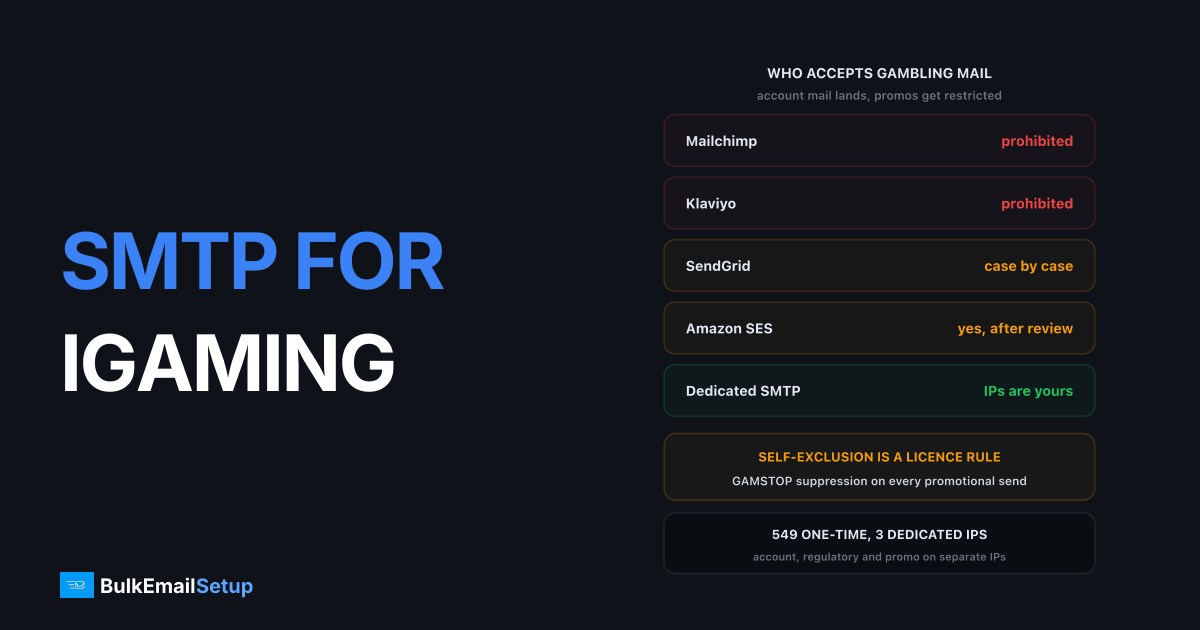
Most shared-pool providers restrict gambling mail, and it is a policy decision rather than a legal one. Mailchimp and Klaviyo prohibit the category outright, SendGrid and Mailgun review it case by case, and Amazon SES will generally carry mail from a licensed operator after review. Promotional gambling email generates above-average complaint rates, and on shared IPs those complaints land on every other customer. Providers manage that by restricting the category instead of assessing each sender.
Understanding that tells you what actually fixes it. A dedicated SMTP server removes the provider policy, since there is no shared pool to protect. It does not remove your licence conditions, self-exclusion obligations, advertising codes, CAN-SPAM or GDPR.
Who permits what, and how it is enforced
Confirm in writing before paying, because these policies move without notice. The enforcement column is the one that costs money, since "restricted" usually means a quiet review that ends in a paused account mid-campaign.
| Provider | Transactional | Promotional | How it is enforced |
|---|---|---|---|
| Amazon SES | Generally yes, subject to review | Case by case | Production access review, automatic pause when complaints pass 0.1% |
| Mailgun | Case by case | Restricted | Account review at signup, licence and consent proof requested later |
| SendGrid | Case by case | Often restricted | Compliance review, promotional gambling usually declined |
| Postmark | Transactional only by design | No | Promotional content on a transactional stream ends the account |
| Mailchimp | Prohibited | Prohibited | Named in the acceptable-use policy, closed on report |
| Klaviyo | Prohibited | Prohibited | Listed as a restricted business, approval can be withdrawn later |
| Dedicated SMTP | Yes, IPs are yours | Yes, subject to law | No provider policy, licence and receiver rules still apply |
The pattern is consistent across restricted sectors: transactional mail is broadly accepted, promotional mail is where the bans bite. A deposit confirmation is expected mail. A free-bet offer is not. The same split appears in crypto and in forex and trading.
Approval at signup is not permanent on SES or Mailgun. Both re-review when volume jumps or complaints move, and a paused account pauses withdrawal confirmations along with the weekend promo unless the streams sit on separate infrastructure.
The licensing reality that shapes the mail
A gambling licence is granted per jurisdiction, and it governs who you may market to as much as what games you may run. That has three direct consequences for the sending setup.
Promotional mail must be geo-targeted to licensed markets only. Sending a free-bet offer to a consumer in a market where you hold no licence is an offence in most regulated territories, and it does not matter where the server sits. Hold the jurisdiction on the player record and enforce it at send time, in the query that builds the audience, rather than trusting a campaign brief.
Self-exclusion suppression is a legal obligation. In Great Britain, marketing to anyone registered with GAMSTOP is a licence breach. Australia, several US states and most EU markets run their own registers with the same effect. This is not list hygiene that you catch up on monthly. The register has to be applied on every promotional send, and the suppression file has to survive a provider migration.
Account closure and time-out states suppress marketing too. A player who has set a cooling-off period or closed their account still receives regulatory and account mail, but no promotions. That means suppression is per stream, not per address, which is one more reason the streams need to be structurally separate.
| Player state | Account mail | Promotional mail |
|---|---|---|
| Active, licensed market | yes | yes |
| Active, unlicensed market | yes, if account exists | no |
| Time-out or cooling-off | yes | no, for the full period |
| Self-excluded (GAMSTOP or equivalent) | closure and regulatory only | never, licence breach |
| Closed account | statements and legal notices | no |
Split account mail from marketing, completely
This is the highest-value structural decision an operator makes, and it needs to happen before the first send.
| Stream | Subdomain | Contains | Complaint risk |
|---|---|---|---|
| Account | account.yourdomain.com | deposits, withdrawals, KYC, password resets, security alerts | near zero, target 0.02% |
| Regulatory | notices.yourdomain.com | responsible gambling notices, reality checks, closure confirmations | near zero |
| Marketing | promo.yourdomain.com | offers, free bets, retention campaigns, reactivation | this is where it lives, cap at 0.1% |
Separate subdomains, separate DKIM selectors, separate DMARC records, separate IPs. A 3-IP starter setup maps to exactly these three streams.
For a regulated operator this goes beyond deliverability. Failing to deliver a verification message or a responsible-gambling notice because a marketing campaign burned the domain reputation is an operational failure and a compliance one at the same time. A player who never receives the reality-check email cannot act on it, and the licence condition still applied. See subdomain vs root domain for email sending for the DNS layout.
Withdrawal confirmations are the stream that gets attention when it breaks. A delayed withdrawal email produces a support ticket and a complaint to the regulator far faster than a missing promo does.
The compliance layer
The ordinary email rules apply first. The FTC's CAN-SPAM compliance guide requires accurate headers, a truthful subject line, a valid physical postal address and an opt-out honoured within 10 business days, with penalties up to $53,088 per email. GDPR and PECR require provable opt-in consent for EU and UK marketing, and CASL applies in Canada.
Gambling advertising is regulated separately on top of all of that.
| Requirement | What it means in an email | Who enforces |
|---|---|---|
| Age restriction | no marketing to under-18s, and in Great Britain no content with strong appeal to under-25s | Gambling Commission, ASA under the CAP codes |
| Responsible gambling messaging | safer-gambling wording and helpline signposting in promotional mail, per market rules | licensing regulator |
| Self-exclusion suppression | GAMSTOP or equivalent register applied to every promotional send | Gambling Commission, licence condition |
| Licence-market targeting | promotional mail only to consumers in jurisdictions you are licensed in | each jurisdiction's regulator |
| Incentive and bonus terms | significant terms of an offer stated in the email, not hidden behind a link | ASA and licensing regulator |
| Identity of sender | licensed trading name and licence details identifiable | licensing regulator |
Several markets prohibit gambling advertising outright, and a few permit it only through state channels. This is not legal advice. Get proper advice per market before running promotional campaigns, and keep the compliance sign-off attached to the campaign record.
What it costs at 100K and 1M a month
Operators scale in steps, because a major sporting event multiplies both account and promotional volume in a single weekend. Price both tiers before you commit.
| Provider | 100K per month | 1M per month | Dedicated IP | Policy risk |
|---|---|---|---|---|
| Amazon SES | about $10 plus $24.95 per IP | about $100 plus $24.95 per IP | add-on | review, pauses on complaint spikes |
| Mailgun | roughly $75 to $90 | roughly $600 to $900 | higher tiers only | case by case |
| SendGrid | roughly $35 to $90 | roughly $700 to $1,500 | high tier only | restricted |
| Klaviyo | $150 to $400 by contact count | $700 to $1,500 by contact count | high tier | prohibited category |
| Dedicated server | $549 one-time plus $30 to $80 hosting | same server, same price | 3 included | none from a provider |
SES has the lowest bill on paper and works for an operator with in-house deliverability staff. The cost is that you own warm-up and monitoring anyway, and an automated review can pause withdrawal confirmations on cup final weekend. At 1M a month the dedicated server is the cheapest option by a wide margin and the only one where no third party's acceptable-use policy sits between a player and their withdrawal email. The arithmetic is in cost to send 1 million emails per month.
Deliverability specifics for gambling mail
DMARC at enforcement is close to mandatory. Betting brands are heavily impersonated, and a domain at p=none lets a criminal send a fake "claim your winnings" from your exact From address. RFC 7489 defines three policies: none requests no action, quarantine asks receivers to treat failures as suspicious, and reject asks them to drop the forgery during the SMTP transaction. Start at none, read the aggregate reports for two to four weeks, then move through quarantine to reject. The path is in DMARC none vs quarantine vs reject.
Keep complaints under 0.1%. Google's bulk sender guidelines set 0.3% as the hard limit and recommend under 0.1%, and require SPF, DKIM and DMARC for any domain sending over 5,000 messages a day to Gmail, plus valid forward and reverse DNS and TLS. In a category filters already distrust, treat 0.1% as the ceiling for promotions and 0.02% for account mail.
Suppression discipline is heavier than average. Self-exclusion registers, cooling-off states, account closures and ordinary opt-outs all have to feed back into every sending stream on the same day. A suppression job that runs nightly is not good enough when the obligation is immediate.
Engagement carries weight. Account mail is opened, which is why it performs. Promotional mail to a segment that has not logged in for six months performs worse in this sector than the same list would elsewhere, so run a sunset policy. See email sunset policy guide.
Content patterns. Urgency framing, countdown timers and heavy image-only creatives all score badly here. Keep safer-gambling wording in live text rather than baked into an image, because filters read text and regulators expect it to be visible with images off.
Why dedicated fits
The core obstacle on shared pools is not technical, it is that you represent risk to the provider's other customers, so you get restricted regardless of how carefully you send. A licensed operator running clean suppression gets the same acceptable-use treatment as an unlicensed affiliate blasting bought lists.
Dedicated IPs remove that. No other customers to protect, no category ban, and your reputation reflects your own behaviour rather than the sector average. For an operator running a clean list with proper suppression, that is a genuine advantage.
The trade is the usual one: warm-up, monitoring and hygiene are yours, and poor list quality has nowhere to hide. Budget 4 to 8 weeks to full volume, ramping roughly 30% every two days per IP. How long does IP warm-up take has the schedule.
What to do after a termination
- Export while you still can. Suppression lists, self-exclusion records, bounce logs, complaint reports, DKIM keys. Access usually closes within 48 hours, and losing the self-exclusion file is a regulatory incident.
- Find the real cause. Complaint rate over 0.1%, bounce rate over 5%, or the category itself. The notice names one, the stats confirm which.
- Check domain reputation. Google Postmaster Tools, domain and IP separately. A Low or Bad rating follows you to the next provider.
- Clean before you move. Drop hard bounces and anyone with no login in 12 months. That typically removes 20 to 30% of an operator list.
- Rebuild on dedicated IPs. Fresh subdomains per stream, SPF, DKIM, DMARC at
p=none, matching PTR records. - Warm up over 4 to 8 weeks. Account mail first because engagement is highest, then regulatory notices, then promotions.
- Do not open a replacement account. Providers link by domain, payment method and sending pattern, and a second closure damages every later appeal.
Step four is the one operators skip. A reactivation list that got a Mailchimp account closed will get dedicated IPs listed on Spamhaus inside a week.
How BulkEmailSetup helps
We build dedicated SMTP infrastructure for senders in restricted categories: your own server, your own IPs, full SPF/DKIM/DMARC/PTR configuration, MTA tuning, bounce handling and a warm-up plan, with account, regulatory and marketing streams separated onto their own subdomains and IPs from the start.
No shared pool means no category policy weighing your sending against other customers. Meeting your licence conditions, self-exclusion obligations and the advertising codes in your markets remains yours. Basic starts at $549 one-time, covering 1 SMTP server, 3 dedicated IPs, 25,000 emails/day and unlimited contacts. Higher tiers scale to 15 IPs and 200,000 emails/day. See pricing.
Frequently asked questions
Which SMTP providers allow iGaming and betting companies?
Policies vary and change, so confirm in writing before paying. Amazon SES generally permits licensed operators subject to review, Mailgun and SendGrid handle it case by case with transactional mail treated more favourably than promotional, and Mailchimp and Klaviyo prohibit gambling content outright. A dedicated server removes the policy question because there is no shared pool to protect.
Why do email providers restrict gambling senders?
Two reasons. Gambling promotions attract above-average complaint rates, often 0.3% or higher against Gmail's 0.1% recommendation, and on shared IP pools those complaints damage every other customer. There is also regulatory exposure, since gambling advertising is licensed and age-restricted in most markets and providers do not want to police whether each customer holds a valid licence.
What rules apply to gambling email marketing?
Beyond the usual email laws, gambling advertising is separately regulated in most markets. In Great Britain the Gambling Commission licence conditions and CAP advertising codes apply, including rules on appealing to under-25s, responsible gambling messaging and self-exclusion. Marketing to anyone on a self-exclusion scheme such as GAMSTOP is a licence breach, not a preference. Take advice for each market you send into.
How do operators keep account emails reliable?
Split them completely from marketing. Deposit confirmations, withdrawal notifications, verification and security alerts should send from a separate subdomain on separate IPs with their own DKIM selector and DMARC record. That way a promotional campaign generating complaints cannot stop a customer receiving a withdrawal confirmation.
Do betting operators need dedicated IPs?
At any real volume, yes. Dedicated IPs remove the shared-pool policy conflict, and they mean your reputation reflects your own sending rather than the category average, which matters in a sector receiving networks already scrutinise. The trade is that you own warm-up over 4 to 8 weeks, plus monitoring and list hygiene.
Can I email players in a market where I am not licensed?
No. A gambling licence is granted per jurisdiction, and promoting to consumers in a market you are not licensed for is an offence in most regulated territories regardless of where your server sits. Geo-target promotional mail to licensed markets only, and hold the market flag on the player record so suppression is enforced at send time, not at the campaign brief.
What should an operator do after an ESP terminates the account?
Export suppression lists, self-exclusion records, bounce logs and DKIM keys immediately, because access often closes inside 48 hours. Losing a self-exclusion suppression file is a regulatory incident, not just an inconvenience. Then check domain reputation in Google Postmaster Tools, clean the list, and rebuild on dedicated IPs with fresh subdomains and a staged warm-up.


