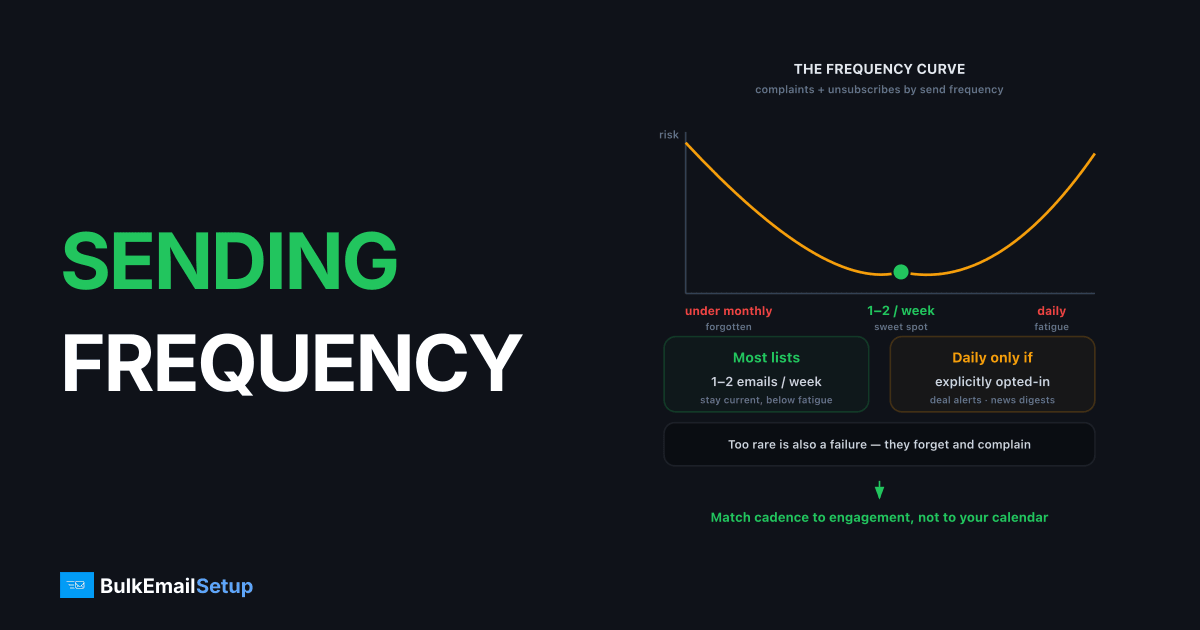
For most lists, 1-2 emails per week is the sweet spot: enough to stay current in the inbox, below the fatigue line where unsubscribes and spam complaints climb. Daily sending works only for segments that explicitly opted into it (deal alerts, news digests), and less than monthly is its own failure mode, subscribers forget you and complain when you reappear.
The frequency curve
Revenue per send falls as frequency rises, while list churn climbs. Total revenue peaks where the marginal send still earns more than the subscribers it burns.
| Cadence | Works for | Typical risk profile |
|---|---|---|
| Daily+ | Deals, news, jobs, subscriber-chosen | High churn unless cadence was the promise |
| 2-3x / week | Active e-commerce, media | Workable with engagement segmentation |
| 1-2x / week | Most B2C and B2B programs | The default answer |
| 2x / month | Considered purchases, B2B nurture | Safe, slightly under-monetized |
| Monthly | Newsletters, SaaS updates | Floor, below this, recognition decays |
| < monthly | Almost nothing | "Who are you?" complaints on every send |
The three dials that say "too often"
Watch these per send, trended over 4-6 sends:
| Metric | Comfortable | Warning | Stop and cut cadence |
|---|---|---|---|
| Unsubscribe rate | < 0.2% | 0.2-0.5% | > 0.5% |
| Spam complaint rate | < 0.05% | 0.05-0.1% | trending to 0.1%+ |
| Open rate trend | Flat/rising | -10% over 4 sends | -20%+ over 4 sends |
Complaints are the dial with teeth: sustained complaints feed directly into Gmail's 0.3% enforcement threshold, and frequency fatigue is one of the most common drivers.
Frequency should follow engagement, not a calendar
A single global cadence over-mails your coolest subscribers and under-mails your hottest ones.
| Segment | Definition | Cadence multiplier |
|---|---|---|
| Hot | Opened/clicked in last 30 days | 1.5-2x base |
| Warm | Engaged in last 90 days | 1x base |
| Cooling | Engaged 90-180 days ago | 0.5x base |
| Inactive | 180+ days | Re-engagement series only |
Two implementation rules: cap total messages per subscriber per week across all campaign types (marketing + lifecycle + promos counted together), and route the inactive tier to a re-engagement campaign instead of the regular calendar.
Changing frequency without breaking things
- Increasing: add one send per week at a time, hold 3-4 weeks, watch the three dials. A volume jump also looks like a behavior change to mailbox providers, large increases should ramp like a mini warm-up.
- Decreasing: safe immediately; expect opens per send to rise within 2-3 sends.
- Set expectations at signup. "Weekly digest" or "daily deals" stated on the form, then honored, is the cheapest complaint prevention available.
- Offer a downgrade option in every unsubscribe flow, "monthly instead" retains a meaningful share of would-be unsubscribers.
One-click unsubscribe (required for bulk senders under the 2024 Gmail/Yahoo rules) makes leaving painless, which means frequency abuse converts to unsubscribes instead of complaints. That's the system working; don't fight it.
Consistency beats intensity
Mailbox providers model your normal. A sender doing steady Tuesday/Thursday volume for months has a predictable pattern; a sender silent for three weeks then blasting four sends in five days looks like a compromised account.
Pick a cadence you can sustain through slow months. The broader signal hygiene this plugs into is covered in email deliverability best practices.
How BulkEmailSetup helps
Our dedicated SMTP servers smooth your sends and enforce per-day volume patterns providers like, and managed deliverability monitoring flags the unsubscribe and complaint drift that says your cadence crossed the line. See plans and pricing.
Frequently asked questions
How many marketing emails per week is too many?
For a typical list, problems start above 2-3 per week: unsubscribes and complaints climb faster than incremental revenue. Daily sending works only for explicitly high-frequency programs like deal alerts where subscribers chose that cadence.
Does sending more emails hurt deliverability?
Indirectly, yes. Higher frequency raises per-subscriber fatigue, which shows up as falling opens, rising unsubscribes, and rising spam complaints, and those engagement signals are what Gmail uses to decide folder placement.
Is it bad to email too infrequently?
Yes. Below roughly one send per month, subscribers forget signing up and complaint rates on your eventual sends rise, while your domain builds reputation slowly from thin data. Monthly is a practical floor.
Should every subscriber get the same sending frequency?
No. Frequency should follow engagement: your most active segment can take 2-4x the cadence of your coolest segment. A frequency cap per subscriber per week beats one global calendar.
What metrics tell me my frequency is too high?
Unsubscribe rate above 0.5% per send, complaint rate trending toward 0.1%, and declining opens across consecutive sends. If all three move together after a cadence increase, the cadence is the cause.